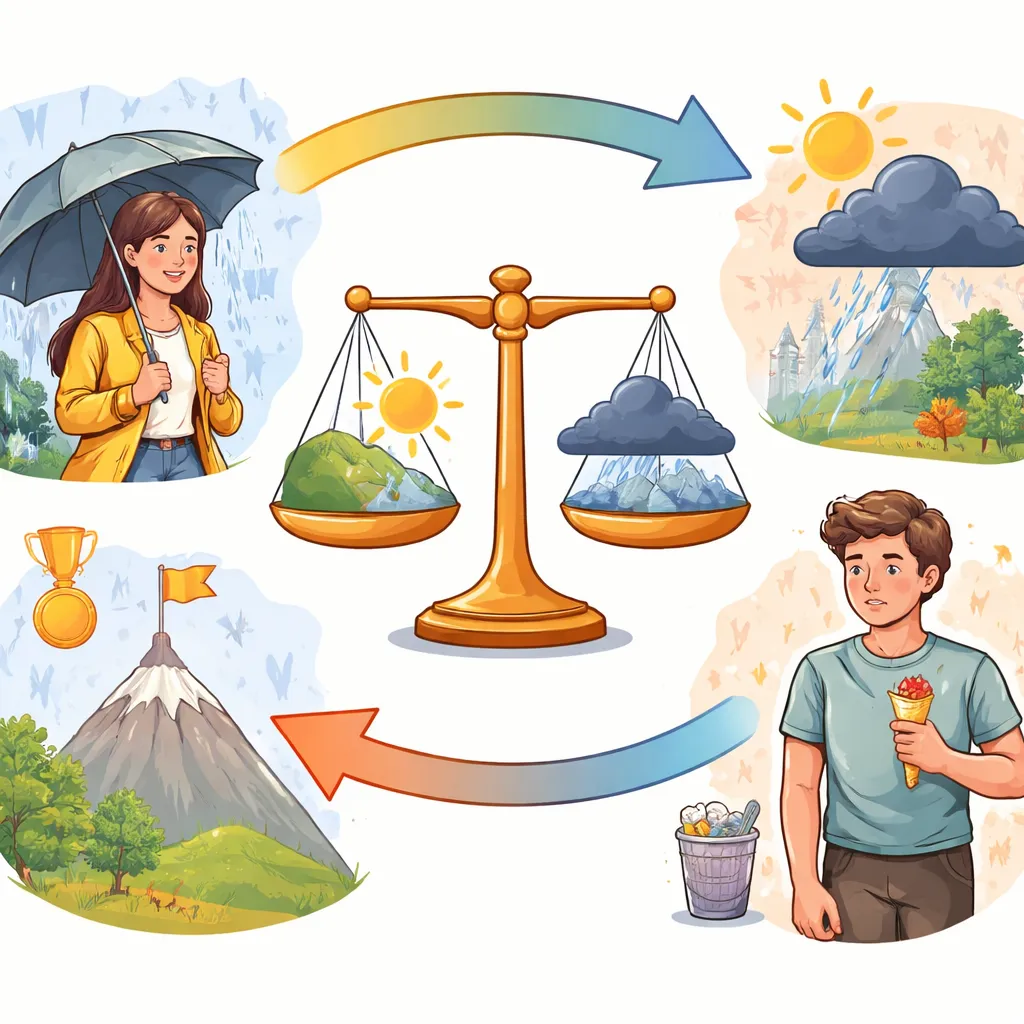
How Can You Use Contrasting Ideas: 'Although', 'Despite' and Others in English Sentences?
What Is Contrasting Ideas: 'Although', 'Despite', and Others?
Read MoreWhat Is Contrasting Ideas: 'Although', 'Despite', and Others?
Read More
What Are Determiners and Quantifiers?
Read More
What Is Word Order in Phrasal Verbs?
Read More
What Are Patterns with Reporting Verbs?
Read More
What Is a Participle Clause?
Read More
Telling a story in English feels magical. You can describe what happened. You can also set the scene. But sometimes one action interrupts another. Tha ...
Read More
Some sentences just need a little something extra. The subject does the action. The verb shows the action. The object receives the action. But sometim ...
Read More
Every sentence has a star. That star is the subject. Every sentence has action. That action is the verb. But sometimes the action needs a target. Some ...
Read More
Sentences are like trains. They carry ideas from one person to another. But sometimes, a simple train is not enough. Sometimes we need to add more car ...
Read More
Conjunctions are the bridges that connect ideas. They join words, phrases, and sentences together. And, but, or, because, if – these small words make ...
Read More
Children learn early that some sentences sound right and others sound wrong. "The dog runs" sounds correct. "The dog run" sounds odd. This is subject- ...
Read More
Children constantly explain things. They tell you when something happened, why they need something, and what will happen if you agree. These explanati ...
Read More
Children love to share what they know and discover what others think. They say things like "I know what you did" or "Tell me why the sky is blue." The ...
Read More
Children naturally want to explain things. They want to tell you why they need a snack, when they will finish their puzzle, or what will happen if you ...
Read More
Every time your child speaks, they use independent clauses. These are complete thoughts that stand alone as sentences. "I want milk." "The dog is funn ...
Read More
Every day your child shares stories with you. They tell you about their friends at school. They describe the game they played outside. They explain wh ...
Read More
As parents, we often marvel at how quickly our little ones absorb language. One moment they are speaking in simple two-word phrases, and the next, the ...
Read More
Hello, word acrobat Do you know how to do a handstand? You flip your body upside down Words can do a cool flip too. Sometimes we switch the normal ord ...
Read More
Hello, little word builder Do you like to play with blocks? You take one block. You place it down. Then you take another. Soon you build a tower Simpl ...
Read More
Four-year-olds are learning to make their sentences sound right. They know that "I runs" sounds wrong, even if they cannot explain why. This is subjec ...
Read More
Four-year-olds are learning to explain the world around them. They want to tell you why things happen. They want to tell you when things happen. They ...
Read More
Four-year-olds are curious about everything. They ask questions. They share what they know. They talk about what they see and think. Noun clauses help ...
Read More
Four-year-olds love to talk about what they do. They tell you about their actions. "I eat." "I run." "I play." These are active voice sentences. In ac ...
Read More
Four-year-olds usually speak in active voice. They say "I ate the cookie." But they also hear passive voice. "The cookie was eaten by me." Passive voi ...
Read More