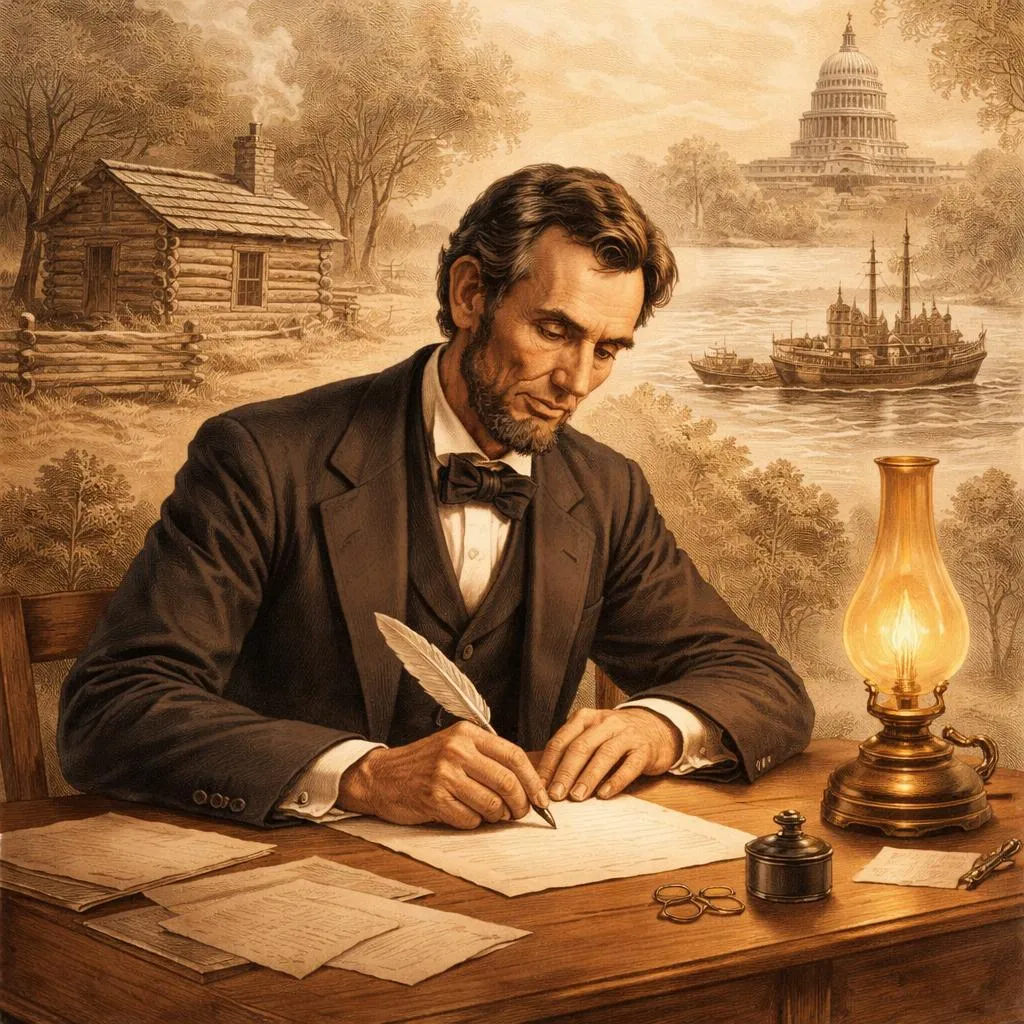

I was born February 12, 1809, in Hardin County, Kentucky. My parents were both born in Virginia, of undistinguished families—second families, perhaps I should say. My mother, who died in my tenth year, was of a family of the name of Hanks, some of whom now reside in Adams, and others in Macon County, Illinois. My paternal grandfather, Abraham Lincoln, emigrated from Rockingham County, Virginia, to Kentucky about 1781 or 1782, where a year or two later he was killed by the Indians, not in battle, but by stealth, when he was laboring to open a farm in the forest. His ancestors, who were Quakers, went to Virginia from Berks County, Pennsylvania. An effort to identify them with the New England family of the same name ended in nothing more definite than a similarity of Christian names in both families, such as Enoch, Levi, Mordecai, Solomon, Abraham, and the like.
My father, at the death of his father, was but six years of age, and he grew up literally without education. He removed from Kentucky to what is now Spencer County, Indiana in my eighth year. We reached our new home about the time the state came into the Union. It was a wild region, with many bears and other wild animals still in the woods. There I grew up. There were some schools, so called, but no qualification was ever required of a teacher beyond “readin’, writin’, and cipherin’” to the rule of three. If a straggler supposed to understand Latin happened to sojourn in the neighborhood, he was looked upon as a wizard. There was absolutely nothing to excite ambition for education. Of course, when I came of age I did not know much. Still, somehow I could read, write, and cipher to the rule of three, but that was all. I have not been to school since. The little advance I now have upon this store of education I have picked up from time to time under the pressure of necessity.
I was raised to farm work, which I continued till I was twenty-two. At twenty-one I came to Illinois, Macon County. Then I got to New Salem, at that time in Sangamon, now in Menard, County, where I remained a year as a sort of clerk in a store.
Then came the Black Hawk war, and I was elected a captain of volunteers, a success which gave me more pleasure than any I have had since. I went the campaign, was elated, ran for the legislature the same year (1832), and was beaten—the only time I have ever been beaten by the people. The next and three succeeding biennial elections I was elected to the legislature. I was not a candidate afterward. During this legislative period I had studied law, and removed to Springfield to practice it. In 1846 I was once elected to the lower house of Congress. I was not a candidate for reelection. From 1849 to 1854, both inclusive practiced law more assiduously than ever before. Always a Whig in politics; and generally on the Whig electoral tickets, making active canvasses. I was losing interest in politics when the repeal of the Missouri Compromise aroused me again. What I have done since then is pretty well known.
If any personal description of me is thought desirable, it may be said I am, in height, six feet four inches, nearly; lean in flesh, weighing on an average one hundred and eighty pounds; dark complexion, with coarse black hair and gray eyes. No other marks or brands recollected.
背景介紹與作者介紹
這段文字摘錄自美國第 16 任總統亞伯拉罕·林肯的早期生活。林肯於 1809 年出生於一個簡樸的邊疆家庭,他的故事是關於毅力、自學和對公共服務的奉獻。他在崎嶇不平、未開發地區的成長經歷,以及有限的正式教育機會,塑造了他的性格和價值觀。儘管面臨這些挑戰,林肯自學法律,並成為美國歷史上的關鍵人物,帶領國家度過最大的危機——內戰。
詳細闡釋與意義
林肯的敘述揭示了 19 世紀初美國邊疆生活的嚴酷現實。缺乏正規教育和惡劣的環境並沒有阻止他尋求知識和自我提升。他早期在農業和體力勞動方面的經驗使他紮根於普通人的現實,這影響了他後來的生活中的同情心和領導風格。
這段文字也突出了韌性的重要性。林肯在他的第一次政治競選中遭遇失敗,但他並沒有放棄。相反,他繼續追求自己的目標,最終取得了重大的政治成就。他的故事強調了挫折是成長的一部分,而決心可以帶來偉大的成就。
給學生的教訓和見解
-
自學的價值: 林肯的一生教導學生,正規教育很有價值,但學習可以在課堂之外繼續進行。好奇心、閱讀和實踐經驗是個人成長的強大工具。
-
克服挑戰的毅力: 學生們了解到失敗不是終點,而是一個墊腳石。林肯最初的政治失敗並沒有使他氣餒;相反,它激勵他更加努力。
-
謙遜和努力工作: 林肯的故事來自卑微的出身,表明成功與你從哪裡開始無關,而與你如何努力和成長有關。
-
領導和服務: 林肯對服務社區和國家的奉獻精神鼓勵學生思考他們如何為社會做出積極貢獻。
將這些教訓應用於日常生活
-
在學習中: 學生可以採用林肯的自學習慣,探索超出學校課程的科目,培養批判性思維和解決問題的能力。
-
在社交場合: 林肯的同情心和理解力提醒學生尊重他人的背景和經歷,培養善良和合作。
-
在面對困難時: 當在學校或個人生活中遇到挫折時,學生可以記住林肯的韌性,並繼續努力實現他們的目標。
從林肯的故事中培養積極的特質
- 好奇心: 鼓勵積極提問和尋求知識。
- 決心: 設定目標,即使進展緩慢也要堅持下去。
- 正直: 在所有行動中維護誠實和公平。
- 領導力: 練習責任感,並在團體活動或社區項目中幫助他人。
通過反思亞伯拉罕·林肯的早期生活和價值觀,學生可以找到啟發,發展他們的性格和技能,為未來的挑戰和機遇做好準備。
