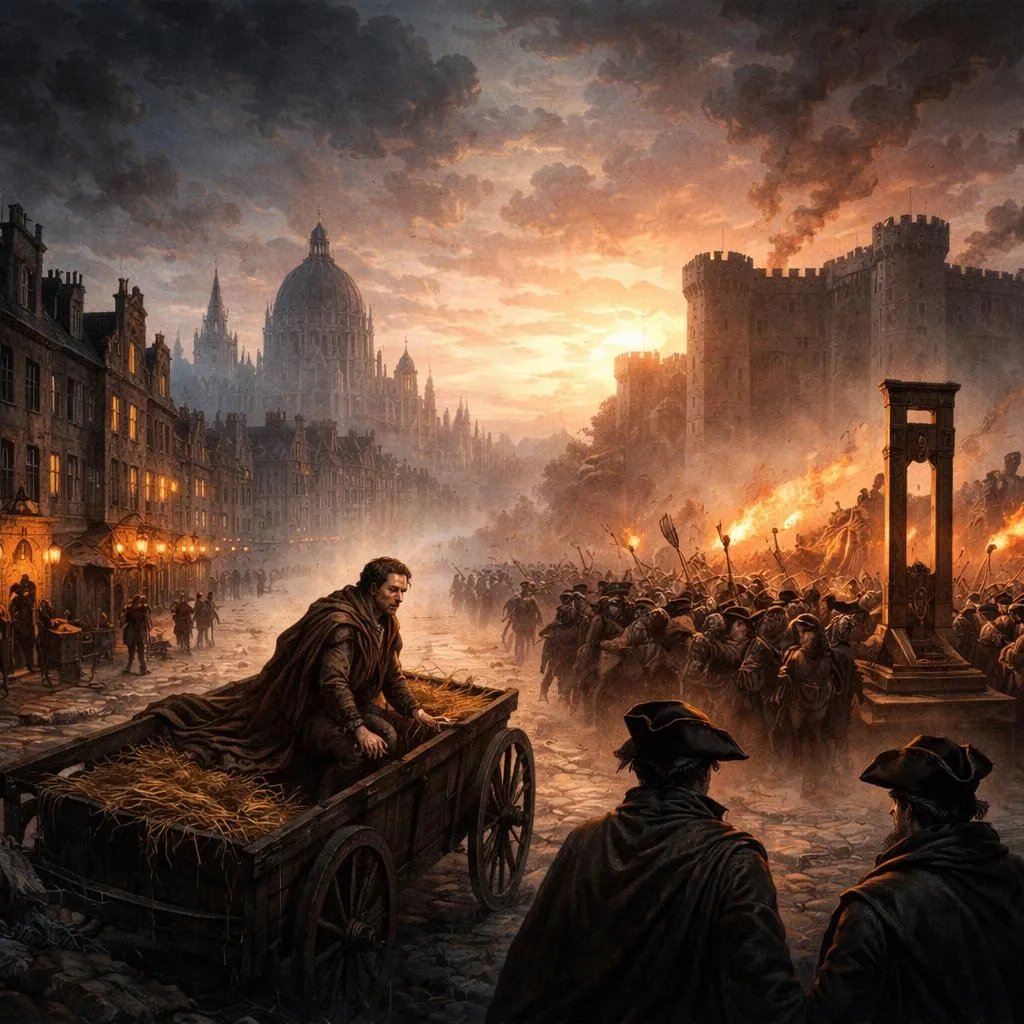

It was the best of times, it was the worst of times, it was the age of wisdom, it was the age of foolishness, it was the epoch of belief, it was the epoch of incredulity, it was the season of Light, it was the season of Darkness, it was the spring of hope, it was the winter of despair, we had everything before us, we had nothing before us, we were all going direct to Heaven, we were all going direct the other way—in short, the period was so far like the present period, that some of its noisiest authorities insisted on its being received, for good or for evil, in the superlative degree of comparison only.
There were a king with a large jaw and a queen with a plain face, on the throne of England; there were a king with a large jaw and a queen with a fair face, on the throne of France. In both countries it was clearer than crystal to the lords of the State preserves of loaves and fishes, that things in general were settled for ever.
It was the year of Our Lord one thousand seven hundred and seventy-five. Spiritual revelations were conceded to England at that favoured period, as at this. Mrs. Southcott had recently attained her five-and-twentieth blessed birthday, of whom a prophetic private in the Life Guards had heralded the sublime appearance by announcing that arrangements were made for the swallowing up of London and Westminster. Even the Cock-lane ghost had been laid only a round dozen of years, after rapping out its messages, as the spirits of this very year last past (supernaturally deficient in originality) rapped out theirs. Mere messages in the earthly order of events had lately come to the English Crown and People, from a congress of British subjects in America: which, strange to relate, have proved more important to the human race than any communications yet received through any of the chickens of the Cock-lane brood.
France, less favoured on the whole as to matters spiritual than her sister of the shield and trident, rolled with exceeding smoothness down hill, making paper money and spending it. Under the guidance of her Christian pastors, she entertained herself, besides, with such humane achievements as sentencing a youth to have his hands cut off, his tongue torn out with pincers, and his body burned alive, because he had not kneeled down in the rain to do honour to a dirty procession of monks which passed within his view, at a distance of some fifty or sixty yards. It is likely enough that, rooted in the woods of France and Norway, there were growing trees, when that sufferer was put to death, already marked by the Woodman, Fate, to come down and be sawn into boards, to make a certain movable framework with a sack and a knife in it, terrible in history. It is likely enough that in the rough outhouses of some tillers of the heavy lands adjacent to Paris, there were sheltered from the weather that very day, rude carts, bespattered with rustic mire, snuffed about by pigs, and roosted in by poultry, which the Farmer, Death, had already set apart to be his tumbrils of the Revolution. But that Woodman and that Farmer, though they work unceasingly, work silently, and no one heard them as they went about with muffled tread: the rather, forasmuch as to entertain any suspicion that they were awake, was to be atheistical and traitorous.
In England, there was scarcely an amount of order and protection to justify much national boasting. Daring burglaries by armed men, and highway robberies, took place in the capital itself every night; families were publicly cautioned not to go out of town without removing their furniture to upholsterers’ warehouses for security; the highwayman in the dark was a City tradesman in the light, and, being recognised and challenged by his fellow- tradesman whom he stopped in his character of “the Captain,” gallantly shot him through the head and rode away; the mall was waylaid by seven robbers, and the guard shot three dead, and then got shot dead himself by the other four, “in consequence of the failure of his ammunition:” after which the mall was robbed in peace; that magnificent potentate, the Lord Mayor of London, was made to stand and deliver on Turnham Green, by one highwayman, who despoiled the illustrious creature in sight of all his retinue; prisoners in London gaols fought battles with their turnkeys, and the majesty of the law fired blunderbusses in among them, loaded with rounds of shot and ball; thieves snipped off diamond crosses from the necks of noble lords at Court drawing-rooms; musketeers went into St. Giles’s, to search for contraband goods, and the mob fired on the musketeers, and the musketeers fired on the mob, and nobody thought any of these occurrences much out of the common way. In the midst of them, the hangman, ever busy and ever worse than useless, was in constant requisition; now, stringing up long rows of miscellaneous criminals; now, hanging a housebreaker on Saturday who had been taken on Tuesday; now, burning people in the hand at Newgate by the dozen, and now burning pamphlets at the door of Westminster Hall; to-day, taking the life of an atrocious murderer, and to-morrow of a wretched pilferer who had robbed a farmer’s boy of sixpence.
All these things, and a thousand like them, came to pass in and close upon the dear old year one thousand seven hundred and seventy-five. Environed by them, while the Woodman and the Farmer worked unheeded, those two of the large jaws, and those other two of the plain and the fair faces, trod with stir enough, and carried their divine rights with a high hand. Thus did the year one thousand seven hundred and seventy-five conduct their Greatnesses, and myriads of small creatures—the creatures of this chronicle among the rest—along the roads that lay before them.
背景介紹與作者介紹
這段文字是狄更斯所著歷史小說《雙城記》的著名開篇,該小說於1859年首次出版。狄更斯是維多利亞時代最偉大的英國小說家之一,以其生動的人物刻畫、社會批判,以及結合戲劇性、幽默感和對人類掙扎的深刻同情的敘事方式而聞名。《雙城記》的背景設定在法國大革命的動盪時期,描繪了倫敦和巴黎的生活對比。這部小說探討了犧牲、重生以及暴政與自由之間的衝突等主題。
詳細闡釋與意義
開篇幾句為整部小說定下了基調,呈現了一個充滿矛盾的世界——希望與絕望、智慧與愚蠢、光明與黑暗。狄更斯利用這些對立面來突出時代的複雜性,表明歷史從來不是簡單的好或壞,而是兩者的混合。 「最好的時代」和「最壞的時代」反映了塑造18世紀的社會和政治動盪,並呼應了我們今天面臨的挑戰。
這段文字介紹了英格蘭和法國的政治和社會動盪,暗示了即將到來的革命。狄更斯生動地描繪了不公正、殘酷和不平等,例如法國的嚴厲懲罰和英格蘭的無法無天。伐木工(命運)和農夫(死亡)默默準備革命工具的隱喻,提醒讀者,重大的歷史變革往往悄無聲息地發生,直到爆發。
給學生的啟示與見解
-
理解歷史的複雜性: 這段文字教導學生歷史是多方面的。事件有多個方面和影響,理解這種複雜性有助於培養批判性思維。
-
同情心與正義: 狄更斯對苦難和不公正的描繪鼓勵讀者同情那些受壓迫的人,並重視公平和人權。
-
變革的力量: 小說表明變革是不可避免的,有時是暴力的,但對進步是必要的。學生可以學習韌性以及為正義奮鬥的重要性。
-
道德反思: 光明與黑暗的對比邀請讀者反思自己的選擇——智慧與愚蠢如何共存,以及信念與懷疑如何塑造我們的生活。
在生活、學習和社交場合中的應用
-
在學習中: 學生可以運用超越表面現象的教訓來理解更深層次的真理,無論是在歷史、文學還是時事中。
-
在社交互動中: 小說對同情心和正義的強調可以激勵學生在人際關係中友善和公正,認識到他人的掙扎。
-
在個人成長中: 重生和轉變的主題鼓勵學生相信第二次機會和個人進步的可能性。
從故事中培養積極的價值觀
-
勇氣與犧牲: 小說中的人物在危險面前表現出勇敢。學生可以學會勇敢地面對挑戰,並重視無私。
-
意識與責任: 伐木工和農夫的默默工作表明,即使是看不見的行為也會產生後果。學生應該注意自己的選擇和責任。
-
批判性思維: 通過認識到矛盾和複雜性,學生培養了批判性地分析情況而不是接受簡單解釋的能力。
結論
《雙城記》對於年輕讀者來說仍然是一個強大的故事,提供了關於歷史、人性與道德的豐富教訓。它鼓勵學生不僅要了解過去,還要將其教訓應用於日常生活中——促進同情心、正義、勇氣和深思熟慮的反思。通過學習這部小說,學生可以在智力和道德上成長,為他們積極貢獻於社區和世界做好準備。
