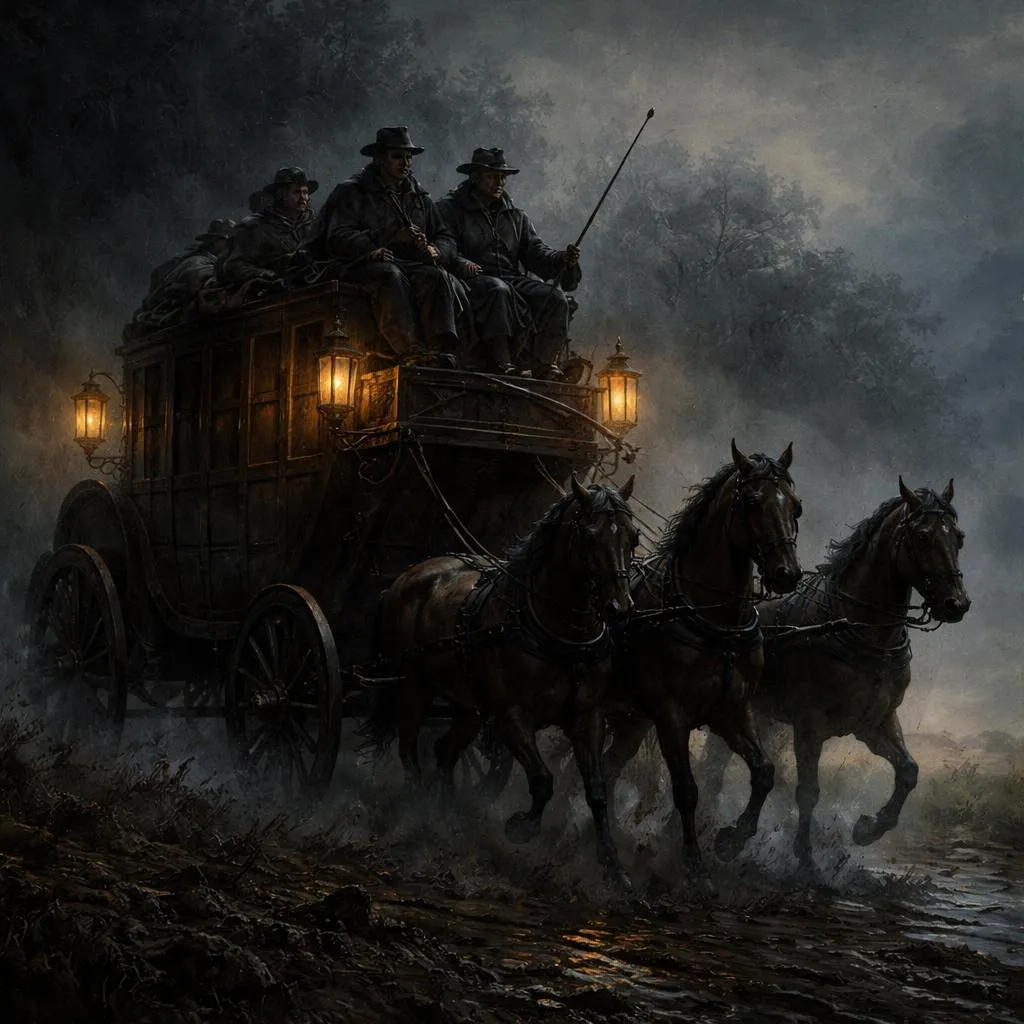

It was the Dover road that lay, on a Friday night late in November, before the first of the persons with whom this history has business. The Dover road lay, as to him, beyond the Dover mail, as it lumbered up Shooter’s Hill. He walked up hill in the mire by the side of the mail, as the rest of the passengers did; not because they had the least relish for walking exercise, under the circumstances, but because the hill, and the harness, and the mud, and the mail, were all so heavy, that the horses had three times already come to a stop, besides once drawing the coach across the road, with the mutinous intent of taking it back to Blackheath. Reins and whip and coachman and guard, however, in combination, had read that article of war which forbade a purpose otherwise strongly in favour of the argument, that some brute animals are endued with Reason; and the team had capitulated and returned to their duty.
With drooping heads and tremulous tails, they mashed their way through the thick mud, floundering and stumbling between whiles, as if they were falling to pieces at the larger joints. As often as the driver rested them and brought them to a stand, with a wary “Wo-ho! so-ho- then!” the near leader violently shook his head and everything upon it—like an unusually emphatic horse, denying that the coach could be got up the hill. Whenever the leader made this rattle, the passenger started, as a nervous passenger might, and was disturbed in mind.
There was a steaming mist in all the hollows, and it had roamed in its forlornness up the hill, like an evil spirit, seeking rest and finding none. A clammy and intensely cold mist, it made its slow way through the air in ripples that visibly followed and overspread one another, as the waves of an unwholesome sea might do. It was dense enough to shut out everything from the light of the coach-lamps but these its own workings, and a few yards of road; and the reek of the labouring horses steamed into it, as if they had made it all.
Two other passengers, besides the one, were plodding up the hill by the side of the mail. All three were wrapped to the cheekbones and over the ears, and wore jack-boots. Not one of the three could have said, from anything he saw, what either of the other two was like; and each was hidden under almost as many wrappers from the eyes of the mind, as from the eyes of the body, of his two companions. In those days, travellers were very shy of being confidential on a short notice, for anybody on the road might be a robber or in league with robbers. As to the latter, when every posting-house and ale-house could produce somebody in “the Captain’s” pay, ranging from the landlord to the lowest stable non-descript, it was the likeliest thing upon the cards. So the guard of the Dover mail thought to himself, that Friday night in November, one thousand seven hundred and seventy-five, lumbering up Shooter’s Hill, as he stood on his own particular perch behind the mail, beating his feet, and keeping an eye and a hand on the arm-chest before him, where a loaded blunderbuss lay at the top of six or eight loaded horse-pistols, deposited on a substratum of cutlass.
The Dover mail was in its usual genial position that the guard suspected the passengers, the passengers suspected one another and the guard, they all suspected everybody else, and the coachman was sure of nothing but the horses; as to which cattle he could with a clear conscience have taken his oath on the two Testaments that they were not fit for the journey.
“Wo-ho!” said the coachman. “So, then! One more pull and you’re at the top and be damned to you, for I have had trouble enough to get you to it.“
“Halloa!” the guard replied.
“What o’clock do you make it, Joe?”
“Ten minutes, good, past eleven.”
“My blood!” ejaculated the vexed coachman, “and not atop of Shooter’s yet! Tst! Yah! Get on with you! “
The emphatic horse, cut short by the whip in a most decided negative, made a decided scramble for it, and the three other horses followed suit. Once more, the Dover mail struggled on, with the jack-boots of its passengers squashing along by its side. They had stopped when the coach stopped, and they kept close company with it. If any one of the three had had the hardihood to propose to another to walk on a little ahead into the mist and darkness, he would have put himself in a fair way of getting shot instantly as a highwayman.
The last burst carried the mail to the summit of the hill. The horses stopped to breathe again, and the guard got down to skid the wheel for the descent, and open the coach-door to let the passengers in.
“Tst! Joe!” cried the coachman in a warning voice, looking down from his box.
“What do you say, Tom?”
They both listened.
“I say a horse at a canter coming up, Joe.”
“I say a horse at a gallop, Tom,” returned the guard, leaving his hold of the door, and mounting nimbly to his place. “Gentlemen! In the kings name, all of you!”
With this hurried adjuration, he cocked his blunderbuss, and stood on the offensive.
The passenger booked by this history, was on the coach-step, getting in; the two other passengers were close behind him, and about to follow. He remained on the step, half in the coach and half out of; they re-mained in the road below him. They all looked from the coachman to the guard, and from the guard to the coachman, and listened. The coachman looked back and the guard looked back, and even the emphatic leader pricked up his ears and looked back, without contradicting.
The stillness consequent on the cessation of the rumbling and and labouring of the coach, added to the stillness of the night, made it very quiet indeed. The panting of the horses communicated a tremulous motion to the coach, as if it were in a state of agitation. The hearts of the passengers beat loud enough perhaps to be heard; but at any rate, the quiet pause was audibly expressive of people out of breath, and holding the breath, and having the pulses quickened by expectation.
The sound of a horse at a gallop came fast and furiously up the hill.
“So-ho!” the guard sang out, as loud as he could roar. “Yo there! Stand! I shall fire!”
The pace was suddenly checked, and, with much splashing and floundering, a man’s voice called from the mist, “Is that the Dover mail?”
“Never you mind what it is!” the guard retorted. “What are you?”
“IS that the Dover mail?”
“Why do you want to know?”
“I want a passenger, if it is.”
“What passenger?”
“Mr. Jarvis Lorry.”
Our booked passenger showed in a moment that it was his name. The guard, the coachman, and the two other passengers eyed him distrustfully.
“Keep where you are,” the guard called to the voice in the mist, “because, if I should make a mistake, it could never be set right in your lifetime. Gentleman of the name of Lorry answer straight.”
“What is the matter?” asked the passenger, then, with mildly quavering speech. “Who wants me? Is it Jerry?”
(“I don’t like Jerry’s voice, if it is Jerry,” growled the guard to himself. “He’s hoarser than suits me, is Jerry.”)
“Yes, Mr. Lorry.”
“What is the matter?”
“A despatch sent after you from over yonder. T. and Co.”
“I know this messenger, guard,” said Mr. Lorry, getting down into the road—assisted from behind more swiftly than politely by the other two passengers, who immediately scrambled into the coach, shut the door, and pulled up the window. “He may come close; there’s nothing wrong.”
“I hope there ain’t, but I can’t make so ‘Nation sure of that,” said the guard, in gruff soliloquy. “Hallo you!”
“Well! And hallo you!” said Jerry, more hoarsely than before.
“Come on at a footpace! d’ye mind me? And if you’ve got holsters to that saddle o’ yourn, don’t let me see your hand go nigh ‘em. For I’m a devil at a quick mistake, and when I make one it takes the form of Lead. So now let’s look at you.”
The figures of a horse and rider came slowly through the eddying mist, and came to the side of the mail, where the passenger stood. The rider stooped, and, casting up his eyes at the guard, handed the passenger a small folded paper. The rider’s horse was blown, and both horse and rider were covered with mud, from the hoofs of the horse to the hat of the man.
“Guard!” said the passenger, in a tone of quiet business confidence.
The watchful guard, with his right hand at the stock of his raised blunderbuss, his left at the barrel, and his eye on the horseman, answered curtly, “Sir.”
“There is nothing to apprehend. I belong to Tellson’s Bank. You must know Tellson’s Bank in London. I am going to Paris on business. A crown to drink. I may read this?”
“If so be as you’re quick, sir.”
He opened it in the light of the coach-lamp on that side, and read—first to himself and then aloud: ”Wait at Dover for Mam’selle.’ It’s not long, you see, guard. Jerry, say that my answer was, RECALLED TO LIFE.” Jerry started in his saddle. “That’s a Blazing strange answer, too,” said he, at his hoarsest. “Take that message back, and they will know that I received this, as well as if I wrote. Make the best of your way. Good night.” With those words the passenger opened the coach-door and got in; not at all assisted by his fellow-passengers, who had expeditiously secreted their watches and purses in their boots, and were now making a general pretence of being asleep. With no more definite purpose than to escape the hazard of originating any other kind of action. The coach lumbered on again, with heavier wreaths of mist closing round it as it began the descent. The guard soon replaced his blunderbuss in his arm-chest, and, having looked to the rest of its contents, and having looked to the supplementary pistols that he wore in his belt, looked to a smaller chest beneath his seat, in which there were a few smith’s tools, a couple of torches, and a tinder-box. For he was furnished with that completeness that if the coach-lamps had been blown and stormed out, which did occasionally happen, he had only to shut himself up inside, keep the flint and steel sparks well off the straw, and get a light with tolerable safety and ease (if he were lucky) in five minutes. “Tom!” softly over the coach roof. “Hallo, Joe.” “Did you hear the message?” “I did, Joe.” “What did you make of it, Tom?” “Nothing at all, Joe.” “That’s a coincidence, too,” the guard mused, “for I made the same of it myself.” Jerry, left alone in the mist and darkness, dismounted meanwhile, not only to ease his spent horse, but to wipe the mud from his face, and shake the wet out of his hat-brim, which might be capable of holding about half a gallon. After standing with the bridle over his heavily-splashed arm, until the wheels of the mail were no longer within hearing and the night was quite still again, he turned to walk down the hill. “After that there gallop from Temple Bar, old lady, I won’t trust your fore-legs till I get you on the level,” said this hoarse messenger, glancing at his mare. ”Recalled to life.’ That’s a Blazing strange message. Much of that wouldn’t do for you, Jerry! I say, Jerry! You’d be in a Blazing bad way, if recalling to life was to come into fashion, Jerry!”
故事背景
這段摘錄出自《雙城記》的開篇章節,這是一部由查爾斯·狄更斯於 1859 年撰寫的著名小說。故事背景設定在動盪的 18 世紀末,重點關注法國大革命前後的時期。這裡描述的多佛路和郵車旅程為一個充滿懸念、神秘和轉變的故事奠定了基礎。狄更斯用生動的筆觸描繪了寒冷、霧濛濛的夜晚和掙扎的馬匹,營造出一種緊張而詭異的氛圍,為讀者預示了即將發生的戲劇性事件。
關於作者:查爾斯·狄更斯
查爾斯·狄更斯是維多利亞時代最受讚譽的英國小說家之一。狄更斯以其敏銳的社會評論和令人難忘的人物而聞名,他經常強調窮人的掙扎和社會的不公。他的作品將引人入勝的情節與對人性和社會狀況的深刻見解結合起來。《雙城記》在他的小說中是獨一無二的,因為它以歷史事件為背景,而不是當代的維多利亞時代的英國,它探討了犧牲、復活以及個人和社會變革的可能性等主題。
詳細闡釋和意義
這段文字捕捉了一個充滿懸念和不確定性的時刻。登上射手山的旅程很艱難,象徵著小說中人物將要面臨的掙扎和艱辛。迷霧和黑暗代表著混亂和危險,而乘客和守衛的謹慎行為反映了當時普遍存在的不信任和恐懼。神秘信使的到來和神秘的信息“重返人間”暗示了小說的核心主題——復活——儘管過去遭受了痛苦,人們和社會仍然可以重生或轉變。
這個場景向我們介紹了賈維斯·羅瑞,他是泰爾森銀行的重要人物,參與了故事的展開。他沉著的舉止與周圍的緊張氣氛形成了鮮明對比,表明了他作為混亂中穩定、理性人物的角色。
給學生的教訓和見解
-
理解歷史背景: 閱讀這個故事可以幫助學生了解法國大革命和 18 世紀的社會動盪,鼓勵他們思考歷史如何塑造人們的生活。
-
希望和更新的主題: “重返人間”這句話引發了人們對這樣一個想法的思考,即無論生活變得多麼艱難,總是有改變和新開始的可能性。
-
氛圍在故事講述中的力量: 狄更斯豐富的描述教導學生作家如何利用環境、情緒和語氣來營造懸念並在情感上吸引讀者。
-
謹慎和信任: 旅行者之間的不信任突出了對信任誰要謹慎的重要性——這是在社會意識和人身安全方面的一堂寶貴的課。
在生活和學習中應用這些教訓
-
在學校: 學生可以學習欣賞歷史小說,以此作為將文學與歷史聯繫起來的一種方式,從而提高他們的閱讀能力和歷史知識。
-
在社交場合: 了解人物的謹慎行為可以幫助年輕人更好地判斷在新環境或不確定環境中的信任和溝通。
-
個人成長: 復活的主題鼓勵韌性——學生可以受到啟發,克服挑戰,並將挫折視為成長的機會。
從故事中培養積極的價值觀
-
耐心和毅力: 就像馬匹在山坡上掙扎一樣,學生們學會了在面對困難時堅持不懈的價值。
-
勇氣和警惕: 守衛保護馬車的準備工作教導了在面對危險時保持警惕和勇敢的重要性。
-
同情和理解: 狄更斯對人物的恐懼和希望的描繪幫助讀者培養了對處於困境中的人們的同情心。
反思和欣賞
閱讀完這段文字後,學生們可能會思考故事的氛圍讓他們有什麼感覺,以及他們認為“重返人間”在他們自己的生活中意味著什麼。他們可以寫作或討論他們如何應對自己的“上坡”掙扎,以及他們需要什麼樣的支持或勇氣。
通過探索《雙城記》,年輕的讀者不僅可以欣賞一個引人入勝的故事,還可以獲得對歷史、人性以及希望和轉變的力量的寶貴見解。
