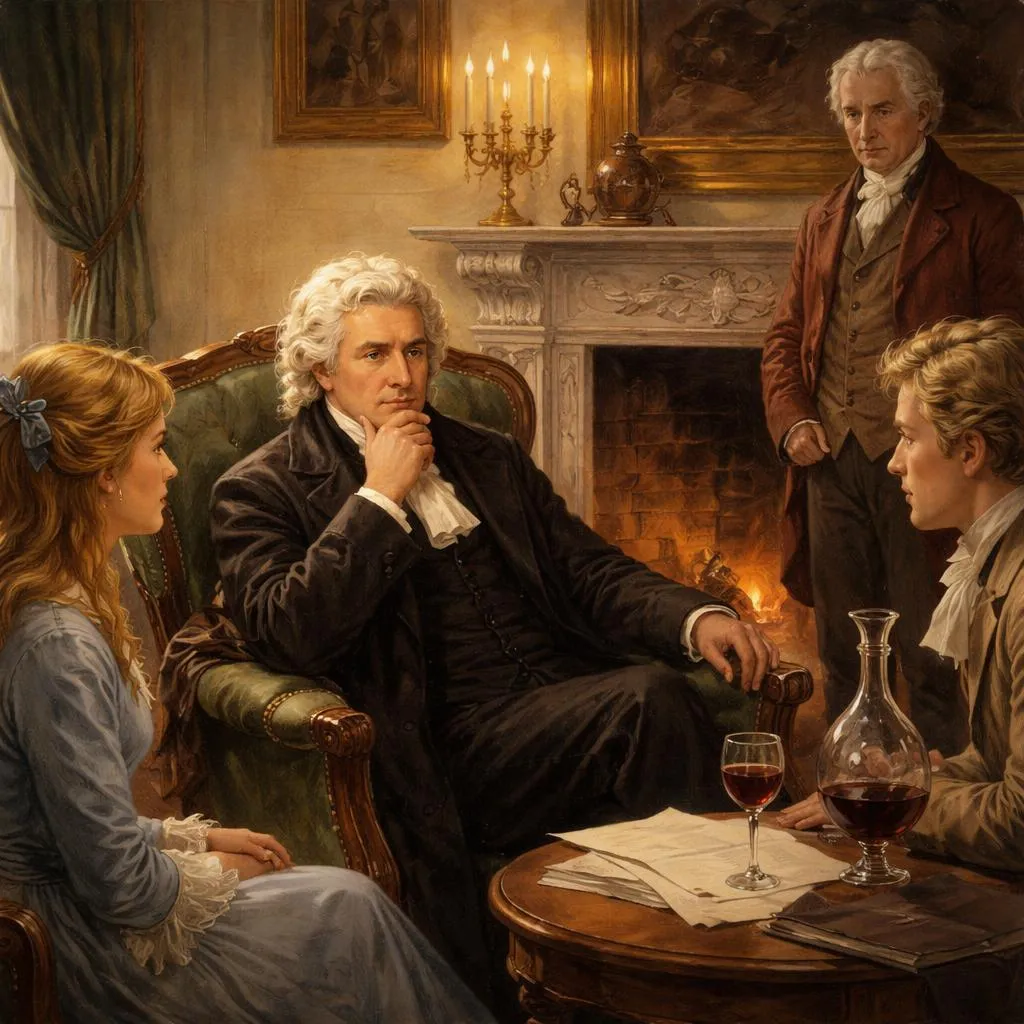

Worn out by anxious watching, Mr. Lorry fell asleep at his post. On the tenth morning of his suspense, he was startled by the shining of the sun into the room where a heavy slumber had overtaken him when it was dark night.
He rubbed his eyes and roused himself; but he doubted, when he had done so, whether he was not still asleep. For, going to the door of the Doctor’s room and looking in, he perceived that the shoemaker’s bench and tools were put aside again, and that the Doctor himself sat reading at the window. He was in his usual morning dress, and his face (which Mr. Lorry could distinctly see), though still very pale, was calmly studious and attentive.
Even when he had satisfied himself that he was awake, Mr. Lorry felt giddily uncertain for some few moments whether the late shoemaking might not be a disturbed dream of his own; for, did not his eyes show him his friend before him in his accustomed clothing and aspect, and employed as usual; and was there any sign within their range, that the change of which he had so strong an impression had actually happened?
It was but the inquiry of his first confusion and astonishment, the answer being obvious. If the impression were not produced by a real corresponding and sufficient cause, how came he, Jarvis Lorry, there? How came he to have fallen asleep, in his clothes, on the sofa in Doctor Manette’s consulting-room, and to be debating these points outside the Doctor’s bedroom door in the early morning?
Within a few minutes, Miss Pross stood whispering at his side. If he had had any particle of doubt left, her talk would of necessity have resolved it; but he was by that time clear-headed, and had none. He advised that they should let the time go by until the regular breakfast-hour, and should then meet the Doctor as if nothing unusual had occurred. If he appeared to be in his customary state of mind, Mr. Lorry would then cautiously proceed to seek direction and guidance from the opinion he had been, in his anxiety, so anxious to obtain.
Miss Pross, submitting herself to his judgment, the scheme was worked out with care. Having abundance of time for his usual methodical toilette, Mr. Lorry presented himself at the breakfast-hour in his usual white linen, and with his usual neat leg. The Doctor was summoned in the usual way, and came to breakfast.
So far as it was possible to comprehend him without overstepping those delicate and gradual approaches which Mr. Lorry felt to be the only safe advance, he at first supposed that his daughter’s marriage had taken place yesterday. An incidental allusion, purposely thrown out, to the day of the week, and the day of the month, set him thinking and counting, and evidently made him uneasy. In all other respects, however, he was so composedly himself, that Mr. Lorry determined to have the aid he sought. And that aid was his own.
Therefore, when the breakfast was done and cleared away, and he and the Doctor were left together, Mr. Lorry said, feelingly:
“My dear Manette, I am anxious to have your opinion, in confidence, on a very curious case in which I am deeply interested; that is to say, it is very curious to me; perhaps, to your better information it may be less so.”
Glancing at his hands, which were discoloured by his late work, the Doctor looked troubled, and listened attentively. He had already glanced at his hands more than once.
“Doctor Manette,” said Mr. Lorry, touching him affectionately on the arm, “the case is the case of a particularly dear friend of mine. Pray give your mind to it, and advise me well for his sake—and above all, for his daughter’s—his daughter’s, my dear Manette.”
“If I understand,” said the Doctor, in a subdued tone, “some mental shock—?”
“Yes!”
“Be explicit,” said the Doctor. “Spare no detail.”
Mr. Lorry saw that they understood one another, and proceeded.
“My dear Manette, it is the case of an old and a prolonged shock, of great acuteness and severity to the affections, the feelings, the—the—as you express it—the mind. The mind. It is the case of a shock under which the sufferer was borne down, one cannot say for how long, because I believe he cannot calculate the time himself, and there are no other means of getting at it. It is the case of a shock from which the sufferer recovered, by a process that he cannot trace himself—as I once heard him publicly relate in a striking manner. It is the case of a shock from which he has recovered, so completely, as to be a highly intelligent man, capable of close application of mind, and great exertion of body, and of constantly making fresh additions to his stock of knowledge, which was already very large. But, unfortunately, there has been,” he paused and took a deep breath—”a slight relapse.”
The Doctor, in a low voice, asked, “Of how long duration?”
“Nine days and nights.”
“How did it show itself? I infer,” glancing at his hands again, “in the resumption of some old pursuit connected with the shock?”
“That is the fact.”
“Now, did you ever see him,” asked the Doctor, distinctly and collectedly, though in the same low voice, “engaged in that pursuit originally?”
“Once.”
“And when the relapse fell on him, was he in most respects—or in all respects—as he was then?”
“I think in all respects.”
“You spoke of his daughter. Does his daughter know of the relapse?”
“No. It has been kept from her, and I hope will always be kept from her. It is known only to myself, and to one other who may be trusted.”
The Doctor grasped his band, and murmured, “That was very kind. That was very thoughtful!” Mr. Lorry grasped his hand in return, and neither of the two spoke for a little while.
“Now, my dear Manette,” said Mr. Lorry, at length, in his most considerate and most affectionate way, “I am a mere man of business, and unfit to cope with such intricate and difficult matters. I do not possess the kind of information necessary; I do not possess the kind of intelligence; I want guiding. There is no man in this world on whom I could so rely for right guidance, as on you. Tell me, how does this relapse come about? Is there danger of another? Could a repetition of it be prevented? How should a repetition of it be treated? How does it come about at all? What can I do for my friend? No man ever can have been more desirous in his heart to serve a friend, than I am to serve mine, if I knew how.
But I don’t know how to originate, in such a case. If your sagacity, knowledge, and experience, could put me on the right track, I might be able to do so much; unenlightened and undirected, I can do so little. Pray discuss it with me; pray enable me to see it a little more clearly, and teach me how to be a little more useful.”
Doctor Manette sat meditating after these earnest words were spoken, and Mr. Lorry did not press him.
“I think it probable,” said the Doctor, breaking silence with an effort, “that the relapse you have described, my dear friend, was not quite unforeseen by its subject.”
“Was it dreaded by him?” Mr. Lorry ventured to ask.
“Very much.” He said it with an involuntary shudder.
“You have no idea how such an apprehension weighs on the sufferer’s mind, and how difficult—how almost impossible—it is, for him to force himself to utter a word upon the topic that oppresses him.”
“Would he,” asked Mr. Lorry, “be sensibly relieved if he could prevail upon himself to impart that secret brooding to any one, when it is on him?”
“I think so. But it is, as I have told you, next to impossible. I even believe it—in some cases—to be quite impossible.”
“Now,” said Mr. Lorry, gently laying his hand on the Doctor’s arm again, after a short silence on both sides, “to what would you refer this attack? “
“I believe,” returned Doctor Manette, “that there had been a strong and extraordinary revival of the train of thought and remembrance that was the first cause of the malady. Some intense associations of a most distressing nature were vividly recalled, I think. It is probable that there had long been a dread lurking in his mind, that those associations would be recalled—say, under certain circumstances—say, on a particular occasion. He tried to prepare himself in vain; perhaps the effort to prepare himself made him less able to bear it.”
“Would he remember what took place in the relapse?” asked Mr. Lorry, with natural hesitation.
The Doctor looked desolately round the room, shook his head, and answered, in a low voice, “Not at all.”
“Now, as to the future,” hinted Mr. Lorry.
“As to the future,” said the Doctor, recovering firmness, “I should have great hope. As it pleased Heaven in its mercy to restore him so soon, I should have great hope. He, yielding under the pressure of a complicated something, long dreaded and long vaguely foreseen and contended against, and recovering after the cloud had burst and passed, I should hope that the worst was over.”
“Well, well! That’s good comfort. I am thankful!” said Mr. Lorry.
“I am thankful!” repeated the Doctor, bending his head with reverence.
“There are two other points,” said Mr. Lorry, “on which I am anxious to be instructed. I may go on?”
“You cannot do your friend a better service.” The Doctor gave him his hand.
“To the first, then. He is of a studious habit, and unusually energetic; he applies himself with great ardour to the acquisition of professional knowledge, to the conducting of experiments, to many things. Now, does he do too much?”
“I think not. It may be the character of his mind, to be always in singular need of occupation. That may be, in part, natural to it; in part, the result of affliction. The less it was occupied with healthy things, the more it would be in danger of turning in the unhealthy direction. He may have observed himself, and made the discovery.”
“You are sure that he is not under too great a strain?”
“I think I am quite sure of it.”
“My dear Manette, if he were overworked now—”
“My dear Lorry, I doubt if that could easily be. There has been a violent stress in one direction, and it needs a counterweight.”
“Excuse me, as a persistent man of business. Assuming for a moment, that he WAS overworked; it would show itself in some renewal of this disorder?”
“I do not think so. I do not think,” said Doctor Manette with the firmness of self-conviction, “that anything but the one train of association would renew it. I think that, henceforth, nothing but some extraordinary jarring of that chord could renew it. After what has happened, and after his recovery, I find it difficult to imagine any such violent sounding of that string again. I trust, and I almost believe, that the circumstances likely to renew it are exhausted.”
He spoke with the diffidence of a man who knew how slight a thing would overset the delicate organisation of the mind, and yet with the confidence of a man who had slowly won his assurance out of personal endurance and distress. It was not for his friend to abate that confidence. He professed himself more relieved and encouraged than he really was, and approached his second and last point. He felt it to be the most difficult of all; but, remembering his old Sunday morning conversation with Miss Pross, and remembering what he had seen in the last nine days, he knew that he must face it.
“The occupation resumed under the influence of this passing affliction so happily recovered from,” said Mr. Lorry, clearing his throat, “we will call—Blacksmith’s work, Blacksmith’s work. We will say, to put a case and for the sake of illustration, that he had been used, in his bad time, to work at a little forge. We will say that he was unexpectedly found at his forge again. Is it not a pity that he should keep it by him?”
The Doctor shaded his forehead with his hand, and beat his foot nervously on the ground.
“He has always kept it by him,” said Mr. Lorry, with an anxious look at his friend. “Now, would it not be better that he should let it go?”
Still, the Doctor, with shaded forehead, beat his foot nervously on the ground.
“You do not find it easy to advise me?” said Mr. Lorry. “I quite understand it to be a nice question. And yet I think—” And there he shook his head, and stopped.
“You see,” said Doctor Manette, turning to him after an uneasy pause, “it is very hard to explain, consistently, the innermost workings of this poor man’s mind. He once yearned so frightfully for that occupation, and it was so welcome when it came; no doubt it relieved his pain so much, by substituting the perplexity of the fingers for the perplexity of the brain, and by substituting, as he became more practised, the ingenuity of the hands, for the ingenuity of the mental torture; that he has never been able to bear the thought of putting it quite out of his reach. Even now, when I believe he is more hopeful of himself than he has ever been, and even speaks of himself with a kind of confidence, the idea that he might need that old employment, and not find it, gives him a sudden sense of terror, like that which one may fancy strikes to the heart of a lost child.”
He looked like his illustration, as he raised his eyes to Mr. Lorry’s face.
“But may not—mind! I ask for information, as a plodding man of business who only deals with such material objects as guineas, shillings, and bank-notes—may not the retention of the thing involve the retention of the idea? If the thing were gone, my dear Manette, might not the fear go with it? In short, is it not a concession to the misgiving, to keep the forge?”
There was another silence.
“You see, too,” said the Doctor, tremulously, “it is such an old companion.”
“I would not keep it,” said Mr. Lorry, shaking his head; for he gained in firmness as he saw the Doctor disquieted. “I would recommend him to sacrifice it. I only want your authority. I am sure it does no good. Come! Give me your authority, like a dear good man. For his daughter’s sake, my dear Manette!”
Very strange to see what a struggle there was within him!
“In her name, then, let it be done; I sanction it. But, I would not take it away while he was present. Let it be removed when he is not there; let him miss his old companion after an absence.”
Mr. Lorry readily engaged for that, and the conference was ended. They passed the day in the country, and the Doctor was quite restored. On the three following days he remained perfectly well, and on the fourteenth day he went away to join Lucie and her husband. The precaution that had been taken to account for his silence, Mr. Lorry had previously explained to him, and he had written to Lucie in accordance with it, and she had no suspicions.
On the night of the day on which he left the house, Mr. Lorry went into his room with a chopper, saw, chisel, and hammer, attended by Miss Pross carrying a light. There, with closed doors, and in a mysterious and guilty manner, Mr. Lorry hacked the shoemaker’s bench to pieces, while Miss Pross held the candle as if she were assisting at a murder—for which, indeed, in her grimness, she was no unsuitable figure. The burning of the body (previously reduced to pieces convenient for the purpose) was commenced without delay in the kitchen fire; and the tools, shoes, and leather, were buried in the garden. So wicked do destruction and secrecy appear to honest minds, that Mr. Lorry and Miss Pross, while engaged in the commission of their deed and in the removal of its traces, almost felt, and almost looked, like accomplices in a horrible crime.
背景與作者介紹
這段文字出自查爾斯·狄更斯所著的《雙城記》,狄更斯是19世紀最受推崇的英國作家之一。狄更斯於1859年寫下了這部小說,當時歐洲正處於巨大的社會動盪之中。故事以法國大革命為背景,探討了復活、犧牲和對正義的追求等主題。狄更斯以其生動的人物和社會評論而聞名,這部小說也不例外,它融合了歷史事件和個人戲劇。
詳細解讀與意義
這段摘錄主要關注賈維斯·羅瑞先生和馬奈特醫生這兩個核心人物。馬奈特醫生在經歷了長期的康復後,再次遭受了精神上的復發。製鞋匠的長凳象徵著他過去的監禁和精神痛苦,因為他曾被不公正地囚禁時用來製作鞋子。羅瑞先生和普羅斯小姐對他復發的謹慎處理,顯示了他們對他脆弱狀態的深切關懷和理解。
這個場景至關重要,它突出了過去創傷和現在康復之間微妙的平衡。對話揭示了心理健康的複雜性,特別是過去的衝擊如何可能意外地重新浮現。醫生的復發和製鞋匠長凳的象徵性破壞標誌著故事的一個轉折點,代表著擺脫舊日的痛苦,擁抱治癒和希望。
給學生的啟示與見解
-
理解心理健康與同情心: 故事教導我們以耐心和同情心來處理心理健康問題。馬奈特醫生的復發不是失敗,而是他康復過程中的自然部分。學生可以學習支持可能正在情緒上掙扎的朋友或家人。
-
友誼與支持的力量: 羅瑞先生致力於幫助他的朋友,這表明了忠誠和善良的價值。真正的友誼意味著在某人最黑暗的時刻陪伴他們,並在不評判的情況下提供幫助。
-
面對過去以求治癒: 製鞋匠的長凳是馬奈特醫生痛苦過去的象徵。摧毀它的行為象徵著放下舊傷,向前邁進。這教導學生,雖然過去塑造了我們,但它不應該囚禁我們。治癒常常需要勇氣去面對和釋放過去的痛苦。
-
韌性和希望: 儘管復發了,但仍有康復的希望。故事鼓勵韌性——理解挫折會發生,但不會定義我們。在支持和決心的幫助下,治癒是可能的。
將這些教訓應用於日常生活
-
在學校: 當面臨學業或個人挑戰時,學生可以記住挫折是成長的一部分。就像馬奈特醫生的康復一樣,堅持不懈和來自他人的支持可以幫助克服困難。
-
在友誼中: 成為一個好朋友意味著傾聽、理解,並在有人掙扎時提供幫助。學生可以練習同情心和善良,就像羅瑞先生和普羅斯小姐所做的那樣。
-
在家庭和社交場合: 認識到每個人都有自己的掙扎,這有助於建立一個更富有同情心的社區。學生可以學會耐心和支持,尤其是在有人正在處理情緒痛苦時。
從故事中培養積極的品質
-
同情心: 嘗試理解他人的感受和經歷,不要急於評判。
-
耐心: 治癒和改變需要時間;對自己和他人保持耐心。
-
忠誠: 站在你的朋友和家人身邊,尤其是在困難時期。
-
勇氣: 勇敢地面對你的恐懼和過去的困難,知道它們不會定義你的未來。
結論
《雙城記》提供了關於人性、苦難和救贖的豐富教訓。特別是,這段文字有力地提醒了我們心理健康的複雜性以及同情心和友誼的重要性。通過反思這些主題,學生可以獲得有價值的見解,這些見解不僅適用於文學,也適用於他們自己的生活和人際關係。
