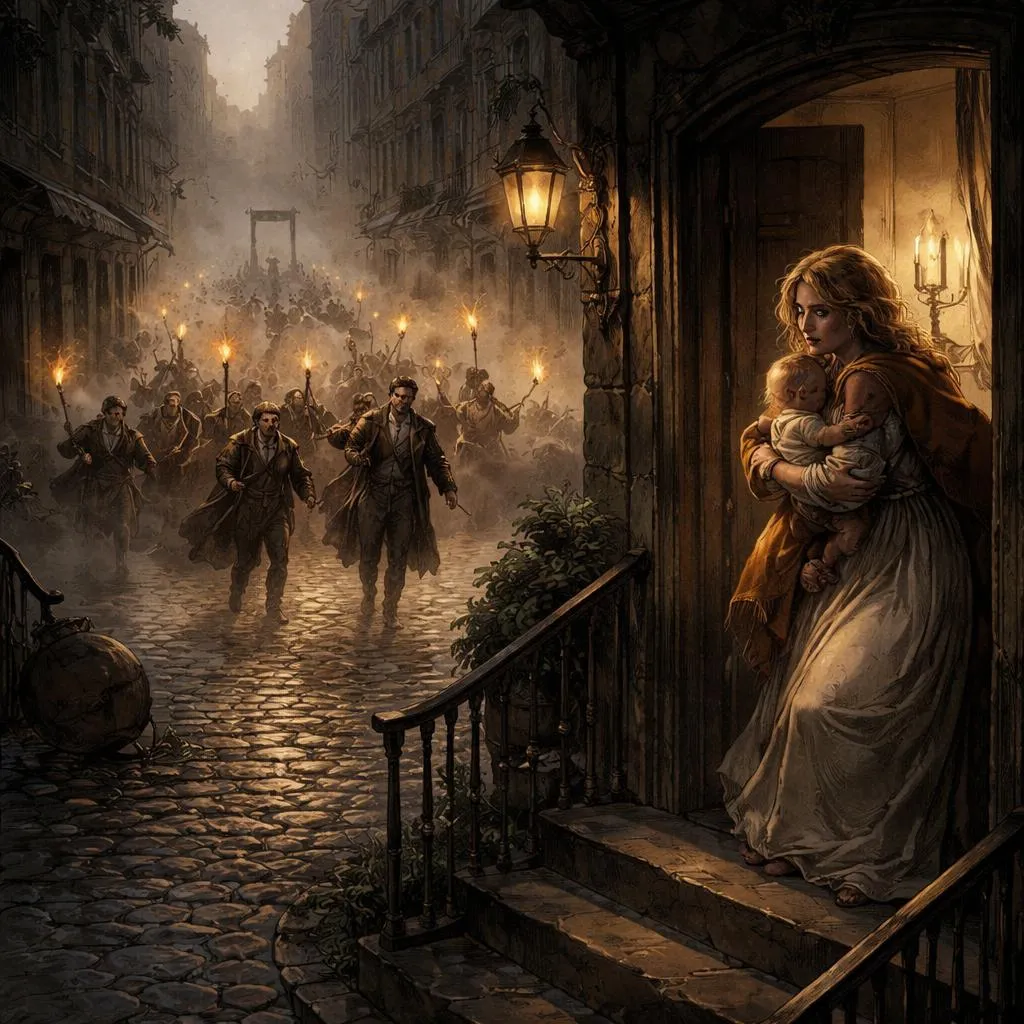

A wonderful corner for echoes, it has been remarked, that corner where the Doctor lived. Ever busily winding the golden thread which bound her husband, and her father, and herself, and her old directress and companion, in a life of quiet bliss, Lucie sat in the still house in the tranquilly resounding corner, listening to the echoing footsteps of years.
At first, there were times, though she was a perfectly happy young wife, when her work would slowly fall from her hands, and her eyes would be dimmed. For, there was something coming in the echoes, something light, afar off, and scarcely audible yet, that stirred her heart too much. Fluttering hopes and doubts—hopes, of a love as yet unknown to her: doubts, of her remaining upon earth, to enjoy that new delight—divided her breast. Among the echoes then, there would arise the sound of footsteps at her own early grave; and thoughts of the husband who would be left so desolate, and who would mourn for her so much, swelled to her eyes, and broke like waves.
That time passed, and her little Lucie lay on her bosom. Then, among the advancing echoes, there was the tread of her tiny feet and the sound of her prattling words. Let greater echoes resound as they would, the young mother at the cradle side could always hear those coming. They came, and the shady house was sunny with a child’s laugh, and the Divine friend of children, to whom in her trouble she had confided hers, seemed to take her child in his arms, as He took the child of old, and made it a sacred joy to her.
Ever busily winding the golden thread that bound them all together, weaving the service of her happy influence through the tissue of all their lives, and making it predominate nowhere, Lucie heard in the echoes of years none but friendly and soothing sounds. Her husband’s step was strong and prosperous among them; her father’s firm and equal. Lo, Miss Pross, in harness of string, awakening the echoes, as an unruly charger, whip-corrected, snorting and pawing the earth under the plane-tree in the garden!
Even when there were sounds of sorrow among the rest, they were not harsh nor cruel. Even when golden hair, like her own, lay in a halo on a pillow round the worn face of a little boy, and he said, with a radiant smile, “Dear papa and mamma, I am very sorry to leave you both, and to leave my pretty sister; but I am called, and I must go!” those were not tears all of agony that wetted his young mother’s cheek, as the spirit departed from her embrace that had been entrusted to it. Suffer them and forbid them not. They see my Father’s face. O Father, blessed words!
Thus, the rustling of an Angel’s wings got blended with the other echoes, and they were not wholly of earth, but had in them that breath of Heaven. Sighs of the winds that blew over a little garden-tomb were mingled with them also, and both were audible to Lucie, in a hushed murmur—like the breathing of a summer sea asleep upon a sandy shore —as the little Lucie, comically studious at the task of the morning, or dressing a doll at her mother’s footstool, chattered in the tongues of the Two Cities that were blended in her life.
The Echoes rarely answered to the actual tread of Sydney Carton. Some half-dozen times a year, at most, he claimed his privilege of coming in uninvited, and would sit among them through the evening, as he had once done often. He never came there heated with wine. And one other thing regarding him was whispered in the echoes, which has been whispered by all true echoes for ages and ages.
No man ever really loved a woman, lost her, and knew her with a blameless though an unchanged mind, when she was a wife and a mother, but her children had a strange sympathy with him—an instinctive delicacy of pity for him. What fine hidden sensibilities are touched in such a case, no echoes tell; but it is so, and it was so here. Carton was the first stranger to whom little Lucie held out her chubby arms, and he kept his place with her as she grew. The little boy had spoken of him, almost at the last. “Poor Carton! Kiss him for me!”
Mr. Stryver shouldered his way through the law, like some great engine forcing itself through turbid water, and dragged his useful friend in his wake, like a boat towed astern. As the boat so favoured is usually in a rough plight, and mostly under water, so, Sydney had a swamped life of it. But, easy and strong custom, unhappily so much easier and stronger in him than any stimulating sense of desert or disgrace, made it the life he was to lead; and he no more thought of emerging from his state of lion’s jackal, than any real jackal may be supposed to think of rising to be a lion. Stryver was rich; had married a florid widow with property and three boys, who had nothing particularly shining about them but the straight hair of their dumpling heads.
These three young gentlemen, Mr. Stryver, exuding patronage of the most offensive quality from every pore, had walked before him like three sheep to the quiet corner in Soho, and had offered as pupils to Lucie’s husband: delicately saying “Halloa! here are three lumps of bread-and- cheese towards your matrimonial picnic, Darnay!” The polite rejection of the three lumps of bread-and-cheese had quite bloated Mr. Stryver with indignation, which he afterwards turned to account in the training of the young gentlemen, by directing them to beware of the pride of Beggars, like that tutor-fellow. He was also in the habit of declaiming to Mrs. Stryver, over his full-bodied wine, on the arts Mrs. Darnay had once put in practice to “catch” him, and on the diamond-cut-diamond arts in himself, madam, which had rendered him “not to be caught.” Some of his King’s Bench familiars, who were occasionally parties to the full-bodied wine and the lie, excused him for the latter by saying that he had told it so often, that he believed it himself—which is surely such an incorrigible aggravation of an originally bad offence, as to justify any such offender’s being carried off to some suitably retired spot, and there hanged out of the way.
These were among the echoes to which Lucie, sometimes pensive, sometimes amused and laughing, listened in the echoing corner, until her little daughter was six years old. How near to her heart the echoes of her child’s tread came, and those of her own dear father’s, always active and self-possessed, and those of her dear husband’s, need not be told. Nor, how the lightest echo of their united home, directed by herself with such a wise and elegant thrift that it was more abundant than any waste, was music to her. Nor, how there were echoes all about her, sweet in her ears, of the many times her father had told her that he found her more devoted to him married (if that could be) than single, and of the many times her husband had said to her that no cares and duties seemed to divide her love for him or her help to him, and asked her “What is the magic secret, my darling, of your being everything to all of us, as if there were only one of us, yet never seeming to be hurried, or to have too much to do?”
But, there were other echoes, from a distance, that rumbled menacingly in the corner all through this space of time. And it was now, about little Lucie’s sixth birthday, that they began to have an awful sound, as of a great storm in France with a dreadful sea rising.
On a night in mid-July, one thousand seven hundred and eighty-nine, Mr. Lorry came in late, from Tellson’s, and sat himself down by Lucie and her husband in the dark window. It was a hot, wild night, and they were all three reminded of the old Sunday night when they had looked at the lightning from the same place.
“I began to think,” said Mr. Lorry, pushing his brown wig back, “that I should have to pass the night at Tellson’s. We have been so full of business all day, that we have not known what to do first, or which way to turn. There is such an uneasiness in Paris, that we have actually a run of confidence upon us! Our customers over there, seem not to be able to confide their property to us fast enough. There is positively a mania among some of them for sending it to England.”
“That has a bad look,” said Darnay—
“A bad look, you say, my dear Darnay? Yes, but we don’t know what reason there is in it. People are so unreasonable! Some of us at Tellson’s are getting old, and we really can’t be troubled out of the ordinary course without due occasion.”
“Still,” said Darnay, “you know how gloomy and threatening the sky is.”
“I know that, to be sure,” assented Mr. Lorry, trying to persuade himself that his sweet temper was soured, and that he grumbled, “but I am determined to be peevish after my long day’s botheration. Where is Manette?”
“Here he is,” said the Doctor, entering the dark room at the moment.
“I am quite glad you are at home; for these hurries and forebodings by which I have been surrounded all day long, have made me nervous without reason. You are not going out, I hope?”
“No; I am going to play backgammon with you, if you like,” said the Doctor.
“I don’t think I do like, if I may speak my mind. I am not fit to be pitted against you to-night. Is the teaboard still there, Lucie? I can’t see.”
“Of course, it has been kept for you.”
“Thank ye, my dear. The precious child is safe in bed?”
“And sleeping soundly.”
“That’s right; all safe and well! I don’t know why anything should be otherwise than safe and well here, thank God; but I have been so put out all day, and I am not as young as I was! My tea, my dear! Thank ye. Now, come and take your place in the circle, and let us sit quiet, and hear the echoes about which you have your theory.”
“Not a theory; it was a fancy.”
“A fancy, then, my wise pet,” said Mr. Lorry, patting her hand. “They are very numerous and very loud, though, are they not? Only hear them!”
Headlong, mad, and dangerous footsteps to force their way into anybody’s life, footsteps not easily made clean again if once stained red, the footsteps raging in Saint Antoine afar off, as the little circle sat in the dark London window.
Saint Antoine had been, that morning, a vast dusky mass of scarecrows heaving to and fro, with frequent gleams of light above the billowy heads, where steel blades and bayonets shone in the sun. A tremendous roar arose from the throat of Saint Antoine, and a forest of naked arms struggled in the air like shrivelled branches of trees in a winter wind: all the fingers convulsively clutching at every weapon or semblance of a weapon that was thrown up from the depths below, no matter how far off.
Who gave them out, whence they last came, where they began, through what agency they crookedly quivered and jerked, scores at a time, over the heads of the crowd, like a kind of lightning, no eye in the throng could have told; but, muskets were being distributed—so were cartridges, powder, and ball, bars of iron and wood, knives, axes, pikes, every weapon that distracted ingenuity could discover or devise. People who could lay hold of nothing else, set themselves with bleeding hands to force stones and bricks out of their places in walls. Every pulse and heart in Saint Antoine was on high-fever strain and at high-fever heat. Every living creature there held life as of no account, and was demented with a passionate readiness to sacrifice it.
As a whirlpool of boiling waters has a centre point, so, all this raging circled round Defarge’s wine-shop, and every human drop in the caldron had a tendency to be sucked towards the vortex where Defarge himself, already begrimed with gunpowder and sweat, issued orders, issued arms, thrust this man back, dragged this man forward, disarmed one to arm another, laboured and strove in the thickest of the uproar.
“Keep near to me, Jacques Three,” cried Defarge; “and do you, Jacques One and Two, separate and put yourselves at the head of as many of these patriots as you can. Where is my wife?”
“Eh, well! Here you see me!” said madame, composed as ever, but not knitting to-day. Madame’s resolute right hand was occupied with an axe, in place of the usual softer implements, and in her girdle were a pistol and a cruel knife.
“Where do you go, my wife?”
“I go,” said madame, “with you at present. You shall see me at the head of women, by-and-bye.”
“Come, then!” cried Defarge, in a resounding voice. “Patriots and friends, we are ready! The Bastille!”
With a roar that sounded as if all the breath in France had been shaped into the detested word, the living sea rose, wave on wave, depth on depth, and overflowed the city to that point. Alarm-bells ringing, drums beating, the sea raging and thundering on its new beach, the attack began.
Deep ditches, double drawbridge, massive stone walls, eight great towers, cannon, muskets, fire and smoke. Through the fire and through the smoke—in the fire and in the smoke, for the sea cast him up against a cannon, and on the instant he became a cannonier—Defarge of the wine-shop worked like a manful soldier, Two fierce hours.
Deep ditch, single drawbridge, massive stone walls, eight great towers, cannon, muskets, fire and smoke. One drawbridge down! “Work, comrades all, work! Work, Jacques One, Jacques Two, Jacques One Thousand, Jacques Two Thousand, Jacques Five-and-Twenty Thousand; in the name of all the Angels or the Devils—which you prefer—work!” Thus Defarge of the wine-shop, still at his gun, which had long gown hot.
“To me, women!” cried madame his wife. “What! We can kill as well as the men when the place is taken!” And to her, with a shrill thirsty cry, trooping women variously armed, but all armed age in hunger and revenge.
Cannon, muskets, fire and smoke; but, still the deep ditch, the single drawbridge, the massive stone wails, and the eight great towers. Slight displacements of the raging sea, made by the falling wounded. Flashing weapons, blazing torches, smoking waggonloads of wet straw, hard work at neighbouring barricades in all directions, shrieks, volleys, execrations, bravery without stint, boom smash and rattle, and the furious sounding of the living sea; but, still the deep ditch, and the single drawbridge, and the massive stone walls, and the eight great towers, and still Defarge of the wine-shop at his gun, grown doubly hot by the service of Four fierce hours.
A white flag from within the fortress, and a parley—this dimly perceptible through the raging storm, nothing audible in it—suddenly the sea rose immeasurably wider and higher, and swept Defarge of the wine-shop over the lowered drawbridge, past the massive stone outer walls, in among the eight great towers surrendered!
So resistless was the force of the ocean bearing him on, that even to draw his breath or turn his head was as impracticable as if he had been struggling in the surf at the South Sea, until he was landed in the outer courtyard of the Bastille. There, against an angle of a wall, he made a struggle to look about him. Jacques Three was nearly at his side; Madame Defarge, still heading some of her women, was visible in the inner distance, and her knife was in her hand. Everywhere was tumult, exultation, deafening and maniacal bewilderment, astounding noise, yet furious dumb-show.
“The Prisoners!”
“The Records!”
“The secret cells!”
“The instruments of torture!”
“The Prisoners!”
Of all these cries, and ten thousand incoherences, “The Prisoners!” was the cry most taken up by the sea that rushed in, as if there were an eternity of people, as well as of time and space. When the foremost billows rolled past, bearing the prison officers with them, and threatening them all with instant death if any secret nook remained undisclosed, Defarge laid his strong hand on the breast of one of these men—a man with a grey head, who had a lighted torch in his hand— separated him from the rest, and got him between himself and the wall.
“Show me the North Tower!” said Defarge. “Quick!”
“I will faithfully,” replied the man, “if you will come with me. But there is no one there.”
“What is the meaning of One Hundred and Five, North Tower?” asked Defarge. “Quick!”
“The meaning, monsieur?”
“Does it mean a captive, or a place of captivity? Or do you mean that I shall strike you dead?”
“Kill him!” croaked Jacques Three, who had come close up.
“Monsieur, it is a cell.”
“Show it me!”
“Pass this way, then.”
Jacques Three, with his usual craving on him, and evidently disappointed by the dialogue taking a turn that did not seem to promise bloodshed, held by Defarge’s arm as he held by the turnkey’s. Their three heads had been close together during this brief discourse, and it had been as much as they could do to hear one another, even then: so tremendous was the noise of the living ocean, in its irruption into the Fortress, and its inundation of the courts and passages and staircases. All around outside, too, it beat the walls with a deep, hoarse roar, from which, occasionally, some partial shouts of tumult broke and leaped into the air like spray.
Through gloomy vaults where the light of day had never shone, past hideous doors of dark dens and cages, down cavernous flights of steps, and again up steep rugged ascents of stone and brick, more like dry waterfalls than staircases, Defarge, the turnkey, and Jacques Three, linked hand and arm, went with all the speed they could make. Here and there, especially at first, the inundation started on them and swept by; but when they had done descending, and were winding and climbing up a tower, they were alone. Hemmed in here by the massive thickness of walls and arches, the storm within the fortress and without was only audible to them in a dull, subdued way, as if the noise out of which they had come had almost destroyed their sense of hearing.
The turnkey stopped at a low door, put a key in a clashing lock, swung the door slowly open, and said, as they all bent their heads and passed in:
“One hundred and five, North Tower!”
There was a small, heavily-grated, unglazed window high in the wall, with a stone screen before it, so that the sky could be only seen by stooping low and looking up. There was a small chimney, heavily barred across, a few feet within. There was a heap of old feathery wood-ashes on the hearth. There was a stool, and table, and a straw bed. There were the four blackened walls, and a rusted iron ring in one of them.
“Pass that torch slowly along these walls, that I may see them,” said Defarge to the turnkey.
The man obeyed, and Defarge followed the light closely with his eyes.
“Stop!—Look here, Jacques!”
“A. M.!” croaked Jacques Three, as he read greedily.
“Alexandre Manette,” said Defarge in his ear, following the letters with his swart forefinger, deeply engrained with gunpowder. “And here he wrote `a poor physician.’ And it was he, without doubt, who scratched a calendar on this stone. What is that in your hand? A crowbar? Give it me!”
He had still the linstock of his gun in his own hand. He made a sudden exchange of the two instruments, and turning on the worm-eaten stool and table, beat them to pieces in a few blows.
“Hold the light higher!” he said, wrathfully, to the turnkey. “Look among those fragments with care, Jacques. And see! Here is my knife,” throwing it to him; “rip open that bed, and search the straw. Hold the light higher, you!”
With a menacing look at the turnkey he crawled upon the hearth, and, peering up the chimney, struck and prised at its sides with the crowbar, and worked at the iron grating across it. In a few minutes, some mortar and dust came dropping down, which he averted his face to avoid; and in it, and in the old wood-ashes, and in a crevice in the chimney into which his weapon had slipped or wrought itself, he groped with a cautious touch.
“Nothing in the wood, and nothing in the straw, Jacques?”
“Nothing.”
“Let us collect them together, in the middle of the cell. So! Light them, you!”
The turnkey fired the little pile, which blazed high and hot. Stooping again to come out at the low-arched door, they left it burning, and retraced their way to the courtyard; seeming to recover their sense of hearing as they came down, until they were in the raging flood once more.
They found it surging and tossing, in quest of Defarge himself. Saint Antoine was clamorous to have its wine-shop keeper foremost in the guard upon the governor who had defended the Bastille and shot the people. Otherwise, the governor would not be marched to the Hotel de Ville for judgment. Otherwise, the governor would escape, and the people’s blood (suddenly of some value, after many years of worthlessness) be unavenged.
In the howling universe of passion and contention that seemed to encompass this grim old officer conspicuous in his grey coat and red decoration, there was but one quite steady figure, and that was a woman’s. “See, there is my husband!” she cried, pointing him out. “See Defarge!” She stood immovable close to the grain old officer, and remained immovable close to him; remained immovable close to him through the streets, as Defarge and the rest bore him along; remained immovable close to him when he was got near his destination, and began to be struck at from behind; remained immovable close to him when the long-gathering rain of stabs and blows fell heavy; was so close to him when he dropped dead under it, that, suddenly animated, she put her foot upon his neck, and with her cruel knife—long ready—hewed off his head.
The hour was come, when Saint Antoine was to execute his horrible idea of hoisting up men for lamps to show what he could be and do. Saint Antoine’s blood was up, and the blood of tyranny and domination by the iron hand was down—down on the steps of the Hotel de Ville where the governor’s body lay—down on the sole of the shoe of Madame Defarge where she had trodden on the body to steady it for mutilation. “Lower the lamp yonder!” cried Saint Antoine, after glaring round for a new means of death; “here is one of his soldiers to be left on guard!” The swinging sentinel was posted, and the sea rushed on.
The sea of black and threatening waters, and of destructive upheaving of wave against wave, whose depths were yet unfathomed and whose forces were yet unknown. The remorseless sea of turbulently swaying shapes, voices of vengeance, and faces hardened in the furnaces of suffering until the touch of pity could make no mark on them.
But, in the ocean of faces where every fierce and furious expression was in vivid life, there were two groups of faces—each seven in number —so fixedly contrasting with the rest, that never did sea roll which bore more memorable wrecks with it. Seven faces of prisoners, suddenly released by the storm that had burst their tomb, were carried high overhead: all scared, all lost, all wondering and amazed, as if the Last Day were come, and those who rejoiced around them were lost spirits. Other seven faces there were, carried higher, seven dead faces, whose drooping eyelids and half-seen eyes awaited the Last Day. Impassive faces, yet with a suspended—not an abolished—expression on them; faces, rather, in a fearful pause, as having yet to raise the dropped lids of the eyes, and bear witness with the bloodless lips, “THOU DIDST IT!”
Seven prisoners released, seven gory heads on pikes, the keys of the accursed fortress of the eight strong towers, some discovered letters and other memorials of prisoners of old time, long dead of broken hearts,—such, and such—like, the loudly echoing footsteps of Saint Antoine escort through the Paris streets in mid-July, one thousand seven hundred and eighty-nine. Now, Heaven defeat the fancy of Lucie Darnay, and keep these feet far out of her life! For, they are headlong, mad, and dangerous; and in the years so long after the breaking of the cask at Defarge’s wine-shop door, they are not easily purified when once stained red.
背景和作者介紹
這段文字出自查爾斯·狄更斯所著的歷史小說《雙城記》,狄更斯是19世紀最著名的英國小說家之一。狄更斯於1859年寫了這部小說,當時英國正經歷快速的社會變遷。故事背景設定在法國大革命時期,那是18世紀末法國動盪不安的時期。狄更斯受到那個時代戲劇性事件的啟發,並用他的故事來探討犧牲、重生和對正義的追求等主題。
故事的詳細闡釋和意義
這段文字捕捉了露西·馬內特和她家人的平靜家庭生活,與遠方法國大革命的暴力混亂形成鮮明對比。「迴響」象徵著記憶、希望和恐懼,在時間和空間中迴盪,將個人的幸福與更大的歷史風暴聯繫起來。露西代表著愛、同情和穩定,而聖安東尼區的風暴則反映了社會不公所釋放的仇恨和復仇的危險力量。
這部小說探討了個人生活如何受到歷史事件的影響,以及善良和忠誠等個人美德如何在巨大的苦難時期也能保持。這裡提到的西德尼·卡頓這個角色,體現了救贖和自我犧牲,表明即使是有缺陷的個體也能找到意義和英雄主義。
給學生的教訓和見解
-
透過文學理解歷史
學生可以學習歷史事件如何塑造人類的經歷和情感。法國大革命不僅僅是一個背景,而是一股影響人物生活的力量,教導我們欣賞歷史對個人的影響。 -
同情心和家庭的力量
露西作為一位慈愛的妻子和母親的角色,突出了善良和情感支持在克服困難中的重要性。這可以激勵學生重視他們的家庭關係,並對他人富有同情心。 -
勇氣和犧牲
故事表明,真正的勇氣往往涉及為更大的利益而犧牲。西德尼·卡頓的例子鼓勵年輕讀者思考他們如何在自己的生活中無私地行動。 -
仇恨和復仇的危險
革命中的暴力場面警告了仇恨的破壞力量。學生可以反思寬恕和和平解決衝突在他們社會交往中的重要性。
如何在日常生活中應用這些教訓
- 在學習中: 將歷史和文學視為相互關聯的領域,幫助我們理解人性與社會。反思人物的決定及其後果,以培養批判性思維能力。
- 在社交場合: 像露西一樣練習同情心和善良,在挑戰中支持朋友和家人。避免嚴厲的判斷,並尋求和平解決衝突的方法。
- 在個人成長中: 擁抱勇氣和責任,從西德尼·卡頓的救贖中學習,以改善自己並為社會做出積極貢獻。
- 在情感韌性中: 認識到生活既有喜悅也有悲傷,希望和愛可以在困難時期提供力量。
培養積極的精神和行為
學生可以透過以下方式培養這個故事中展現的美德:
- 每天練習耐心和同情心。
- 理解寬恕與和解的價值。
- 培養正義感,並反對不公平。
- 學會在個人幸福與社會責任之間取得平衡。
結論
《雙城記》不僅是一部引人入勝的歷史小說,也是一個包裹在引人入勝的故事中的深刻道德教訓。它邀請年輕讀者探索複雜的情感和歷史現實,同時激勵他們培養同情心、勇氣和正直。透過參與這個故事,學生可以獲得超越文學的見解,進入他們自己的生活,幫助他們成長為有思想和富有同情心的人。
