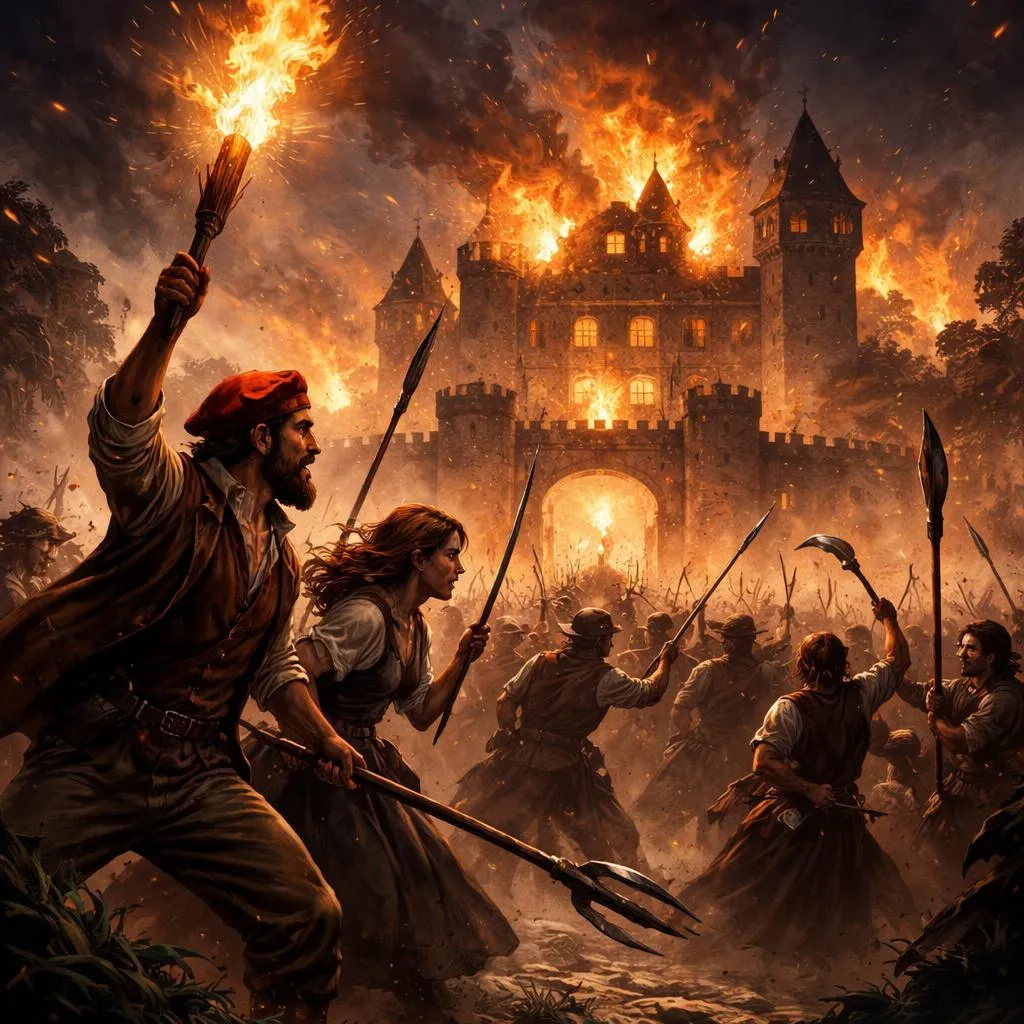

There was a change on the village where the fountain fell, and where the mender of roads went forth daily to hammer out of the stones on the highway such morsels of bread as might serve for patches to hold his poor ignorant soul and his poor reduced body together. The prison on the crag was not so dominant as of yore; there were soldiers to guard it, but not many; there were officers to guard the soldiers, but not one of them knew what his men would do—beyond this: that it would probably not be what he was ordered.
Far and wide lay a ruined country, yielding nothing but desolation. Every green leaf, every blade of grass and blade of grain, was as shrivelled and poor as the miserable people. Everything was bowed down, dejected, oppressed, and broken. Habitations, fences, domesticated animals, men, women, children, and the soil that bore them—all worn out.
Monseigneur (often a most worthy individual gentleman) was a national blessing, gave a chivalrous tone to things, was a polite example of luxurious and shining fife, and a great deal more to equal purpose; nevertheless, Monseigneur as a class had, somehow or other, brought things to this. Strange that Creation, designed expressly for Monseigneur, should be so soon wrung dry and squeezed out! There must be something short-sighted in the eternal arrangements, surely! Thus it was, however; and the last drop of blood having been extracted from the flints, and the last screw of the rack having been turned so often that its purchase crumbled, and it now turned and turned with nothing to bite, Monseigneur began to run away from a phenomenon so low and unaccountable.
But, this was not the change on the village, and on many a village like it. For scores of years gone by, Monseigneur had squeezed it and wrung it, and had seldom graced it with his presence except for the pleasures of the chase—now, found in hunting the people; now, found in hunting the beasts, for whose preservation Monseigneur made edifying spaces of barbarous and barren wilderness. No. The change consisted in the appearance of strange faces of low caste, rather than in the disappearance of the high caste, chiselled, and otherwise beautified and beautifying features of Monseigneur.
For, in these times, as the mender of roads worked, solitary, in the dust, not often troubling himself to reflect that dust he was and to dust he must return, being for the most part too much occupied in thinking how little he had for supper and how much more he would eat if he had it—in these times, as he raised his eyes from his lonely labour, and viewed the prospect, he would see some rough figure approaching on foot, the like of which was once a rarity in those parts, but was now a frequent presence. As it advanced, the mender of roads would discern without surprise, that it was a shaggy-haired man, of almost barbarian aspect, tall, in wooden shoes that were clumsy even to the eyes of a mender of roads, grim, rough, swart, steeped in the mud and dust of many highways, dank with the marshy moisture of many low grounds, sprinkled with the thorns and leaves and moss of many byways through woods.
Such a man came upon him, like a ghost, at noon in the July weather, as he sat on his heap of stones under a bank, taking such shelter as he could get from a shower of hail.
The man looked at him, looked at the village in the hollow, at the mill, and at the prison on the crag. When he had identified these objects in what benighted mind he had, he said, in a dialect that was just intelligible:
“How goes it, Jacques?”
“All well, Jacques.”
“Touch then!”
They joined hands, and the man sat down on the heap of stones.
“No dinner?”
“Nothing but supper now,” said the mender of roads, with a hungry face.
“It is the fashion,” growled the man. “I meet no dinner anywhere.”
He took out a blackened pipe, filled it, lighted it with flint and steel, pulled at it until it was in a bright glow: then, suddenly held it from him and dropped something into it from between his finger and thumb, that blazed and went out in a puff of smoke.
“Touch then.” It was the turn of the mender of roads to say it this time, after observing these operations. They again joined hands.
“To-night?” said the mender of roads.
“To-night,” said the man, putting the pipe in his mouth.
“Where?”
“Here.”
He and the mender of roads sat on the heap of stones looking silently at one another, with the hail driving in between them like a pigmy charge of bayonets, until the sky began to clear over the village.
“Show me!” said the traveller then, moving to the brow of the hill.
“See!” returned the mender of roads, with extended finger. “You go down here, and straight through the street, and past the fountain—”
“To the Devil with all that!” interrupted the other, rolling his eye over the landscape. “I go through no streets and past no fountains. Well?”
“Well! About two leagues beyond the summit of that hill above the village.”
“Good. When do you cease to work?”
“At sunset.”
“Will you wake me, before departing? I have walked two nights without resting. Let me finish my pipe, and I shall sleep like a child. Will you wake me?”
“Surely.”
The wayfarer smoked his pipe out, put it in his breast, slipped off his great wooden shoes, and lay down on his back on the heap of stones. He was fast asleep directly.
As the road-mender plied his dusty labour, and the hail-clouds, rolling away, revealed bright bars and streaks of sky which were responded to by silver gleams upon the landscape, the little man (who wore a red cap now, in place of his blue one) seemed fascinated by the figure on the heap of stones. His eyes were so often turned towards it, that he used his tools mechanically, and, one would have said, to very poor account. The bronze face, the shaggy black hair and beard, the coarse woollen red cap, the rough medley dress of home-spun stuff and hairy skins of beasts, the powerful frame attenuated by spare living, and the sullen and desperate compression of the lips in sleep, inspired the mender of roads with awe. The traveller had travelled far, and his feet were footsore, and his ankles chafed and bleeding; his great shoes, stuffed with leaves and grass, had been heavy to drag over the many long leagues, and his clothes were chafed into holes, as he himself was into sores. Stooping down beside him, the road-mender tried to get a peep at secret weapons in his breast or where not; but, in vain, for he slept with his arms crossed upon him, and set as resolutely as his lips. Fortified towns with their stockades, guard-houses, gates, trenches, and drawbridges, seemed to the mender of roads, to be so much air as against this figure. And when he lifted his eyes from it to the horizon and looked around, he saw in his small fancy similar figures, stopped by no obstacle, tending to centres all over France.
The man slept on, indifferent to showers of hail and intervals of brightness, to sunshine on his face and shadow, to the paltering lumps of dull ice on his body and the diamonds into which the sun changed them, until the sun was low in the west, and the sky was glowing. Then, the mender of roads having got his tools together and all things ready to go down into the village, roused him.
“Good!” said the sleeper, rising on his elbow. “Two leagues beyond the summit of the hill?”
“About.”
“About. Good!”
The mender of roads went home, with the dust going on before him according to the set of the wind, and was soon at the fountain, squeezing himself in among the lean kine brought there to drink, and appearing even to whisper to them in his whispering to all the village. When the village had taken its poor supper, it did not creep to bed, as it usually did, but came out of doors again, and remained there. A curious contagion of whispering was upon it, and also, when it gathered together at the fountain in the dark, another curious contagion of looking expectantly at the sky in one direction only. Monsieur Gabelle, chief functionary of the place, became uneasy; went out on his house-top alone, and looked in that direction too; glanced down from behind his chimneys at the darkening faces by the fountain below, and sent word to the sacristan who kept the keys of the church, that there might be need to ring the tocsin by-and-bye.
The night deepened. The trees environing the old chateau, keeping its solitary state apart, moved in a rising wind, as though they threatened the pile of building massive and dark in the gloom. Up the two terrace flights of steps the rain ran wildly, and beat at the great door, like a swift messenger rousing those within; uneasy rushes of wind went through the hall, among the old spears and knives, and passed lamenting up the stairs, and shook the curtains of the bed where the last Marquis had slept. East, West, North, and South, through the woods, four heavy-treading, unkempt figures crushed the high grass and cracked the branches, striding on cautiously to come together in the courtyard. Four lights broke out there, and moved away in different directions, and all was black again.
But, not for long. Presently, the chateau began to make itself strangely visible by some light of its own, as though it were growing luminous. Then, a flickering streak played behind the architecture of the front, picking out transparent places, and showing where balustrades, arches, and windows were. Then it soared higher, and grew broader and brighter. Soon, from a score of the great windows, flames burst forth, and the stone faces awakened, stared out of fire.
A faint murmur arose about the house from the few people who were left there, and there was a saddling of a horse and riding away. There was spurring and splashing through the darkness, and bridle was drawn in the space by the village fountain, and the horse in a foam stood at Monsieur Gabelle’s door. “Help, Gabelle! Help, every one!” The tocsin rang impatiently, but other help (if that were any) there was none. The mender of roads, and two hundred and fifty particular friends, stood with folded arms at the fountain, looking at the pillar of fire in the sky. “It must be forty feet high,” said they, grimly; and never moved.
The rider from the chateau, and the horse in a foam, clattered away through the village, and galloped up the stony steep, to the prison on the crag. At the gate, a group of officers were looking at the fire; removed from them, a group of soldiers. “Help, gentlemen— officers! The chateau is on fire; valuable objects may be saved from the flames by timely aid! Help, help!” The officers looked towards the soldiers who looked at the fire; gave no orders; and answered, with shrugs and biting of lips, “It must burn.”
As the rider rattled down the hill again and through the street, the village was illuminating. The mender of roads, and the two hundred and fifty particular friends, inspired as one man and woman by the idea of lighting up, had darted into their houses, and were putting candles in every dull little pane of glass. The general scarcity of everything, occasioned candles to be borrowed in a rather peremptory manner of Monsieur Gabelle; and in a moment of reluctance and hesitation on that functionary’s part, the mender of roads, once so submissive to authority, had remarked that carriages were good to make bonfires with, and that post-horses would roast.
The chateau was left to itself to flame and burn. In the roaring and raging of the conflagration, a red-hot wind, driving straight from the infernal regions, seemed to be blowing the edifice away. With the rising and falling of the blaze, the stone faces showed as if they were in torment. When great masses of stone and timber fell, the face with the two dints in the nose became obscured: anon struggled out of the smoke again, as if it were the face of the cruel Marquis, burning at the stake and contending with the fire.
The chateau burned; the nearest trees, laid hold of by the fire, scorched and shrivelled; trees at a distance, fired by the four fierce figures, begirt the blazing edifice with a new forest of smoke. Molten lead and iron boiled in the marble basin of the fountain; the water ran dry; the extinguisher tops of the towers vanished like ice before the heat, and trickled down into four rugged wells of flame. Great rents and splits branched out in the solid walls, like crystallisation; stupefied birds wheeled about and dropped into the furnace; four fierce figures trudged away, East, West, North, and South, along the night- enshrouded roads, guided by the beacon they had lighted, towards their next destination. The illuminated village had seized hold of the tocsin, and, abolishing the lawful ringer, rang for joy.
Not only that; but the village, light-headed with famine, fire, and bell-ringing, and bethinking itself that Monsieur Gabelle had to do with the collection of rent and taxes—though it was but a small instalment of taxes, and no rent at all, that Gabelle had got in those latter days—became impatient for an interview with him, and, surrounding his house, summoned him to come forth for personal conference. Whereupon, Monsieur Gabelle did heavily bar his door, and retire to hold counsel with himself. The result of that conference was, that Gabelle again withdrew himself to his housetop behind his stack of chimneys; this time resolved, if his door were broken in (he was a small Southern man of retaliative temperament), to pitch himself head foremost over the parapet, and crush a man or two below.
Probably, Monsieur Gabelle passed a long night up there, with the distant chateau for fire and candle, and the beating at his door, combined with the joy-ringing, for music; not to mention his having an ill-omened lamp slung across the road before his posting-house gate, which the village showed a lively inclination to displace in his favour. A trying suspense, to be passing a whole summer night on the brink of the black ocean, ready to take that plunge into it upon which Monsieur Gabelle had resolved! But, the friendly dawn appearing at last, and the rush-candles of the village guttering out, the people happily dispersed, and Monsieur Gabelle came down bringing his life with him for that while.
Within a hundred miles, and in the light of other fires, there were other functionaries less fortunate, that night and other nights, whom the rising sun found hanging across once-peaceful streets, where they had been born and bred; also, there were other villagers and townspeople less fortunate than the mender of roads and his fellows, upon whom the functionaries and soldiery turned with success, and whom they strung up in their turn. But, the fierce figures were steadily wending East, West, North, and South, be that as it would; and whosoever hung, fire burned. The altitude of the gallows that would turn to water and quench it, no functionary, by any stretch of mathematics, was able to calculate successfully.
背景介紹與作者介紹
這段文字出自查爾斯·狄更斯的小說《雙城記》,這是一部歷史小說,於 1859 年首次出版。狄更斯是一位著名的英國作家和社會評論家,以其生動的人物和對維多利亞時代社會的描繪而聞名。這部小說的背景設定在法國大革命的動盪時期,這是一個充滿社會動盪、不公正和劇烈變革的時期。狄更斯通過被捲入非凡事件的普通人的生活,探討了犧牲、復活以及暴政與自由之間的鬥爭等主題。
詳細解讀與意義
這段摘錄描繪了一個被貧困、壓迫和衰敗摧殘的村莊的悲慘景象。「修路人」象徵著在惡劣條件下無休止地勞作,勉強生存的普通百姓。「貴族」代表貴族,既是特權的象徵,也是人民苦難的根源。粗魯、神秘的旅行者的到來暗示了即將到來的革命,這股力量將挑戰既定的秩序。
燃燒的城堡和村民的反應的意象反映了對統治階級的反抗。村民點燃蠟燭和敲響警鐘象徵著希望、團結和反叛的火花。這個故事捕捉了絕望與對變革的渴望之間的緊張關係,突出了社會不公的代價。
給學生的教訓和見解
- 通過文學了解歷史: 這個故事為我們打開了一扇了解法國大革命的窗口,幫助學生掌握當時複雜的社會和政治動態。
- 同情心和社會意識: 通過關注普通人的生活,這部小說鼓勵讀者同情那些遭受不公正待遇的人,並認識到公平和平等的重要性。
- 變革的力量: 敘事表明集體行動和勇氣如何挑戰壓迫,激勵年輕讀者相信他們有能力做出改變。
在日常生活、學習和社會互動中的應用
- 韌性和毅力: 像修路人一樣,學生可以學會在困難面前繼續努力,明白微小的努力會促成更大的改變。
- 批判性思維: 這個故事邀請讀者質疑權威和社會結構,培養對個人成長和公民責任至關重要的批判性思維能力。
- 社區和團結: 村民在逆境中的團結教會了我們互相支持和共同努力克服挑戰的價值。
從故事中培養積極的價值觀
- 正義與公平: 鼓勵學生反對不公平的待遇,並為那些被邊緣化的人發聲。
- 勇氣與希望: 激勵年輕讀者勇敢地面對困難,即使在黑暗時期也要保持希望。
- 同情與理解: 促進對他人的善良和同情,認識到我們共同的人性。
通過學習這個故事,學生不僅可以獲得文學知識,還可以培養道德洞察力和社會意識,這可以指導他們在學校、友誼和未來社區中的行為。
