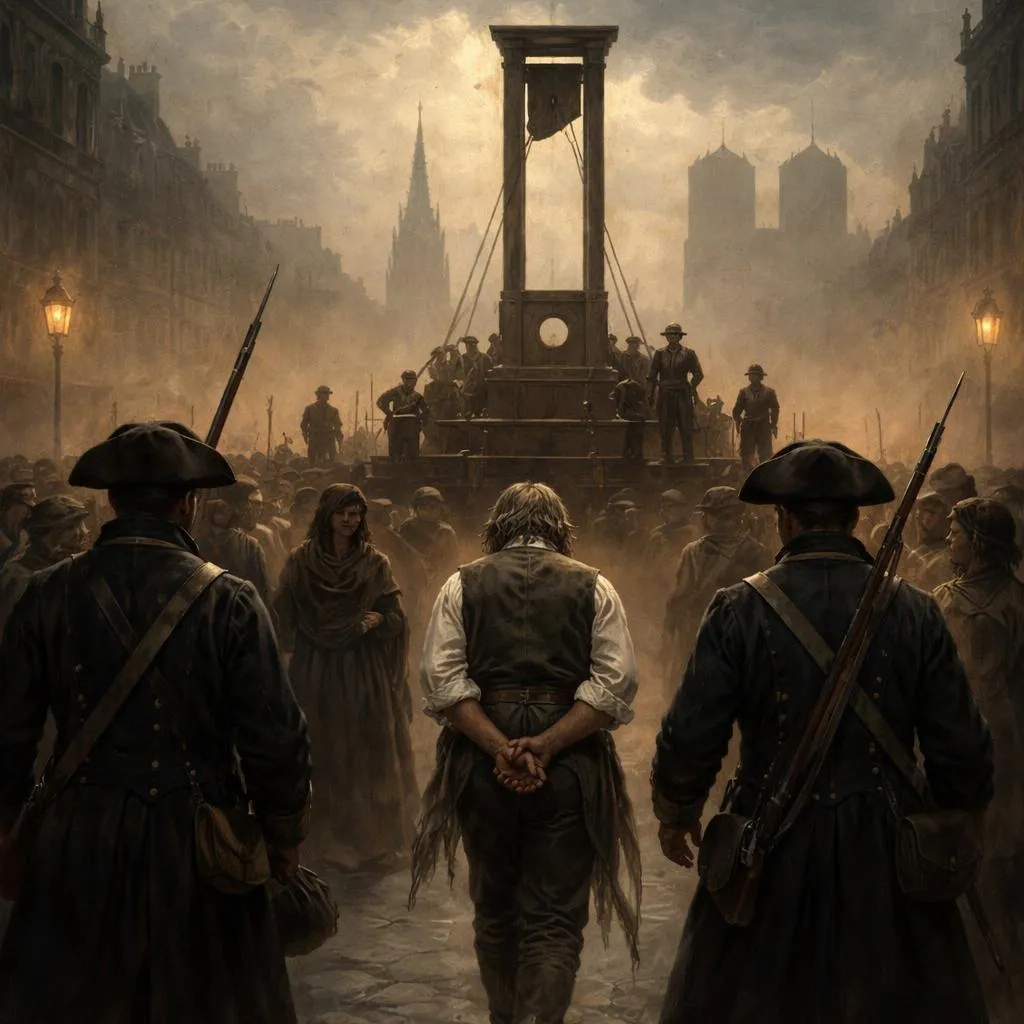

Along the Paris streets, the death-carts rumble, hollow and harsh. Six tumbrils carry the day’s wine to La Guillotine. All the devouring and insatiate Monsters imagined since imagination could record itself, are fused in the one realisation, Guillotine. And yet there is not in France, with its rich variety of soil and climate, a blade, a leaf, a root, a sprig, a peppercorn, which will grow to maturity under conditions more certain than those that have produced this horror. Crush humanity out of shape once more, under similar hammers, and it will twist itself into the same tortured forms. Sow the same seed of rapacious license and oppression over again, and it will surely yield the same fruit according to its kind.
Six tumbrils roll along the streets. Change these back again to what they were, thou powerful enchanter, Time, and they shall be seen to be the carriages of absolute monarchs, the equipages of feudal nobles, the toilettes of flaring Jezebels, the churches that are not my father’s house but dens of thieves, the huts of millions of starving peasants! No; the great magician who majestically works out the appointed order of the Creator, never reverses his transformations. “If thou be changed into this shape by the will of God,” say the seers to the enchanted, in the wise Arabian stories, “then remain so! But, if thou wear this form through mere passing conjuration, then resume thy former aspect!” Changeless and hopeless, the tumbrils roll along.
As the sombre wheels of the six carts go round, they seem to plough up a long crooked furrow among the populace in the streets. Ridges of faces are thrown to this side and to that, and the ploughs go steadily onward. So used are the regular inhabitants of the houses to the spectacle, that in many windows there are no people, and in some the occupation of the hands is not so much as suspended, while the eyes survey the faces in the tumbrils. Here and there, the inmate has visitors to see the sight; then he points his finger, with something of the complacency of a curator or authorised exponent, to this cart and to this, and seems to tell who sat here yesterday, and who there the day before.
Of the riders in the tumbrils, some observe these things, and all things on their last roadside, with an impassive stare; others, with a lingering interest in the ways of life and men. Some, seated with drooping heads, are sunk in silent despair; again, there are some so heedful of their looks that they cast upon the multitude such glances as they have seen in theatres, and in pictures. Several close their eyes, and think, or try to get their straying thoughts together. Only one, and he a miserable creature, of a crazed aspect, is so shattered and made drunk by horror, that he sings, and tries to dance. Not one of the whole number appeals by look or gesture, to the pity of the people.
There is a guard of sundry horsemen riding abreast of the tumbrils, and faces are often turned up to some of them, and they are asked some question. It would seem to be always the same question, for, it is always followed by a press of people towards the third cart. The horsemen abreast of that cart, frequently point out one man in it with their swords. The leading curiosity is, to know which is he; he stands at the back of the tumbril with his head bent down, to converse with a mere girl who sits on the side of the cart, and holds his hand. He has no curiosity or care for the scene about him, and always speaks to the girl. Here and there in the long street of St. Honore, cries are raised against him. If they move him at all, it is only to a quiet smile, as he shakes his hair a little more loosely about his face. He cannot easily touch his face, his arms being bound.
On the steps of a church, awaiting the coming-up of the tumbrils, stands the Spy and prison-sheep. He looks into the first of them: not there. He looks into the second: not there. He already asks himself, “Has he sacrificed me?” when his face clears, as he looks into the third.
“Which is Evremonde?” says a man behind him.
“That. At the back there.”
“With his hand in the girl’s?”
“Yes.”
The man cries, “Down, Evremonde! To the Guillotine all aristocrats! Down, Evremonde!”
“Hush, hush!” the Spy entreats him, timidly.
“And why not, citizen?”
“He is going to pay the forfeit: it will be paid in five minutes more. Let him be at peace.”
But the man continuing to exclaim, “Down, Evremonde!” the face of Evremonde is for a moment turned towards him. Evremonde then sees the Spy, and looks attentively at him, and goes his way.
The clocks are on the stroke of three, and the furrow ploughed among the populace is turning round, to come on into the place of execution, and end. The ridges thrown to this side and to that, now crumble in and close behind the last plough as it passes on, for all are following to the Guillotine. In front of it, seated in chairs, as in a garden of public diversion, are a number of women, busily knitting. On one of the fore-most chairs, stands The Vengeance, looking about for her friend.
“Therese!” she cries, in her shrill tones. “Who has seen her? Therese Defarge!”
“She never missed before,” says a knitting-woman of the sisterhood.
“No; nor will she miss now,” cries The Vengeance, petulantly. “Therese.”
“Louder,” the woman recommends.
Ay! Louder, Vengeance, much louder, and still she will scarcely hear thee. Louder yet, Vengeance, with a little oath or so added, and yet it will hardly bring her. Send other women up and down to seek her, lingering somewhere; and yet, although the messengers have done dread deeds, it is questionable whether of their own wills they will go far enough to find her!
“Bad Fortune!” cries The Vengeance, stamping her foot in the chair, “and here are the tumbrils! And Evremonde will be despatched in a wink, and she not here! See her knitting in my hand, and her empty chair ready for her. I cry with vexation and disappointment!”
As The Vengeance descends from her elevation to do it, the tumbrils begin to discharge their loads. The ministers of Sainte Guillotine are robed and ready. Crash!—A head is held up, and the knitting- women who scarcely lifted their eyes to look at it a moment ago when it could think and speak, count One.
The second tumbril empties and moves on; the third comes up. Crash! —And the knitting-women, never faltering or pausing in their Work, count Two.
The supposed Evremonde descends, and the seamstress is lifted out next after him. He has not relinquished her patient hand in getting out, but still holds it as he promised. He gently places her with her back to the crashing engine that constantly whirrs up and falls, and she looks into his face and thanks him.
“But for you, dear stranger, I should not be so composed, for I am naturally a poor little thing, faint of heart; nor should I have been able to raise my thoughts to Him who was put to death, that we might have hope and comfort here to-day. I think you were sent to me by Heaven.”
“Or you to me,” says Sydney Carton. “Keep your eyes upon me, dear child, and mind no other object.”
“I mind nothing while I hold your hand. I shall mind nothing when I let it go, if they are rapid.”
“They will be rapid. Fear not!”
The two stand in the fast-thinning throng of victims, but they speak as if they were alone. Eye to eye, voice to voice, hand to hand, heart to heart, these two children of the Universal Mother, else so wide apart and differing, have come together on the dark highway, to repair home together, and to rest in her bosom.
“Brave and generous friend, will you let me ask you one last question? I am very ignorant, and it troubles me—just a little.”
“Tell me what it is.”
“I have a cousin, an only relative and an orphan, like myself, whom I love very dearly. She is five years younger than I, and she lives in a farmer’s house in the south country. Poverty parted us, and she knows nothing of my fate—for I cannot write—and if I could, how should I tell her! It is better as it is.”
“Yes, yes: better as it is.”
“What I have been thinking as we came along, and what I am still thinking now, as I look into your kind strong face which gives me so much support, is this:—If the Republic really does good to the poor, and they come to be less hungry, and in all ways to suffer less, she may live a long time: she may even live to be old.”
“What then, my gentle sister?”
“Do you think:” the uncomplaining eyes in which there is so much endurance, fill with tears, and the lips part a little more and tremble: “that it will seem long to me, while I wait for her in the better land where I trust both you and I will be mercifully sheltered?”
“It cannot be, my child; there is no Time there, and no trouble there.”
“You comfort me so much! I am so ignorant. Am I to kiss you now? Is the moment come?”
“Yes.”
She kisses his lips; he kisses hers; they solemnly bless each other. The spare hand does not tremble as he releases it; nothing worse than a sweet, bright constancy is in the patient face. She goes next before him—is gone; the knitting-women count Twenty-Two.
“I am the Resurrection and the Life, saith the Lord: he that believeth in me, though he were dead, yet shall he live: and whosoever liveth and believeth in me shall never die.”
The murmuring of many voices, the upturning of many faces, the pressing on of many footsteps in the outskirts of the crowd, so that it swells forward in a mass, like one great heave of water, all flashes away. Twenty-Three.
They said of him, about the city that night, that it was the peacefullest man’s face ever beheld there. Many added that he looked sublime and prophetic.
One of the most remarkable sufferers by the same axe—a woman-had asked at the foot of the same scaffold, not long before, to be allowed to write down the thoughts that were inspiring her. If he had given any utterance to his, and they were prophetic, they would have been these:
“I see Barsad, and Cly, Defarge, The Vengeance, the Juryman, the Judge, long ranks of the new oppressors who have risen on the destruction of the old, perishing by this retributive instrument, before it shall cease out of its present use. I see a beautiful city and a brilliant people rising from this abyss, and, in their struggles to be truly free, in their triumphs and defeats, through long years to come, I see the evil of this time and of the previous time of which this is the natural birth, gradually making expiation for itself and wearing out.
“I see the lives for which I lay down my life, peaceful, useful, prosperous and happy, in that England which I shall see no more. I see Her with a child upon her bosom, who bears my name. I see her father, aged and bent, but otherwise restored, and faithful to all men in his healing office, and at peace. I see the good old man, so long their friend, in ten years’ time enriching them with all he has, and passing tranquilly to his reward.
“I see that I hold a sanctuary in their hearts, and in the hearts of their descendants, generations hence. I see her, an old woman, weeping for me on the anniversary of this day. I see her and her husband, their course done, lying side by side in their last earthly bed, and I know that each was not more honoured and held sacred in the other’s soul, than I was in the souls of both.
“I see that child who lay upon her bosom and who bore my name, a man winning his way up in that path of life which once was mine. I see him winning it so well, that my name is made illustrious there by the light of his. I see the blots I threw upon it, faded away. I see him, fore-most of just judges and honoured men, bringing a boy of my name, with a forehead that I know and golden hair, to this place— then fair to look upon, with not a trace of this day’s disfigurement —and I hear him tell the child my story, with a tender and a faltering voice.
“It is a far, far better thing that I do, than I have ever done; it is a far, far better rest that I go to than I have ever known.”
背景介紹與作者介紹
這段文字出自查爾斯·狄更斯所著的歷史小說《雙城記》,該小說於1859年首次出版。狄更斯是最著名的英國小說家之一,以其生動的人物刻畫和社會批判而聞名。這部小說的背景設定在法國大革命的動盪時期,那是18世紀末法國社會動盪和暴力的時期。狄更斯寫這個故事是為了探討犧牲、復活和在混亂與苦難中救贖的可能性。
詳細闡釋與意義
這段場景生動地描述了前往斷頭台的陰森隊伍,象徵著不公正和暴政的破壞性後果。六輛運載囚犯前往處決的囚車代表了多年壓迫和社會不平等的頂峰。狄更斯運用強大的意象來展示如果沒有解決苦難的根本原因——例如貪婪、殘酷和濫用權力——歷史如何會重演。
西德尼·卡頓這個人物出現在這段文字的結尾,體現了個人犧牲和救贖的主題。儘管他過著虛度光陰的生活,但他最後的勇氣和愛之舉將他變成了一個英雄。他在面對死亡時的鎮定和同情心激勵了希望,並表明即使在最黑暗的時刻,人類的尊嚴和善良也能佔上風。
給學生的教訓和見解
-
理解歷史與正義: 這個故事幫助學生欣賞歷史的複雜性,特別是社會不公如何導致暴力和革命。它鼓勵批判性地思考公平以及社會行為的後果。
-
犧牲的力量: 西德尼·卡頓的犧牲教導了無私和勇氣的價值。學生可以學到真正的英雄主義往往涉及將他人置於自己之上,即使在困難的情況下也是如此。
-
希望與救贖: 這部小說表明,無論生活看起來多麼黯淡,總是有更新和積極變化的可能性。這個訊息可以激勵韌性和樂觀。
-
同情心與憐憫: 通過展示受害者和壓迫者的人性,這個故事鼓勵讀者培養同情心並理解不同的觀點。
在生活中應用這些教訓
-
在學校: 學生可以通過與同學合作、幫助他人以及即使在遇到挑戰時也努力學習來應用犧牲的教訓。理解歷史也可以提高他們的批判性思維和對當前社會問題的認識。
-
在社交生活中: 這個故事鼓勵善良和維護正義。學生可以通過傾聽他人和支持有需要的朋友來練習同情心。
-
在個人成長中: 西德尼·卡頓的轉變表明,永遠不會太晚去變得更好。學生可以反思自己的行為並努力改善自己。
從故事中培養積極的價值觀
- 勇氣: 面對恐懼並堅持正確的事情。
- 無私: 思考超越個人利益來幫助他人。
- 韌性: 在艱難時期保持希望。
- 同情心: 理解和分享他人的感受。
通過閱讀和反思《雙城記》,年輕的讀者可以獲得對人性、歷史和道德的寶貴見解,這將幫助他們成長為有思想和富有同情心的人。
