
One of the first considerations which arose in the business mind of Mr. Lorry when business hours came round, was this:—that he had no right to imperil Tellson’s by sheltering the wife of an emigrant prisoner under the Bank roof, His own possessions, safety, life, he would have hazarded for Lucie and her child, without a moment’s demur; but the great trust he held was not his own, and as to that business charge he was a strict man of business.
At first, his mind reverted to Defarge, and he thought of finding out the wine-shop again and taking counsel with its master in reference to the safest dwelling-place in the distracted state of the city. But, the same consideration that suggested him, repudiated him; he lived in the most violent Quarter, and doubtless was influential there, and deep in its dangerous workings.
Noon coming, and the Doctor not returning, and every minute’s delay tending to compromise Tellson’s, Mr. Lorry advised with Lucie. She said that her father had spoken of hiring a lodging for a short term, in that Quarter, near the Banking-house. As there was no business objection to this, and as he foresaw that even if it were all well with Charles, and he were to be released, he could not hope to leave the city, Mr. Lorry went out in quest of such a lodging, and found a suitable one, high up in a removed by-street where the closed blinds in all the other windows of a high melancholy square of buildings marked deserted homes.
To this lodging he at once removed Lucie and her child, and Miss Pross: giving them what comfort he could, and much more than he had himself. He left Jerry with them, as a figure to fill a doorway that would bear considerable knocking on the head, and retained to his own occupations. A disturbed and doleful mind he brought to bear upon them, and slowly and heavily the day lagged on with him.
It wore itself out, and wore him out with it, until the Bank closed. He was again alone in his room of the previous night, considering what to do next, when he heard a foot upon the stair. In a few moments, a man stood in his presence, who, with a keenly observant look at him, addressed him by his name.
“Your servant,” said Mr. Lorry. “Do you know me?”
He was a strongly made man with dark curling hair, from forty-five to fifty years of age. For answer he repeated, without any change of emphasis, the words:
“Do you know me?”
“I have seen you somewhere.”
“Perhaps at my wine-shop?”
Much interested and agitated, Mr. Lorry said: “You come from Doctor Manette?”
“Yes. I come from Doctor Manette.”
“And what says he? What does he send me?”
Defarge gave into his anxious hand, an open scrap of paper. It bore the words in the Doctor’s writing:
“Charles is safe, but I cannot safely leave this place yet.
I have obtained the favour that the bearer has a short note from Charles to his wife. Let the bearer see his wife.”
It was dated from La Force, within an hour.
“Will you accompany me,” said Mr. Lorry, joyfully relieved after reading this note aloud, “to where his wife resides?”
“Yes,” returned Defarge.
Scarcely noticing as yet, in what a curiously reserved and mechanical way Defarge spoke, Mr. Lorry put on his hat and they went down into the courtyard. There, they found two women; one, knitting.
“Madame Defarge, surely!” said Mr. Lorry, who had left her in exactly the same attitude some seventeen years ago.
“It is she,” observed her husband.
“Does Madame go with us?” inquired Mr. Lorry, seeing that she moved as they moved.
“Yes. That she may be able to recognise the faces and know the persons. It is for their safety.”
Beginning to be struck by Defarge’s manner, Mr. Lorry looked dubiously at him, and led the way. Both the women followed; the second woman being The Vengeance.
They passed through the intervening streets as quickly as they might, ascended the staircase of the new domicile, were admitted by Jerry, and found Lucie weeping, alone. She was thrown into a transport by the tidings Mr. Lorry gave her of her husband, and clasped the hand that delivered his note—little thinking what it had been doing near him in the night, and might, but for a chance, have done to him.
“DEAREST,—Take courage. I am well, and your father has influence around me. You cannot answer this. Kiss our child for me.”
That was all the writing. It was so much, however, to her who received it, that she turned from Defarge to his wife, and kissed one of the hands that knitted. It was a passionate, loving, thankful, womanly action, but the hand made no response—dropped cold and heavy, and took to its knitting again.
There was something in its touch that gave Lucie a check. She stopped in the act of putting the note in her bosom, and, with her hands yet at her neck, looked terrified at Madame Defarge. Madame Defarge met the lifted eyebrows and forehead with a cold, impassive stare.
“My dear,” said Mr. Lorry, striking in to explain; “there are frequent risings in the streets; and, although it is not likely they will ever trouble you, Madame Defarge wishes to see those whom she has the power to protect at such times, to the end that she may know them—that she may identify them. I believe,” said Mr. Lorry, rather halting in his reassuring words, as the stony manner of all the three impressed itself upon him more and more, “I state the case, Citizen Defarge?”
Defarge looked gloomily at his wife, and gave no other answer than a gruff sound of acquiescence.
“You had better, Lucie,” said Mr. Lorry, doing all he could to propitiate, by tone and manner, “have the dear child here, and our good Pross. Our good Pross, Defarge, is an English lady, and knows no French.”
The lady in question, whose rooted conviction that she was more than a match for any foreigner, was not to be shaken by distress and, danger, appeared with folded arms, and observed in English to The Vengeance, whom her eyes first encountered, “Well, I am sure, Boldface! I hope YOU are pretty well!” She also bestowed a British cough on Madame Defarge; but, neither of the two took much heed of her.
“Is that his child?” said Madame Defarge, stopping in her work for the first time, and pointing her knitting-needle at little Lucie as if it were the finger of Fate.
“Yes, madame,” answered Mr. Lorry; “this is our poor prisoner’s darling daughter, and only child.”
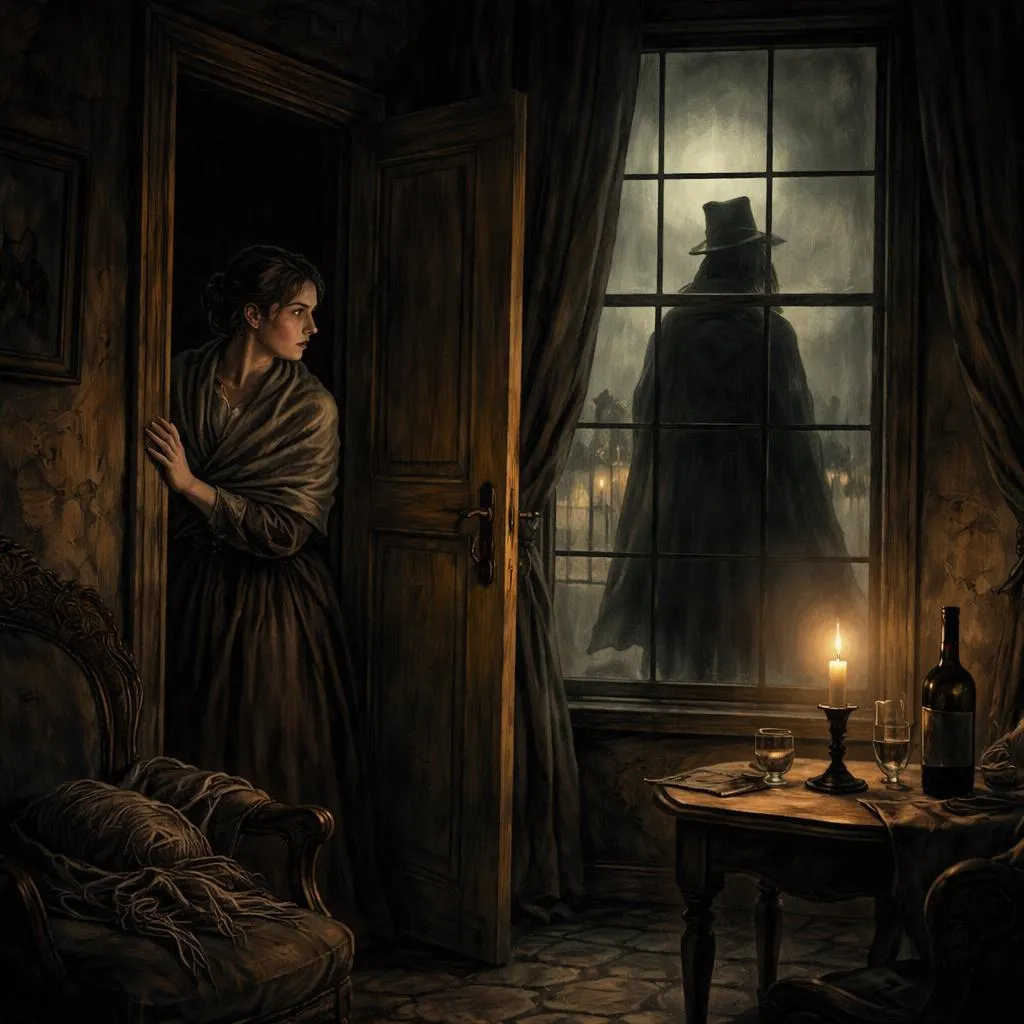
The shadow attendant on Madame Defarge and her party seemed to fall so threatening and dark on the child, that her mother instinctively kneeled on the ground beside her, and held her to her breast. The shadow attendant on Madame Defarge and her party seemed then to fall, threatening and dark, on both the mother and the child.
“It is enough, my husband,” said Madame Defarge. “I have seen them. We may go.”
But, the suppressed manner had enough of menace in it—not visible and presented, but indistinct and withheld—to alarm Lucie into saying, as she laid her appealing hand on Madame Defarge’s dress:
“You will be good to my poor husband. You will do him no harm. You will help me to see him if you can?”
“Your husband is not my business here,” returned Madame Defarge, looking down at her with perfect composure. “It is the daughter of your father who is my business here.”
“For my sake, then, be merciful to my husband. For my child’s sake! She will put her hands together and pray you to be merciful. We are more afraid of you than of these others.”
Madame Defarge received it as a compliment, and looked at her husband. Defarge, who had been uneasily biting his thumb-nail and looking at her, collected his face into a sterner expression.
“What is it that your husband says in that little letter?” asked Madame Defarge, with a lowering smile. “Influence; he says something touching influence?”
“That my father,” said Lucie, hurriedly taking the paper from her breast, but with her alarmed eyes on her questioner and not on it, “has much influence around him.”
“Surely it will release him!” said Madame Defarge. “Let it do so.”
“As a wife and mother,” cried Lucie, most earnestly, “I implore you to have pity on me and not to exercise any power that you possess, against my innocent husband, but to use it in his behalf. O sister-woman, think of me. As a wife and mother!”
Madame Defarge looked, coldly as ever, at the suppliant, and said, turning to her friend The Vengeance:
“The wives and mothers we have been used to see, since we were as little as this child, and much less, have not been greatly considered? We have known THEIR husbands and fathers laid in prison and kept from them, often enough? All our lives, we have seen our sister-women suffer, in themselves and in their children, poverty, nakedness, hunger, thirst, sickness, misery, oppression and neglect of all kinds?”
“We have seen nothing else,” returned The Vengeance.
“We have borne this a long time,” said Madame Defarge, turning her eyes again upon Lucie. “Judge you! Is it likely that the trouble of one wife and mother would be much to us now?”
She resumed her knitting and went out. The Vengeance followed. Defarge went last, and closed the door.
“Courage, my dear Lucie,” said Mr. Lorry, as he raised her. “Courage, courage! So far all goes well with us—much, much better than it has of late gone with many poor souls. Cheer up, and have a thankful heart.”
“I am not thankless, I hope, but that dreadful woman seems to throw a shadow on me and on all my hopes.”
“Tut, tut!” said Mr. Lorry; “what is this despondency in the brave little breast? A shadow indeed! No substance in it, Lucie.”
But the shadow of the manner of these Defarges was dark upon himself, for all that, and in his secret mind it troubled him greatly.
背景介紹與作者介紹
這段文字出自《雙城記》,這是一部由查爾斯·狄更斯所寫的歷史小說,他是19世紀最著名的英國小說家之一。這部小說於1859年出版,背景設定在法國大革命的動盪時期,主要講述了倫敦和巴黎人民的生活。狄更斯寫這部小說是為了探討犧牲、復活以及暴政與正義之間的鬥爭等主題。
查爾斯·狄更斯以其生動的人物和社會評論而聞名,他經常強調窮人和受壓迫者的艱辛。《雙城記》是他最受讚譽的作品之一,以其戲劇性的敘事和令人難忘的開場白而聞名:「那是最好的時代,那是壞的時代……」
詳細解讀與意義
這段摘錄揭示了人物在穿越革命時期的巴黎混亂時所面臨的緊張和危險。洛瑞先生是一位忠誠而謹慎的銀行家,他努力履行保護露西·馬內特和她的孩子的職責,同時維護銀行的利益。這個場景介紹了德伐日夫婦,他們是革命中的關鍵人物,他們冷酷而具有威脅性的舉止與露西的溫暖和脆弱形成了鮮明對比。
這個故事突出了忠誠、勇氣和政治動盪的殘酷現實等主題。露西為她的丈夫查爾斯·達奈請求憐憫和保護,突顯了衝突的人類代價。德伐日夫人的編織,是命運和即將到來的厄運的象徵,增加了令人不寒而慄的懸念。
給學生的教訓和見解
-
逆境中的勇氣: 露西在面對危險時的勇敢和希望,教會了我們即使在情況看似黯淡時也要保持堅強和富有同情心的重要性。
-
正義的複雜性: 德伐日夫婦代表了革命正義的殘酷性,提醒我們正義可能很複雜,有時是冷酷無情的。它鼓勵對公平和同情心的批判性思考。
-
忠誠與犧牲: 洛瑞先生對露西和她的家人的奉獻表明了忠誠和無私的價值,這些品質可以建立信任和牢固的關係。
-
理解歷史: 這個故事讓學生得以一窺法國大革命對普通人的影響,幫助學生欣賞歷史對人類生活和社會的影響。
將這些教訓應用於生活
-
在學校: 學生可以學會像露西一樣,以韌性面對挑戰。當感到不知所措時,記住她的勇氣可以激勵毅力。
-
在社交場合: 這個故事鼓勵對他人的掙扎感同身受。理解不同的觀點,例如德伐日夫婦和露西的觀點,有助於建立善良和寬容。
-
在個人成長中: 培養忠誠並為朋友和家人挺身而出,就像洛瑞先生一樣,可以增強性格和社區聯繫。
從故事中培養積極的價值觀
-
同情心: 試著從他人的角度看問題,即使他們看起來很嚴厲或不友好,以加深理解和同情。
-
勇敢: 通過為正義發聲並支持有需要的人來鍛鍊勇氣。
-
責任: 像洛瑞先生一樣,平衡個人感受與責任和承諾,學會做出深思熟慮的決定。
-
希望: 在困難時期保持希望,因為它能激勵毅力和積極的結果。
通過反思這些人物和他們的選擇,學生可以培養對文學及其與日常生活的相關性的更豐富的欣賞。《雙城記》不僅能娛樂,還能傳授關於人性、正義以及愛與犧牲的力量的永恆教訓。
