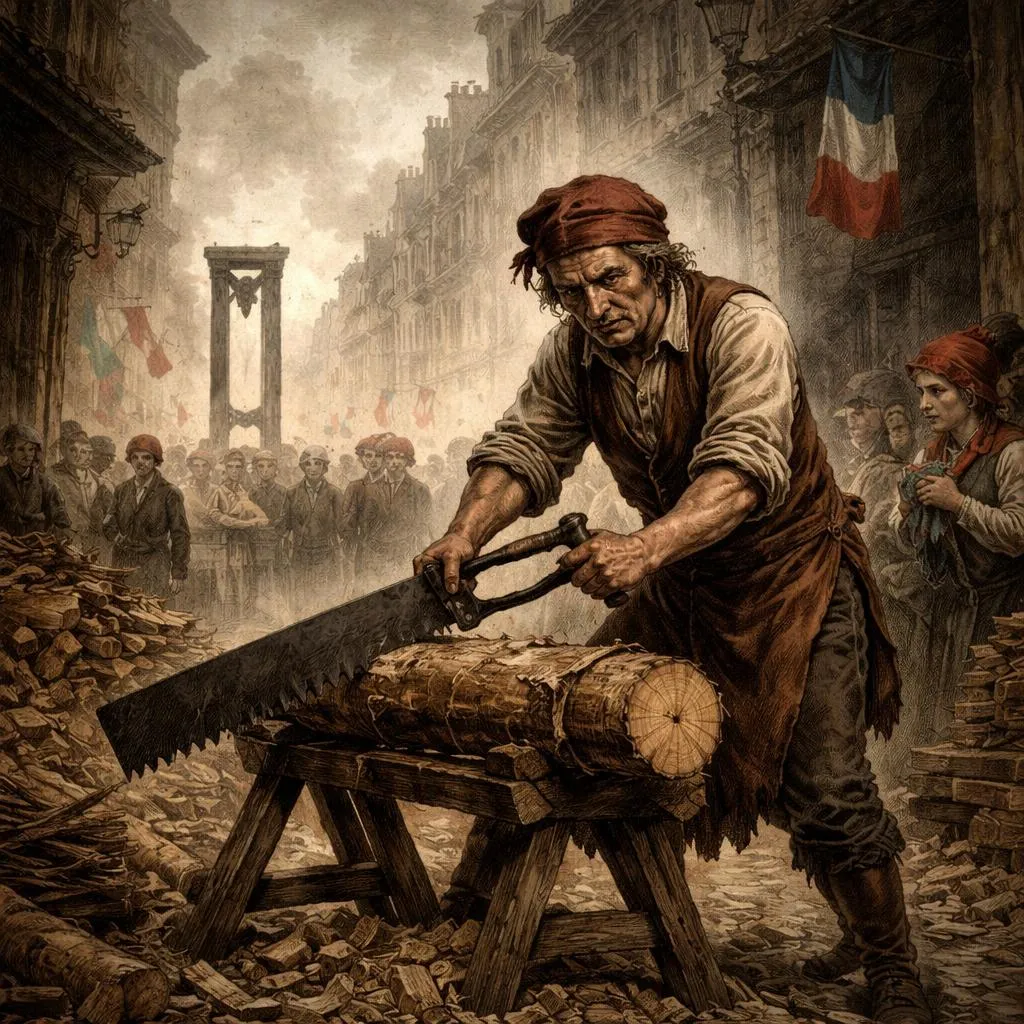

One year and three months. During all that time Lucie was never sure, from hour to hour, but that the Guillotine would strike off her husband’s head next day. Every day, through the stony streets, the tumbrils now jolted heavily, filled with Condemned. Lovely girls; bright women, brown-haired, black-haired, and grey; youths; stalwart men and old; gentle born and peasant born; all red wine for La Guillotine, all daily brought into light from the dark cellars of the loathsome prisons, and carried to her through the streets to slake her devouring thirst. Liberty, equality, fraternity, or death;—the last, much the easiest to bestow, O Guillotine!
If the suddenness of her calamity, and the whirling wheels of the time, had stunned the Doctor’s daughter into awaiting the result in idle despair, it would but have been with her as it was with many. But, from the hour when she had taken the white head to her fresh young bosom in the garret of Saint Antoine, she had been true to her duties. She was truest to them in the season of trial, as all the quietly loyal and good will always be.
As soon as they were established in their new residence, and her father had entered on the routine of his avocations, she arranged the little household as exactly as if her husband had been there. Everything had its appointed place and its appointed time. Little Lucie she taught, as regularly, as if they had all been united in their English home. The slight devices with which she cheated herself into the show of a belief that they would soon be reunited— the little preparations for his speedy return, the setting aside of his chair and his books—these, and the solemn prayer at night for one dear prisoner especially, among the many unhappy souls in prison and the shadow of death—were almost the only outspoken reliefs of her heavy mind.
She did not greatly alter in appearance. The plain dark dresses, akin to mourning dresses, which she and her child wore, were as neat and as well attended to as the brighter clothes of happy days. She lost her colour, and the old and intent expression was a constant, not an occasional, thing; otherwise, she remained very pretty and comely. Sometimes, at night on kissing her father, she would burst into the grief she had repressed all day, and would say that her sole reliance, under Heaven, was on him. He always resolutely answered: “Nothing can happen to him without my knowledge, and I know that I can save him, Lucie.”
They had not made the round of their changed life many weeks, when her father said to her, on coming home one evening:
“My dear, there is an upper window in the prison, to which Charles can sometimes gain access at three in the afternoon. When he can get to it—which depends on many uncertainties and incidents—he might see you in the street, he thinks, if you stood in a certain place that I can show you. But you will not be able to see him, my poor child, and even if you could, it would be unsafe for you to make a sign of recognition.”
“O show me the place, my father, and I will go there every day.”
From that time, in all weathers, she waited there two hours. As the clock struck two, she was there, and at four she turned resignedly away. When it was not too wet or inclement for her child to be with her, they went together; at other times she was alone; but, she never missed a single day.
It was the dark and dirty corner of a small winding street. The hovel of a cutter of wood into lengths for burning, was the only house at that end; all else was wall. On the third day of her being there, he noticed her.
“Good day, citizeness.”
“Good day, citizen.”
This mode of address was now prescribed by decree. It had been established voluntarily some time ago, among the more thorough patriots; but, was now law for everybody.
“Walking here again, citizeness?”
“You see me, citizen!”
The wood-sawyer, who was a little man with a redundancy of gesture (he had once been a mender of roads), cast a glance at the prison, pointed at the prison, and putting his ten fingers before his face to represent bars, peeped through them jocosely.
“But it’s not my business,” said he. And went on sawing his wood.
Next day he was looking out for her, and accosted her the moment she appeared.
“What? Walking here again, citizeness?”
“Yes, citizen.”
“Ah! A child too! Your mother, is it not, my little citizeness?”
“Do I say yes, mamma?” whispered little Lucie, drawing close to her.
“Yes, dearest.”
“Yes, citizen.”
“Ah! But it’s not my business. My work is my business. See my saw! I call it my Little Guillotine. La, la, la; La, la, la! And off his head comes!”
The billet fell as he spoke, and he threw it into a basket.
“I call myself the Samson of the firewood guillotine. See here again! Loo, loo, loo; Loo, loo, loo! And off HER head comes! Now, a child. Tickle, tickle; Pickle, pickle! And off ITS head comes. All the family!”
Lucie shuddered as he threw two more billets into his basket, but it was impossible to be there while the wood-sawyer was at work, and not be in his sight. Thenceforth, to secure his good will, she always spoke to him first, and often gave him drink-money, which he readily received.
He was an inquisitive fellow, and sometimes when she had quite forgotten him in gazing at the prison roof and grates, and in lifting her heart up to her husband, she would come to herself to find him looking at her, with his knee on his bench and his saw stopped in its work. “But it’s not my business!” he would generally say at those times, and would briskly fall to his sawing again.
In all weathers, in the snow and frost of winter, in the bitter winds of spring, in the hot sunshine of summer, in the rains of autumn, and again in the snow and frost of winter, Lucie passed two hours of every day at this place; and every day on leaving it, she kissed the prison wall. Her husband saw her (so she learned from her father) it might be once in five or six times: it might be twice or thrice running: it might be, not for a week or a fortnight together. It was enough that he could and did see her when the chances served, and on that possibility she would have waited out the day, seven days a week.
These occupations brought her round to the December month, wherein her father walked among the terrors with a steady head. On a lightly-snowing afternoon she arrived at the usual corner. It was a day of some wild rejoicing, and a festival. She had seen the houses, as she came along, decorated with little pikes, and with little red caps stuck upon them; also, with tricoloured ribbons; also, with the standard inscription (tricoloured letters were the favourite), Republic One and Indivisible. Liberty, Equality, Fraternity, or Death!
The miserable shop of the wood-sawyer was so small, that its whole surface furnished very indifferent space for this legend. He had got somebody to scrawl it up for him, however, who had squeezed Death in with most inappropriate difficulty. On his house-top, he displayed pike and cap, as a good citizen must, and in a window he had stationed his saw inscribed as his “Little Sainte Guillotine”— for the great sharp female was by that time popularly canonised. His shop was shut and he was not there, which was a relief to Lucie, and left her quite alone.
But, he was not far off, for presently she heard a troubled movement and a shouting coming along, which filled her with fear. A moment afterwards, and a throng of people came pouring round the corner by the prison wall, in the midst of whom was the wood-sawyer hand in hand with The Vengeance. There could not be fewer than five hundred people, and they were dancing like five thousand demons. There was no other music than their own singing. They danced to the popular Revolution song, keeping a ferocious time that was like a gnashing of teeth in unison. Men and women danced together, women danced together, men danced together, as hazard had brought them together. At first, they were a mere storm of coarse red caps and coarse woollen rags; but, as they filled the place, and stopped to dance about Lucie, some ghastly apparition of a dance-figure gone raving mad arose among them. They advanced, retreated, struck at one another’s hands, clutched at one another’s heads, spun round alone, caught one another and spun round in pairs, until many of them dropped. While those were down, the rest linked hand in hand, and all spun round together: then the ring broke, and in separate rings of two and four they turned and turned until they all stopped at once, began again, struck, clutched, and tore, and then reversed the spin, and all spun round another way. Suddenly they stopped again, paused, struck out the time afresh, formed into lines the width of the public way, and, with their heads low down and their hands high up, swooped screaming off. No fight could have been half so terrible as this dance. It was so emphatically a fallen sport—a something, once innocent, delivered over to all devilry—a healthy pastime changed into a means of angering the blood, bewildering the senses, and steeling the heart. Such grace as was visible in it, made it the uglier, showing how warped and perverted all things good by nature were become. The maidenly bosom bared to this, the pretty almost-child’s head thus distracted, the delicate foot mincing in this slough of blood and dirt, were types of the disjointed time.
This was the Carmagnole. As it passed, leaving Lucie frightened and bewildered in the doorway of the wood-sawyer’s house, the feathery snow fell as quietly and lay as white and soft, as if it had never been.
“O my father!” for he stood before her when she lifted up the eyes she had momentarily darkened with her hand; “such a cruel, bad sight.”
“I know, my dear, I know. I have seen it many times. Don’t be frightened! Not one of them would harm you.”
“I am not frightened for myself, my father. But when I think of my husband, and the mercies of these people—”
“We will set him above their mercies very soon. I left him climbing to the window, and I came to tell you. There is no one here to see. You may kiss your hand towards that highest shelving roof.”
“I do so, father, and I send him my Soul with it!”
“You cannot see him, my poor dear?”
“No, father,” said Lucie, yearning and weeping as she kissed her hand, “no.”
A footstep in the snow. Madame Defarge. “I salute you, citizeness,” from the Doctor. “I salute you, citizen.” This in passing. Nothing more. Madame Defarge gone, like a shadow over the white road.
“Give me your arm, my love. Pass from here with an air of cheerfulness and courage, for his sake. That was well done;” they had left the spot; “it shall not be in vain. Charles is summoned for to-morrow.”
“For to-morrow!”
“There is no time to lose. I am well prepared, but there are precautions to be taken, that could not be taken until he was actually summoned before the Tribunal. He has not received the notice yet, but I know that he will presently be summoned for to-morrow, and removed to the Conciergerie; I have timely information. You are not afraid?”
She could scarcely answer, “I trust in you.”
“Do so, implicitly. Your suspense is nearly ended, my darling; he shall be restored to you within a few hours; I have encompassed him with every protection. I must see Lorry.”
He stopped. There was a heavy lumbering of wheels within hearing. They both knew too well what it meant. One. Two. Three. Three tumbrils faring away with their dread loads over the hushing snow.
“I must see Lorry,” the Doctor repeated, turning her another way.
The staunch old gentleman was still in his trust; had never left it. He and his books were in frequent requisition as to property confiscated and made national. What he could save for the owners, he saved. No better man living to hold fast by what Tellson’s had in keeping, and to hold his peace.
A murky red and yellow sky, and a rising mist from the Seine, denoted the approach of darkness. It was almost dark when they arrived at the Bank. The stately residence of Monseigneur was altogether blighted and deserted. Above a heap of dust and ashes in the court, ran the letters: National Property. Republic One and Indivisible. Liberty, Equality, Fraternity, or Death!
Who could that be with Mr. Lorry—the owner of the riding-coat upon the chair—who must not be seen? From whom newly arrived, did he come out, agitated and surprised, to take his favourite in his arms? To whom did he appear to repeat her faltering words, when, raising his voice and turning his head towards the door of the room from which he had issued, he said: “Removed to the Conciergerie, and summoned for to-morrow?”
背景介紹與作者介紹
這段文字出自查爾斯·狄更斯所著的著名歷史小說《雙城記》,該書於1859年首次出版。狄更斯是維多利亞時代最偉大的英國小說家之一,以其生動的人物形象和社會批判而聞名。《雙城記》的故事背景設定在法國大革命的動盪時期,描繪了倫敦和巴黎這兩個城市的不同景象。故事探討了犧牲、正義、重生以及暴政與自由之間的鬥爭等主題。
詳細解讀與意義
這段摘錄主要講述了露西·馬內特的故事,她是一位忠誠的妻子,她的丈夫查爾斯·達爾內醫生在恐怖統治時期被監禁,並面臨被送上斷頭台的命運。這段文字生動地描繪了革命時期的巴黎所瀰漫的恐懼和絕望氣氛,每天都有無辜的人被判刑。露西堅定的愛和希望穿透黑暗,她維持著家庭,照顧著她的孩子,儘管威脅迫在眉睫。
鋸木人對他的“小斷頭台”的陰森玩笑,以及狂野、暴力的卡馬尼奧舞,象徵著吞噬社會的殘酷和瘋狂。斷頭台,作為死亡和正義的象徵,被擬人化為一種無情的力量,吞噬著生命。然而,露西的信仰和忠誠與混亂形成了對比,強調了人類的韌性和愛的偉大力量。
這部分也介紹了關鍵人物,如德伐夫人,她冷酷而復仇的形象與露西的溫暖和同情形成了鮮明對比。查爾斯被傳喚到法庭,緊張氣氛不斷加劇,突顯了革命時期生命的岌岌可危。
給學生的啟示和見解
-
希望與忠誠的力量: 露西對丈夫堅定不移的奉獻精神,教會了我們在困難時期保持希望和信念的重要性。即使情況看起來毫無希望,忠於我們所愛的人和價值觀也能提供力量。
-
理解歷史背景: 這個故事幫助學生了解法國大革命對普通人的影響,鼓勵同情心,並加深對歷史複雜性的理解。
-
仇恨和復仇的後果: 暴力場面和像德伐夫人這樣的角色警告人們不要受到仇恨和復仇的危害,因為它們會吞噬社會和個人。
-
逆境中的韌性: 露西在動盪中維持家庭和照顧孩子的能力,展現了韌性——這是學生在生活中面臨挑戰時的一種寶貴品質。
將這些教訓應用於日常生活
- 在學校: 學生可以學會在困難時期支持他們的同伴和家人,即使在情況艱難時,也要表現出忠誠和友善。
- 在社交場合: 理解憤怒和復仇的影響可以幫助學生和平地解決衝突,避免有害行為。
- 在個人成長中: 培養韌性,就像露西一樣,使學生能夠勇敢而堅韌地面對挫折。
從故事中培養積極的價值觀
- 同情心: 通過想像露西的痛苦和希望,學生可以培養對他人掙扎的同情心。
- 勇氣: 露西在危險面前的勇敢鼓勵學生在自己的生活中勇敢。
- 同情心: 她對家人的關懷和對囚犯的祈禱激發了同情心和善良。
- 對正義和善良的信念: 儘管她身邊一片黑暗,露西仍然相信正義和善良,教導學生堅持積極的理想。
結論
《雙城記》中的這段文字為學生提供了豐富的素材,讓他們探索愛、犧牲和人在壓力下的精神等主題。它鼓勵人們反思歷史、道德和個人價值觀。通過研究露西的故事,年輕的讀者可以獲得見解,幫助他們以同情、勇氣和希望來應對自己的生活。
