
Marilla said nothing to Matthew about the affair that evening; but when Anne proved still refractory the next morning an explanation had to be made to account for her absence from the breakfast table. Marilla told Matthew the whole story, taking pains to impress him with a due sense of the enormity of Anne’s behavior.
“It’s a good thing Rachel Lynde got a calling down; she’s a meddlesome old gossip,” was Matthew’s consolatory rejoinder.
“Matthew Cuthbert, I’m astonished at you. You know that Anne’s behavior was dreadful, and yet you take her part! I suppose you’ll be saying next thing that she oughtn’t to be punished at all!”
“Well now—no—not exactly,” said Matthew uneasily. “I reckon she ought to be punished a little. But don’t be too hard on her, Marilla. Recollect she hasn’t ever had anyone to teach her right. You’re—you’re going to give her something to eat, aren’t you?”
“When did you ever hear of me starving people into good behavior?” demanded Marilla indignantly. “She’ll have her meals regular, and I’ll carry them up to her myself. But she’ll stay up there until she’s willing to apologize to Mrs. Lynde, and that’s final, Matthew.”
Breakfast, dinner, and supper were very silent meals—for Anne still remained obdurate. After each meal Marilla carried a well-filled tray to the east gable and brought it down later on not noticeably depleted. Matthew eyed its last descent with a troubled eye. Had Anne eaten anything at all?
When Marilla went out that evening to bring the cows from the back pasture, Matthew, who had been hanging about the barns and watching, slipped into the house with the air of a burglar and crept upstairs. As a general thing Matthew gravitated between the kitchen and the little bedroom off the hall where he slept; once in a while he ventured uncomfortably into the parlor or sitting room when the minister came to tea. But he had never been upstairs in his own house since the spring he helped Marilla paper the spare bedroom, and that was four years ago.
He tiptoed along the hall and stood for several minutes outside the door of the east gable before he summoned courage to tap on it with his fingers and then open the door to peep in.
Anne was sitting on the yellow chair by the window gazing mournfully out into the garden. Very small and unhappy she looked, and Matthew’s heart smote him. He softly closed the door and tiptoed over to her.
“Anne,” he whispered, as if afraid of being overheard, “how are you making it, Anne?”
Anne smiled wanly.
“Pretty well. I imagine a good deal, and that helps to pass the time. Of course, it’s rather lonesome. But then, I may as well get used to that.”
Anne smiled again, bravely facing the long years of solitary imprisonment before her.
Matthew recollected that he must say what he had come to say without loss of time, lest Marilla return prematurely. “Well now, Anne, don’t you think you’d better do it and have it over with?” he whispered. “It’ll have to be done sooner or later, you know, for Marilla’s a dreadful deter-mined woman—dreadful determined, Anne. Do it right off, I say, and have it over.”
“Do you mean apologize to Mrs. Lynde?”
“Yes—apologize—that’s the very word,” said Matthew eagerly. “Just smooth it over so to speak. That’s what I was trying to get at.”
“I suppose I could do it to oblige you,” said Anne thoughtfully. “It would be true enough to say I am sorry, because I AM sorry now. I wasn’t a bit sorry last night. I was mad clear through, and I stayed mad all night. I know I did because I woke up three times and I was just furious every time. But this morning it was over. I wasn’t in a temper anymore—and it left a dreadful sort of goneness, too. I felt so ashamed of myself. But I just couldn’t think of going and telling Mrs. Lynde so. It would be so humiliating. I made up my mind I’d stay shut up here forever rather than do that. But still—I’d do anything for you—if you really want me to—”
“Well now, of course I do. It’s terrible lonesome downstairs without you. Just go and smooth things over—that’s a good girl.”
“Very well,” said Anne resignedly. “I’ll tell Marilla as soon as she comes in I’ve repented.”
“That’s right—that’s right, Anne. But don’t tell Marilla I said anything about it. She might think I was putting my oar in and I promised not to do that.”
“Wild horses won’t drag the secret from me,” promised Anne solemnly. “How would wild horses drag a secret from a person anyhow?”
But Matthew was gone, scared at his own success. He fled hastily to the remotest corner of the horse pasture lest Marilla should suspect what he had been up to. Marilla herself, upon her return to the house, was agreeably surprised to hear a plaintive voice calling, “Marilla” over the banisters.
“Well?” she said, going into the hall.
“I’m sorry I lost my temper and said rude things, and I’m willing to go and tell Mrs. Lynde so.”
“Very well.” Marilla’s crispness gave no sign of her relief. She had been wondering what under the canopy she should do if Anne did not give in. “I’ll take you down after milking.”
Accordingly, after milking, behold Marilla and Anne walking down the lane, the former erect and triumphant, the latter drooping and dejected. But halfway down Anne’s dejection vanished as if by enchantment. She lifted her head and stepped lightly along, her eyes fixed on the sunset sky and an air of subdued exhilaration about her. Marilla beheld the change disapprovingly. This was no meek penitent such as it behooved her to take into the presence of the offended Mrs. Lynde.
“What are you thinking of, Anne?” she asked sharply.
“I’m imagining out what I must say to Mrs. Lynde,” answered Anne dreamily.
This was satisfactory—or should have been so. But Marilla could not rid herself of the notion that something in her scheme of punishment was going askew. Anne had no business to look so rapt and radiant.
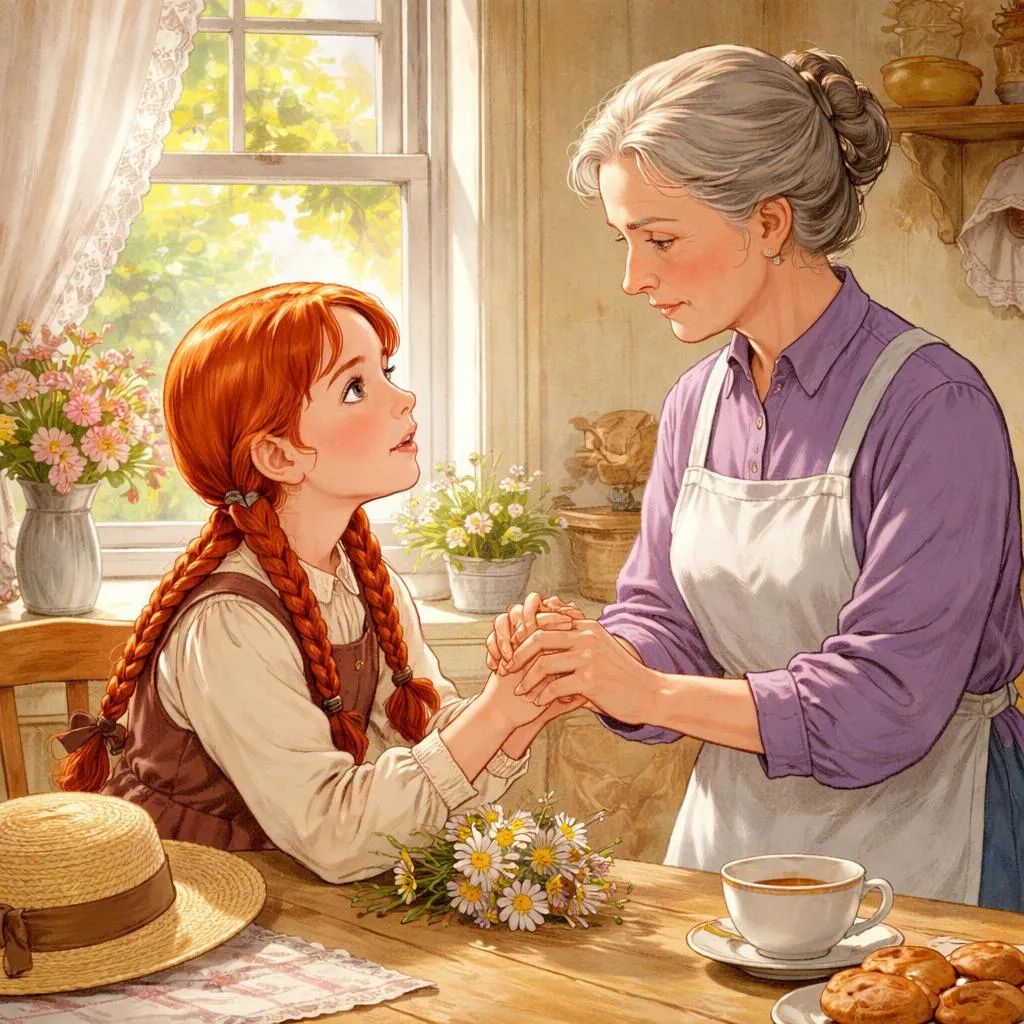
Rapt and radiant Anne continued until they were in the very presence of Mrs. Lynde, who was sitting knitting by her kitchen window. Then the radiance vanished. Mournful penitence appeared on every feature. Before a word was spoken Anne suddenly went down on her knees before the astonished Mrs. Rachel and held out her hands beseechingly.
“Oh, Mrs. Lynde, I am so extremely sorry,” she said with a quiver in her voice. “I could never express all my sorrow, no, not if I used up a whole dictionary. You must just imagine it. I behaved terribly to you—and I’ve disgraced the dear friends, Matthew and Marilla, who have let me stay at Green Gables although I’m not a boy. I’m a dreadfully wicked and ungrateful girl, and I deserve to be punished and cast out by respectable people forever. It was very wicked of me to fly into a temper because you told me the truth. It WAS the truth; every word you said was true. My hair is red and I’m freckled and skinny and ugly. What I said to you was true, too, but I shouldn’t have said it. Oh, Mrs. Lynde, please, please, forgive me. If you refuse it will be a lifelong sorrow on a poor little orphan girl, would you, even if she had a dreadful temper? Oh, I am sure you wouldn’t. Please say you forgive me, Mrs. Lynde.”
Anne clasped her hands together, bowed her head, and waited for the word of judgment.
There was no mistaking her sincerity—it breathed in every tone of her voice. Both Marilla and Mrs. Lynde recognized its unmistakable ring. But the former under-stood in dismay that Anne was actually enjoying her valley of humiliation—was reveling in the thoroughness of her abasement. Where was the wholesome punishment upon which she, Marilla, had plumed herself? Anne had turned it into a species of positive pleasure.
Good Mrs. Lynde, not being overburdened with perception, did not see this. She only perceived that Anne had made a very thorough apology and all resentment vanished from her kindly, if somewhat officious, heart.
“There, there, get up, child,” she said heartily. “Of course I forgive you. I guess I was a little too hard on you, anyway. But I’m such an outspoken person. You just mustn’t mind me, that’s what. It can’t be denied your hair is terrible red; but I knew a girl once—went to school with her, in fact—whose hair was every mite as red as yours when she was young, but when she grew up it darkened to a real handsome auburn. I wouldn’t be a mite surprised if yours did, too—not a mite.”
“Oh, Mrs. Lynde!” Anne drew a long breath as she rose to her feet. “You have given me a hope. I shall always feel that you are a benefactor. Oh, I could endure anything if I only thought my hair would be a handsome auburn when I grew up. It would be so much easier to be good if one’s hair was a handsome auburn, don’t you think? And now may I go out into your garden and sit on that bench under the apple-trees while you and Marilla are talking? There is so much more scope for imagination out there.”
“Laws, yes, run along, child. And you can pick a bouquet of them white June lilies over in the corner if you like.”
As the door closed behind Anne Mrs. Lynde got briskly up to light a lamp.
“She’s a real odd little thing. Take this chair, Marilla; it’s easier than the one you’ve got; I just keep that for the hired boy to sit on. Yes, she certainly is an odd child, but there is something kind of taking about her after all. I don’t feel so surprised at you and Matthew keeping her as I did—nor so sorry for you, either. She may turn out all right. Of course, she has a queer way of expressing herself—a little too—well, too kind of forcible, you know; but she’ll likely get over that now that she’s come to live among civilized folks. And then, her temper’s pretty quick, I guess; but there’s one comfort, a child that has a quick temper, just blaze up and cool down, ain’t never likely to be sly or deceitful. Preserve me from a sly child, that’s what. On the whole, Marilla, I kind of like her.”
When Marilla went home Anne came out of the fragrant twilight of the orchard with a sheaf of white narcissi in her hands.
“I apologized pretty well, didn’t I?” she said proudly as they went down the lane. “I thought since I had to do it I might as well do it thoroughly.”
“You did it thoroughly, all right enough,” was Marilla’s comment. Marilla was dismayed at finding herself inclined to laugh over the recollection. She had also an uneasy feeling that she ought to scold Anne for apologizing so well; but then, that was ridiculous! She compromised with her conscience by saying severely:
“I hope you won’t have occasion to make many more such apologies. I hope you’ll try to control your temper now, Anne.”
“That wouldn’t be so hard if people wouldn’t twit me about my looks,” said Anne with a sigh. “I don’t get cross about other things; but I’m SO tired of being twitted about my hair and it just makes me boil right over. Do you suppose my hair will really be a handsome auburn when I grow up?”
“You shouldn’t think so much about your looks, Anne. I’m afraid you are a very vain little girl.”
“How can I be vain when I know I’m homely?” protested Anne. “I love pretty things; and I hate to look in the glass and see something that isn’t pretty. It makes me feel so sorrowful—just as I feel when I look at any ugly thing. I pity it because it isn’t beautiful.”
“Handsome is as handsome does,” quoted Marilla. “I’ve had that said to me before, but I have my doubts about it,” remarked skeptical Anne, sniffing at her narcissi. “Oh, aren’t these flowers sweet! It was lovely of Mrs. Lynde to give them to me. I have no hard feelings against Mrs. Lynde now. It gives you a lovely, comfortable feeling to apologize and be forgiven, doesn’t it? Aren’t the stars bright tonight? If you could live in a star, which one would you pick? I’d like that lovely clear big one away over there above that dark hill.”
“Anne, do hold your tongue.” said Marilla, thoroughly worn out trying to follow the gyrations of Anne’s thoughts.
Anne said no more until they turned into their own lane. A little gypsy wind came down it to meet them, laden with the spicy perfume of young dew-wet ferns. Far up in the shadows a cheerful light gleamed out through the trees from the kitchen at Green Gables. Anne suddenly came close to Marilla and slipped her hand into the older woman’s hard palm.
“It’s lovely to be going home and know it’s home,” she said. “I love Green Gables already, and I never loved any place before. No place ever seemed like home. Oh, Marilla, I’m so happy. I could pray right now and not find it a bit hard.”
Something warm and pleasant welled up in Marilla’s heart at touch of that thin little hand in her own—a throb of the maternity she had missed, perhaps. Its very unaccustomedness and sweetness disturbed her. She hastened to restore her sensations to their normal calm by inculcating a moral.
“If you’ll be a good girl you’ll always be happy, Anne. And you should never find it hard to say your prayers.”
“Saying one’s prayers isn’t exactly the same thing as praying,” said Anne meditatively. “But I’m going to imagine that I’m the wind that is blowing up there in those tree tops. When I get tired of the trees I’ll imagine I’m gently waving down here in the ferns—and then I’ll fly over to Mrs. Lynde’s garden and set the flowers dancing—and then I’ll go with one great swoop over the clover field—and then I’ll blow over the Lake of Shining Waters and ripple it all up into little sparkling waves. Oh, there’s so much scope for imagination in a wind! So I’ll not talk any more just now, Marilla.”
“Thanks be to goodness for that,” breathed Marilla in devout relief.
背景介紹與作者介紹
這段摘錄自《清秀佳人》,是加拿大作家露西·莫德·蒙哥馬利於 1908 年創作的經典小說。故事背景設定在加拿大愛德華王子島上的虛構村莊艾凡里。它講述了安妮·雪莉的冒險故事,安妮·雪莉是一位富有想像力和活力的孤兒,她被誤送到與瑪麗拉和馬修·卡斯伯特一起生活,這對兄妹原本打算收養一個男孩來幫助他們的農場。這部小說探討了歸屬感、身份認同、友誼和個人成長等主題。
露西·莫德·蒙哥馬利從她自己的童年經歷和愛德華王子島美麗的風景中汲取靈感。她生動的描述和真摯的人物塑造使《清秀佳人》深受世界各地人們的喜愛,激發了無數的改編,並持續引起所有年齡段讀者的共鳴。
故事的詳細分析和意義
這段情節突出了故事中的一個關鍵時刻,安妮面臨著她脾氣的後果,並學會了道歉和謙遜的重要性。安妮最初拒絕道歉,顯示了她的驕傲和固執,但通過馬修的溫柔鼓勵和她自己的反思,她開始理解改正錯誤的價值。與林德太太的和解以及安妮衷心的道歉,闡釋了寬恕、個人責任和善良的力量等主題。
安妮的想像力也很明顯,當她夢想成為風時,展示了她的創造力如何幫助她應對孤獨和逆境。故事強調,雖然安妮有缺點,但她善良的心和韌性使她成為一個值得支持的角色。
給學生和年輕讀者的教訓和見解
-
道歉和寬恕的力量: 安妮的旅程告訴我們,承認錯誤並真誠地道歉可以治癒人際關係並帶來和平。正如林德太太所展示的那樣,寬恕是一種慷慨的行為,對雙方都有好處。
-
理解和同情: 馬修對安妮的善良,儘管她有缺點,提醒我們要對他人保持耐心和理解,尤其是那些來自困難背景的人。
-
擁抱個性: 安妮獨特的個性和外貌最初是衝突的根源,但故事鼓勵讀者接受自己和他人。
-
想像力是一種力量: 安妮生動的想像力不僅僅是一種怪癖;它是韌性和快樂的重要工具。學生可以學會培養他們的創造力,以此來豐富他們的生活。
-
管理情緒: 安妮與她脾氣的鬥爭表明,情緒是自然的,但必須深思熟慮地管理。學習自我控制是一項重要的人生技能。
在日常生活中應用這些教訓
-
在學校: 學生可以練習承認錯誤並向同學或老師道歉,從而營造一個互相尊重和支持的環境。
-
在友誼中: 理解朋友的感受並原諒他們的錯誤可以加強聯繫並建立信任。
-
在家裡: 對家人表現出耐心和善良,尤其是在發生衝突時,有助於營造和諧的家庭。
-
個人成長: 擁抱自己獨特的品質並創造性地運用想像力可以增強自信心和解決問題的能力。
-
情緒健康: 認識到自己的感受並找到健康的方式來表達或平息它們,例如安妮富有想像力的白日夢,支持心理健康。
從故事中培養積極的特質
-
善良: 像馬修和林德太太一樣,即使在困難的時候表現出善良,也能對某人的生活產生很大的影響。
-
勇氣: 安妮願意面對自己的錯誤並道歉,這表明了學生可以效仿的勇敢。
-
韌性: 儘管遇到挫折,安妮仍然充滿希望和樂觀,教導了堅持不懈的價值。
-
謙遜: 學會承認錯誤並接受糾正,是成熟和智慧的標誌。
-
想像力: 鼓勵創造性思維可以開啟新的視角並激發喜悅。
結論
《清秀佳人》提供了豐富的教訓,這些教訓包裹在一個吸引年輕讀者和學生的迷人敘事中。通過安妮的經歷,讀者了解了人類情感的複雜性、寬恕的重要性以及想像力的美好。這些教訓是永恆而普遍的,不僅為個人發展提供了指導,也為建立積極的關係和充滿優雅和希望地應對生活的挑戰提供了指導。
