
“Well, how do you like them?” said Marilla.
Anne was standing in the gable room, looking solemnly at three new dresses spread out on the bed. One was of snuffy colored gingham which Marilla had been tempted to buy from a peddler the preceding summer because it looked so serviceable; one was of black-and-white checkered sateen which she had picked up at a bargain counter in the winter; and one was a stiff print of an ugly blue shade which she had purchased that week at a Carmody store.
She had made them up herself, and they were all made alike—plain skirts fulled tightly to plain waists, with sleeves as plain as waist and skirt and tight as sleeves could be.
“I’ll imagine that I like them,” said Anne soberly.
“I don’t want you to imagine it,” said Marilla, offended. “Oh, I can see you don’t like the dresses! What is the matter with them? Aren’t they neat and clean and new?”
“Yes.”
“Then why don’t you like them?”
“They’re—they’re not—pretty,” said Anne reluctantly.
“Pretty!” Marilla sniffed. “I didn’t trouble my head about getting pretty dresses for you. I don’t believe in pampering vanity, Anne, I’ll tell you that right off. Those dresses are good, sensible, serviceable dresses, without any frills or furbelows about them, and they’re all you’ll get this summer. The brown gingham and the blue print will do you for school when you begin to go. The sateen is for church and Sunday school. I’ll expect you to keep them neat and clean and not to tear them. I should think you’d be grateful to get most anything after those skimpy wincey things you’ve been wearing.”
“Oh, I AM grateful,” protested Anne. “But I’d be ever so much gratefuller if—if you’d made just one of them with puffed sleeves. Puffed sleeves are so fashionable now. It would give me such a thrill, Marilla, just to wear a dress with puffed sleeves.”
“Well, you’ll have to do without your thrill. I hadn’t any material to waste on puffed sleeves. I think they are ridiculous-looking things anyhow. I prefer the plain, sensible ones.”
“But I’d rather look ridiculous when everybody else does than plain and sensible all by myself,” persisted Anne mournfully.
“Trust you for that! Well, hang those dresses carefully up in your closet, and then sit down and learn the Sunday school lesson. I got a quarterly from Mr. Bell for you and you’ll go to Sunday school tomorrow,” said Marilla, disappearing downstairs in high dudgeon.
Anne clasped her hands and looked at the dresses.
“I did hope there would be a white one with puffed sleeves,” she whispered disconsolately. “I prayed for one, but I didn’t much expect it on that account. I didn’t suppose God would have time to bother about a little orphan girl’s dress. I knew I’d just have to depend on Marilla for it. Well, fortunately I can imagine that one of them is of snow-white muslin with lovely lace frills and three-puffed sleeves.”
The next morning warnings of a sick headache prevented Marilla from going to Sunday-school with Anne.
“You’ll have to go down and call for Mrs. Lynde, Anne.” she said. “She’ll see that you get into the right class. Now, mind you behave yourself properly. Stay to preaching afterwards and ask Mrs. Lynde to show you our pew. Here’s a cent for collection. Don’t stare at people and don’t fidget. I shall expect you to tell me the text when you come home.”
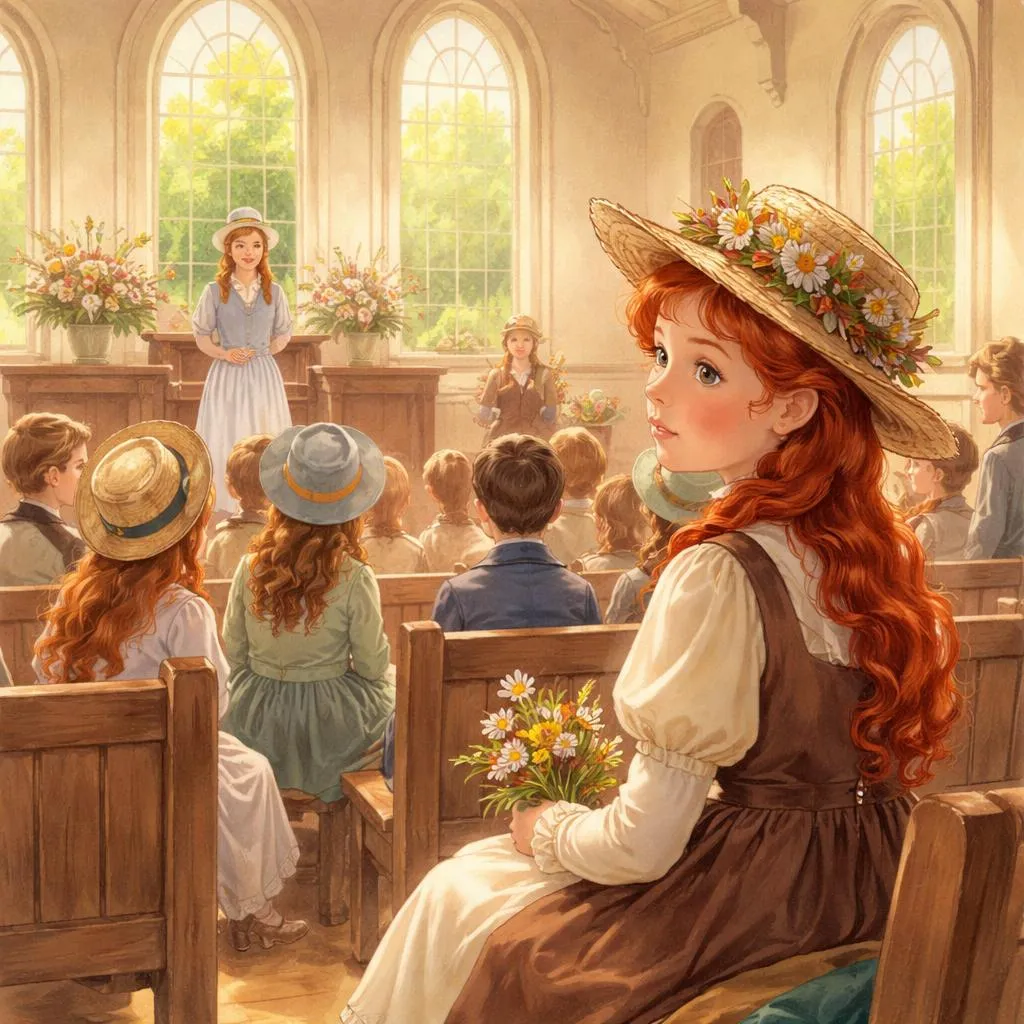
Anne started off irreproachable, arrayed in the stiff black-and-white sateen, which, while decent as regards length and certainly not open to the charge of skimpiness, contrived to emphasize every corner and angle of her thin figure. Her hat was a little, flat, glossy, new sailor, the extreme plainness of which had likewise much disappointed Anne, who had permitted herself secret visions of ribbon and flowers. The latter, however, were supplied before Anne reached the main road, for being confronted halfway down the lane with a golden frenzy of wind-stirred buttercups and a glory of wild roses, Anne promptly and liberally garlanded her hat with a heavy wreath of them. Whatever other people might have thought of the result it satisfied Anne, and she tripped gaily down the road, holding her ruddy head with its decoration of pink and yellow very proudly.
When she had reached Mrs. Lynde’s house she found that lady gone. Nothing daunted, Anne proceeded onward to the church alone. In the porch she found a crowd of little girls, all more or less gaily attired in whites and blues and pinks, and all staring with curious eyes at this stranger in their midst, with her extraordinary head adornment. Avonlea little girls had already heard queer stories about Anne. Mrs. Lynde said she had an awful temper; Jerry Buote, the hired boy at Green Gables, said she talked all the time to herself or to the trees and flowers like a crazy girl. They looked at her and whispered to each other behind their quarterlies. Nobody made any friendly advances, then or later on when the opening exercises were over and Anne found herself in Miss Rogerson’s class.
Miss Rogerson was a middle-aged lady who had taught a Sunday-school class for twenty years. Her method of teaching was to ask the printed questions from the quarterly and look sternly over its edge at the particular little girl she thought ought to answer the question. She looked very often at Anne, and Anne, thanks to Marilla’s drilling, answered promptly; but it may be questioned if she understood very much about either question or answer.
She did not think she liked Miss Rogerson, and she felt very miserable; every other little girl in the class had puffed sleeves. Anne felt that life was really not worth living without puffed sleeves.
“Well, how did you like Sunday school?” Marilla wanted to know when Anne came home. Her wreath having faded, Anne had discarded it in the lane, so Marilla was spared the knowledge of that for a time.
“I didn’t like it a bit. It was horrid.”
“Anne Shirley!” said Marilla rebukingly.
Anne sat down on the rocker with a long sigh, kissed one of Bonny’s leaves, and waved her hand to a blossoming fuchsia.
“They might have been lonesome while I was away,” she explained. “And now about the Sunday school. I behaved well, just as you told me. Mrs. Lynde was gone, but I went right on myself. I went into the church, with a lot of other little girls, and I sat in the corner of a pew by the window while the opening exercises went on. Mr. Bell made an awfully long prayer. I would have been dreadfully tired before he got through if I hadn’t been sitting by that window. But it looked right out on the Lake of Shining Waters, so I just gazed at that and imagined all sorts of splendid things.”
“You shouldn’t have done anything of the sort. You should have listened to Mr. Bell.”
“But he wasn’t talking to me,” protested Anne. “He was talking to God and he didn’t seem to be very much inter-ested in it, either. I think he thought God was too far off though. There was a long row of white birches hanging over the lake and the sunshine fell down through them, ‘way, ‘way down, deep into the water. Oh, Marilla, it was like a beautiful dream! It gave me a thrill and I just said, ‘Thank you for it, God,’ two or three times.”
“Not out loud, I hope,” said Marilla anxiously.
“Oh, no, just under my breath. Well, Mr. Bell did get through at last and they told me to go into the classroom with Miss Rogerson’s class. There were nine other girls in it. They all had puffed sleeves. I tried to imagine mine were puffed, too, but I couldn’t. Why couldn’t I? It was as easy as could be to imagine they were puffed when I was alone in the east gable, but it was awfully hard there among the others who had really truly puffs.”
“You shouldn’t have been thinking about your sleeves in Sunday school. You should have been attending to the lesson. I hope you knew it.”
“Oh, yes; and I answered a lot of questions. Miss Rogerson asked ever so many. I don’t think it was fair for her to do all the asking. There were lots I wanted to ask her, but I didn’t like to because I didn’t think she was a kindred spirit. Then all the other little girls recited a paraphrase. She asked me if I knew any. I told her I didn’t, but I could recite, ‘The Dog at His Master’s Grave’ if she liked. That’s in the Third Royal Reader. It isn’t a really truly religious piece of poetry, but it’s so sad and melancholy that it might as well be. She said it wouldn’t do and she told me to learn the nineteenth paraphrase for next Sunday. I read it over in church afterwards and it’s splendid. There are two lines in particular that just thrill me.
"'Quick as the slaughtered squadrons fell In Midian's evil day.'"
“I don’t know what ‘squadrons’ means nor ‘Midian,’ either, but it sounds SO tragical. I can hardly wait until next Sunday to recite it. I’ll practice it all the week. After Sunday school I asked Miss Rogerson—because Mrs. Lynde was too far away—to show me your pew. I sat just as still as I could and the text was Revelations, third chapter, second and third verses. It was a very long text. If I was a minister I’d pick the short, snappy ones. The sermon was awfully long, too. I suppose the minister had to match it to the text. I didn’t think he was a bit interesting. The trouble with him seems to be that he hasn’t enough imagination. I didn’t listen to him very much. I just let my thoughts run and I thought of the most surprising things.”
Marilla felt helplessly that all this should be sternly reproved, but she was hampered by the undeniable fact that some of the things Anne had said, especially about the minister’s sermons and Mr. Bell’s prayers, were what she herself had really thought deep down in her heart for years, but had never given expression to. It almost seemed to her that those secret, unuttered, critical thoughts had suddenly taken visible and accusing shape and form in the person of this outspoken morsel of neglected humanity.
背景介紹與作者介紹
這段摘錄自加拿大作家露西·莫德·蒙哥馬利於 1908 年所著的經典小說《綠山牆的安妮》。故事講述了安妮·雪莉,一個富有想像力和活力的孤兒女孩,她被誤送到馬里拉和馬修·卡斯伯特那裡,這對兄妹原本打算收養一個男孩來幫助他們在愛德華王子島艾凡里鎮的農場。這部小說以其對鄉村生活的生動描述、安妮豐富的內心世界,以及關於歸屬感、身份認同和個人成長的主題而聞名。
露西·莫德·蒙哥馬利本人於 1874 年出生於愛德華王子島。她在鄉村環境中長大的經歷深深地影響了她的寫作。她以溫暖和幽默的方式描寫了童年的喜悅和挑戰,以及大自然的美麗,贏得了世界各地讀者的心。
詳細解讀與意義
這段文字突出了安妮對美的渴望和在馬里拉所施加的平淡和實用主義之間的對比,馬里拉代表著一種更保守和務實的世界觀。安妮對泡泡袖——一種時尚且略帶輕浮的細節——的渴望,象徵著她對自我表達的渴望以及對生活中一絲魔力的嚮往。馬里拉的拒絕反映了當時的經濟現實和社會期望,強調責任、謙遜和實用性,而不是虛榮。
安妮的想像力在她將樸素的衣服轉變成美麗的服裝時閃耀,展現了她的韌性和創造力。她在主日學校的經歷進一步突顯了她作為局外人的地位——她與眾不同,被誤解,渴望融入,但她仍然忠於自己。她在佈道期間的反思揭示了一個思想深邃、敏感的心靈,即使在正式的宗教似乎沉悶或遙遠時,也能發現奇蹟。
這一幕也探討了孤獨、接納以及順從與個性的緊張關係。安妮生動的想像力和情感深度與她周圍僵化的社會規範形成對比,使她成為年輕希望和想像力力量的永恆象徵。
給學生的教訓和見解
-
擁抱你的個性: 安妮的故事鼓勵年輕讀者珍視他們獨特的品質和夢想,即使它們與他人的期望不符。忠於自己,並在想像力和創造力中找到快樂是很重要的。
-
逆境中的韌性: 儘管安妮經歷了失望和挑戰,但她仍然充滿希望和足智多謀。這教導學生在面對困難時堅持不懈和積極思考的價值。
-
欣賞簡樸和實用: 馬里拉的觀點提醒我們,生活常常需要實用性和責任感。平衡夢想與現實世界的需求是一項重要的生活技能。
-
同情心和理解: 這個故事邀請讀者超越外表和判斷。安妮的同學在她背後竊竊私語,但她的內心世界是豐富而複雜的。這鼓勵了對與眾不同的人的善良和開放的心態。
-
在日常生活中尋找美: 安妮在自然世界中,甚至在冗長的佈道中也能找到奇蹟,這表明了正念和欣賞微小美麗時刻的重要性。
在日常生活中的應用
-
在學校: 學生可以從安妮的好奇心和渴望回答問題中學習,即使她沒有完全理解。這表明了參與和學習的意願的重要性,這可以增強自信和知識。
-
在社交場合: 安妮感到自己像個局外人的經歷提醒學生要包容和歡迎新的或不同的同學。培養同情心和友誼可以創造一個支持性的環境。
-
在個人成長中: 像安妮一樣,學生可以通過閱讀、寫作或藝術來培養他們的想像力和創造力。這培養了情商和解決問題的能力。
-
在家庭生活中: 安妮和馬里拉之間的互動突出了溝通和妥協在關係中的重要性。理解不同的觀點可以幫助解決衝突。
從故事中培養積極的特質
-
想像力和創造力: 鼓勵學生不僅將他們的想像力用於娛樂,還用於解決問題和情感表達的工具。
-
感恩和知足: 安妮對她的衣服的感激之情,儘管它們很樸素,但教導了對自己所擁有的東西的欣賞。
-
勇氣和自信: 安妮願意做自己,即使其他人評判她,也激勵學生培養自信並堅持自己的價值觀。
-
尊重他人: 馬里拉對安妮的關懷,儘管嚴厲,但表現出一種愛和責任的形式。學生可以學會尊重權威,並感謝那些關心他們的人。
結論
《綠山牆的安妮》不僅僅是一個兒童故事;它對人類情感、社會價值觀和想像力的變革力量進行了豐富的探索。通過安妮的冒險和挑戰,學生可以學到關於身份、韌性、善良和生活簡單時刻之美的寶貴教訓。通過反思安妮的經歷,年輕讀者被鼓勵擁抱他們的獨特性,以希望面對生活的艱辛,並在他們自己的生活中培養同情心和創造力。
