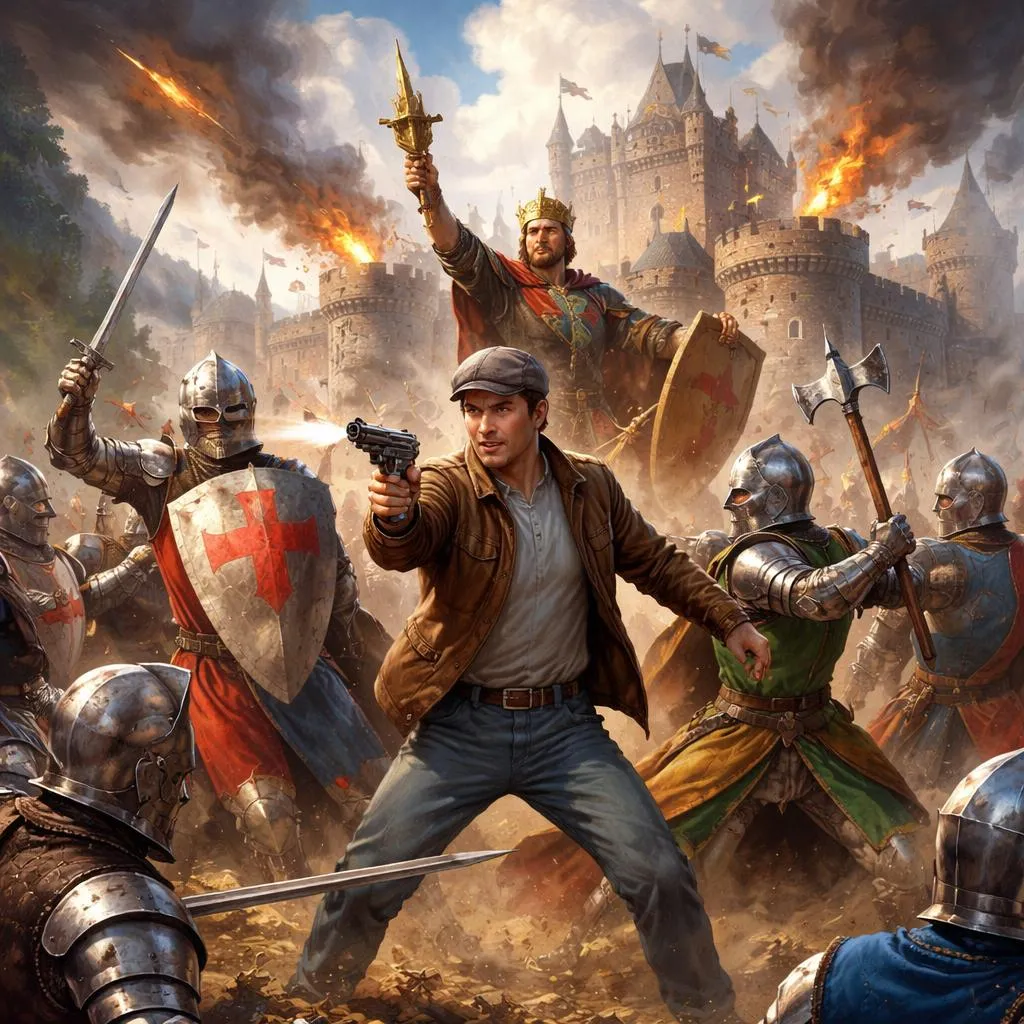

I paid three pennies for my breakfast, and a most extravagant price it was, too, seeing that one could have breakfasted a dozen persons for that money; but I was feeling good by this time, and I had always been a kind of spendthrift anyway; and then these people had wanted to give me the food for nothing, scant as their provision was, and so it was a grateful pleasure to emphasize my appreciation and sincere thankfulness with a good big financial lift where the money would do so much more good than it would in my helmet, where, these pennies being made of iron and not stinted in weight, my half-dollar’s worth was a good deal of a burden to me. I spent money rather too freely in those days, it is true; but one reason for it was that I hadn’t got the proportions of things entirely adjusted, even yet, after so long a sojourn in Britain—hadn’t got along to where I was able to absolutely realize that a penny in Arthur’s land and a couple of dollars in Connecticut were about one and the same thing: just twins, as you may say, in purchasing power. If my start from Camelot could have been delayed a very few days I could have paid these people in beautiful new coins from our own mint, and that would have pleased me; and them, too, not less. I had adopted the American values exclusively. In a week or two now, cents, nickels, dimes, quarters, and half-dollars, and also a trifle of gold, would be trickling in thin but steady streams all through the commercial veins of the kingdom, and I looked to see this new blood freshen up its life.
The farmers were bound to throw in something, to sort of offset my liberality, whether I would or no; so I let them give me a flint and steel; and as soon as they had comfortably bestowed Sandy and me on our horse, I lit my pipe. When the first blast of smoke shot out through the bars of my helmet, all those people broke for the woods, and Sandy went over backwards and struck the ground with a dull thud. They thought I was one of those fire-belching dragons they had heard so much about from knights and other professional liars. I had infinite trouble to persuade those people to venture back within explaining distance. Then I told them that this was only a bit of enchantment which would work harm to none but my enemies. And I promised, with my hand on my heart, that if all who felt no enmity toward me would come forward and pass before me they should see that only those who remained behind would be struck dead. The procession moved with a good deal of promptness. There were no casualties to report, for nobody had curiosity enough to remain behind to see what would happen.
I lost some time, now, for these big children, their fears gone, became so ravished with wonder over my awe-compelling fireworks that I had to stay there and smoke a couple of pipes out before they would let me go. Still the delay was not wholly unproductive, for it took all that time to get Sandy thoroughly wonted to the new thing, she being so close to it, you know. It plugged up her conversation mill, too, for a considerable while, and that was a gain. But above all other benefits accruing, I had learned something. I was ready for any giant or any ogre that might come along, now.
We tarried with a holy hermit, that night, and my opportunity came about the middle of the next afternoon. We were crossing a vast meadow by way of short-cut, and I was musing absently, hearing nothing, seeing nothing, when Sandy suddenly interrupted a remark which she had begun that morning, with the cry:
“Defend thee, lord!—peril of life is toward!”
And she slipped down from the horse and ran a little way and stood. I looked up and saw, far off in the shade of a tree, half a dozen armed knights and their squires; and straightway there was bustle among them and tightening of saddle-girths for the mount. My pipe was ready and would have been lit, if I had not been lost in thinking about how to banish oppression from this land and restore to all its people their stolen rights and manhood without disobliging anybody. I lit up at once, and by the time I had got a good head of reserved steam on, here they came. All together, too; none of those chivalrous magnanimities which one reads so much about —one courtly rascal at a time, and the rest standing by to see fair play. No, they came in a body, they came with a whirr and a rush, they came like a volley from a battery; came with heads low down, plumes streaming out behind, lances advanced at a level. It was a handsome sight, a beautiful sight—for a man up a tree. I laid my lance in rest and waited, with my heart beating, till the iron wave was just ready to break over me, then spouted a column of white smoke through the bars of my helmet. You should have seen the wave go to pieces and scatter! This was a finer sight than the other one.
But these people stopped, two or three hundred yards away, and this troubled me. My satisfaction collapsed, and fear came; I judged I was a lost man. But Sandy was radiant; and was going to be eloquent—but I stopped her, and told her my magic had miscarried, somehow or other, and she must mount, with all despatch, and we must ride for life. No, she wouldn’t. She said that my enchantment had disabled those knights; they were not riding on, because they couldn’t; wait, they would drop out of their saddles presently, and we would get their horses and harness. I could not deceive such trusting simplicity, so I said it was a mistake; that when my fireworks killed at all, they killed instantly; no, the men would not die, there was something wrong about my apparatus, I couldn’t tell what; but we must hurry and get away, for those people would attack us again, in a minute. Sandy laughed, and said:
“Lack-a-day, sir, they be not of that breed! Sir Launcelot will give battle to dragons, and will abide by them, and will assail them again, and yet again, and still again, until he do conquer and destroy them; and so likewise will Sir Pellinore and Sir Aglovale and Sir Carados, and mayhap others, but there be none else that will venture it, let the idle say what the idle will. And, la, as to yonder base rufflers, think ye they have not their fill, but yet desire more?”
“Well, then, what are they waiting for? Why don’t they leave? Nobody’s hindering. Good land, I’m willing to let bygones be bygones, I’m sure.”
“Leave, is it? Oh, give thyself easement as to that. They dream not of it, no, not they. They wait to yield them.”
“Come—really, is that ‘sooth’—as you people say? If they want to, why don’t they?”
“It would like them much; but an ye wot how dragons are esteemed, ye would not hold them blamable. They fear to come.”
“Well, then, suppose I go to them instead, and—”
“Ah, wit ye well they would not abide your coming. I will go.”
And she did. She was a handy person to have along on a raid. I would have considered this a doubtful errand, myself. I presently saw the knights riding away, and Sandy coming back. That was a relief. I judged she had somehow failed to get the first innings —I mean in the conversation; otherwise the interview wouldn’t have been so short. But it turned out that she had managed the business well; in fact, admirably. She said that when she told those people I was The Boss, it hit them where they lived: “smote them sore with fear and dread” was her word; and then they were ready to put up with anything she might require. So she swore them to appear at Arthur’s court within two days and yield them, with horse and harness, and be my knights henceforth, and subject to my command. How much better she managed that thing than I should have done it myself! She was a daisy.
背景介紹與作者導讀
這段摘錄出自一個故事,它融合了亞瑟王傳說的元素,並帶有獨特而富有想像力的轉折。敘述者發現自己身處中世紀,與騎士、農民和神話生物互動,同時將現代的視角和價值觀帶入這個古老的時代。這個故事讓人聯想到馬克·吐溫的《亞瑟王朝的康乃狄克州美國佬》,這是一部經典小說,探討了現代科技與中世紀迷信之間的衝突。
馬克·吐溫,他的真名是薩繆爾·朗赫恩·克萊門斯,是一位著名的美國作家,以其智慧、幽默和社會批判而聞名。在19世紀後期,吐溫經常使用諷刺手法來挑戰社會規範,並揭示人類的愚蠢。 《亞瑟王朝的康乃狄克州美國佬》是他最受讚譽的作品之一,它融合了幻想和諷刺,質疑了對騎士精神和君主制的浪漫化觀點。
詳細闡釋與意義
這段描述了敘述者在中世紀世界的經歷,他利用來自現代的知識和資源。他以高昂的價格購買早餐,象徵著他的世界與中世紀世界之間的文化和經濟差異。敘述者的慷慨與他周圍的匱乏形成了對比,他的互動揭示了對價值、貨幣和人類善良的幽默而深刻的評論。
與騎士們衝鋒並被敘述者的煙霧「煙火」擊退的情節,展示了知識和創造力勝過蠻力的力量。它也突出了不同文化和時代之間的誤解主題。敘述者的同伴桑迪扮演著重要的調解人和談判者的角色,展現了勇氣和外交手腕。
這個故事邀請讀者思考正義、權力和進步。它挑戰了以力服人的觀念,並暗示智慧、善良和公平是變革的更強大力量。它也探討了如何在不造成傷害或不尊重的情況下帶來積極的改變。
給學生的啟示與靈感
-
欣賞不同的文化和時代
這個故事鼓勵年輕讀者尊重和理解與他們自己不同的文化和歷史。它表明,善良和公平等價值觀是普世的,即使習俗和外表發生變化。 -
創造力和知識的力量
敘述者使用煙霧和巧妙的策略來保護自己,這教導學生創造性思考和運用知識解決問題的重要性,而不是訴諸暴力。 -
勇氣和領導力
桑迪的勇敢和外交技巧突出了堅持正義並以智慧和同情心領導的價值。學生可以學習領導力不僅僅是力量,還包括溝通和信任。 -
慷慨和感恩
儘管財富和貨幣存在差異,但敘述者表現出慷慨和感恩,提醒讀者善良和感激在任何情況下都很重要。
在日常生活中應用這些教訓
-
**在學校:**學生可以使用創造性思維來應對挑戰,無論是在解決問題還是小組專案中。他們還可以通過傾聽他人和鼓勵團隊合作來練習領導力。
-
**在社交場合:**理解和尊重不同的背景有助於建立友誼和和平的社區。表現出感恩和慷慨可以加強人際關係。
-
**在個人成長中:**勇敢地面對恐懼並堅持公平有助於建立品格。從歷史和故事中學習可以啟發更好的決策和同情心。
從故事中培養積極的價值觀
為了培養故事中展現的積極特質,學生可以:
- 每天練習善良,即使是很小的行為。
- 廣泛閱讀以了解不同的觀點和歷史。
- 面對問題時進行批判性和創造性思考。
- 與他人清晰、尊重地溝通。
- 反思自己的行為,並努力做到公平公正。
這個故事,它融合了幻想、幽默和道德教訓,為年輕讀者提供了豐富的體驗,在娛樂的同時也教導了重要的生活技能和價值觀。它提醒我們,勇氣、善良和智慧是永恆的品質,可以讓世界變得更美好。
