
Madame, seeing me pacific and unresentful, no doubt judged that I was deceived by her excuse; for her fright dissolved away, and she was soon so importunate to have me give an exhibition and kill somebody, that the thing grew to be embarrassing. However, to my relief she was presently interrupted by the call to prayers. I will say this much for the nobility: that, tyrannical, murderous, rapacious, and morally rotten as they were, they were deeply and enthusiastically religious. Nothing could divert them from the regular and faithful performance of the pieties enjoined by the Church. More than once I had seen a noble who had gotten his enemy at a disadvantage, stop to pray before cutting his throat; more than once I had seen a noble, after ambushing and despatching his enemy, retire to the nearest wayside shrine and humbly give thanks, without even waiting to rob the body. There was to be nothing finer or sweeter in the life of even Benvenuto Cellini, that rough-hewn saint, ten centuries later. All the nobles of Britain, with their families, attended divine service morning and night daily, in their private chapels, and even the worst of them had family worship five or six times a day besides. The credit of this belonged entirely to the Church. Although I was no friend to that Catholic Church, I was obliged to admit this. And often, in spite of me, I found myself saying, “What would this country be without the Church?”
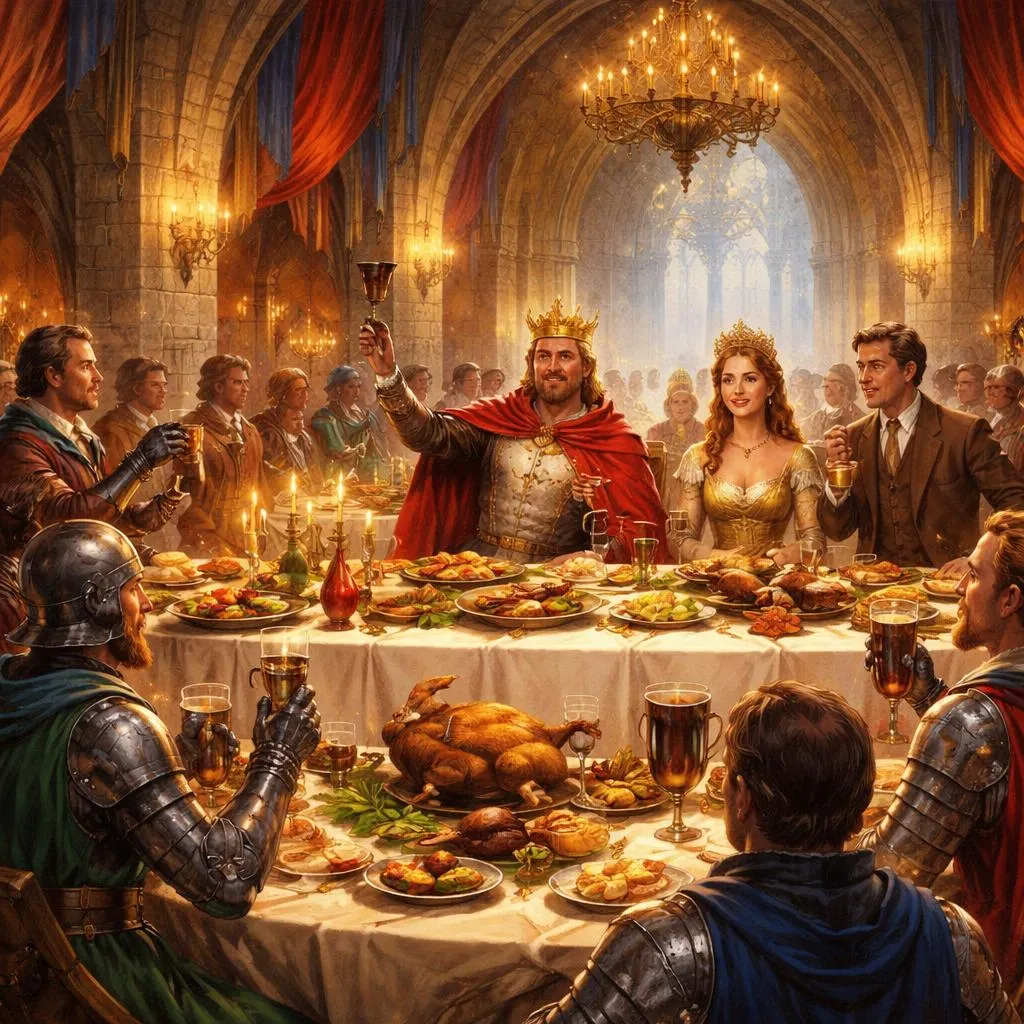
After prayers we had dinner in a great banqueting hall which was lighted by hundreds of grease-jets, and everything was as fine and lavish and rudely splendid as might become the royal degree of the hosts. At the head of the hall, on a dais, was the table of the king, queen, and their son, Prince Uwaine. Stretching down the hall from this, was the general table, on the floor. At this, above the salt, sat the visiting nobles and the grown members of their families, of both sexes,—the resident Court, in effect—sixty-one persons; below the salt sat minor officers of the household, with their principal subordinates: altogether a hundred and eighteen persons sitting, and about as many liveried servants standing behind their chairs, or serving in one capacity or another. It was a very fine show. In a gallery a band with cymbals, horns, harps, and other horrors, opened the proceedings with what seemed to be the crude first-draft or original agony of the wail known to later centuries as “In the Sweet Bye and Bye.” It was new, and ought to have been rehearsed a little more. For some reason or other the queen had the composer hanged, after dinner.
After this music, the priest who stood behind the royal table said a noble long grace in ostensible Latin. Then the battalion of waiters broke away from their posts, and darted, rushed, flew, fetched and carried, and the mighty feeding began; no words anywhere, but absorbing attention to business. The rows of chops opened and shut in vast unison, and the sound of it was like to the muffled burr of subterranean machinery.
The havoc continued an hour and a half, and unimaginable was the destruction of substantials. Of the chief feature of the feast —the huge wild boar that lay stretched out so portly and imposing at the start—nothing was left but the semblance of a hoop-skirt; and he was but the type and symbol of what had happened to all the other dishes.
With the pastries and so on, the heavy drinking began—and the talk. Gallon after gallon of wine and mead disappeared, and everybody got comfortable, then happy, then sparklingly joyous—both sexes, —and by and by pretty noisy. Men told anecdotes that were terrific to hear, but nobody blushed; and when the nub was sprung, the assemblage let go with a horse-laugh that shook the fortress. Ladies answered back with historiettes that would almost have made Queen Margaret of Navarre or even the great Elizabeth of England hide behind a handkerchief, but nobody hid here, but only laughed —howled, you may say. In pretty much all of these dreadful stories, ecclesiastics were the hardy heroes, but that didn’t worry the chaplain any, he had his laugh with the rest; more than that, upon invitation he roared out a song which was of as daring a sort as any that was sung that night.
By midnight everybody was fagged out, and sore with laughing; and, as a rule, drunk: some weepingly, some affectionately, some hilariously, some quarrelsomely, some dead and under the table. Of the ladies, the worst spectacle was a lovely young duchess, whose wedding-eve this was; and indeed she was a spectacle, sure enough. Just as she was she could have sat in advance for the portrait of the young daughter of the Regent d’Orleans, at the famous dinner whence she was carried, foul-mouthed, intoxicated, and helpless, to her bed, in the lost and lamented days of the Ancient Regime.
Suddenly, even while the priest was lifting his hands, and all conscious heads were bowed in reverent expectation of the coming blessing, there appeared under the arch of the far-off door at the bottom of the hall an old and bent and white-haired lady, leaning upon a crutch-stick; and she lifted the stick and pointed it toward the queen and cried out:
“The wrath and curse of God fall upon you, woman without pity, who have slain mine innocent grandchild and made desolate this old heart that had nor chick, nor friend nor stay nor comfort in all this world but him!”
Everybody crossed himself in a grisly fright, for a curse was an awful thing to those people; but the queen rose up majestic, with the death-light in her eye, and flung back this ruthless command:
“Lay hands on her! To the stake with her!”
The guards left their posts to obey. It was a shame; it was a cruel thing to see. What could be done? Sandy gave me a look; I knew she had another inspiration. I said:
“Do what you choose.”
She was up and facing toward the queen in a moment. She indicated me, and said:
“Madame, he saith this may not be. Recall the commandment, or he will dissolve the castle and it shall vanish away like the instable fabric of a dream!”
Confound it, what a crazy contract to pledge a person to! What if the queen—
But my consternation subsided there, and my panic passed off; for the queen, all in a collapse, made no show of resistance but gave a countermanding sign and sunk into her seat. When she reached it she was sober. So were many of the others. The assemblage rose, whiffed ceremony to the winds, and rushed for the door like a mob; overturning chairs, smashing crockery, tugging, struggling, shouldering, crowding—anything to get out before I should change my mind and puff the castle into the measureless dim vacancies of space. Well, well, well, they were a superstitious lot. It is all a body can do to conceive of it.
The poor queen was so scared and humbled that she was even afraid to hang the composer without first consulting me. I was very sorry for her—indeed, any one would have been, for she was really suffering; so I was willing to do anything that was reasonable, and had no desire to carry things to wanton extremities. I therefore considered the matter thoughtfully, and ended by having the musicians ordered into our presence to play that Sweet Bye and Bye again, which they did. Then I saw that she was right, and gave her permission to hang the whole band. This little relaxation of sternness had a good effect upon the queen. A statesman gains little by the arbitrary exercise of iron-clad authority upon all occasions that offer, for this wounds the just pride of his subordinates, and thus tends to undermine his strength. A little concession, now and then, where it can do no harm, is the wiser policy.
Now that the queen was at ease in her mind once more, and measurably happy, her wine naturally began to assert itself again, and it got a little the start of her. I mean it set her music going—her silver bell of a tongue. Dear me, she was a master talker. It would not become me to suggest that it was pretty late and that I was a tired man and very sleepy. I wished I had gone off to bed when I had the chance. Now I must stick it out; there was no other way. So she tinkled along and along, in the otherwise profound and ghostly hush of the sleeping castle, until by and by there came, as if from deep down under us, a far-away sound, as of a muffled shriek —with an expression of agony about it that made my flesh crawl. The queen stopped, and her eyes lighted with pleasure; she tilted her graceful head as a bird does when it listens. The sound bored its way up through the stillness again.
“What is it?” I said.
“It is truly a stubborn soul, and endureth long. It is many hours now.”
“Endureth what?”
“The rack. Come—ye shall see a blithe sight. An he yield not his secret now, ye shall see him torn asunder.”
What a silky smooth hellion she was; and so composed and serene, when the cords all down my legs were hurting in sympathy with that man’s pain. Conducted by mailed guards bearing flaring torches, we tramped along echoing corridors, and down stone stairways dank and dripping, and smelling of mould and ages of imprisoned night —a chill, uncanny journey and a long one, and not made the shorter or the cheerier by the sorceress’s talk, which was about this sufferer and his crime. He had been accused by an anonymous informer, of having killed a stag in the royal preserves. I said:
“Anonymous testimony isn’t just the right thing, your Highness. It were fairer to confront the accused with the accuser.”
“I had not thought of that, it being but of small consequence. But an I would, I could not, for that the accuser came masked by night, and told the forester, and straightway got him hence again, and so the forester knoweth him not.”
“Then is this the only person who saw the stag killed?”
“Marry, no man saw the killing, but this saw this hardy wretch near to the spot where the stag lay, and came with right loyal zeal and betrayed him to the forester.”
“So the was near the dead stag, too? Isn’t it just possible that he did the killing himself? His loyal zeal—in a mask—looks just a shade suspicious. But what is your highness’s idea for racking the prisoner? Where is the profit?”
“He will not confess, else; and then were his soul lost. For his crime his life is forfeited by the law—and of a surety will I see that he payeth it!—but it were peril to my own soul to let him die unconfessed and unabsolved. Nay, I were a fool to fling me into hell for his accommodation.”
“But, your Highness, suppose he has nothing to confess?”
“As to that, we shall see, anon. An I rack him to death and he confess not, it will peradventure show that he had indeed naught to confess—ye will grant that that is sooth? Then shall I not be damned for an unconfessed man that had naught to confess —wherefore, I shall be safe.”
It was the stubborn unreasoning of the time. It was useless to argue with her. Arguments have no chance against petrified training; they wear it as little as the waves wear a cliff. And her training was everybody’s. The brightest intellect in the land would not have been able to see that her position was defective.
As we entered the rack-cell I caught a picture that will not go from me; I wish it would. A native young giant of thirty or thereabouts lay stretched upon the frame on his back, with his wrists and ankles tied to ropes which led over windlasses at either end. There was no color in him; his features were contorted and set, and sweat-drops stood upon his forehead. A priest bent over him on each side; the executioner stood by; guards were on duty; smoking torches stood in sockets along the walls; in a corner crouched a poor young creature, her face drawn with anguish, a half-wild and hunted look in her eyes, and in her lap lay a little child asleep. Just as we stepped across the threshold the executioner gave his machine a slight turn, which wrung a cry from both the prisoner and the woman; but I shouted, and the executioner released the strain without waiting to see who spoke. I could not let this horror go on; it would have killed me to see it. I asked the queen to let me clear the place and speak to the prisoner privately; and when she was going to object I spoke in a low voice and said I did not want to make a scene before her servants, but I must have my way; for I was King Arthur’s representative, and was speaking in his name. She saw she had to yield. I asked her to indorse me to these people, and then leave me. It was not pleasant for her, but she took the pill; and even went further than I was meaning to require. I only wanted the backing of her own authority; but she said:
“Ye will do in all things as this lord shall command. It is The Boss.”
It was certainly a good word to conjure with: you could see it by the squirming of these rats. The queen’s guards fell into line, and she and they marched away, with their torch-bearers, and woke the echoes of the cavernous tunnels with the measured beat of their retreating footfalls. I had the prisoner taken from the rack and placed upon his bed, and medicaments applied to his hurts, and wine given him to drink. The woman crept near and looked on, eagerly, lovingly, but timorously,—like one who fears a repulse; indeed, she tried furtively to touch the man’s forehead, and jumped back, the picture of fright, when I turned unconsciously toward her. It was pitiful to see.
“Lord,” I said, “stroke him, lass, if you want to. Do anything you’re a mind to; don’t mind me.”
Why, her eyes were as grateful as an animal’s, when you do it a kindness that it understands. The baby was out of her way and she had her cheek against the man’s in a minute and her hands fondling his hair, and her happy tears running down. The man revived and caressed his wife with his eyes, which was all he could do. I judged I might clear the den, now, and I did; cleared it of all but the family and myself. Then I said:
“Now, my friend, tell me your side of this matter; I know the other side.”
The man moved his head in sign of refusal. But the woman looked pleased—as it seemed to me—pleased with my suggestion. I went on—
“You know of me?”
“Yes. All do, in Arthur’s realms.”
“If my reputation has come to you right and straight, you should not be afraid to speak.”
The woman broke in, eagerly:
“Ah, fair my lord, do thou persuade him! Thou canst an thou wilt. Ah, he suffereth so; and it is for me—for me ! And how can I bear it? I would I might see him die—a sweet, swift death; oh, my Hugo, I cannot bear this one!”
And she fell to sobbing and grovelling about my feet, and still imploring. Imploring what? The man’s death? I could not quite get the bearings of the thing. But Hugo interrupted her and said:
“Peace! Ye wit not what ye ask. Shall I starve whom I love, to win a gentle death? I wend thou knewest me better.”
“Well,” I said, “I can’t quite make this out. It is a puzzle. Now—”
“Ah, dear my lord, an ye will but persuade him! Consider how these his tortures wound me! Oh, and he will not speak!—whereas, the healing, the solace that lie in a blessed swift death—”
“What are you maundering about? He’s going out from here a free man and whole—he’s not going to die.”
The man’s white face lit up, and the woman flung herself at me in a most surprising explosion of joy, and cried out:
“He is saved!—for it is the king’s word by the mouth of the king’s servant—Arthur, the king whose word is gold!”
“Well, then you do believe I can be trusted, after all. Why didn’t you before?”
“Who doubted? Not I, indeed; and not she.”
“Well, why wouldn’t you tell me your story, then?”
“Ye had made no promise; else had it been otherwise.”
“I see, I see.... And yet I believe I don’t quite see, after all. You stood the torture and refused to confess; which shows plain enough to even the dullest understanding that you had nothing to confess—”
“I, my lord? How so? It was I that killed the deer!”
“You did ? Oh, dear, this is the most mixed-up business that ever—”
“Dear lord, I begged him on my knees to confess, but—”
“You did ! It gets thicker and thicker. What did you want him to do that for?”
“Sith it would bring him a quick death and save him all this cruel pain.”
“Well—yes, there is reason in that. But he didn’t want the quick death.”
“He? Why, of a surety he did .”
“Well, then, why in the world didn’t he confess?”
“Ah, sweet sir, and leave my wife and chick without bread and shelter?”
“Oh, heart of gold, now I see it! The bitter law takes the convicted man’s estate and beggars his widow and his orphans. They could torture you to death, but without conviction or confession they could not rob your wife and baby. You stood by them like a man; and you—true wife and the woman that you are—you would have bought him release from torture at cost to yourself of slow starvation and death—well, it humbles a body to think what your sex can do when it comes to self-sacrifice. I’ll book you both for my colony; you’ll like it there; it’s a Factory where I’m going to turn groping and grubbing automata into men .”
背景與作者介紹
這個故事是馬克·吐溫較少人知的作品中的一個生動片段,它融合了歷史小說和奇幻元素。 吐溫是美國最受讚譽的作家之一,以《湯姆·索亞歷險記》和《哈克貝利·費恩歷險記》等經典作品聞名。 他的作品經常將尖銳的社會批判與幽默和深刻的人性洞察力結合起來。 這個特別的故事反映了吐溫對中世紀的迷戀,以及人類道德、權威和正義的複雜本質。
詳細闡釋與意義
這段描述了一個充滿宏偉、迷信和殘酷的中世紀宴會場景。 貴族們儘管本性殘暴和腐敗,卻又非常虔誠,這顯示了那個時代的矛盾。 皇后的嚴厲和對囚犯的殘酷折磨揭示了當時正義和權力的黑暗面。 然而,代表更開明和仁慈的權威的敘述者的介入,引入了同情和理性戰勝殘酷和迷信的主題。
這個故事批判了權力的濫用以及盲目遵守傳統和法律而沒有正義的危險。 它也突出了人類的愛和犧牲的力量,正如囚犯拒絕虛假供認以保護家人的福祉所見。
給學生的教訓和見解
-
對權威的批判性思考: 故事鼓勵讀者質疑可能不公正或殘酷的權威和法律。 盲目服從可能導致痛苦,因此批判性思考並為公平而奮鬥非常重要。
-
同情心和同理心: 敘述者的仁慈和妻子的奉獻精神教導了善良和同情心的價值,即使在惡劣的環境下也是如此。 這些品質有助於建立更好的社區和關係。
-
犧牲的力量: 囚犯和他的妻子的行為表明愛往往涉及犧牲。 理解這一點可以幫助學生欣賞支持和保護親人的重要性。
-
宗教和文化矛盾: 貴族們的虔誠與他們的暴力行為邀請人們反思人們如何持有相互矛盾的信仰和行為,促使學生考慮他們自己價值觀的完整性和一致性。
在生活、學習和社交場合中的應用
-
在學校: 學生可以學會質疑不公平的規則或做法,並尊重地倡導正義。 他們還可以通過理解同學的感受和挑戰來練習同理心。
-
在社交生活中: 故事鼓勵為朋友和家人挺身而出,即使在困難的時候也要表現出忠誠和支持。
-
個人成長: 培養同情心和批判性思維有助於學生成為有思想、負責任的成年人,他們可以應對複雜的道德情境。
從故事中培養積極的特質
-
勇氣: 就像挑戰女王命令的敘述者一樣,學生可以學會在捍衛正義時勇敢。
-
仁慈: 對他人表現出善良,尤其是那些受苦的人,是這個故事的一個強有力的教訓。
-
正直: 即使在壓力下,也要誠實並堅持自己的信念和行動,這一點至關重要。
-
愛與忠誠: 妻子的奉獻精神體現了在關愛關係中發現的力量。
通過反思這些主題,學生可以豐富他們對歷史、人性、倫理的理解,並將這些教訓應用於成為更好的學習者和公民。
