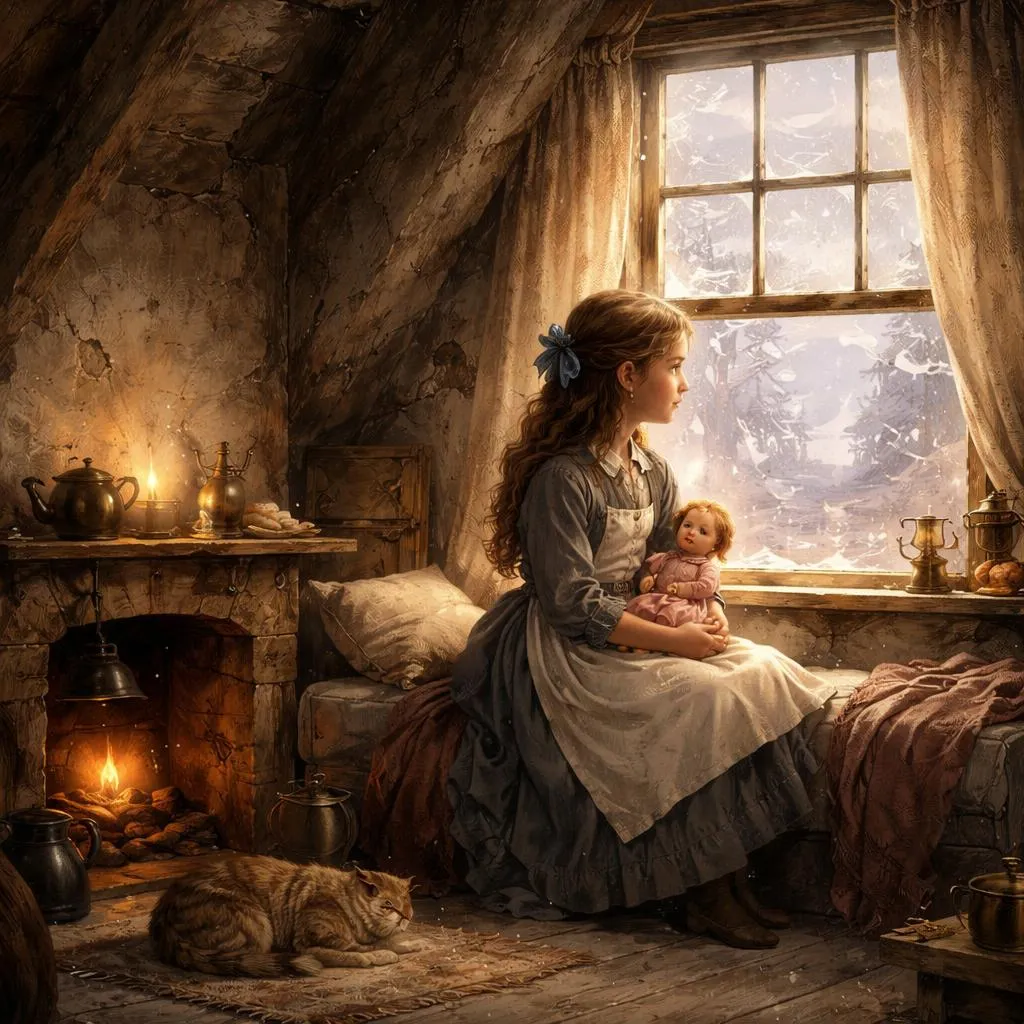

Never had such joy reigned in the nursery of the Large Family. Never had they dreamed of such delights as resulted from an intimate acquaintance with the little-girl-who-was-not-a-beggar. The mere fact of her sufferings and adventures made her a priceless possession. Everybody wanted to be told over and over again the things which had happened to her. When one was sitting by a warm fire in a big, glowing room, it was quite delightful to hear how cold it could be in an attic. It must be admitted that the attic was rather delighted in, and that its coldness and bareness quite sank into insignificance when Melchisedec was remembered, and one heard about the sparrows and things one could see if one climbed on the table and stuck one’s head and shoulders out of the skylight.
Of course the thing loved best was the story of the banquet and the dream which was true. Sara told it for the first time the day after she had been found. Several members of the Large Family came to take tea with her, and as they sat or curled up on the hearth-rug she told the story in her own way, and the Indian gentleman listened and watched her. When she had finished she looked up at him and put her hand on his knee.
“That is my part,” she said. “Now won’t you tell your part of it, Uncle Tom?” He had asked her to call him always “Uncle Tom.” “I don’t know your part yet, and it must be beautiful.”
So he told them how, when he sat alone, ill and dull and irritable, Ram Dass had tried to distract him by describing the passers by, and there was one child who passed oftener than any one else; he had begun to be interested in her—partly perhaps because he was thinking a great deal of a little girl, and partly because Ram Dass had been able to relate the incident of his visit to the attic in chase of the monkey. He had described its cheerless look, and the bearing of the child, who seemed as if she was not of the class of those who were treated as drudges and servants. Bit by bit, Ram Dass had made discoveries concerning the wretchedness of her life. He had found out how easy a matter it was to climb across the few yards of roof to the skylight, and this fact had been the beginning of all that followed.
“Sahib,” he had said one day, “I could cross the slates and make the child a fire when she is out on some errand. When she returned, wet and cold, to find it blazing, she would think a magician had done it.”
The idea had been so fanciful that Mr. Carrisford’s sad face had lighted with a smile, and Ram Dass had been so filled with rapture that he had enlarged upon it and explained to his master how simple it would be to accomplish numbers of other things. He had shown a childlike pleasure and invention, and the preparations for the carrying out of the plan had filled many a day with interest which would otherwise have dragged wearily. On the night of the frustrated banquet Ram Dass had kept watch, all his packages being in readiness in the attic which was his own; and the person who was to help him had waited with him, as interested as himself in the odd adventure. Ram Dass had been lying flat upon the slates, looking in at the skylight, when the banquet had come to its disastrous conclusion; he had been sure of the profoundness of Sara’s wearied sleep; and then, with a dark lantern, he had crept into the room, while his companion remained outside and handed the things to him. When Sara had stirred ever so faintly, Ram Dass had closed the lantern-slide and lain flat upon the floor. These and many other exciting things the children found out by asking a thousand questions.
“I am so glad,” Sara said. “I am so glad it was you who were my friend!”
There never were such friends as these two became. Somehow, they seemed to suit each other in a wonderful way. The Indian gentleman had never had a companion he liked quite as much as he liked Sara. In a month’s time he was, as Mr. Carmichael had prophesied he would be, a new man. He was always amused and interested, and he began to find an actual pleasure in the possession of the wealth he had imagined that he loathed the burden of. There were so many charming things to plan for Sara. There was a little joke between them that he was a magician, and it was one of his pleasures to invent things to surprise her. She found beautiful new flowers growing in her room, whimsical little gifts tucked under pillows, and once, as they sat together in the evening, they heard the scratch of a heavy paw on the door, and when Sara went to find out what it was, there stood a great dog—a splendid Russian boarhound—with a grand silver and gold collar bearing an inscription. “I am Boris,” it read; “I serve the Princess Sara.”
There was nothing the Indian gentleman loved more than the recollection of the little princess in rags and tatters. The afternoons in which the Large Family, or Ermengarde and Lottie, gathered to rejoice together were very delightful. But the hours when Sara and the Indian gentleman sat alone and read or talked had a special charm of their own. During their passing many interesting things occurred.
One evening, Mr. Carrisford, looking up from his book, noticed that his companion had not stirred for some time, but sat gazing into the fire.
“What are you `supposing,’ Sara?” he asked.
Sara looked up, with a bright color on her cheek.
“I was supposing,” she said; “I was remembering that hungry day, and a child I saw.”
“But there were a great many hungry days,” said the Indian gentleman, with rather a sad tone in his voice. “Which hungry day was it?”
“I forgot you didn’t know,” said Sara. “It was the day the dream came true.”
Then she told him the story of the bun shop, and the fourpence she picked up out of the sloppy mud, and the child who was hungrier than herself. She told it quite simply, and in as few words as possible; but somehow the Indian gentleman found it necessary to shade his eyes with his hand and look down at the carpet.
“And I was supposing a kind of plan,” she said, when she had finished. “I was thinking I should like to do something.”
“What was it?” said Mr. Carrisford, in a low tone. “You may do anything you like to do, princess.”
“I was wondering,” rather hesitated Sara—”you know, you say I have so much money—I was wondering if I could go to see the bun- woman, and tell her that if, when hungry children—particularly on those dreadful days—come and sit on the steps, or look in at the window, she would just call them in and give them something to eat, she might send the bills to me. Could I do that?”
“You shall do it tomorrow morning,” said the Indian gentleman.
“Thank you,” said Sara. “You see, I know what it is to be hungry, and it is very hard when one cannot even pretend it away.”
“Yes, yes, my dear,” said the Indian gentleman. “Yes, yes, it must be. Try to forget it. Come and sit on this footstool near my knee, and only remember you are a princess.”
“Yes,” said Sara, smiling; “and I can give buns and bread to the populace.” And she went and sat on the stool, and the Indian gentleman (he used to like her to call him that, too, sometimes) drew her small dark head down on his knee and stroked her hair.
The next morning, Miss Minchin, in looking out of her window, saw the things she perhaps least enjoyed seeing. The Indian gentleman’s carriage, with its tall horses, drew up before the door of the next house, and its owner and a little figure, warm with soft, rich furs, descended the steps to get into it. The little figure was a familiar one, and reminded Miss Minchin of days in the past. It was followed by another as familiar—the sight of which she found very irritating. It was Becky, who, in the character of delighted attendant, always accompanied her young mistress to her carriage, carrying wraps and belongings. Already Becky had a pink, round face.
A little later the carriage drew up before the door of the baker’s shop, and its occupants got out, oddly enough, just as the bun-woman was putting a tray of smoking-hot buns into the window.
When Sara entered the shop the woman turned and looked at her, and, leaving the buns, came and stood behind the counter. For a moment she looked at Sara very hard indeed, and then her good- natured face lighted up.
“I’m sure that I remember you, miss,” she said. “And yet—”
“Yes,” said Sara; “once you gave me six buns for fourpence, and—”
“And you gave five of ‘em to a beggar child,” the woman broke in on her. “I’ve always remembered it. I couldn’t make it out at first.” She turned round to the Indian gentleman and spoke her next words to him. “I beg your pardon, sir, but there’s not many young people that notices a hungry face in that way; and I’ve thought of it many a time. Excuse the liberty, miss,”—to Sara— “but you look rosier and—well, better than you did that—that—”
“I am better, thank you,” said Sara. “And—I am much happier— and I have come to ask you to do something for me.”
“Me, miss!” exclaimed the bun-woman, smiling cheerfully. “Why, bless you! Yes, miss. What can I do?”
And then Sara, leaning on the counter, made her little proposal concerning the dreadful days and the hungry waifs and the buns.
The woman watched her, and listened with an astonished face.
“Why, bless me!” she said again when she had heard it all; “it’ll be a pleasure to me to do it. I am a working-woman myself and cannot afford to do much on my own account, and there’s sights of trouble on every side; but, if you’ll excuse me, I’m bound to say I’ve given away many a bit of bread since that wet afternoon, just along o’ thinking of you—an’ how wet an’ cold you was, an’ how hungry you looked; an’ yet you gave away your hot buns as if you was a princess.”
The Indian gentleman smiled involuntarily at this, and Sara smiled a little, too, remembering what she had said to herself when she put the buns down on the ravenous child’s ragged lap.
“She looked so hungry,” she said. “She was even hungrier than I was.”
“She was starving,” said the woman. “Many’s the time she’s told me of it since—how she sat there in the wet, and felt as if a wolf was a-tearing at her poor young insides.”
“Oh, have you seen her since then?” exclaimed Sara. “Do you know where she is?”
“Yes, I do,” answered the woman, smiling more good-naturedly than ever. “Why, she’s in that there back room, miss, an’ has been for a month; an’ a decent, well-meanin’ girl she’s goin’ to turn out, an’ such a help to me in the shop an’ in the kitchen as you’d scarce believe, knowin’ how she’s lived.”
She stepped to the door of the little back parlor and spoke; and the next minute a girl came out and followed her behind the counter. And actually it was the beggar-child, clean and neatly clothed, and looking as if she had not been hungry for a long time. She looked shy, but she had a nice face, now that she was no longer a savage, and the wild look had gone from her eyes. She knew Sara in an instant, and stood and looked at her as if she could never look enough.
“You see,” said the woman, “I told her to come when she was hungry, and when she’d come I’d give her odd jobs to do; an’ I found she was willing, and somehow I got to like her; and the end of it was, I’ve given her a place an’ a home, and she helps me, an’ behaves well, an’ is as thankful as a girl can be. Her name’s Anne. She has no other.”
The children stood and looked at each other for a few minutes; and then Sara took her hand out of her muff and held it out across the counter, and Anne took it, and they looked straight into each other’s eyes.
“I am so glad,” Sara said. “And I have just thought of something. Perhaps Mrs. Brown will let you be the one to give the buns and bread to the children. Perhaps you would like to do it because you know what it is to be hungry, too.”
“Yes, miss,” said the girl.
And, somehow, Sara felt as if she understood her, though she said so little, and only stood still and looked and looked after her as she went out of the shop with the Indian gentleman, and they got into the carriage and drove away.
背景介紹與作者介紹
這段文字出自《小公主》,這是法蘭西斯·霍奇森·伯內特於1905年創作的一部深受喜愛的兒童小說。伯內特是一位英裔美國作家,以其永恆的兒童文學作品而聞名,包括《秘密花園》和《小法蘭克羅伊》。《小公主》講述了莎拉·克魯的故事,一個年輕女孩面臨困境和失去,但在她的試煉中始終保持著善良、想像力和尊嚴。這部小說探討了韌性、慷慨和想像力的力量等主題。
詳細闡釋與意義
這段摘錄捕捉了莎拉的一個關鍵時刻,她曾經是一個貧窮且受到虐待的孩子,後來被一個關懷的家庭和一位富有同情心的紳士卡里斯福德先生所接納。這個故事突出了莎拉的生活從困境到舒適的轉變,但更重要的是,它展示了她如何對遭受苦難的人保持慷慨和同情心,例如麵包店裡飢餓的孩子。莎拉渴望幫助飢餓的孩子,反映了她對貧困和善良的深刻理解,這超越了她自己改變了的環境。
敘述也強調了友誼和支持的重要性。這位印度紳士最初是一個孤獨且不快樂的人,通過與莎拉的友誼找到了快樂和目標。這種相互的療癒和成長說明了善良如何改變雙方的生活。
給學生的教訓和見解
-
同情心和憐憫心: 莎拉的故事教導學生要意識到他人的掙扎,並以善良回應。即使一個人的情況有所改善,也要記住那些不幸的人並幫助他們,這是一個關於人性的有力教訓。
-
韌性和樂觀: 儘管莎拉面臨困境,但她從未失去希望或高尚的精神。學生可以學會勇敢地面對困難,並保持積極的態度。
-
想像力的力量: 莎拉即使在寒冷的閣樓裡也能想像魔法和美麗,這表明創造力如何在艱難時期帶來安慰和快樂。這鼓勵學生培養他們的想像力作為力量的源泉。
-
友誼和支持: 莎拉和印度紳士之間的紐帶教導了真誠友誼的價值,以及它如何激發個人成長和幸福。
在日常生活中應用這些教訓
-
在學校: 學生可以通過善待可能正在掙扎或感到被排斥的同學來練習同情心。他們也可以在面對學業挑戰時保持樂觀,就像莎拉保持希望一樣。
-
在社交場合: 像莎拉一樣,學生可以超越外表和社會地位去理解和幫助他人。小的善行,例如分享或傾聽,可以產生很大的不同。
-
在個人成長中: 鼓勵創造力和想像力可以幫助學生培養解決問題的技能和情感韌性。閱讀和講故事可以成為這種成長的工具。
從故事中培養積極的價值觀
-
慷慨: 莎拉願意與一個更飢餓的孩子分享她的麵包,這教導了慷慨的重要性。學生可以學會與有需要的人分享他們的時間、資源或才能。
-
感恩: 像莎拉成為公主時那樣欣賞自己所擁有的,有助於培養滿足感和謙遜。
-
勇氣: 像莎拉那樣有尊嚴地面對逆境,激勵學生在自己的生活中勇敢。
結論
《小公主》不僅僅是一個女孩從貧困中崛起的故事;它是一個關於善良、韌性以及愛和友誼的變革力量的永恆教訓。參與這個故事的學生可以培養同情心、樂觀精神和慷慨的精神——這些品質將使他們在學校、友誼和更廣闊的世界中受益。通過莎拉的榜樣,年輕的讀者了解到真正的貴族來自內心,而不是財富或地位,並且每個人都有能力讓世界變得更美好。
