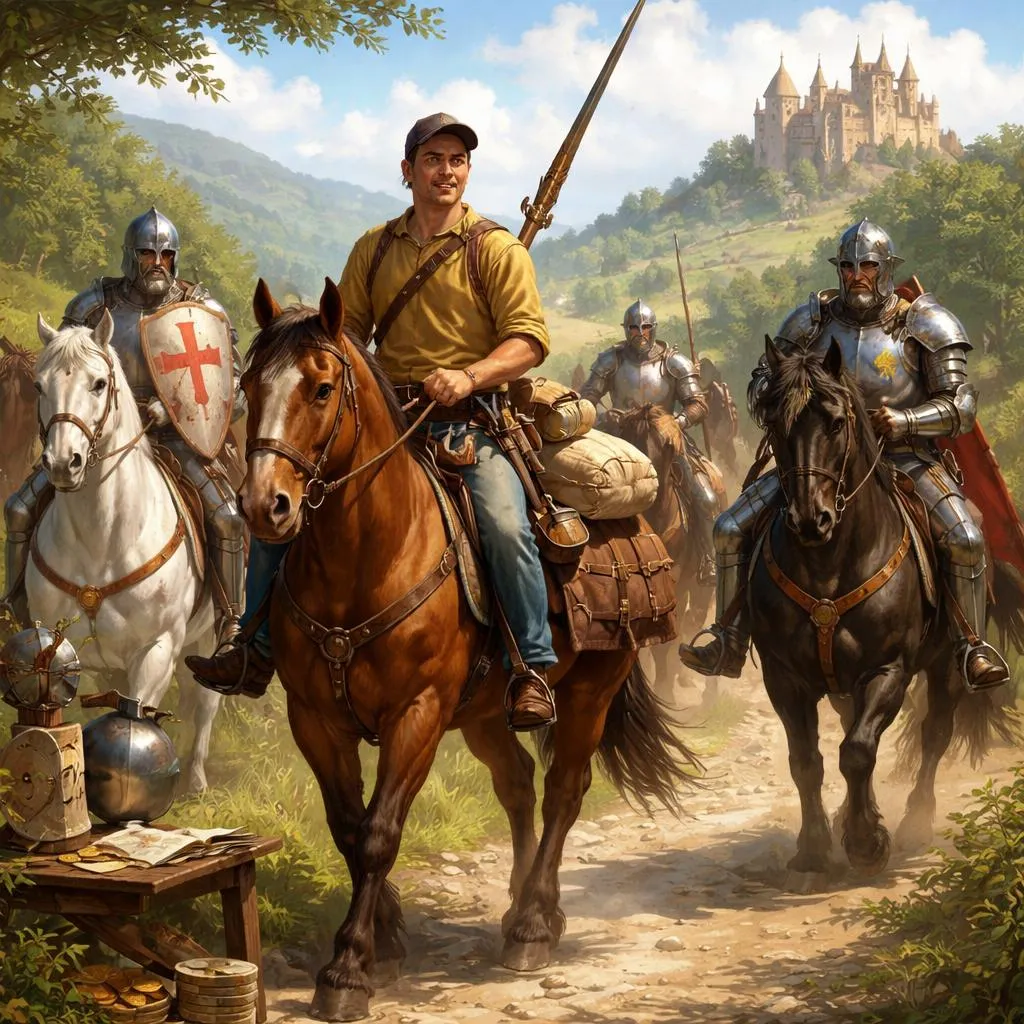

Sandy and I were on the road again, next morning, bright and early. It was so good to open up one’s lungs and take in whole luscious barrels-ful of the blessed God’s untainted, dew-fashioned, woodland-scented air once more, after suffocating body and mind for two days and nights in the moral and physical stenches of that intolerable old buzzard-roost! I mean, for me: of course the place was all right and agreeable enough for Sandy, for she had been used to high life all her days.
Poor girl, her jaws had had a wearisome rest now for a while, and I was expecting to get the consequences. I was right; but she had stood by me most helpfully in the castle, and had mightily supported and reinforced me with gigantic foolishnesses which were worth more for the occasion than wisdoms double their size; so I thought she had earned a right to work her mill for a while, if she wanted to, and I felt not a pang when she started it up:
“Now turn we unto Sir Marhaus that rode with the damsel of thirty winter of age southward—”
“Are you going to see if you can work up another half-stretch on the trail of the cowboys, Sandy?”
“Even so, fair my lord.”
“Go ahead, then. I won’t interrupt this time, if I can help it. Begin over again; start fair, and shake out all your reefs, and I will load my pipe and give good attention.”
“Now turn we unto Sir Marhaus that rode with the damsel of thirty winter of age southward. And so they came into a deep forest, and by fortune they were nighted, and rode along in a deep way, and at the last they came into a courtelage where abode the duke of South Marches, and there they asked harbour. And on the morn the duke sent unto Sir Marhaus, and bad him make him ready. And so Sir Marhaus arose and armed him, and there was a mass sung afore him, and he brake his fast, and so mounted on horseback in the court of the castle, there they should do the battle. So there was the duke already on horseback, clean armed, and his six sons by him, and every each had a spear in his hand, and so they encountered, whereas the duke and his two sons brake their spears upon him, but Sir Marhaus held up his spear and touched none of them. Then came the four sons by couples, and two of them brake their spears, and so did the other two. And all this while Sir Marhaus touched them not. Then Sir Marhaus ran to the duke, and smote him with his spear that horse and man fell to the earth. And so he served his sons. And then Sir Marhaus alight down, and bad the duke yield him or else he would slay him. And then some of his sons recovered, and would have set upon Sir Marhaus. Then Sir Marhaus said to the duke, Cease thy sons, or else I will do the uttermost to you all. When the duke saw he might not escape the death, he cried to his sons, and charged them to yield them to Sir Marhaus. And they kneeled all down and put the pommels of their swords to the knight, and so he received them. And then they holp up their father, and so by their common assent promised unto Sir Marhaus never to be foes unto King Arthur, and thereupon at Whitsuntide after, to come he and his sons, and put them in the king’s grace.*
[*Footnote: The story is borrowed, language and all, from the Morte d’Arthur.—M.T.]
“Even so standeth the history, fair Sir Boss. Now ye shall wit that that very duke and his six sons are they whom but few days past you also did overcome and send to Arthur’s court!”
“Why, Sandy, you can’t mean it!”
“An I speak not sooth, let it be the worse for me.”
“Well, well, well,—now who would ever have thought it? One whole duke and six dukelets; why, Sandy, it was an elegant haul. Knight-errantry is a most chuckle-headed trade, and it is tedious hard work, too, but I begin to see that there is money in it, after all, if you have luck. Not that I would ever engage in it as a business, for I wouldn’t. No sound and legitimate business can be established on a basis of speculation. A successful whirl in the knight-errantry line—now what is it when you blow away the nonsense and come down to the cold facts? It’s just a corner in pork, that’s all, and you can’t make anything else out of it. You’re rich—yes,—suddenly rich—for about a day, maybe a week; then somebody corners the market on you , and down goes your bucket-shop; ain’t that so, Sandy?”
“Whethersoever it be that my mind miscarrieth, bewraying simple language in such sort that the words do seem to come endlong and overthwart—”
“There’s no use in beating about the bush and trying to get around it that way, Sandy, it’s so, just as I say. I know it’s so. And, moreover, when you come right down to the bedrock, knight-errantry is worse than pork; for whatever happens, the pork’s left, and so somebody’s benefited anyway; but when the market breaks, in a knight-errantry whirl, and every knight in the pool passes in his checks, what have you got for assets? Just a rubbish-pile of battered corpses and a barrel or two of busted hardware. Can you call those assets? Give me pork, every time. Am I right?”
“Ah, peradventure my head being distraught by the manifold matters whereunto the confusions of these but late adventured haps and fortunings whereby not I alone nor you alone, but every each of us, meseemeth—”
“No, it’s not your head, Sandy. Your head’s all right, as far as it goes, but you don’t know business; that’s where the trouble is. It unfits you to argue about business, and you’re wrong to be always trying. However, that aside, it was a good haul, anyway, and will breed a handsome crop of reputation in Arthur’s court. And speaking of the cowboys, what a curious country this is for women and men that never get old. Now there’s Morgan le Fay, as fresh and young as a Vassar pullet, to all appearances, and here is this old duke of the South Marches still slashing away with sword and lance at his time of life, after raising such a family as he has raised. As I understand it, Sir Gawaine killed seven of his sons, and still he had six left for Sir Marhaus and me to take into camp. And then there was that damsel of sixty winter of age still excursioning around in her frosty bloom—How old are you, Sandy?”
It was the first time I ever struck a still place in her. The mill had shut down for repairs, or something.
背景介紹與作者介紹
這段摘錄取材自一個故事,靈感來自於《亞瑟之死》,這是托馬斯·馬洛里爵士在15世紀編纂的亞瑟王傳奇的著名合集。馬洛里的作品是亞瑟王、他的騎士以及塑造了西方文學和文化的騎士冒險故事最重要的來源之一。《亞瑟之死》融合了歷史、神話和浪漫,呈現了關於勇敢、忠誠、榮譽和悲劇的故事。這裡的故事涉及圓桌騎士之一的馬豪斯爵士,描繪了一場經典的騎士戰鬥以及榮譽與和解的主題。
詳細闡釋與意義
這段文字捕捉了中世紀騎士精神的精髓——騎士們旅行、尋求冒險,並參與戰鬥以維護正義和忠誠。馬豪斯爵士與南馬奇公爵及其兒子的相遇,生動地展示了騎士們所面臨的挑戰:體力搏鬥、勇氣的考驗,以及通過力量追求和平。這個故事也將騎士精神的理想主義與生活的殘酷現實進行了對比,敘述者反思了成功的稍縱即逝以及騎士精神的“生意”。
敘述者和桑迪之間的對話為這些古老的故事增添了現代的、略帶幽默的視角。它突出了浪漫理想與現實之間的緊張關係,這個主題引起了所有年齡段讀者的共鳴。提到摩根勒菲和高文爵士等角色,將這一集與更大的亞瑟王神話聯繫起來,豐富了傳奇的織錦。
給學生的教訓和見解
-
勇氣與榮譽: 騎士們在戰鬥中表現出勇敢,在勝利和失敗中表現出榮譽。學生可以學習到堅持正義的重要性,勇敢地面對挑戰,即使在衝突中也要尊重他人。
-
忠誠與和解: 故事以被擊敗的公爵和他的兒子們向亞瑟王宣誓效忠而結束,這表明真正的力量包括寬恕和和解的能力。這教導了和平解決爭端和維護聯盟的價值。
-
現實與理想主義: 敘述者的反思提醒學生,雖然理想很重要,但理解生活的實際方面也同樣重要。這種平衡是在學校、友誼和未來職業生涯中做出明智決定的關鍵。
-
故事的力量: 桑迪的講故事,儘管有“巨大的愚蠢”,但支持和鼓勵了敘述者。這表明故事如何激勵、安慰和教導我們,即使它們看起來很奇特。
將這些教訓應用於日常生活
-
在學習中: 像騎士一樣擁抱挑戰,充滿勇氣和決心。當面臨困難的科目時,堅持下去並尋求幫助,知道努力會帶來成長。
-
在社交場合: 在友誼中練習忠誠和公平。當發生衝突時,目標是和解和理解,而不是長期的敵意。
-
在個人成長中: 平衡夢想與現實。設定目標,但準備好適應並從挫折中學習,就像敘述者對騎士精神“生意”的看法一樣。
-
在創造力中: 使用講故事作為表達自己和與他人聯繫的工具。像桑迪一樣,你的想像力可以成為力量和快樂的源泉。
從故事中培養積極的特質
-
勇敢: 勇敢地面對恐懼和挑戰,無論是在公開演講、考試還是社交場合。
-
尊重: 尊重他人的觀點和背景,培養一個支持性的社區。
-
智慧: 從成功和失敗中學習,理解每一次經歷都有助於你的成長。
-
想像力: 保持你的創造力;它可以幫助解決問題並豐富你的生活。
結論
這段取材自亞瑟王傳奇的故事為學生提供了豐富的材料,以探索勇氣、榮譽、忠誠以及理想主義與現實之間平衡的永恆主題。通過反思這些故事,年輕的讀者可以獲得寶貴的見解,這些見解不僅適用於文學,也適用於日常生活,幫助他們成長為有思想、勇敢和富有同情心的人。
