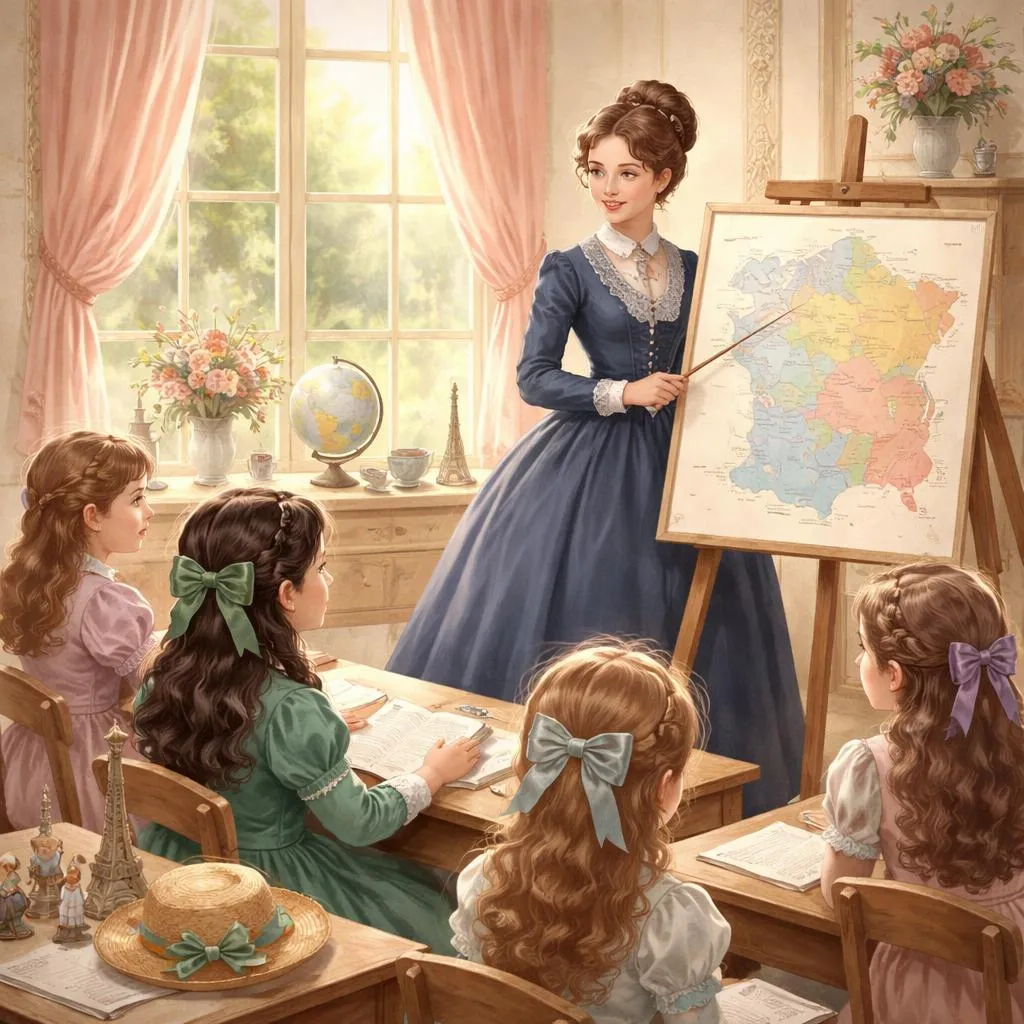

When Sara entered the schoolroom the next morning everybody looked at her with wide, interested eyes. By that time every pupil— from Lavinia Herbert, who was nearly thirteen and felt quite grown up, to Lottie Legh, who was only just four and the baby of the school— had heard a great deal about her. They knew very certainly that she was Miss Minchin’s show pupil and was considered a credit to the establishment. One or two of them had even caught a glimpse of her French maid, Mariette, who had arrived the evening before. Lavinia had managed to pass Sara’s room when the door was open, and had seen Mariette opening a box which had arrived late from some shop.
“It was full of petticoats with lace frills on them—frills and frills,” she whispered to her friend Jessie as she bent over her geography. “I saw her shaking them out. I heard Miss Minchin say to Miss Amelia that her clothes were so grand that they were ridiculous for a child. My mamma says that children should be dressed simply. She has got one of those petticoats on now. I saw it when she sat down.”
“She has silk stockings on!” whispered Jessie, bending over her geography also. “And what little feet! I never saw such little feet.”
“Oh,” sniffed Lavinia, spitefully, “that is the way her slippers are made. My mamma says that even big feet can be made to look small if you have a clever shoemaker. I don’t think she is pretty at all. Her eyes are such a queer color.”
“She isn’t pretty as other pretty people are,” said Jessie, stealing a glance across the room; “but she makes you want to look at her again. She has tremendously long eyelashes, but her eyes are almost green.”
Sara was sitting quietly in her seat, waiting to be told what to do. She had been placed near Miss Minchin’s desk. She was not abashed at all by the many pairs of eyes watching her. She was interested and looked back quietly at the children who looked at her. She wondered what they were thinking of, and if they liked Miss Minchin, and if they cared for their lessons, and if any of them had a papa at all like her own. She had had a long talk with Emily about her papa that morning.
“He is on the sea now, Emily,” she had said. “We must be very great friends to each other and tell each other things. Emily, look at me. You have the nicest eyes I ever saw—but I wish you could speak.”
She was a child full of imaginings and whimsical thoughts, and one of her fancies was that there would be a great deal of comfort in even pretending that Emily was alive and really heard and understood. After Mariette had dressed her in her dark-blue schoolroom frock and tied her hair with a dark-blue ribbon, she went to Emily, who sat in a chair of her own, and gave her a book.
“You can read that while I am downstairs,” she said; and, seeing Mariette looking at her curiously, she spoke to her with a serious little face.
“What I believe about dolls,” she said, “is that they can do things they will not let us know about. Perhaps, really, Emily can read and talk and walk, but she will only do it when people are out of the room. That is her secret. You see, if people knew that dolls could do things, they would make them work. So, perhaps, they have promised each other to keep it a secret. If you stay in the room, Emily will just sit there and stare; but if you go out, she will begin to read, perhaps, or go and look out of the window. Then if she heard either of us coming, she would just run back and jump into her chair and pretend she had been there all the time.”
“Comme elle est drole!” Mariette said to herself, and when she went downstairs she told the head housemaid about it. But she had already begun to like this odd little girl who had such an intelligent small face and such perfect manners. She had taken care of children before who were not so polite. Sara was a very fine little person, and had a gentle, appreciative way of saying, “If you please, Mariette,” “Thank you, Mariette,” which was very charming. Mariette told the head housemaid that she thanked her as if she was thanking a lady.
“Elle a l’air d’une princesse, cette petite,” she said. Indeed, she was very much pleased with her new little mistress and liked her place greatly.
After Sara had sat in her seat in the schoolroom for a few minutes, being looked at by the pupils, Miss Minchin rapped in a dignified manner upon her desk.
“Young ladies,” she said, “I wish to introduce you to your new companion.” All the little girls rose in their places, and Sara rose also. “I shall expect you all to be very agreeable to Miss Crewe; she has just come to us from a great distance—in fact, from India. As soon as lessons are over you must make each other’s acquaintance.”
The pupils bowed ceremoniously, and Sara made a little curtsy, and then they sat down and looked at each other again.
“Sara,” said Miss Minchin in her schoolroom manner, “come here to me.”
She had taken a book from the desk and was turning over its leaves. Sara went to her politely.
“As your papa has engaged a French maid for you,” she began, “I conclude that he wishes you to make a special study of the French language.”
Sara felt a little awkward.
“I think he engaged her,” she said, “because he—he thought I would like her, Miss Minchin.”
“I am afraid,” said Miss Minchin, with a slightly sour smile, “that you have been a very spoiled little girl and always imagine that things are done because you like them. My impression is that your papa wished you to learn French.”
If Sara had been older or less punctilious about being quite polite to people, she could have explained herself in a very few words. But, as it was, she felt a flush rising on her cheeks. Miss Minchin was a very severe and imposing person, and she seemed so absolutely sure that Sara knew nothing whatever of French that she felt as if it would be almost rude to correct her. The truth was that Sara could not remember the time when she had not seemed to know French. Her father had often spoken it to her when she had been a baby. Her mother had been a French woman, and Captain Crewe had loved her language, so it happened that Sara had always heard and been familiar with it.
“I—I have never really learned French, but—but—” she began, trying shyly to make herself clear.
One of Miss Minchin’s chief secret annoyances was that she did not speak French herself, and was desirous of concealing the irritating fact. She, therefore, had no intention of discussing the matter and laying herself open to innocent questioning by a new little pupil.
“That is enough,” she said with polite tartness. “If you have not learned, you must begin at once. The French master, Monsieur Dufarge, will be here in a few minutes. Take this book and look at it until he arrives.”
Sara’s cheeks felt warm. She went back to her seat and opened the book. She looked at the first page with a grave face. She knew it would be rude to smile, and she was very determined not to be rude. But it was very odd to find herself expected to study a page which told her that “le pere” meant “the father,” and “la mere” meant “the mother.”
Miss Minchin glanced toward her scrutinizingly.
“You look rather cross, Sara,” she said. “I am sorry you do not like the idea of learning French.”
“I am very fond of it,” answered Sara, thinking she would try again; “but—”
“You must not say `but’ when you are told to do things,” said Miss Minchin. “Look at your book again.”
And Sara did so, and did not smile, even when she found that “le fils” meant “the son,” and “le frere” meant “the brother.”
“When Monsieur Dufarge comes,” she thought, “I can make him understand.”
Monsieur Dufarge arrived very shortly afterward. He was a very nice, intelligent, middle-aged Frenchman, and he looked interested when his eyes fell upon Sara trying politely to seem absorbed in her little book of phrases.
“Is this a new pupil for me, madame?” he said to Miss Minchin. “I hope that is my good fortune.”
“Her papa—Captain Crewe—is very anxious that she should begin the language. But I am afraid she has a childish prejudice against it. She does not seem to wish to learn,” said Miss Minchin.
“I am sorry of that, mademoiselle,” he said kindly to Sara. “Perhaps, when we begin to study together, I may show you that it is a charming tongue.”
Little Sara rose in her seat. She was beginning to feel rather desperate, as if she were almost in disgrace. She looked up into Monsieur Dufarge’s face with her big, green-gray eyes, and they were quite innocently appealing. She knew that he would understand as soon as she spoke. She began to explain quite simply in pretty and fluent French. Madame had not understood. She had not learned French exactly—not out of books—but her papa and other people had always spoken it to her, and she had read it and written it as she had read and written English. Her papa loved it, and she loved it because he did. Her dear mamma, who had died when she was born, had been French. She would be glad to learn anything monsieur would teach her, but what she had tried to explain to madame was that she already knew the words in this book— and she held out the little book of phrases.
When she began to speak Miss Minchin started quite violently and sat staring at her over her eyeglasses, almost indignantly, until she had finished. Monsieur Dufarge began to smile, and his smile was one of great pleasure. To hear this pretty childish voice speaking his own language so simply and charmingly made him feel almost as if he were in his native land—which in dark, foggy days in London sometimes seemed worlds away. When she had finished, he took the phrase book from her, with a look almost affectionate. But he spoke to Miss Minchin.
“Ah, madame,” he said, “there is not much I can teach her. She has not learned French; she is French. Her accent is exquisite.”
“You ought to have told me,” exclaimed Miss Minchin, much mortified, turning to Sara.
“I—I tried,” said Sara. “I—I suppose I did not begin right.”
Miss Minchin knew she had tried, and that it had not been her fault that she was not allowed to explain. And when she saw that the pupils had been listening and that Lavinia and Jessie were giggling behind their French grammars, she felt infuriated.
“Silence, young ladies!” she said severely, rapping upon the desk. “Silence at once!”
And she began from that minute to feel rather a grudge against her show pupil.
背景介紹與作者介紹
這段文字出自法蘭西斯·霍奇森·伯內特所著的兒童小說《小公主》,該書於1905年首次出版。伯內特是一位英裔美國作家,以其探討童年、韌性和善良等主題的作品而聞名。《小公主》講述了莎拉·克魯的故事,一位年輕女孩在失去富有的父親並陷入貧困後,以尊嚴和優雅面對困境。這部小說因其豐富的人物塑造以及對想像力和內在力量的強調而備受讚譽。
故事的詳細解讀和意義
在這段摘錄中,我們看到莎拉進入了一個新的學校環境,她在那里既受到同學的欽佩,也受到同學的嫉妒。這一幕突出了莎拉獨特的背景——她的財富、她的法國女僕以及她優雅的舉止——這使她與其他女孩區分開來。然而,莎拉仍然保持謙遜和鎮定,表現出超越她年齡的成熟。與嚴厲的校長明欽小姐的互動引發了一場衝突:明欽小姐對莎拉法語知識的誤解,象征著莎拉所面臨的更廣泛的誤判和偏見主題。
莎拉與她的玩偶艾米莉富有想像力的對話,揭示了她溫柔和富有創造力的天性。這一刻說明了莎拉如何通過創造一個舒適和陪伴的秘密世界來應對孤獨和不確定性。法國老師杜法吉先生的到來,以及莎拉流利的法語,進一步強調了她的智慧和文化底蘊,與明欽小姐的狹隘形成鮮明對比。
給兒童和學生的教訓和啟示
-
逆境中的韌性和優雅: 莎拉在面對審視和誤解時的鎮定,教導年輕讀者即使在他人不公正地評判時,也要保持尊嚴和自尊的重要性。
-
想像力的力量: 莎拉相信她的玩偶艾米莉可能偷偷地活過來,鼓勵孩子們運用他們的想像力作為安慰和創造力的源泉,尤其是在困難時期。
-
文化欣賞和語言學習: 莎拉流利的法語,儘管明欽小姐有所猜測,但突出了文化多樣性的價值以及學習新語言的好處。它鼓勵學生擁抱和尊重不同的文化。
-
善良和禮貌: 莎拉溫柔的舉止,例如恭敬地感謝瑪麗埃特,表明了善良和禮貌如何積極地影響人際關係並創造善意。
在日常生活中應用這些教訓
-
在學校: 學生可以學會像莎拉一樣,以耐心和自信面對挑戰和誤解。當遇到難相處的老師或同伴時,保持鎮定和禮貌可以幫助維持積極的環境。
-
在社交場合: 莎拉的尊重互動提醒我們要友善地對待每個人,無論他們的地位如何。這有助於建立友誼並贏得尊重。
-
在學習中: 擁抱新的語言和文化可以拓寬視野並培養同理心。應鼓勵學生探索不同的語言和傳統,以變得更加開放。
-
在個人成長中: 像莎拉一樣運用想像力和創造力,可以成為應對壓力或孤獨的健康方式。寫故事、繪畫或玩想像力遊戲可以培養情感健康。
從故事中培養積極的特質
-
同理心: 理解莎拉的感受,幫助學生培養對可能與眾不同或被誤解的其他人產生同理心。
-
自信: 莎拉的沉靜自信激勵孩子們相信自己的能力,即使其他人懷疑他們。
-
好奇心: 莎拉對新環境的興趣以及她學習法語的意願,表明了好奇心和對學習的熱愛的重要性。
-
感恩: 莎拉禮貌的感謝表達了欣賞他人努力的價值。
結論
《小公主》不僅僅是一個關於學校里富家女孩的故事;它是一堂關於善良、韌性和人類精神力量的永恆課程。通過研究莎拉的經歷,年輕讀者可以獲得寶貴的見解,了解如何以勇氣和優雅面對生活的挑戰,如何欣賞文化多樣性,以及如何培養他們的想像力和同理心。這些教訓不僅對學業成功至關重要,而且對於建立有意義的關係和過上富有同情心的生活也至關重要。
