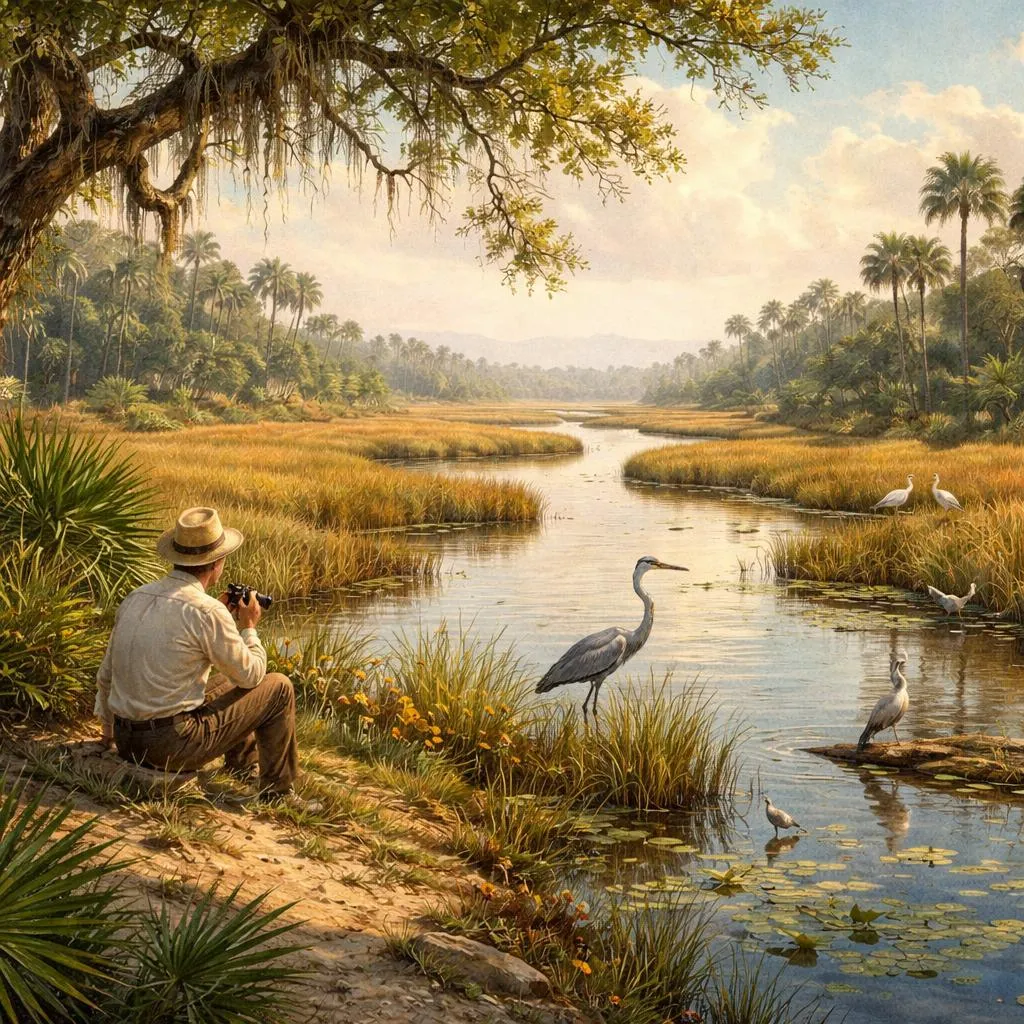

I am sitting upon the upland bank of a narrow winding creek. Before me is a sea of grass, brown and green of many shades. To the north themarsh is bounded by live-oak woods,—a line with numberlessindentations,—beyond which runs the Matanzas River, as I know by thepassing and repassing of sails behind the trees. Eastward aresand-hills, dazzling white in the sun, with a ragged green fringe alongtheir tops. Then comes a stretch of the open sea, and then, more to thesouth, St. Anastasia Island, with its tall black-and-white lighthouseand the cluster of lower buildings at its base. Small sailboats, and nowand then a tiny steamer, pass up and down the river to and from St.Augustine.
A delicious south wind is blowing (it is the 15th of February), and Isit in the shade of a cedar-tree and enjoy the air and the scene. Acontrast, this, to the frozen world I was living in, less than a weekago.
As I approached the creek, a single spotted sandpiper was teeteringalong the edge of the water, and the next moment a big blue heron rosejust beyond him and went flapping away to the middle of the marsh. Now,an hour afterward, he is still standing there, towering above the tallgrass. Once when I turned that way I saw, as I thought, a stake, andthen something moved upon it,—a bird of some kind. And what an enormousbeak! I raised my field-glass. It was the heron. His body was the post,and his head was the bird. Meanwhile, the sandpiper has stolen away, Iknow not when or where. He must have omitted the “tweet, tweet,” withwhich ordinarily he signalizes his flight. He is the first of his kindthat I have seen during my brief stay in these parts.
Now a multitude of crows pass over; fish crows, I think they must be,from their small size and their strange, ridiculous voices. And now asecond great blue heron comes in sight, and keeps on over the marsh andover the live-oak wood, on his way to the San Sebastian marshes, or somepoint still more remote. A fine show he makes, with his wide expanse ofwing, and his feet drawn up and standing out behind him. Next a marshhawk in brown plumage comes skimming over the grass. This way and thathe swerves in ever graceful lines. For one to whom ease and grace comeby nature, even the chase of meadow mice is an act of beauty, whileanother goes awkwardly though in pursuit of a goddess.
Several times I have noticed a kingfisher hovering above the grass (soit looks, but no doubt he is over an arm of the creek), striking the airwith quick strokes, and keeping his head pointed downward, after themanner of a tern. Then he disappeared while I was looking at somethingelse. Now I remark him sitting motionless upon the top of a post in themidst of the marsh.
A third blue heron appears, and he too flies over without stopping.Number One still keeps his place; through the glass I can see himdressing his feathers with his clumsy beak. The lively strain of awhite-eyed vireo, pertest of songsters, comes to me from somewhere on myright, and the soft chipping of myrtle warblers is all but incessant. Ilook up from my paper to see a turkey buzzard sailing majesticallynorthward. I watch him till he fades in the distance. Not once does heflap his wings, but sails and sails, going with the wind, yet turningagain and again to rise against it,—helping himself thus to itsadverse, uplifting pressure in the place of wing-strokes, perhaps,—andpassing onward all the while in beautiful circles. He, too, scavengerthough he is, has a genius for being graceful. One might almost bewilling to be a buzzard, to fly like that!
The kingfisher and the heron are still at their posts. An exquisiteyellow butterfly, of a sort strange to my Yankee eyes, flits past,followed by a red admiral. The marsh hawk is on the wing again, andwhile looking at him I descry a second hawk, too far away to be madeout. Now the air behind me is dark with crows,—a hundred or two, atleast, circling over the low cedars. Some motive they have for all theirclamor, but it passes my owlish wisdom to guess what it can be. A fourthblue heron appears, and drops into the grass out of sight.
Between my feet is a single blossom of the yellow oxalis, the onlyflower to be seen; and very pretty it is, each petal with an orange spotat the base.
Another buzzard, another marsh hawk, another yellow butterfly, and thena smaller one, darker, almost orange. It passes too quickly over thecreek and away. The marsh hawk comes nearer, and I see the strong yellowtinge of his plumage, especially underneath. He will grow handsomer ashe grows older. A pity the same could not be true of men. Behind me aresharp cries of titlarks. From the direction of the river come frequentreports of guns. Somebody is doing his best to be happy! All at once Iprick up my ears. From the grass just across the creek rises the brief,hurried song of a long-billed marsh wren. So he is in Florida, is he?Already I have heard confused noises which I feel sure are the work ofrails of some kind. No doubt there is abundant life concealed in thoseacres on acres of close grass.
The heron and the kingfisher are still quiet. Their morning hunt wassuccessful, and for to-day Fate cannot harm them. A buzzard, withnervous, rustling beats, goes directly above the low cedar under which Iam resting.
At last, after a siesta of two hours, the heron has changed his place. Ilooked up just in season to see him sweeping over the grass, into whichhe dropped the next instant. The tide is falling. The distant sand-hillsare winking in the heat, but the breeze is deliciously cool, the veryperfection of temperature, if a man is to sit still in the shade. It iseleven o’clock. I have a mile to go in the hot sun, and turn away. Butfirst I sweep the line once more with my glass. Yonder to the south aretwo more blue herons standing in the grass. Perhaps there are morestill. I sweep the line. Yes, far, far away I can see four heads in arow. Heads and necks rise above the grass. But so far away! Are theybirds, or only posts made alive by my imagination? I look again. Ibelieve I was deceived. They are nothing but stakes. See how in a rowthey stand. I smile at myself. Just then one of them moves, and anotheris pulled down suddenly into the grass. I smile again. “Ten great blueherons,” I say to myself.
All this has detained me, and meantime the kingfisher has taken wing andgone noisily up the creek. The marsh hawk appears once more. Akilldeer’s sharp, rasping note—a familiar sound in St. Augustine—comesfrom I know not where. A procession of more than twenty black vulturespasses over my head. I can see their feet drawn up under them. My own Imust use in plodding homeward.
背景介紹與作者介紹
這篇生動的自然敘事詳細地觀察了沼澤生態系統,捕捉了沿海環境的美麗與生機。作者,這裡未指明身份,展現了敏銳的觀察力和對野生動物,尤其是鳥類的深刻欣賞。這種描述性的寫作方式是自然主義作家的典型風格,他們將科學觀察與詩意語言相結合,使大自然在讀者面前栩栩如生。這種風格鼓勵讀者,尤其是學生和年輕人,放慢腳步,注意周圍自然界的小奇蹟。
詳細闡釋與意義
這段文字描繪了佛羅里達州聖奧古斯丁附近沼澤地一個陽光明媚的寧靜日子的景象。作者對鳥類的行為和外觀的細緻關注——藍鷺、沙鷸、翠鳥、沼澤鷹、禿鷹等——邀請讀者欣賞野生動物的多樣性和優雅。敘事還將溫暖、生動的場景與作者最近經歷的冰凍冬季景觀進行了對比,強調了溫暖氣候下大自然的更新和活力。
這個故事不僅僅是關於鳥類,更是關於生命的相互聯繫以及自然界的寧靜節奏。鳥類的活動、叫聲和互動揭示了一個複雜的生態系統,其中每個生物都扮演著自己的角色。作者對禿鷹等食腐鳥類的美麗和優雅的反思,暗示著一種關於在所有生命形式中尋找價值和尊嚴的信息。
給學生的教訓和見解
-
觀察技巧:詳細的描述鼓勵學生培養細緻的觀察技巧。注意到小細節——比如花瓣上的橙色斑點或鷹的飛行模式——可以加深對自然的理解和欣賞。
-
耐心和正念:作者花費數小時靜靜地觀察沼澤,展現了耐心和正念。學生可以學習放慢腳步並專注於當下,從而真正體驗並從他們的環境中學習。
-
對自然的尊重:敘事培養了對野生動物和環境的尊重。了解不同動物所扮演的角色有助於建立對自然世界的管理意識。
-
與地方的聯繫:作者與沼澤及其生物的聯繫表明了地方如何具有特殊的意義。可以鼓勵學生探索並與他們當地的環境建立聯繫。
在生活、學習和社交環境中的應用
-
在學習中:學生可以將這裡展示的觀察技巧應用於科學研究,提高他們記錄和解釋數據的能力。這個故事可以啟發自然日誌或實地研究。
-
在社交生活中:對所有生物的尊重,包括那些不太受人喜愛的生物,如禿鷹,教導了同情心和對多樣性的接受,這些都是社交關係中的寶貴特質。
-
在個人成長中:展示的耐心和鎮定可以幫助學生管理壓力並培養正念練習。
從故事中培養積極的品質
-
好奇心和驚奇:鼓勵對自然世界的好奇心可以帶來終身學習和發現。
-
耐心:學會等待和仔細觀察是一項對生活許多方面都有益的技能。
-
尊重和同情心:看到所有生物的價值可以促進對他人的善良和理解。
-
與自然的聯繫:在戶外度過時間和觀察野生動物可以改善心理健康並培養環境責任感。
結論
這段文字是自然寫作的一個美好例子,它邀請年輕讀者放慢腳步,觀察並欣賞他們周圍的生命世界。它傳授了關於耐心、尊重和生命以各種形式存在的美麗的寶貴教訓。通過參與這些故事,學生可以培養豐富他們教育和個人生活的技能和態度,幫助他們成長為有思想、有愛心、與自然和社區相連的個體。
