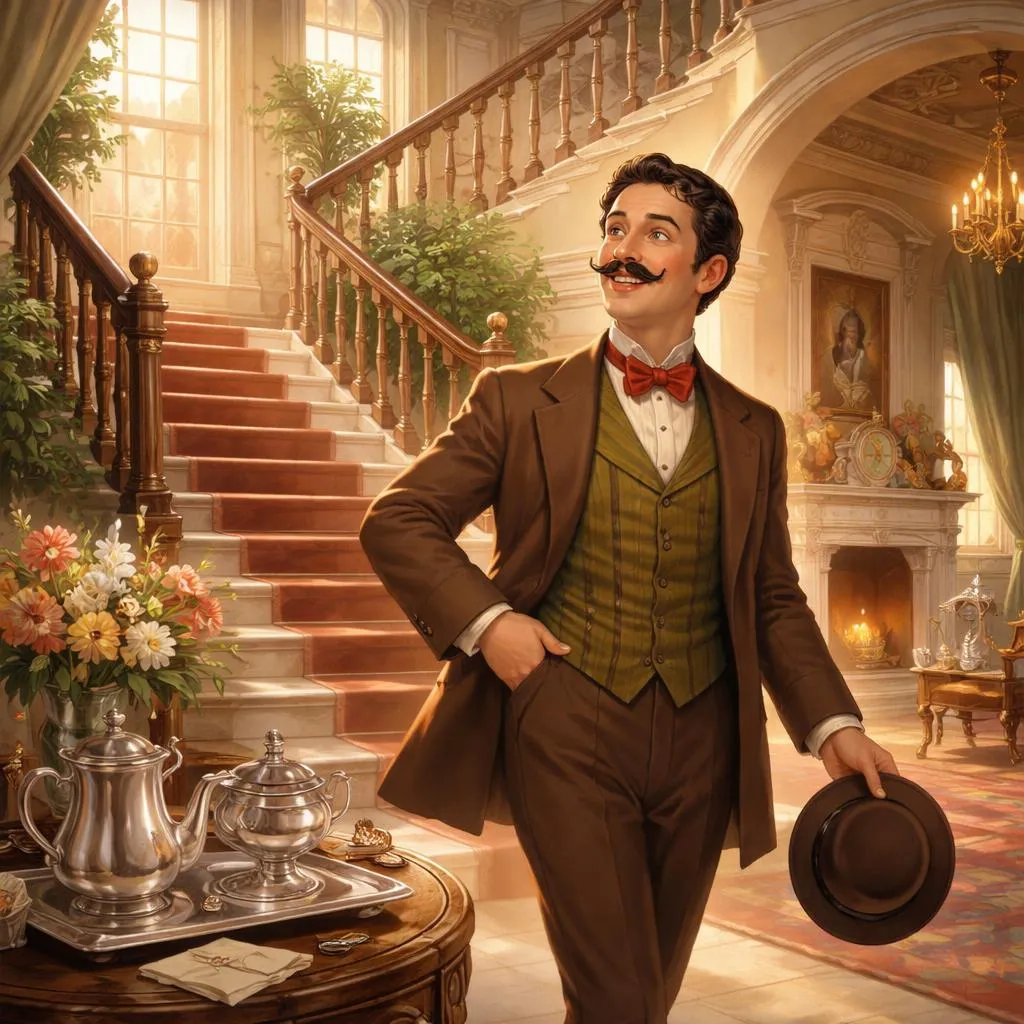

"Faith," muttered Passepartout, somewhat flurried, "I've seen people at Madame Tussaud's as lively as my new master!"
Madame Tussaud's "people," let it be said, are of wax, and are much visited in London; speech is all that is wanting to make them human.
During his brief interview with Mr. Fogg, Passepartout had been carefully observing him. He appeared to be a man about forty years of age, with fine, handsome features, and a tall, well-shaped figure; his hair and whiskers were light, his forehead compact and unwrinkled, his face rather pale, his teeth magnificent. His countenance possessed in the highest degree what physiognomists call "repose in action," a quality of those who act rather than talk. Calm and phlegmatic, with a clear eye, Mr. Fogg seemed a perfect type of that English composure which Angelica Kauffmann has so skilfully represented on canvas. Seen in the various phases of his daily life, he gave the idea of being perfectly well-balanced, as exactly regulated as a Leroy chronometer. Phileas Fogg was, indeed, exactitude personified, and this was betrayed even in the expression of his very hands and feet; for in men, as well as in animals, the limbs themselves are expressive of the passions.
He was so exact that he was never in a hurry, was always ready, and was economical alike of his steps and his motions. He never took one step too many, and always went to his destination by the shortest cut; he made no superfluous gestures, and was never seen to be moved or agitated. He was the most deliberate person in the world, yet always reached his destination at the exact moment.
He lived alone, and, so to speak, outside of every social relation; and as he knew that in this world account must be taken of friction, and that friction retards, he never rubbed against anybody.
As for Passepartout, he was a true Parisian of Paris. Since he had abandoned his own country for England, taking service as a valet, he had in vain searched for a master after his own heart. Passepartout was by no means one of those pert dunces depicted by Moliere with a bold gaze and a nose held high in the air; he was an honest fellow, with a pleasant face, lips a trifle protruding, soft-mannered and serviceable, with a good round head, such as one likes to see on the shoulders of a friend. His eyes were blue, his complexion rubicund, his figure almost portly and well-built, his body muscular, and his physical powers fully developed by the exercises of his younger days. His brown hair was somewhat tumbled; for, while the ancient sculptors are said to have known eighteen methods of arranging Minerva's tresses, Passepartout was familiar with but one of dressing his own: three strokes of a large-tooth comb completed his toilet.
It would be rash to predict how Passepartout's lively nature would agree with Mr. Fogg. It was impossible to tell whether the new servant would turn out as absolutely methodical as his master required; experience alone could solve the question. Passepartout had been a sort of vagrant in his early years, and now yearned for repose; but so far he had failed to find it, though he had already served in ten English houses. But he could not take root in any of these; with chagrin, he found his masters invariably whimsical and irregular, constantly running about the country, or on the look-out for adventure. His last master, young Lord Longferry, Member of Parliament, after passing his nights in the Haymarket taverns, was too often brought home in the morning on policemen's shoulders. Passepartout, desirous of respecting the gentleman whom he served, ventured a mild remonstrance on such conduct; which, being ill-received, he took his leave. Hearing that Mr. Phileas Fogg was looking for a servant, and that his life was one of unbroken regularity, that he neither travelled nor stayed from home overnight, he felt sure that this would be the place he was after. He presented himself, and was accepted, as has been seen.
At half-past eleven, then, Passepartout found himself alone in the house in Saville Row. He begun its inspection without delay, scouring it from cellar to garret. So clean, well-arranged, solemn a mansion pleased him; it seemed to him like a snail's shell, lighted and warmed by gas, which sufficed for both these purposes. When Passepartout reached the second story he recognised at once the room which he was to inhabit, and he was well satisfied with it. Electric bells and speaking-tubes afforded communication with the lower stories; while on the mantel stood an electric clock, precisely like that in Mr. Fogg's bedchamber, both beating the same second at the same instant. "That's good, that'll do," said Passepartout to himself.
He suddenly observed, hung over the clock, a card which, upon inspection, proved to be a programme of the daily routine of the house. It comprised all that was required of the servant, from eight in the morning, exactly at which hour Phileas Fogg rose, till half-past eleven, when he left the house for the Reform Club—all the details of service, the tea and toast at twenty-three minutes past eight, the shaving-water at thirty-seven minutes past nine, and the toilet at twenty minutes before ten. Everything was regulated and foreseen that was to be done from half-past eleven a.m. till midnight, the hour at which the methodical gentleman retired.
Mr. Fogg's wardrobe was amply supplied and in the best taste. Each pair of trousers, coat, and vest bore a number, indicating the time of year and season at which they were in turn to be laid out for wearing; and the same system was applied to the master's shoes. In short, the house in Saville Row, which must have been a very temple of disorder and unrest under the illustrious but dissipated Sheridan, was cosiness, comfort, and method idealised. There was no study, nor were there books, which would have been quite useless to Mr. Fogg; for at the Reform two libraries, one of general literature and the other of law and politics, were at his service. A moderate-sized safe stood in his bedroom, constructed so as to defy fire as well as burglars; but Passepartout found neither arms nor hunting weapons anywhere; everything betrayed the most tranquil and peaceable habits.
Having scrutinised the house from top to bottom, he rubbed his hands, a broad smile overspread his features, and he said joyfully, "This is just what I wanted! Ah, we shall get on together, Mr. Fogg and I! What a domestic and regular gentleman! A real machine; well, I don't mind serving a machine."
背景介紹與作者介紹
這段文字出自儒勒·凡爾納的經典小說《八十天環遊世界》,這位法國作家以其冒險和科幻作品而聞名。這部小說寫於1873年,捕捉了工業革命的精神,以及對新技術和全球旅行的迷戀。凡爾納生動的想像力和細緻的描述,將環遊世界的興奮和挑戰生動地呈現出來,在那個時代,這樣的旅行仍然是一項了不起的壯舉。
故事詳解
這段摘錄介紹了兩個主要人物:福克,一個嚴格遵守常規和精確的人,以及他新聘用的僕人路路通,他活潑和靈活的性格與福克的機械規律形成了鮮明對比。福克被描繪成一位模範的英國紳士,他的生活井然有序,每一分鐘和每一個動作都經過精心計劃和執行。另一方面,路路通是一個溫暖、有人情味的角色,他有著豐富的過去,並渴望穩定。
這段開場為小說的主要冒險奠定了基礎:福克打賭要在八十天內環遊世界。福克有條不紊的性格與他即將面對的不可預測的世界之間的對比,在整個故事中創造了緊張感和幽默感。
學生可以學到什麼
-
紀律和常規的價值: 福克的性格體現了紀律的力量。他的準時、周密的計劃和冷靜的舉止表明,結構如何幫助實現雄心勃勃的目標。學生可以學習時間管理和組織在他們的學習和日常生活中的重要性。
-
適應性和開放的心態: 路路通的性格提醒我們,雖然常規很有價值,但靈活性和善良同樣重要。他過去的經歷和隨和的性格平衡了福克的僵化,教導學生欣賞不同的人格,並適應新的情況。
-
勇氣和冒險: 這部小說鼓勵讀者擁抱挑戰,走出自己的舒適區。福克的旅程是毅力和勇氣的隱喻,激勵年輕讀者克服障礙,追求自己的夢想。
-
文化意識: 隨著故事穿越不同的國家和文化,它為世界的多樣性打開了一扇窗戶。這拓寬了學生的視野,並培養了對不同民族和傳統的尊重。
將這些教訓應用於生活
- 在學習中: 學生可以效仿福克的奉獻精神,設定明確的目標並遵循學習計劃,同時也要記住路路通的靈活性,從容應對意想不到的變化或困難。
- 在社交場合: 認識到不同個性的價值有助於建立同情心和團隊合作精神。正如福克和路路通互相補充一樣,學生可以學會與具有不同優勢的同學良好合作。
- 在個人成長中: 冒險精神鼓勵好奇心和韌性。學生可以挑戰自己去嘗試新的活動、旅行或探索新的想法,從而增強他們的自信心和世界觀。
從故事中培養積極的特質
- 精確和責任: 像福克一樣,學生可以練習對自己的任務負責,並準時履行承諾。
- 友善和支持: 受路路通的啟發,對他人表現出友善和支持,可以建立牢固的友誼和積極的環境。
- 解決問題: 故事表明,意想不到的問題會出現,但冷靜的思考和決心會帶來成功。學生可以通過保持冷靜和創造性地思考來培養解決問題的技能。
結論
《八十天環遊世界》不僅僅是一場令人興奮的冒險;它也是關於性格、文化和勇氣的豐富的教訓來源。通過閱讀和思考這個故事,學生可以獲得幫助他們在學校、人際關係和生活中的許多旅程中獲得啟發。擁抱紀律和靈活性,尊重多樣性,並敢於探索未知,這些都是這部經典小說所傳達的永恆價值。
