
The moment I got a chance I slipped aside privately and touched an ancient common looking man on the shoulder and said, in an insinuating, confidential way:
“Friend, do me a kindness. Do you belong to the asylum, or are you just on a visit or something like that?”
He looked me over stupidly, and said:
“Marry, fair sir, me seemeth—”
“That will do,” I said; “I reckon you are a patient.”
I moved away, cogitating, and at the same time keeping an eye out for any chance passenger in his right mind that might come along and give me some light. I judged I had found one, presently; so I drew him aside and said in his ear:
“If I could see the head keeper a minute—only just a minute—”
“Prithee do not let me.”
“Let you what ?”
“Hinder me, then, if the word please thee better. Then he went on to say he was an under-cook and could not stop to gossip, though he would like it another time; for it would comfort his very liver to know where I got my clothes. As he started away he pointed and said yonder was one who was idle enough for my purpose, and was seeking me besides, no doubt. This was an airy slim boy in shrimp-colored tights that made him look like a forked carrot, the rest of his gear was blue silk and dainty laces and ruffles; and he had long yellow curls, and wore a plumed pink satin cap tilted complacently over his ear. By his look, he was good-natured; by his gait, he was satisfied with himself. He was pretty enough to frame. He arrived, looked me over with a smiling and impudent curiosity; said he had come for me, and informed me that he was a page.
“Go ‘long,” I said; “you ain’t more than a paragraph.”
It was pretty severe, but I was nettled. However, it never phazed him; he didn’t appear to know he was hurt. He began to talk and laugh, in happy, thoughtless, boyish fashion, as we walked along, and made himself old friends with me at once; asked me all sorts of questions about myself and about my clothes, but never waited for an answer—always chattered straight ahead, as if he didn’t know he had asked a question and wasn’t expecting any reply, until at last he happened to mention that he was born in the beginning of the year 513.
It made the cold chills creep over me! I stopped and said, a little faintly:
“Maybe I didn’t hear you just right. Say it again—and say it slow. What year was it?”
“513.”
“513! You don’t look it! Come, my boy, I am a stranger and friendless; be honest and honorable with me. Are you in your right mind?”
He said he was.
“Are these other people in their right minds?”
He said they were.
“And this isn’t an asylum? I mean, it isn’t a place where they cure crazy people?”
He said it wasn’t.
“Well, then,” I said, “either I am a lunatic, or something just as awful has happened. Now tell me, honest and true, where am I?”
“IN KING ARTHUR’S COURT.”
I waited a minute, to let that idea shudder its way home, and then said:
“And according to your notions, what year is it now?”
“528—nineteenth of June.”
I felt a mournful sinking at the heart, and muttered: “I shall never see my friends again—never, never again. They will not be born for more than thirteen hundred years yet.”
I seemed to believe the boy, I didn’t know why. Something in me seemed to believe him—my consciousness, as you may say; but my reason didn’t. My reason straightway began to clamor; that was natural. I didn’t know how to go about satisfying it, because I knew that the testimony of men wouldn’t serve—my reason would say they were lunatics, and throw out their evidence. But all of a sudden I stumbled on the very thing, just by luck. I knew that the only total eclipse of the sun in the first half of the sixth century occurred on the 21st of June, A.D. 528, O.S., and began at 3 minutes after 12 noon. I also knew that no total eclipse of the sun was due in what to me was the present year—i.e., 1879. So, if I could keep my anxiety and curiosity from eating the heart out of me for forty-eight hours, I should then find out for certain whether this boy was telling me the truth or not.
Wherefore, being a practical Connecticut man, I now shoved this whole problem clear out of my mind till its appointed day and hour should come, in order that I might turn all my attention to the circumstances of the present moment, and be alert and ready to make the most out of them that could be made. One thing at a time, is my motto—and just play that thing for all it is worth, even if it’s only two pair and a jack. I made up my mind to two things: if it was still the nineteenth century and I was among lunatics and couldn’t get away, I would presently boss that asylum or know the reason why; and if, on the other hand, it was really the sixth century, all right, I didn’t want any softer thing: I would boss the whole country inside of three months; for I judged I would have the start of the best-educated man in the kingdom by a matter of thirteen hundred years and upward. I’m not a man to waste time after my mind’s made up and there’s work on hand; so I said to the page:
“Now, Clarence, my boy—if that might happen to be your name —I’ll get you to post me up a little if you don’t mind. What is the name of that apparition that brought me here?”
“My master and thine? That is the good knight and great lord Sir Kay the Seneschal, foster brother to our liege the king.”
“Very good; go on, tell me everything.”
He made a long story of it; but the part that had immediate interest for me was this: He said I was Sir Kay’s prisoner, and that in the due course of custom I would be flung into a dungeon and left there on scant commons until my friends ransomed me—unless I chanced to rot, first. I saw that the last chance had the best show, but I didn’t waste any bother about that; time was too precious. The page said, further, that dinner was about ended in the great hall by this time, and that as soon as the sociability and the heavy drinking should begin, Sir Kay would have me in and exhibit me before King Arthur and his illustrious knights seated at the Table Round, and would brag about his exploit in capturing me, and would probably exaggerate the facts a little, but it wouldn’t be good form for me to correct him, and not over safe, either; and when I was done being exhibited, then ho for the dungeon; but he, Clarence, would find a way to come and see me every now and then, and cheer me up, and help me get word to my friends.
Get word to my friends! I thanked him; I couldn’t do less; and about this time a lackey came to say I was wanted; so Clarence led me in and took me off to one side and sat down by me.
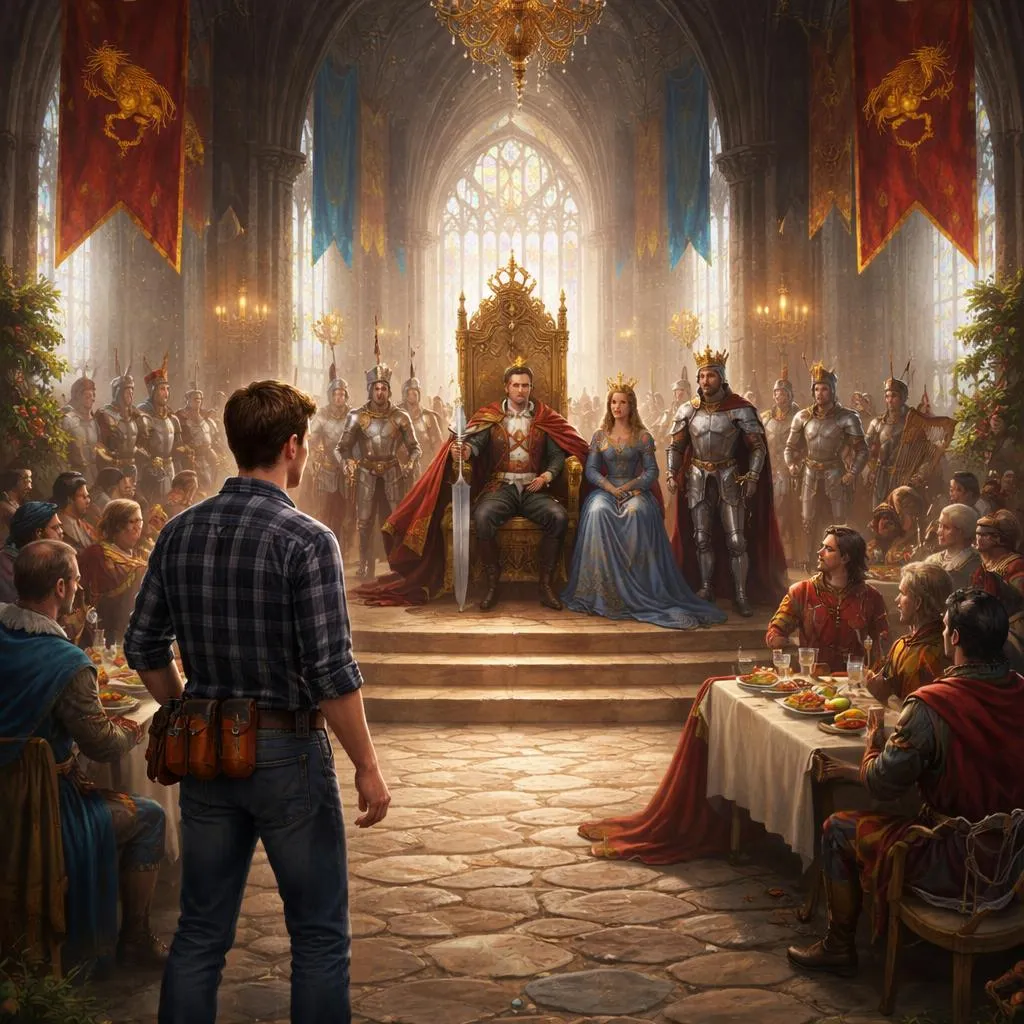
Well, it was a curious kind of spectacle, and interesting. It was an immense place, and rather naked—yes, and full of loud contrasts. It was very, very lofty; so lofty that the banners depending from the arched beams and girders away up there floated in a sort of twilight; there was a stone-railed gallery at each end, high up, with musicians in the one, and women, clothed in stunning colors, in the other. The floor was of big stone flags laid in black and white squares, rather battered by age and use, and needing repair. As to ornament, there wasn’t any, strictly speaking; though on the walls hung some huge tapestries which were probably taxed as works of art; battle-pieces, they were, with horses shaped like those which children cut out of paper or create in gingerbread; with men on them in scale armor whose scales are represented by round holes—so that the man’s coat looks as if it had been done with a biscuit-punch. There was a fireplace big enough to camp in; and its projecting sides and hood, of carved and pillared stonework, had the look of a cathedral door. Along the walls stood men-at-arms, in breastplate and morion, with halberds for their only weapon —rigid as statues; and that is what they looked like.
In the middle of this groined and vaulted public square was an oaken table which they called the Table Round. It was as large as a circus ring; and around it sat a great company of men dressed in such various and splendid colors that it hurt one’s eyes to look at them. They wore their plumed hats, right along, except that whenever one addressed himself directly to the king, he lifted his hat a trifle just as he was beginning his remark.
Mainly they were drinking—from entire ox horns; but a few were still munching bread or gnawing beef bones. There was about an average of two dogs to one man; and these sat in expectant attitudes till a spent bone was flung to them, and then they went for it by brigades and divisions, with a rush, and there ensued a fight which filled the prospect with a tumultuous chaos of plunging heads and bodies and flashing tails, and the storm of howlings and barkings deafened all speech for the time; but that was no matter, for the dog-fight was always a bigger interest anyway; the men rose, sometimes, to observe it the better and bet on it, and the ladies and the musicians stretched themselves out over their balusters with the same object; and all broke into delighted ejaculations from time to time. In the end, the winning dog stretched himself out comfortably with his bone between his paws, and proceeded to growl over it, and gnaw it, and grease the floor with it, just as fifty others were already doing; and the rest of the court resumed their previous industries and entertainments.
As a rule, the speech and behavior of these people were gracious and courtly; and I noticed that they were good and serious listeners when anybody was telling anything—I mean in a dog-fightless interval. And plainly, too, they were a childlike and innocent lot; telling lies of the stateliest pattern with a most gentle and winning naivety, and ready and willing to listen to anybody else’s lie, and believe it, too. It was hard to associate them with anything cruel or dreadful; and yet they dealt in tales of blood and suffering with a guileless relish that made me almost forget to shudder.
I was not the only prisoner present. There were twenty or more. Poor devils, many of them were maimed, hacked, carved, in a frightful way; and their hair, their faces, their clothing, were caked with black and stiffened drenchings of blood. They were suffering sharp physical pain, of course; and weariness, and hunger and thirst, no doubt; and at least none had given them the comfort of a wash, or even the poor charity of a lotion for their wounds; yet you never heard them utter a moan or a groan, or saw them show any sign of restlessness, or any disposition to complain. The thought was forced upon me: “The rascals—they have served other people so in their day; it being their own turn, now, they were not expecting any better treatment than this; so their philosophical bearing is not an outcome of mental training, intellectual fortitude, reasoning; it is mere animal training; they are white Indians.”
背景介紹與作者介紹
這段文字摘自馬克·吐溫所著的《康乃狄克州美國佬在亞瑟王宮廷》,他是美國最受推崇的作家之一,以其機智和犀利的社會評論而聞名。這部小說於1889年出版,故事結合了奇幻、諷刺和歷史小說的元素。吐溫利用時間旅行來探索和批判浪漫化的中世紀觀點,並突顯現代社會與古代社會之間的對比。
馬克·吐溫,原名薩繆爾·蘭霍恩·克萊門斯,是一位敏銳的人性與社會觀察家。在他的作品中,他經常挑戰社會規範,並以幽默和諷刺揭露不公。這部小說反映了他對理想化歷史的懷疑,以及他對進步和理性的信念。
故事詳解與重要性
在這段摘錄中,主角是一位19世紀的男子,他神秘地被傳送到6世紀的亞瑟王宮廷。敘事始於他的困惑,他試圖理解自己身在何處,可以信任誰,以及如何在這個陌生的新世界中生存。故事巧妙地融合了主角的現代知識與中世紀的背景,創造了既幽默又發人深省的情境。
這段文字生動地描述了中世紀宮廷的氛圍,突出了主角的現代感性與當時的習俗之間的對比。騎士的騎士精神、宏偉但略顯原始的環境,以及囚犯的堅忍,都描繪了那個時代複雜的景象——既浪漫又殘酷。
吐溫利用這個背景來批判騎士精神和中世紀的浪漫觀念,揭露其殘酷和迷信。同時,主角的現代思維和知識賦予了他戰略優勢,象徵著教育、理性和創新的力量。
給學生的啟示與見解
-
批判性思維與懷疑精神: 主角努力區分真相與幻象,鼓勵讀者質疑表象,並在接受主張之前尋求證據。這是在學習和日常決策中一項寶貴的技能。
-
適應能力與解決問題: 面對陌生的環境,主角迅速評估他的情況,並計劃如何利用他的知識來生存並影響周圍環境。學生可以學習在遇到挑戰時靈活思考和戰略性思考的重要性。
-
知識與教育的價值: 故事強調了來自未來的知識如何賦予主角在過去的優勢,強調了學習和創新的變革力量。
-
用批判的眼光理解歷史: 吐溫的描繪邀請讀者超越神話和傳說,去理解歷史現實,培養對過去更細緻的欣賞。
-
同情心與人性: 儘管條件惡劣,囚犯們表現出非凡的耐力和接受度。這可以教導學生關於韌性和在艱難環境下的人類行為的複雜性。
將這些啟示應用於生活和學習中
-
在學校: 學生可以通過質疑來源、仔細分析信息,並且不全盤接受所有內容來運用批判性思維。他們也可以在面對新科目或困難時學習調整學習策略。
-
在社交場合: 理解不同的觀點,例如主角與來自另一個時代的人的相遇,有助於培養同情心和溝通技巧。認識到人們來自不同的背景和經歷,對於社會和諧至關重要。
-
在個人成長中: 主角決心充分利用他的處境,塑造了韌性和積極主動的態度。學生可以通過設定目標、擁抱挑戰並從挫折中學習來培養這些特質。
從故事中培養積極的價值觀
-
好奇心與開放的心態: 主角願意接觸未知事物,鼓勵學生對新體驗和想法保持好奇和開放。
-
勇氣與主動性: 儘管害怕或不確定,仍然採取行動是關鍵主題。學生可以通過走出舒適區並對他們的學習和選擇負責來練習這一點。
-
尊重知識與創新: 重視教育和創造性思維可以激勵學生熱情地追求知識並建設性地應用它。
總結
馬克·吐溫的《康乃狄克州美國佬在亞瑟王宮廷》為年輕讀者提供了豐富的材料,以探索歷史、人性以及知識的力量。通過其富有想像力的故事和深刻的見解,它鼓勵學生批判性地思考、明智地適應並勇敢地行動。這些啟示不僅與文學相關,而且對於個人發展和生活中的成功至關重要。
