
Spring had come once more to Green Gables—the beautiful capricious, reluctant Canadian spring, lingering along through April and May in a succession of sweet, fresh, chilly days, with pink sunsets and miracles of resurrection and growth. The maples in Lover’s Lane were red budded and little curly ferns pushed up around the Dryad’s Bubble. Away up in the barrens, behind Mr. Silas Sloane’s place, the Mayflowers blossomed out, pink and white stars of sweetness under their brown leaves. All the school girls and boys had one golden afternoon gathering them, coming home in the clear, echoing twilight with arms and baskets full of flowery spoil.
“I’m so sorry for people who live in lands where there are no Mayflowers,” said Anne. “Diana says perhaps they have something better, but there couldn’t be anything better than Mayflowers, could there, Marilla? And Diana says if they don’t know what they are like they don’t miss them. But I think that is the saddest thing of all. I think it would be TRAGIC, Marilla, not to know what Mayflowers are like and NOT to miss them. Do you know what I think Mayflowers are, Marilla? I think they must be the souls of the flowers that died last summer and this is their heaven. But we had a splendid time today, Marilla. We had our lunch down in a big mossy hollow by an old well—such a ROMANTIC spot. Charlie Sloane dared Arty Gillis to jump over it, and Arty did because he wouldn’t take a dare. Nobody would in school. It is very FASHIONABLE to dare. Mr. Phillips gave all the Mayflowers he found to Prissy Andrews and I heard him to say ‘sweets to the sweet.’ He got that out of a book, I know; but it shows he has some imagination. I was offered some Mayflowers too, but I rejected them with scorn. I can’t tell you the person’s name because I have vowed never to let it cross my lips. We made wreaths of the Mayflowers and put them on our hats; and when the time came to go home we marched in procession down the road, two by two, with our bouquets and wreaths, singing ‘My Home on the Hill.’ Oh, it was so thrilling, Marilla. All Mr. Silas Sloane’s folks rushed out to see us and everybody we met on the road stopped and stared after us. We made a real sensation.”
“Not much wonder! Such silly doings!” was Marilla’s response.
After the Mayflowers came the violets, and Violet Vale was empurpled with them. Anne walked through it on her way to school with reverent steps and worshiping eyes, as if she trod on holy ground.
“Somehow,” she told Diana, “when I’m going through here I don’t really care whether Gil—whether anybody gets ahead of me in class or not. But when I’m up in school it’s all different and I care as much as ever. There’s such a lot of different Annes in me. I sometimes think that is why I’m such a troublesome person. If I was just the one Anne it would be ever so much more comfortable, but then it wouldn’t be half so interesting.”
One June evening, when the orchards were pink blossomed again, when the frogs were singing silverly sweet in the marshes about the head of the Lake of Shining Waters, and the air was full of the savor of clover fields and balsamic fir woods, Anne was sitting by her gable window. She had been studying her lessons, but it had grown too dark to see the book, so she had fallen into wide-eyed reverie, looking out past the boughs of the Snow Queen, once more bestarred with its tufts of blossom.
In all essential respects the little gable chamber was unchanged. The walls were as white, the pincushion as hard, the chairs as stiffly and yellowly upright as ever. Yet the whole character of the room was altered. It was full of a new vital, pulsing personality that seemed to pervade it and to be quite independent of schoolgirl books and dresses and ribbons, and even of the cracked blue jug full of apple blossoms on the table. It was as if all the dreams, sleeping and waking, of its vivid occupant had taken a visible although unmaterial form and had tapestried the bare room with splendid filmy tissues of rainbow and moonshine. Presently Marilla came briskly in with some of Anne’s freshly ironed school aprons. She hung them over a chair and sat down with a short sigh. She had had one of her headaches that afternoon, and although the pain had gone she felt weak and “tuckered out,” as she expressed it. Anne looked at her with eyes limpid with sympathy.
“I do truly wish I could have had the headache in your place, Marilla. I would have endured it joyfully for your sake.”
“I guess you did your part in attending to the work and letting me rest,” said Marilla. “You seem to have got on fairly well and made fewer mistakes than usual. Of course it wasn’t exactly necessary to starch Matthew’s handkerchiefs! And most people when they put a pie in the oven to warm up for dinner take it out and eat it when it gets hot instead of leaving it to be burned to a crisp. But that doesn’t seem to be your way evidently.”
Headaches always left Marilla somewhat sarcastic.
“Oh, I’m so sorry,” said Anne penitently. “I never thought about that pie from the moment I put it in the oven till now, although I felt INSTINCTIVELY that there was something missing on the dinner table. I was firmly resolved, when you left me in charge this morning, not to imagine anything, but keep my thoughts on facts. I did pretty well until I put the pie in, and then an irresistible temptation came to me to imagine I was an enchanted princess shut up in a lonely tower with a handsome knight riding to my rescue on a coal-black steed. So that is how I came to forget the pie. I didn’t know I starched the handkerchiefs. All the time I was ironing I was trying to think of a name for a new island Diana and I have discovered up the brook. It’s the most ravishing spot, Marilla. There are two maple trees on it and the brook flows right around it. At last it struck me that it would be splendid to call it Victoria Island because we found it on the Queen’s birthday. Both Diana and I are very loyal. But I’m sorry about that pie and the handkerchiefs. I wanted to be extra good today because it’s an anniversary. Do you remember what happened this day last year, Marilla?”
“No, I can’t think of anything special.”
“Oh, Marilla, it was the day I came to Green Gables. I shall never forget it. It was the turning point in my life. Of course it wouldn’t seem so important to you. I’ve been here for a year and I’ve been so happy. Of course, I’ve had my troubles, but one can live down troubles. Are you sorry you kept me, Marilla?”
“No, I can’t say I’m sorry,” said Marilla, who sometimes wondered how she could have lived before Anne came to Green Gables, “no, not exactly sorry. If you’ve finished your lessons, Anne, I want you to run over and ask Mrs. Barry if she’ll lend me Diana’s apron pattern.”
“Oh—it’s—it’s too dark,” cried Anne.
“Too dark? Why, it’s only twilight. And goodness knows you’ve gone over often enough after dark.”
“I’ll go over early in the morning,” said Anne eagerly. “I’ll get up at sunrise and go over, Marilla.”
“What has got into your head now, Anne Shirley? I want that pattern to cut out your new apron this evening. Go at once and be smart too.”
“I’ll have to go around by the road, then,” said Anne, taking up her hat reluctantly.
“Go by the road and waste half an hour! I’d like to catch you!”
“I can’t go through the Haunted Wood, Marilla,” cried Anne desperately.
Marilla stared.
“The Haunted Wood! Are you crazy? What under the canopy is the Haunted Wood?”
“The spruce wood over the brook,” said Anne in a whisper.
“Fiddlesticks! There is no such thing as a haunted wood anywhere. Who has been telling you such stuff?”
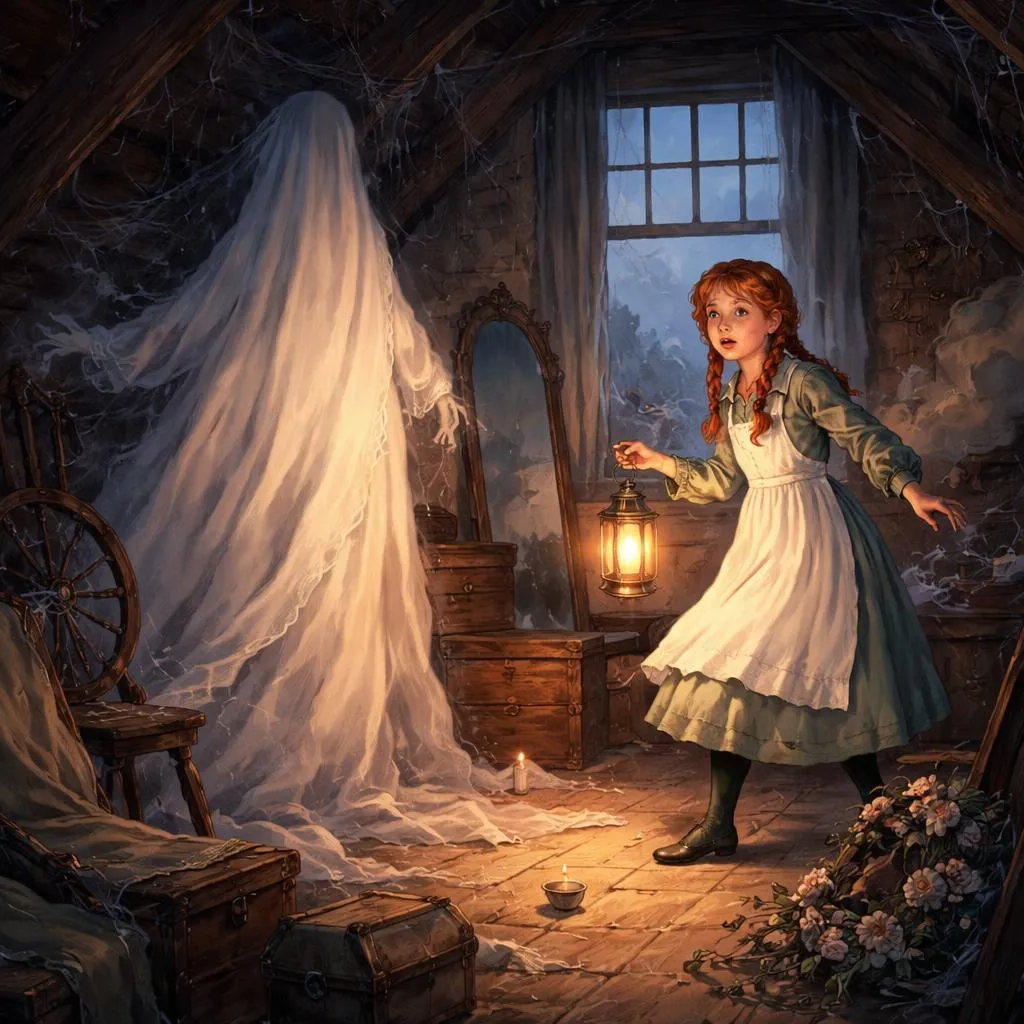
“Nobody,” confessed Anne. “Diana and I just imagined the wood washaunted. All the places around here are so—so—COMMONPLACE. We just gotthis up for our own amusement. We began it in April. A haunted wood isso very romantic, Marilla. We chose the spruce grove because it’s sogloomy. Oh, we have imagined the most harrowing things. There’s a whitelady walks along the brook just about this time of the night and wringsher hands and utters wailing cries. She appears when there is to be adeath in the family. And the ghost of a little murdered child haunts thecorner up by Idlewild; it creeps up behind you and lays its cold fingerson your hand—so. Oh, Marilla, it gives me a shudder to think of it. Andthere’s a headless man stalks up and down the path and skeletons glowerat you between the boughs. Oh, Marilla, I wouldn’t go through theHaunted Wood after dark now for anything. I’d be sure that white thingswould reach out from behind the trees and grab me.” listened in dumb amazement. “Anne Shirley, do you mean to tell me youbelieve all that wicked nonsense of your own imagination?” “Not believe EXACTLY,” faltered Anne. “At least, I don’t believe it in daylight. But after dark, Marilla, it’s different. That is when ghosts walk.”
“Did ever anyone hear the like!” ejaculated Marilla, who had listened in dumb amazement. “Anne Shirley, do you mean to tellme you believe all that wicked nonsense of your own imagination?”
“Not believe EXACTLY,” faltered Anne. “At least, I don’tbelieve it in daylight. But after dark, Marilla, it’sdifferent. That is when ghosts walk.”
“There are no such things as ghosts, Anne.”
“Oh, but there are, Marilla,” cried Anne eagerly. “I know people who have seen them. And they are respectable people. Charlie Sloane says that his grandmother saw his grandfather driving home the cows one night after he’d been buried for a year. You know Charlie Sloane’s grandmother wouldn’t tell a story for anything. She’s a very religious woman. And Mrs. Thomas’s father was pursued home one night by a lamb of fire with its head cut off hanging by a strip of skin. He said he knew it was the spirit of his brother and that it was a warning he would die within nine days. He didn’t, but he died two years after, so you see it was really true. And Ruby Gillis says—”
“Anne Shirley,” interrupted Marilla firmly, “I never want to hear you talking in this fashion again. I’ve had my doubts about that imagination of yours right along, and if this is going to be the outcome of it, I won’t countenance any such doings. You’ll go right over to Barry’s, and you’ll go through that spruce grove, just for a lesson and a warning to you. And never let me hear a word out of your head about haunted woods again.”
Anne might plead and cry as she liked—and did, for her terror was very real. Her imagination had run away with her and she held the spruce grove in mortal dread after nightfall. But Marilla was inexorable. She marched the shrinking ghost-seer down to the spring and ordered her to proceed straightaway over the bridge and into the dusky retreats of wailing ladies and headless specters beyond.
“Oh, Marilla, how can you be so cruel?” sobbed Anne. “What would you feel like if a white thing did snatch me up and carry me off?”
“I’ll risk it,” said Marilla unfeelingly. “You know I always mean what I say. I’ll cure you of imagining ghosts into places. March, now.”
Anne marched. That is, she stumbled over the bridge and went shuddering up the horrible dim path beyond. Anne never forgot that walk. Bitterly did she repent the license she had given to her imagination. The goblins of her fancy lurked in every shadow about her, reaching out their cold, fleshless hands to grasp the terrified small girl who had called them into being. A white strip of birch bark blowing up from the hollow over the brown floor of the grove made her heart stand still. The long-drawn wail of two old boughs rubbing against each other brought out the perspiration in beads on her forehead. The swoop of bats in the darkness over her was as the wings of unearthly creatures. When she reached Mr. William Bell’s field she fled across it as if pursued by an army of white things, and arrived at the Barry kitchen door so out of breath that she could hardly gasp out her request for the apron pattern. Diana was away so that she had no excuse to linger. The dreadful return journey had to be faced. Anne went back over it with shut eyes, preferring to take the risk of dashing her brains out among the boughs to that of seeing a white thing. When she finally stumbled over the log bridge she drew one long shivering breath of relief.
“Well, so nothing caught you?” said Marilla unsympathetically.
“Oh, Mar—Marilla,” chattered Anne, “I’ll b-b-be contt-tented with c-c-commonplace places after this.”
背景介紹與作者介紹
這段摘錄出自《綠山牆的安妮》,這是一部由加拿大作家露西·莫德·蒙哥馬利所著的經典小說,於1908年首次出版。故事發生在加拿大愛德華王子島虛構的艾凡利村莊,講述了安妮·雪莉的冒險和成長,她是一位富有想像力和活力的孤兒,被誤送到瑪麗拉和馬修·卡斯伯特那裡,這對兄妹原本打算收養一個男孩來幫助他們在農場工作。
露西·莫德·蒙哥馬利深受她在愛德華王子島鄉村長大的經歷的影響,她的作品充滿了對大自然的生動描述,以及對季節變化的深刻欣賞。她筆下的安妮·雪莉已成為全球兒童文學中最受歡迎的角色之一。
故事的詳細解讀和意義
這段文字捕捉了安妮的性格精髓——她豐富的想像力、她與大自然的深厚聯繫,以及她情感上的敏感。春天的到來象徵著更新和希望,反映了安妮在新家中的成長和綻放。五月花和紫羅蘭不僅僅是花朵;它們代表著美麗、純真,以及安妮深深珍視的生活中的小小的快樂。
安妮對「鬼森林」的想像恐懼揭示了她年輕的純真和故事的力量,同時也突出了想像與現實之間的緊張關係——這是小說中的一個核心主題。瑪麗拉務實和不苟言笑的態度與安妮夢幻的性格形成了鮮明對比,創造了一種推動故事大部分溫暖和幽默感的動態。
這個故事講述了成長的普遍經歷——平衡夢想與現實,學習責任,以及找到自己在世界上的位置。安妮對她多個「自我」的反思顯示了她的自我意識和複雜性,使她成為年輕讀者可以產生共鳴和啟發的人物。
給兒童和學生的教訓和啟示
-
想像力的力量: 安妮豐富的想像力既是她的優勢,也是她的挑戰。學生可以學會擁抱創造力,同時也要理解在必要時將他們的想法建立在現實基礎上的重要性。
-
對自然的欣賞: 對花朵、季節和風景的詳細描述鼓勵讀者觀察和欣賞周圍的自然世界,培養一種敬畏感和環境意識。
-
韌性和成長: 安妮從孤兒到社區中受人愛戴的成員的旅程教會了韌性。儘管遇到困難,她仍然充滿希望和決心,這對學生來說是一個寶貴的教訓,他們正在面臨自己的困難。
-
平衡情感和實用性: 安妮的情感反應與瑪麗拉的實用性之間的對比表明了平衡情感與理性的重要性——這是在個人和學術生活中都有用的技能。
-
友誼和社區: 安妮與黛安娜和其他人的互動說明了友誼、善良和社會聯繫的價值,鼓勵學生建立支持性的關係。
如何在生活和學習中應用這些教訓
-
在學校: 學生可以將他們的創造力引導到寫作、藝術和解決問題中,同時也要像安妮學習的那樣,練習紀律和責任。
-
在社交場合: 像安妮一樣,學生應該擁抱他們的獨特性,但也尊重他人的觀點。他們可以學會公開交流並以同情心處理衝突。
-
在個人成長中: 安妮的故事鼓勵自我反思和接受自己的複雜性。學生可以受到啟發,探索自己的身份,並充滿信心地追求自己的夢想。
-
在克服恐懼中: 安妮與鬼森林的對峙教會了勇氣。學生可以通過理解他們的恐懼並採取小步驟來克服它們來學會面對他們的恐懼。
培養積極的精神和行為
為了培養安妮所體現的積極品質,學生可以:
- 通過創意項目練習想像性思維。
- 花時間在大自然中培養正念和欣賞。
- 設定個人目標並堅持克服挑戰。
- 用深思熟慮的決策來平衡情緒。
- 建立在善良和信任基礎上的友誼。
- 勇敢地面對恐懼,並在需要時尋求支持。
《綠山牆的安妮》仍然是一個永恆的故事,它不僅娛樂,而且教育和啟發年輕讀者成長為有思想、有想像力和有韌性的人。
