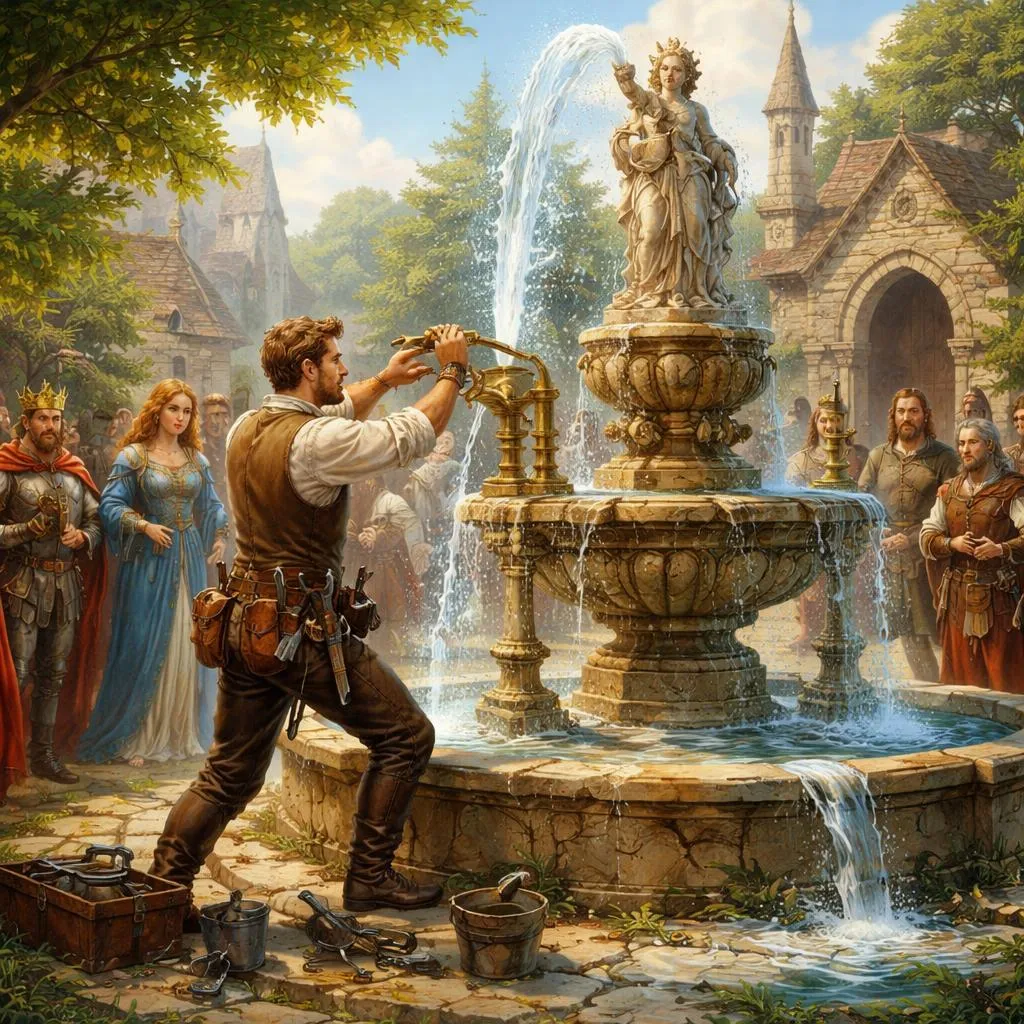

Saturday noon I went to the well and looked on a while. Merlin was still burning smoke-powders, and pawing the air, and muttering gibberish as hard as ever, but looking pretty down-hearted, for of course he had not started even a perspiration in that well yet. Finally I said:
“How does the thing promise by this time, partner?”
“Behold, I am even now busied with trial of the powerfulest enchantment known to the princes of the occult arts in the lands of the East; an it fail me, naught can avail. Peace, until I finish.”
He raised a smoke this time that darkened all the region, and must have made matters uncomfortable for the hermits, for the wind was their way, and it rolled down over their dens in a dense and billowy fog. He poured out volumes of speech to match, and contorted his body and sawed the air with his hands in a most extraordinary way. At the end of twenty minutes he dropped down panting, and about exhausted. Now arrived the abbot and several hundred monks and nuns, and behind them a multitude of pilgrims and a couple of acres of foundlings, all drawn by the prodigious smoke, and all in a grand state of excitement. The abbot inquired anxiously for results. Merlin said:
“If any labor of mortal might break the spell that binds these waters, this which I have but just essayed had done it. It has failed; whereby I do now know that that which I had feared is a truth established; the sign of this failure is, that the most potent spirit known to the magicians of the East, and whose name none may utter and live, has laid his spell upon this well. The mortal does not breathe, nor ever will, who can penetrate the secret of that spell, and without that secret none can break it. The water will flow no more forever, good Father. I have done what man could. Suffer me to go.”
Of course this threw the abbot into a good deal of a consternation. He turned to me with the signs of it in his face, and said:
“Ye have heard him. Is it true?”
“Part of it is.”
“Not all, then, not all! What part is true?”
“That that spirit with the Russian name has put his spell upon the well.”
“God’s wounds, then are we ruined!”
“Possibly.”
“But not certainly? Ye mean, not certainly?”
“That is it.”
“Wherefore, ye also mean that when he saith none can break the spell—”
“Yes, when he says that, he says what isn’t necessarily true. There are conditions under which an effort to break it may have some chance—that is, some small, some trifling chance—of success.”
“The conditions—”
“Oh, they are nothing difficult. Only these: I want the well and the surroundings for the space of half a mile, entirely to myself from sunset to-day until I remove the ban—and nobody allowed to cross the ground but by my authority.”
“Are these all?”
“Yes.”
“And you have no fear to try?”
“Oh, none. One may fail, of course; and one may also succeed. One can try, and I am ready to chance it. I have my conditions?”
“These and all others ye may name. I will issue commandment to that effect.”
“Wait,” said Merlin, with an evil smile. “Ye wit that he that would break this spell must know that spirit’s name?”
“Yes, I know his name.”
“And wit you also that to know it skills not of itself, but ye must likewise pronounce it? Ha-ha! Knew ye that?”
“Yes, I knew that, too.”
“You had that knowledge! Art a fool? Are ye minded to utter that name and die?”
“Utter it? Why certainly. I would utter it if it was Welsh.”
“Ye are even a dead man, then; and I go to tell Arthur.”
“That’s all right. Take your gripsack and get along. The thing for you to do is to go home and work the weather, John W. Merlin.”
It was a home shot, and it made him wince; for he was the worst weather-failure in the kingdom. Whenever he ordered up the danger-signals along the coast there was a week’s dead calm, sure, and every time he prophesied fair weather it rained brickbats. But I kept him in the weather bureau right along, to undermine his reputation. However, that shot raised his bile, and instead of starting home to report my death, he said he would remain and enjoy it.
My two experts arrived in the evening, and pretty well fagged, for they had traveled double tides. They had pack-mules along, and had brought everything I needed—tools, pump, lead pipe, Greek fire, sheaves of big rockets, roman candles, colored fire sprays, electric apparatus, and a lot of sundries—everything necessary for the stateliest kind of a miracle. They got their supper and a nap, and about midnight we sallied out through a solitude so wholly vacant and complete that it quite overpassed the required conditions. We took possession of the well and its surroundings. My boys were experts in all sorts of things, from the stoning up of a well to the constructing of a mathematical instrument. An hour before sunrise we had that leak mended in ship-shape fashion, and the water began to rise. Then we stowed our fireworks in the chapel, locked up the place, and went home to bed.
Before the noon mass was over, we were at the well again; for there was a deal to do yet, and I was determined to spring the miracle before midnight, for business reasons: for whereas a miracle worked for the Church on a week-day is worth a good deal, it is worth six times as much if you get it in on a Sunday. In nine hours the water had risen to its customary level—that is to say, it was within twenty-three feet of the top. We put in a little iron pump, one of the first turned out by my works near the capital; we bored into a stone reservoir which stood against the outer wall of the well-chamber and inserted a section of lead pipe that was long enough to reach to the door of the chapel and project beyond the threshold, where the gushing water would be visible to the two hundred and fifty acres of people I was intending should be present on the flat plain in front of this little holy hillock at the proper time.
We knocked the head out of an empty hogshead and hoisted this hogshead to the flat roof of the chapel, where we clamped it down fast, poured in gunpowder till it lay loosely an inch deep on the bottom, then we stood up rockets in the hogshead as thick as they could loosely stand, all the different breeds of rockets there are; and they made a portly and imposing sheaf, I can tell you. We grounded the wire of a pocket electrical battery in that powder, we placed a whole magazine of Greek fire on each corner of the roof—blue on one corner, green on another, red on another, and purple on the last—and grounded a wire in each.
About two hundred yards off, in the flat, we built a pen of scantlings, about four feet high, and laid planks on it, and so made a platform. We covered it with swell tapestries borrowed for the occasion, and topped it off with the abbot’s own throne. When you are going to do a miracle for an ignorant race, you want to get in every detail that will count; you want to make all the properties impressive to the public eye; you want to make matters comfortable for your head guest; then you can turn yourself loose and play your effects for all they are worth. I know the value of these things, for I know human nature. You can’t throw too much style into a miracle. It costs trouble, and work, and sometimes money; but it pays in the end. Well, we brought the wires to the ground at the chapel, and then brought them under the ground to the platform, and hid the batteries there. We put a rope fence a hundred feet square around the platform to keep off the common multitude, and that finished the work. My idea was, doors open at 10:30, performance to begin at 11:25 sharp. I wished I could charge admission, but of course that wouldn’t answer. I instructed my boys to be in the chapel as early as 10, before anybody was around, and be ready to man the pumps at the proper time, and make the fur fly. Then we went home to supper.
The news of the disaster to the well had traveled far by this time; and now for two or three days a steady avalanche of people had been pouring into the valley. The lower end of the valley was become one huge camp; we should have a good house, no question about that. Criers went the rounds early in the evening and announced the coming attempt, which put every pulse up to fever heat. They gave notice that the abbot and his official suite would move in state and occupy the platform at 10:30, up to which time all the region which was under my ban must be clear; the bells would then cease from tolling, and this sign should be permission to the multitudes to close in and take their places.
I was at the platform and all ready to do the honors when the abbot’s solemn procession hove in sight—which it did not do till it was nearly to the rope fence, because it was a starless black night and no torches permitted. With it came Merlin, and took a front seat on the platform; he was as good as his word for once. One could not see the multitudes banked together beyond the ban, but they were there, just the same. The moment the bells stopped, those banked masses broke and poured over the line like a vast black wave, and for as much as a half hour it continued to flow, and then it solidified itself, and you could have walked upon a pavement of human heads to—well, miles.
We had a solemn stage-wait, now, for about twenty minutes—a thing I had counted on for effect; it is always good to let your audience have a chance to work up its expectancy. At length, out of the silence a noble Latin chant—men’s voices—broke and swelled up and rolled away into the night, a majestic tide of melody. I had put that up, too, and it was one of the best effects I ever invented. When it was finished I stood up on the platform and extended my hands abroad, for two minutes, with my face uplifted—that always produces a dead hush—and then slowly pronounced this ghastly word with a kind of awfulness which caused hundreds to tremble, and many women to faint:
“Constantinopolitanischerdudelsackspfeifenmachersgesellschafft!”
Just as I was moaning out the closing hunks of that word, I touched off one of my electric connections and all that murky world of people stood revealed in a hideous blue glare! It was immense —that effect! Lots of people shrieked, women curled up and quit in every direction, foundlings collapsed by platoons. The abbot and the monks crossed themselves nimbly and their lips fluttered with agitated prayers. Merlin held his grip, but he was astonished clear down to his corns; he had never seen anything to begin with that, before. Now was the time to pile in the effects. I lifted my hands and groaned out this word—as it were in agony:
“Nihilistendynamittheaterkaestchenssprengungsattentaetsversuchungen!”
—and turned on the red fire! You should have heard that Atlantic of people moan and howl when that crimson hell joined the blue! After sixty seconds I shouted:
“Transvaaltruppentropentransporttrampelthiertreibertrauungsthraenen- tragoedie!”
—and lit up the green fire! After waiting only forty seconds this time, I spread my arms abroad and thundered out the devastating syllables of this word of words:
“Mekkamuselmannenmassenmenchenmoerdermohrenmuttermarmormonumentenmacher!”
—and whirled on the purple glare! There they were, all going at once, red, blue, green, purple!—four furious volcanoes pouring vast clouds of radiant smoke aloft, and spreading a blinding rainbowed noonday to the furthest confines of that valley. In the distance one could see that fellow on the pillar standing rigid against the background of sky, his seesaw stopped for the first time in twenty years. I knew the boys were at the pump now and ready. So I said to the abbot:
“The time is come, Father. I am about to pronounce the dread name and command the spell to dissolve. You want to brace up, and take hold of something.” Then I shouted to the people: “Behold, in another minute the spell will be broken, or no mortal can break it. If it break, all will know it, for you will see the sacred water gush from the chapel door!”
I stood a few moments, to let the hearers have a chance to spread my announcement to those who couldn’t hear, and so convey it to the furthest ranks, then I made a grand exhibition of extra posturing and gesturing, and shouted:
“Lo, I command the fell spirit that possesses the holy fountain to now disgorge into the skies all the infernal fires that still remain in him, and straightway dissolve his spell and flee hence to the pit, there to lie bound a thousand years. By his own dread name I command it—BGWJJILLIGKKK!”
Then I touched off the hogshead of rockets, and a vast fountain of dazzling lances of fire vomited itself toward the zenith with a hissing rush, and burst in mid-sky into a storm of flashing jewels! One mighty groan of terror started up from the massed people —then suddenly broke into a wild hosannah of joy—for there, fair and plain in the uncanny glare, they saw the freed water leaping forth! The old abbot could not speak a word, for tears and the chokings in his throat; without utterance of any sort, he folded me in his arms and mashed me. It was more eloquent than speech. And harder to get over, too, in a country where there were really no doctors that were worth a damaged nickel.
You should have seen those acres of people throw themselves down in that water and kiss it; kiss it, and pet it, and fondle it, and talk to it as if it were alive, and welcome it back with the dear names they gave their darlings, just as if it had been a friend who was long gone away and lost, and was come home again. Yes, it was pretty to see, and made me think more of them than I had done before.
I sent Merlin home on a shutter. He had caved in and gone down like a landslide when I pronounced that fearful name, and had never come to since. He never had heard that name before,—neither had I—but to him it was the right one. Any jumble would have been the right one. He admitted, afterward, that that spirit’s own mother could not have pronounced that name better than I did. He never could understand how I survived it, and I didn’t tell him. It is only young magicians that give away a secret like that. Merlin spent three months working enchantments to try to find out the deep trick of how to pronounce that name and outlive it. But he didn’t arrive.
When I started to the chapel, the populace uncovered and fell back reverently to make a wide way for me, as if I had been some kind of a superior being—and I was. I was aware of that. I took along a night shift of monks, and taught them the mystery of the pump, and set them to work, for it was plain that a good part of the people out there were going to sit up with the water all night, consequently it was but right that they should have all they wanted of it. To those monks that pump was a good deal of a miracle itself, and they were full of wonder over it; and of admiration, too, of the exceeding effectiveness of its performance.
It was a great night, an immense night. There was reputation in it. I could hardly get to sleep for glorying over it.
背景介紹與作者介紹
這個故事是馬克·吐溫的《水巫師》的節選,馬克·吐溫是美國最著名的作家之一,以其智慧、幽默和對社會的敏銳觀察而聞名。 吐溫的真名是塞繆爾·克萊門斯,生活在 19 世紀,以《湯姆·索亞歷險記》和《哈克貝利·費恩歷險記》等經典作品而聞名。 他的故事經常將幽默與尖銳的社會批判相結合,並以生動、令人難忘的方式探索人性。
在《水巫師》中,吐溫融合了幻想、諷刺和冒險的元素,講述了一個關於魔法、信仰和人類智慧的故事。 故事圍繞著一口被強大的精靈詛咒的神秘井展開,導致水無法流動。 敘述者與他的同伴一起,進行了一場大膽而戲劇性的努力,以打破魔咒並恢復水源,使用了科學、表演和勇氣的混合。
詳細闡釋與意義
從本質上講,這個故事探討了信仰、懷疑和人類創造力的主題。 這口井象徵著一個看似無法克服的問題或挑戰,受到迷信和恐懼的束縛。 巫師梅林代表著傳統的魔法和舊的信仰,但最終未能解決這個問題。 相比之下,敘述者使用現代工具、技術和巧妙的舞台設計來創造一個“奇蹟”,為社區恢復希望和生命。
吐溫巧妙地批判了對迷信的盲目信仰和對奇觀的誘惑,同時也讚揚了人類的決心和創新。 戲劇性的煙花、吟唱的人群和精心設計的佈局都突出了人們如何被奇蹟和神秘所吸引,但真正的“魔法”在於知識和努力。
給學生的教訓和見解
-
批判性思維和創新: 敘述者的成功並非來自魔法,而是來自於運用知識、規劃和技術。 學生可以學習批判性思維和創造力在解決問題中的價值,而不是依賴迷信或放棄。
-
挑戰現狀的勇氣: 這個故事鼓勵質疑被接受的信仰,並有勇氣嘗試新的方法,即使其他人懷疑你。
-
展示的力量: 敘述者了解人性,並利用表演來激勵和團結人們。 這教導了溝通技巧的重要性以及展示如何影響他人。
-
團隊合作和準備: 敘述者的成功取決於一支專家團隊和周密的準備,突出了合作和規劃的重要性。
-
尊重他人的信仰: 雖然這個故事批判了迷信,但它也表現出對人們的希望和恐懼的同情,提醒學生在提倡理性的同時尊重不同的觀點。
在日常生活中應用故事的精神
-
在學習中: 以好奇心和願意嘗試的精神來應對挑戰。 積極運用知識,不要害怕失敗; 這是發現的一部分。
-
在社交場合: 了解言行舉止的力量。 就像敘述者精心策劃的舞台一樣,學生可以學會清晰地表達自己並積極地激勵他人。
-
在個人成長中: 接受新想法並準備好質疑舊的假設。 培養韌性和創造力以克服障礙。
-
在團隊合作中: 重視他人的優勢並共同努力實現共同目標。 準備和合作往往會帶來成功。
從故事中培養積極的品質
-
聰明才智: 鼓勵解決問題的技能和創造性思維。
-
自信: 相信自己能夠有所作為,即使面臨懷疑。
-
同情心: 認識到他人的感受和信仰,在尊重與理性之間取得平衡。
-
領導力: 學會以身作則和有效的溝通來激勵和引導他人。
-
毅力: 了解成功往往需要耐心、努力和堅持。
總結
馬克·吐溫的《水巫師》不僅僅是一個關於魔法和奇蹟的故事; 它是一個關於人類精神、智力以及理性和勇氣戰勝恐懼和迷信的故事。 對於學生和年輕讀者來說,它提供了關於如何應對挑戰、批判性思考和激勵他人的豐富教訓。 通過擁抱故事的積極價值觀,年輕人可以成長為有思想、有創造力和富有同情心的個體,準備好在世界上創造他們自己的魔法。
