
It was October again when Anne was ready to go back to school—a glorious October, all red and gold, with mellow mornings when the valleys were filled with delicate mists as if the spirit of autumn had poured them in for the sun to drain—amethyst, pearl, silver, rose, and smoke-blue. The dews were so heavy that the fields glistened like cloth of silver and there were such heaps of rustling leaves in the hollows of many-stemmed woods to run crisply through. The Birch Path was a canopy of yellow and the ferns were sear and brown all along it. There was a tang in the very air that inspired the hearts of small maidens tripping, unlike snails, swiftly and willingly to school; and it WAS jolly to be back again at the little brown desk beside Diana, with Ruby Gillis nodding across the aisle and Carrie Sloane sending up notes and Julia Bell passing a “chew” of gum down from the back seat. Anne drew a long breath of happiness as she sharpened her pencil and arranged her picture cards in her desk. Life was certainly very interesting.
In the new teacher she found another true and helpful friend. Miss Stacy was a bright, sympathetic young woman with the happy gift of winning and holding the affections of her pupils and bringing out the best that was in them mentally and morally. Anne expanded like a flower under this wholesome influence and carried home to the admiring Matthew and the critical Marilla glowing accounts of schoolwork and aims.
“I love Miss Stacy with my whole heart, Marilla. She is so ladylike and she has such a sweet voice. When she pronounces my name I feel INSTINCTIVELY that she’s spelling it with an E. We had recitations this afternoon. I just wish you could have been there to hear me recite ‘Mary, Queen of Scots.’ I just put my whole soul into it. Ruby Gillis told me coming home that the way I said the line, ‘Now for my father’s arm,’ she said, ‘my woman’s heart farewell,’ just made her blood run cold.”
“Well now, you might recite it for me some of these days, out in the barn,” suggested Matthew.
“Of course I will,” said Anne meditatively, “but I won’t be able to do it so well, I know. It won’t be so exciting as it is when you have a whole schoolful before you hanging breathlessly on your words. I know I won’t be able to make your blood run cold.”
“Mrs. Lynde says it made HER blood run cold to see the boys climbing to the very tops of those big trees on Bell’s hill after crows’ nests last Friday,” said Marilla. “I wonder at Miss Stacy for encouraging it.”
“But we wanted a crow’s nest for nature study,” explained Anne. “That was on our field afternoon. Field afternoons are splendid, Marilla. And Miss Stacy explains everything so beautifully. We have to write compositions on our field afternoons and I write the best ones.”
“It’s very vain of you to say so then. You’d better let your teacher say it.”
“But she DID say it, Marilla. And indeed I’m not vain about it. How can I be, when I’m such a dunce at geometry? Although I’m really beginning to see through it a little, too. Miss Stacy makes it so clear. Still, I’ll never be good at it and I assure you it is a humbling reflection. But I love writing compositions. Mostly Miss Stacy lets us choose our own subjects; but next week we are to write a composition on some remarkable person. It’s hard to choose among so many remarkable people who have lived. Mustn’t it be splendid to be remarkable and have compositions written about you after you’re dead? Oh, I would dearly love to be remarkable. I think when I grow up I’ll be a trained nurse and go with the Red Crosses to the field of battle as a messenger of mercy. That is, if I don’t go out as a foreign missionary. That would be very romantic, but one would have to be very good to be a missionary, and that would be a stumbling block. We have physical culture exercises every day, too. They make you graceful and promote digestion.”
“Promote fiddlesticks!” said Marilla, who honestly thought it was all nonsense.
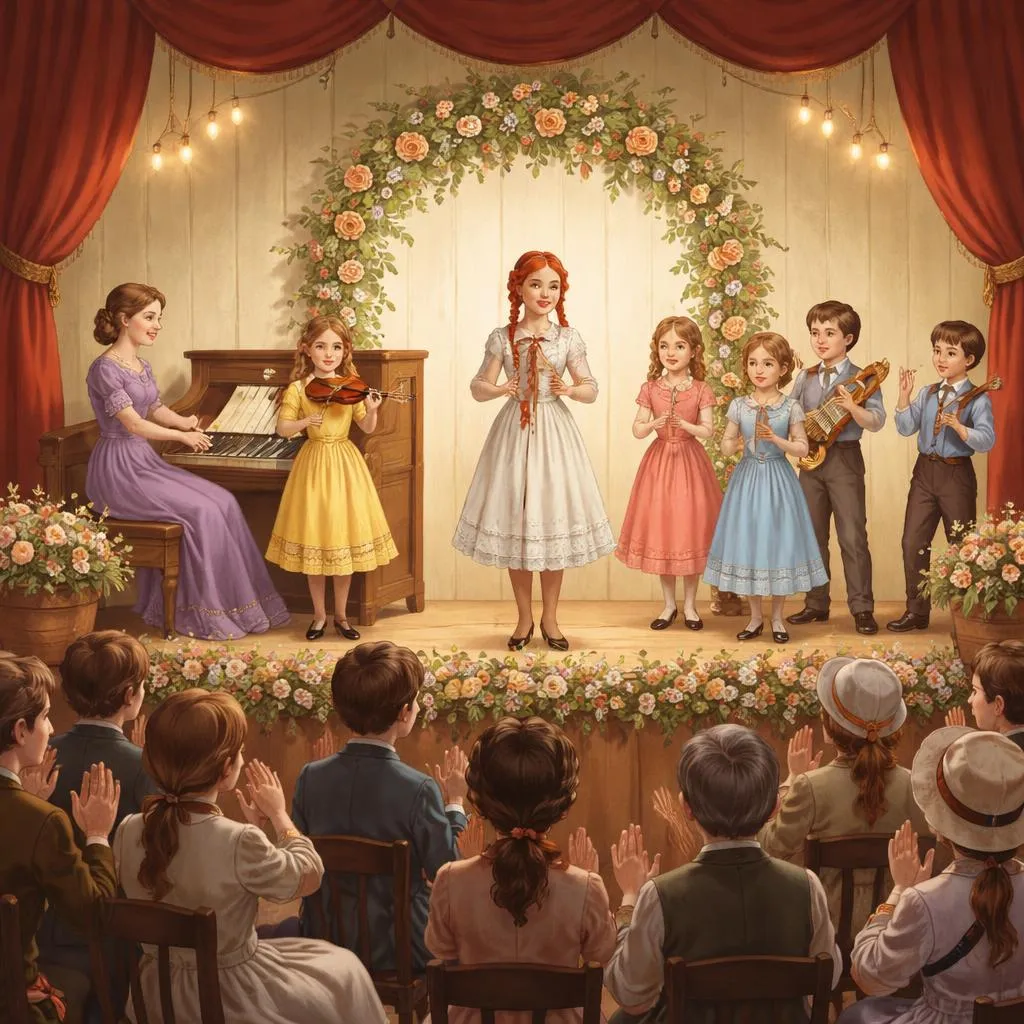
But all the field afternoons and recitation Fridays and physical culture contortions paled before a project which Miss Stacy brought forward in November. This was that the scholars of Avonlea school should get up a concert and hold it in the hall on Christmas Night, for the laudable purpose of helping to pay for a schoolhouse flag. The pupils one and all taking graciously to this plan, the preparations for a program were begun at once. And of all the excited performers-elect none was so excited as Anne Shirley, who threw herself into the undertaking heart and soul, hampered as she was by Marilla’s disapproval. Marilla thought it all rank foolishness.
“It’s just filling your heads up with nonsense and taking time that ought to be put on your lessons,” she grumbled. “I don’t approve of children’s getting up concerts and racing about to practices. It makes them vain and forward and fond of gadding.”
“But think of the worthy object,” pleaded Anne. “A flag will cultivate a spirit of patriotism, Marilla.”
“Fudge! There’s precious little patriotism in the thoughts of any of you. All you want is a good time.”
“Well, when you can combine patriotism and fun, isn’t it all right? Of course it’s real nice to be getting up a concert. We’re going to have six choruses and Diana is to sing a solo. I’m in two dialogues—’The Society for the Suppression of Gossip’ and ‘The Fairy Queen.’ The boys are going to have a dialogue too. And I’m to have two recitations, Marilla. I just tremble when I think of it, but it’s a nice thrilly kind of tremble. And we’re to have a tableau at the last—’Faith, Hope and Charity.’ Diana and Ruby and I are to be in it, all draped in white with flowing hair. I’m to be Hope, with my hands clasped—so—and my eyes uplifted. I’m going to practice my recitations in the garret. Don’t be alarmed if you hear me groaning. I have to groan heartrendingly in one of them, and it’s really hard to get up a good artistic groan, Marilla. Josie Pye is sulky because she didn’t get the part she wanted in the dialogue. She wanted to be the fairy queen. That would have been ridiculous, for who ever heard of a fairy queen as fat as Josie? Fairy queens must be slender. Jane Andrews is to be the queen and I am to be one of her maids of honor. Josie says she thinks a red-haired fairy is just as ridiculous as a fat one, but I do not let myself mind what Josie says. I’m to have a wreath of white roses on my hair and Ruby Gillis is going to lend me her slippers because I haven’t any of my own. It’s necessary for fairies to have slippers, you know. You couldn’t imagine a fairy wearing boots, could you? Especially with copper toes? We are going to decorate the hall with creeping spruce and fir mottoes with pink tissue-paper roses in them. And we are all to march in two by two after the audience is seated, while Emma White plays a march on the organ. Oh, Marilla, I know you are not so enthusiastic about it as I am, but don’t you hope your little Anne will distinguish herself?”
“All I hope is that you’ll behave yourself. I’ll be heartily glad when all this fuss is over and you’ll be able to settle down. You are simply good for nothing just now with your head stuffed full of dialogues and groans and tableaus. As for your tongue, it’s a marvel it’s not clean worn out.”
Anne sighed and betook herself to the back yard, over which a young new moon was shining through the leafless poplar boughs from an apple-green western sky, and where Matthew was splitting wood. Anne perched herself on a block and talked the concert over with him, sure of an appreciative and sympathetic listener in this instance at least.
“Well now, I reckon it’s going to be a pretty good concert. And I expect you’ll do your part fine,” he said, smiling down into her eager, vivacious little face. Anne smiled back at him. Those two were the best of friends and Matthew thanked his stars many a time and oft that he had nothing to do with bringing her up. That was Marilla’s exclusive duty; if it had been his he would have been worried over frequent conflicts between inclination and said duty. As it was, he was free to, “spoil Anne”—Marilla’s phrasing—as much as he liked. But it was not such a bad arrangement after all; a little “appreciation” sometimes does quite as much good as all the conscientious “bringing up” in the world.
背景與作者介紹
這篇摘錄自《清秀佳人》,是一部由加拿大作家露西·莫德·蒙哥馬利所著的經典小說。該書於1908年出版,講述了安妮·雪莉的故事,她是一位富有想像力和活力的孤兒,被誤送到馬里拉和馬修·卡斯伯特那裡,他們是一對兄妹,原本打算收養一個男孩來幫助他們在愛德華王子島艾凡里鎮的農場工作。這部小說因其對鄉村生活的生動描寫、迷人的角色以及關於歸屬感、身份認同和個人成長的主題而深受世界各地人們的喜愛。蒙哥馬利受到她自己的童年經歷和愛德華王子島美麗風光的啟發,創造了一個永恆的故事,頌揚想像力、韌性以及成長的喜悅和挑戰。
詳細解讀與意義
這段文字捕捉了安妮重返學校的興奮之情,以及她對新老師史黛西小姐的欽佩之情,史黛西小姐鼓勵她的智力和道德發展。對秋天和學校環境的生動描寫突出了安妮與自然的深厚聯繫以及她歡快的精神。學校音樂會項目象徵著社區精神、創造力以及為共同目標共同努力的重要性。安妮的熱情與馬里拉的實際擔憂形成了對比,說明了想像力與現實主義之間的緊張關係——這是小說中的一個核心主題。
安妮渴望變得出色,以及她想成為護士或傳教士的夢想,揭示了她希望對世界產生有意義的影響的願望,反映了小說對雄心壯志和目標的鼓勵。這個故事也觸及了友誼、自我表達和教育價值的主題,展示了像史黛西小姐這樣的積極影響如何培養孩子的潛力。
給學生的教訓和啟發
學生們閱讀這個故事可以學到幾個寶貴的教訓:
-
**想像力和樂觀主義的力量:**安妮生動的想像力和積極的態度幫助她克服挑戰,並在日常生活中找到快樂。學生們可以受到啟發,以創造性的方式看待世界,並擁抱他們獨特的品質。
-
**教育和指導的重要性:**史黛西小姐作為一位支持性的老師,展示了教育工作者如何激發信心和成長。學生們應該欣賞學習的價值,並從導師那裡尋求指導。
-
**平衡夢想與現實:**安妮的夢想是宏大的,但她也認識到自己的局限性,例如她在幾何方面的掙扎。這教導學生堅持不懈和謙遜的重要性。
-
**社區與合作:**學校音樂會項目表明,共同努力如何實現有意義的目標並建立歸屬感。
-
**尊重不同的觀點:**安妮和馬里拉的不同觀點鼓勵讀者理解和尊重各種意見,平衡熱情與實用性。
在生活、學習和社交場合中的應用
- **在學校:**學生們可以運用安妮對學習的熱情,積極參與課堂,參加課外活動,並勇敢地迎接挑戰。
- **在社交生活中:**安妮的善良和樂於接納他人的精神可以激勵學生建立在同情和支持基礎上的友誼。
- **在個人成長中:**安妮的故事鼓勵自我表達和追求自己的熱情,同時也從建設性的批評中學習並努力改進。
- **在社區參與中:**像音樂會項目一樣,學生們可以參與社區活動,學習團隊合作和為事業做出貢獻的喜悅。
從故事中培養積極的特質
- **好奇心和對學習的熱愛:**效仿安妮的榜樣,提出問題,探索新科目,並享受發現的過程。
- **韌性和樂觀主義:**以樂觀的態度面對困難,將挫折視為變得更強大的機會。
- **創造力和想像力:**運用創造性思維來解決問題,並通過寫作、藝術或表演來表達自己。
- **尊重和善良:**尊重他人,即使意見不同,並向朋友和同學提供支持。
- **責任感和承諾:**認真履行你的職責,無論是在學校項目還是家庭任務中,都要平衡樂趣與專注。
《清秀佳人》仍然是一個對年輕讀者來說很有力量的故事,鼓勵他們擁抱自己的個性,培養自己的才能,並為他們的社區做出積極貢獻。通過安妮的眼睛,學生們了解到生活充滿了奇蹟,只要有勇氣和善良,他們就能在世界上留下自己非凡的印記。
