
When I told the king I was going out disguised as a petty freeman to scour the country and familiarize myself with the humbler life of the people, he was all afire with the novelty of the thing in a minute, and was bound to take a chance in the adventure himself—nothing should stop him—he would drop everything and go along—it was the prettiest idea he had run across for many a day. He wanted to glide out the back way and start at once; but I showed him that that wouldn’t answer. You see, he was billed for the king’s-evil—to touch for it, I mean—and it wouldn’t be right to disappoint the house and it wouldn’t make a delay worth considering, anyway, it was only a one-night stand. And I thought he ought to tell the queen he was going away. He clouded up at that and looked sad. I was sorry I had spoken, especially when he said mournfully:
“Thou forgettest that Launcelot is here; and where Launcelot is, she noteth not the going forth of the king, nor what day he returneth.”
Of course, I changed the Subject. Yes, Guenever was beautiful, it is true, but take her all around she was pretty slack. I never meddled in these matters, they weren’t my affair, but I did hate to see the way things were going on, and I don’t mind saying that much. Many’s the time she had asked me, “Sir Boss, hast seen Sir Launcelot about?” but if ever she went fretting around for the king I didn’t happen to be around at the time.
There was a very good lay-out for the king’s-evil business—very tidy and creditable. The king sat under a canopy of state; about him were clustered a large body of the clergy in full canonicals. Conspicuous, both for location and personal outfit, stood Marinel, a hermit of the quack-doctor species, to introduce the sick. All abroad over the spacious floor, and clear down to the doors, in a thick jumble, lay or sat the scrofulous, under a strong light. It was as good as a tableau; in fact, it had all the look of being gotten up for that, though it wasn’t. There were eight hundred sick people present. The work was slow; it lacked the interest of novelty for me, because I had seen the ceremonies before; the thing soon became tedious, but the proprieties required me to stick it out. The doctor was there for the reason that in all such crowds there were many people who only imagined something was the matter with them, and many who were consciously sound but wanted the immortal honor of fleshly contact with a king, and yet others who pretended to illness in order to get the piece of coin that went with the touch. Up to this time this coin had been a wee little gold piece worth about a third of a dollar. When you consider how much that amount of money would buy, in that age and country, and how usual it was to be scrofulous, when not dead, you would understand that the annual king’s-evil appropriation was just the River and Harbor bill of that government for the grip it took on the treasury and the chance it afforded for skinning the surplus. So I had privately concluded to touch the treasury itself for the king’s-evil. I covered six-sevenths of the appropriation into the treasury a week before starting from Camelot on my adventures, and ordered that the other seventh be inflated into five-cent nickels and delivered into the hands of the head clerk of the King’s Evil Department; a nickel to take the place of each gold coin, you see, and do its work for it. It might strain the nickel some, but I judged it could stand it. As a rule, I do not approve of watering stock, but I considered it square enough in this case, for it was just a gift, anyway. Of course, you can water a gift as much as you want to; and I generally do. The old gold and silver coins of the country were of ancient and origin, as a rule, but some of them were Roman; they were ill-shapen, and seldom rounder than a moon that is a week past the full; they were hammered, not minted, and they were so worn with use that the devices upon them were as illegible as blisters, and looked like them. I judged that a sharp, bright new nickel, with a first-rate likeness of the king on one side of it and Guenever on the other, and a blooming pious motto, would take the tuck out of scrofula as handy as a nobler coin and please the scrofulous fancy more; and I was right. This batch was the first it was tried on, and it worked to a charm. The saving in expense was a notable economy. You will see that by these figures: We touched a trifle over 700 of the 800 patients; at former rates, this would have cost the government about $240; at the new rate we pulled through for about $35, thus saving upward of $200 at one swoop. To appreciate the full magnitude of this stroke, consider these other figures: the annual expenses of a national government amount to the equivalent of a contribution of three days’ average wages of every individual of the population, counting every individual as if he were a man. If you take a nation of 60,000,000, where average wages are $2 per day, three days’ wages taken from each individual will provide $360,000,000 and pay the government’s expenses. In my day, in my own country, this money was collected from imposts, and the citizen imagined that the foreign importer paid it, and it made him comfortable to think so; whereas, in fact, it was paid by the American people, and was so equally and exactly distributed among them that the annual cost to the 100-millionaire and the annual cost to the sucking child of the day-laborer was precisely the same—each paid $6. Nothing could be equaler than that, I reckon. Well, Scotland and Ireland were tributary to Arthur, and the united populations of the British Islands amounted to something less than 1,000,000. A mechanic’s average wage was 3 cents a day, when he paid his own keep. By this rule the national government’s expenses were $90,000 a year, or about $250 a day. Thus, by the substitution of nickels for gold on a king’s-evil day, I not only injured no one, dissatisfied no one, but pleased all concerned and saved four-fifths of that day’s national expense into the bargain—a saving which would have been the equivalent of $800,000 in my day in America. In making this substitution I had drawn upon the wisdom of a very remote source—the wisdom of my boyhood—for the true statesman does not despise any wisdom, howsoever lowly may be its origin: in my boyhood I had always saved my pennies and contributed buttons to the foreign missionary cause. The buttons would answer the ignorant savage as well as the coin, the coin would answer me better than the buttons; all hands were happy and nobody hurt.
Marinel took the patients as they came. He examined the candidate; if he couldn’t qualify he was warned off; if he could he was passed along to the king. A priest pronounced the words, “They shall lay their hands on the sick, and they shall recover.” Then the king stroked the ulcers, while the reading continued; finally, the patient graduated and got his nickel—the king hanging it around his neck himself—and was dismissed. Would you think that that would cure? It certainly did. Any mummery will cure if the patient’s faith is strong in it. Up by Astolat there was a chapel where the Virgin had once appeared to a girl who used to herd geese around there—the girl said so herself—and they built the chapel upon that spot and hung a picture in it representing the occurrence—a picture which you would think it dangerous for a sick person to approach; whereas, on the contrary, thousands of the lame and the sick came and prayed before it every year and went away whole and sound; and even the well could look upon it and live. Of course, when I was told these things I did not believe them; but when I went there and saw them I had to succumb. I saw the cures effected myself; and they were real cures and not questionable. I saw cripples whom I had seen around Camelot for years on crutches, arrive and pray before that picture, and put down their crutches and walk off without a limp. There were piles of crutches there which had been left by such people as a testimony.
In other places people operated on a patient’s mind, without saying a word to him, and cured him. In others, experts assembled patients in a room and prayed over them, and appealed to their faith, and those patients went away cured. Wherever you find a king who can’t cure the king’s-evil you can be sure that the most valuable superstition that supports his throne—the subject’s belief in the divine appointment of his sovereign—has passed away. In my youth the monarchs of England had ceased to touch for the evil, but there was no occasion for this diffidence: they could have cured it forty-nine times in fifty.
Well, when the priest had been droning for three hours, and the good king polishing the evidences, and the sick were still pressing forward as plenty as ever, I got to feeling intolerably bored. I was sitting by an open window not far from the canopy of state. For the five hundredth time a patient stood forward to have his repulsivenesses stroked; again those words were being droned out: “they shall lay their hands on the sick”—when outside there rang clear as a clarion a note that enchanted my soul and tumbled thirteen worthless centuries about my ears: “Camelot Weekly Hosannah and Literary Volcano! —latest irruption—only two cents —all about the big miracle in the Valley of Holiness!” One greater than kings had arrived—the newsboy. But I was the only person in all that throng who knew the meaning of this mighty birth, and what this imperial magician was come into the world to do.
I dropped a nickel out of the window and got my paper; the Adam-newsboy of the world went around the corner to get my change; is around the corner yet. It was delicious to see a newspaper again, yet I was conscious of a secret shock when my eye fell upon the first batch of display head-lines. I had lived in a clammy atmosphere of reverence, respect, deference, so long that they sent a quivery little cold wave through me:
—and so on, and so on. Yes, it was too loud. Once I could have enjoyed it and seen nothing out of the way about it, but now its note was discordant. It was good Arkansas journalism, but this was not Arkansas. Moreover, the next to the last line was calculated to give offense to the hermits, and perhaps lose us their advertising. Indeed, there was too lightsome a tone of flippancy all through the paper. It was plain I had undergone a considerable change without noticing it. I found myself unpleasantly affected by pert little irreverencies which would have seemed but proper and airy graces of speech at an earlier period of my life. There was an abundance of the following breed of items, and they discomforted me:
Of course it was good enough journalism for a beginning; I knew that quite well, and yet it was somehow disappointing. The “Court Circular” pleased me better; indeed, its simple and dignified respectfulness was a distinct refreshment to me after all those disgraceful familiarities. But even it could have been improved. Do what one may, there is no getting an air of variety into a court circular, I acknowledge that. There is a profound monotonousness about its facts that baffles and defeats one’s sincerest efforts to make them sparkle and enthuse. The best way to manage—in fact, the only sensible way—is to disguise repetitiousness of fact under variety of form: skin your fact each time and lay on a new cuticle of words. It deceives the eye; you think it is a new fact; it gives you the idea that the court is carrying on like everything; this excites you, and you drain the whole column, with a good appetite, and perhaps never notice that it’s a barrel of soup made out of a single bean. Clarence’s way was good, it was simple, it was dignified, it was direct and business-like; all I say is, it was not the best way:
COURT CIRCULAR.
On Monday, the king rode in the park. “ Tuesday, “ “ “ “ Wendesday “ “ “ “ Thursday “ “ “ “ Friday, “ “ “ “ Saturday “ “ “ “ Sunday, “ “ “ However, take the paper by and large, I was vastly pleased with it. Little crudities of a mechanical sort were observable here and there, but there were not enough of them to amount to anything, and it was good enough Arkansas proof-reading, anyhow, and better than was needed in Arthur’s day and realm. As a rule, the grammar was leaky and the construction more or less lame; but I did not much mind these things. They are common defects of my own, and one mustn’t criticise other people on grounds where he can’t stand perpendicular himself.
I was hungry enough for literature to want to take down the whole paper at this one meal, but I got only a few bites, and then had to postpone, because the monks around me besieged me so with eager questions: What is this curious thing? What is it for? Is it a handkerchief?—saddle blanket?—part of a shirt? What is it made of? How thin it is, and how dainty and frail; and how it rattles. Will it wear, do you think, and won’t the rain injure it? Is it writing that appears on it, or is it only ornamentation? They suspected it was writing, because those among them who knew how to read Latin and had a smattering of Greek, recognized some of the letters, but they could make nothing out of the result as a whole. I put my information in the simplest form I could:
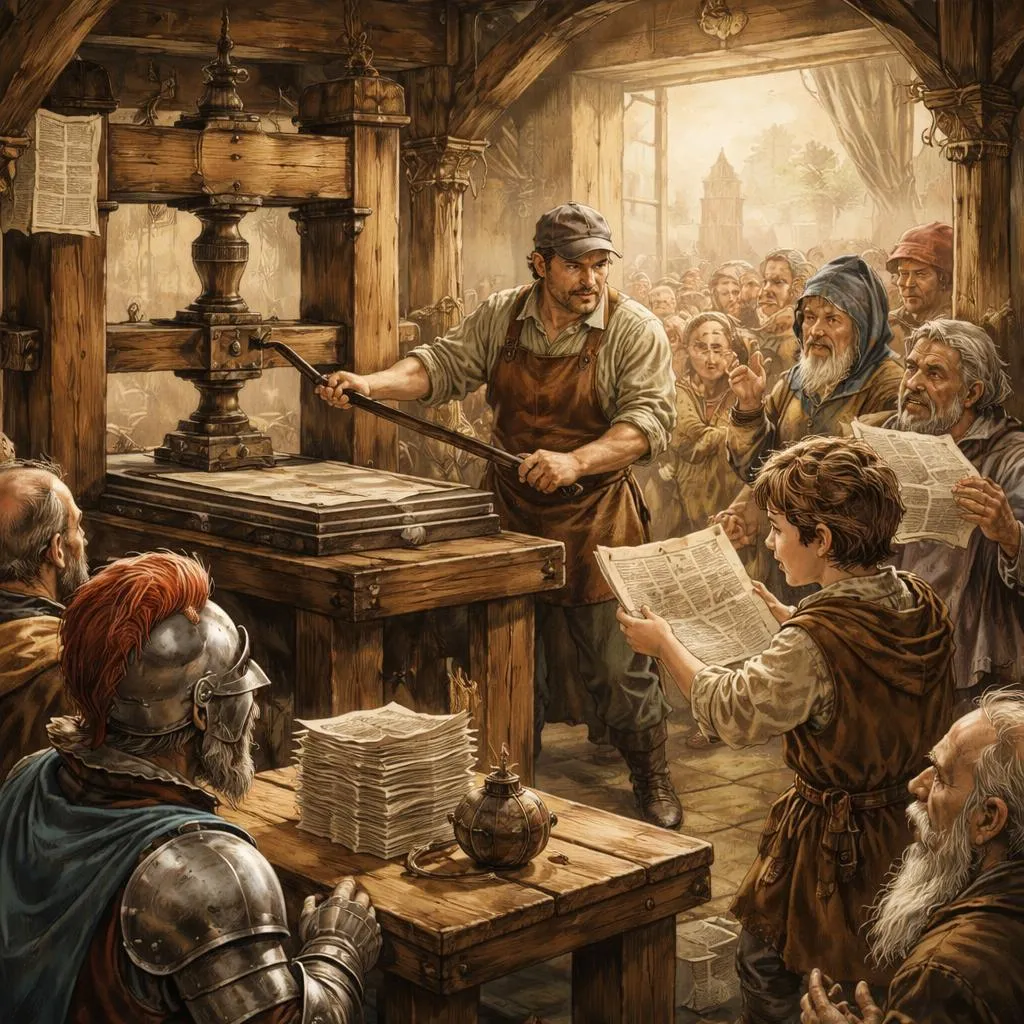
“It is a public journal; I will explain what that is, another time. It is not cloth, it is made of paper; some time I will explain what paper is. The lines on it are reading matter; and not written by hand, but printed; by and by I will explain what printing is. A thousand of these sheets have been made, all exactly like this, in every minute detail—they can’t be told apart.” Then they all broke out with exclamations of surprise and admiration:
“A thousand! Verily a mighty work—a year’s work for many men.”
“No—merely a day’s work for a man and a boy.”
They crossed themselves, and whiffed out a protective prayer or two.
“Ah-h—a miracle, a wonder! Dark work of enchantment.”
I let it go at that. Then I read in a low voice, to as many as could crowd their shaven heads within hearing distance, part of the account of the miracle of the restoration of the well, and was accompanied by astonished and reverent ejaculations all through: “Ah-h-h!” “How true!” “Amazing, amazing!” “These be the very haps as they happened, in marvelous exactness!” And might they take this strange thing in their hands, and feel of it and examine it?—they would be very careful. Yes. So they took it, handling it as cautiously and devoutly as if it had been some holy thing come from some supernatural region; and gently felt of its texture, caressed its pleasant smooth surface with lingering touch, and scanned the mysterious characters with fascinated eyes. These grouped bent heads, these charmed faces, these speaking eyes —how beautiful to me! For was not this my darling, and was not all this mute wonder and interest and homage a most eloquent tribute and unforced compliment to it? I knew, then, how a mother feels when women, whether strangers or friends, take her new baby, and close themselves about it with one eager impulse, and bend their heads over it in a tranced adoration that makes all the rest of the universe vanish out of their consciousness and be as if it were not, for that time. I knew how she feels, and that there is no other satisfied ambition, whether of king, conqueror, or poet, that ever reaches half-way to that serene far summit or yields half so divine a contentment.
During all the rest of the seance my paper traveled from group to group all up and down and about that huge hall, and my happy eye was upon it always, and I sat motionless, steeped in satisfaction, drunk with enjoyment. Yes, this was heaven; I was tasting it once, if I might never taste it more.
背景與作者介紹
這段文字選自馬克·吐溫的《國王的邪惡》,馬克·吐溫是一位備受讚譽的美國作家,以其敏銳的智慧和深刻的社會評論而聞名。吐溫經常運用幽默和諷刺來探討人性以及社會的缺陷。這個故事的背景設定在傳奇的亞瑟王宮廷,結合了歷史幻想和吐溫對政治、迷信和人類行為的獨特見解。
馬克·吐溫(塞繆爾·克萊門斯)生活在19世紀,以《湯姆·索亞歷險記》和《哈克貝利·費恩歷險記》等經典作品而聞名。他的作品經常反映道德、社會和人類狀況,使其對所有年齡段的讀者都具有價值。
詳細闡釋與意義
這個故事幽默地批判了「國王的邪惡」的做法——這是一種歷史悠久的信仰,認為國王可以通過觸摸受害者來治癒淋巴結核(一種結核病)。吐溫利用這個背景來探討權力、信仰以及統治者與其臣民之間的關係等主題。國王願意偽裝成平民加入冒險,表明了他的好奇心和與人民聯繫的願望,但觸摸國王的邪惡的儀式揭示了維持其權威的迷信與政治的融合。
吐溫引入鎳幣取代金幣,象徵著實用的創新和經濟改革,表明微小的變化如何產生重大影響。這個故事也突出了信仰和信念如何帶來真正的治癒,即使治癒本身是象徵性的或心理上的。
報紙的到來代表了現代信息和交流的曙光,與舊的敬畏和神秘的方式形成對比。吐溫對僧侶們對報紙的反應的思考,表明了傳統與進步之間的衝突。
給學生的教訓和見解
-
批判性思維和質疑傳統: 故事鼓勵讀者批判性地思考習俗和信仰。雖然信仰可以發揮強大的作用,但重要的是要理解傳統背後的理由,並對變化和創新持開放態度。
-
信仰和希望的力量: 吐溫表明,信念本身就可以治癒。這教導學生在克服困難時,積極思考和希望的力量。
-
領導力和同理心: 國王渴望了解他的人民的生活,提醒學生領導者應該富有同情心,並與他們所服務的人聯繫起來。
-
創新的價值: 用鎳幣代替金幣說明了創造性的解決方案如何改善社會並節省資源——這是解決問題和足智多謀的一課。
-
溝通的重要性: 報紙的引入突出了獲取信息如何改變社會,強調了學習、識字和保持知情的重要性。
在日常生活中應用這些教訓
-
在學習中: 學生可以通過質疑他們所讀和所聽到的內容、尋求證據並對新想法持開放態度來運用批判性思維。
-
在社交場合: 同情心和理解他人的觀點,例如國王的方法,有助於建立更牢固的友誼和社區。
-
在個人成長中: 在挑戰中保持希望和信念可以提高心理韌性和動力。
-
在創造力中: 尋找創新的方法來解決問題,即使是小問題,也可以帶來有意義的改進。
-
在公民參與中: 通過閱讀和交流保持知情,使學生能夠積極而負責任地參與社會。
從故事中培養積極的價值觀
-
好奇心: 像國王一樣,對你直接經驗之外的世界保持好奇。
-
尊重傳統和進步: 欣賞歷史和文化的價值,但也擁抱進步和新想法。
-
慷慨和服務: 國王在治癒中的作用表明了用善意服務他人的重要性。
-
相信自己和他人: 相信自己的潛力,並支持他人的旅程。
這個故事是歷史、幻想和社會評論的豐富融合,為年輕讀者提供了對人性、領導力和信念力量的寶貴見解。通過反思其主題,學生可以培養批判性思維、同理心和創造力,這對於他們成長為有思想和參與的個體至關重要。
