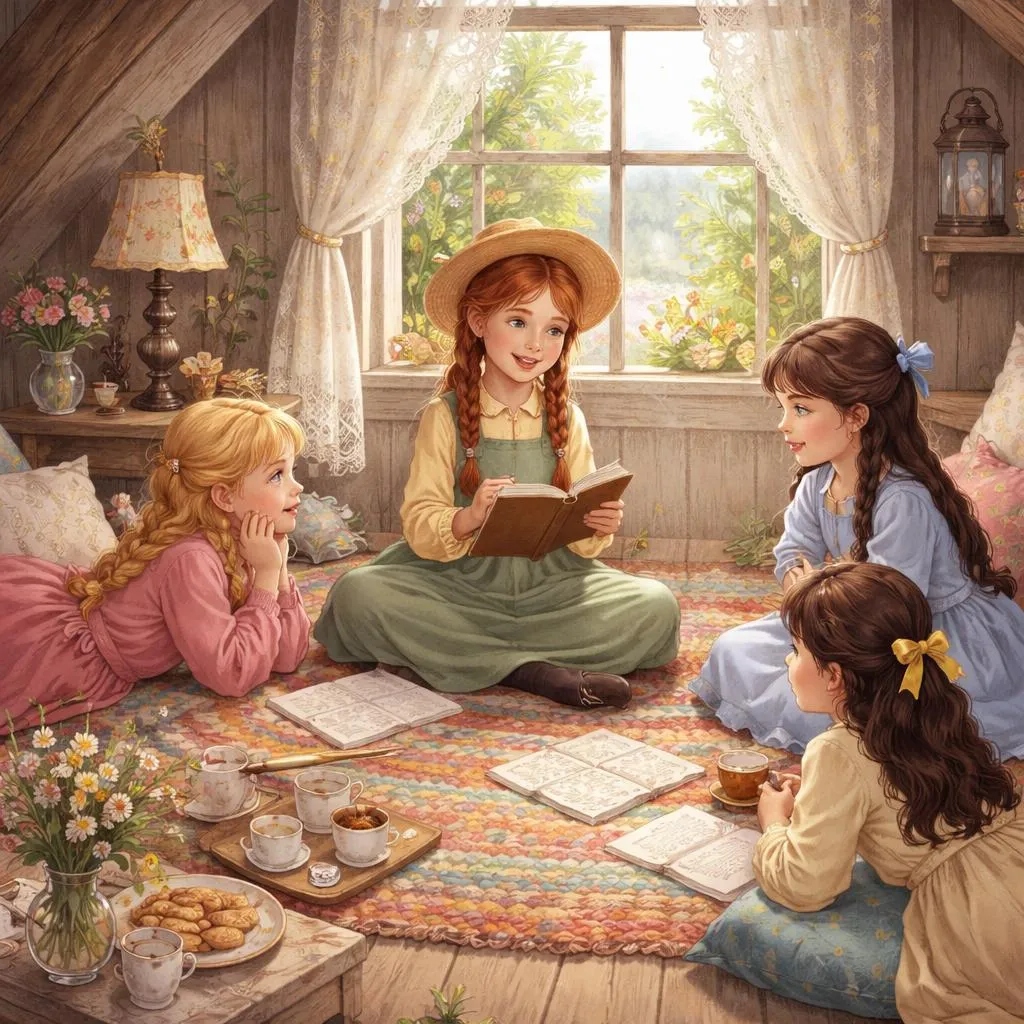

Junior Avonlea found it hard to settle down to humdrum existence again. To Anne in particular things seemed fearfully flat, stale, and unprofitable after the goblet of excitement she had been sipping for weeks. Could she go back to the former quiet pleasures of those faraway days before the concert? At first, as she told Diana, she did not really think she could.
“I’m positively certain, Diana, that life can never be quite the same again as it was in those olden days,” she said mournfully, as if referring to a period of at least fifty years back. “Perhaps after a while I’ll get used to it, but I’m afraid concerts spoil people for everyday life. I suppose that is why Marilla disapproves of them. Marilla is such a sensible woman. It must be a great deal better to be sensible; but still, I don’t believe I’d really want to be a sensible person, because they are so unromantic. Mrs. Lynde says there is no danger of my ever being one, but you can never tell. I feel just now that I may grow up to be sensible yet. But perhaps that is only because I’m tired. I simply couldn’t sleep last night for ever so long. I just lay awake and imagined the concert over and over again. That’s one splendid thing about such affairs—it’s so lovely to look back to them.”
Eventually, however, Avonlea school slipped back into its old groove and took up its old interests. To be sure, the concert left traces. Ruby Gillis and Emma White, who had quarreled over a point of precedence in their platform seats, no longer sat at the same desk, and a promising friendship of three years was broken up. Josie Pye and Julia Bell did not “speak” for three months, because Josie Pye had told Bessie Wright that Julia Bell’s bow when she got up to recite made her think of a chicken jerking its head, and Bessie told Julia. None of the Sloanes would have any dealings with the Bells, because the Bells had declared that the Sloanes had too much to do in the program, and the Sloanes had retorted that the Bells were not capable of doing the little they had to do properly. Finally, Charlie Sloane fought Moody Spurgeon MacPherson, because Moody Spurgeon had said that Anne Shirley put on airs about her recitations, and Moody Spurgeon was “licked”; consequently Moody Spurgeon’s sister, Ella May, would not “speak” to Anne Shirley all the rest of the winter. With the exception of these trifling frictions, work in Miss Stacy’s little kingdom went on with regularity and smoothness.
The winter weeks slipped by. It was an unusually mild winter, with so little snow that Anne and Diana could go to school nearly every day by way of the Birch Path. On Anne’s birthday they were tripping lightly down it, keeping eyes and ears alert amid all their chatter, for Miss Stacy had told them that they must soon write a composition on “A Winter’s Walk in the Woods,” and it behooved them to be observant.
“Just think, Diana, I’m thirteen years old today,” remarked Anne in an awed voice. “I can scarcely realize that I’m in my teens. When I woke this morning it seemed to me that everything must be different. You’ve been thirteen for a month, so I suppose it doesn’t seem such a novelty to you as it does to me. It makes life seem so much more interesting. In two more years I’ll be really grown up. It’s a great comfort to think that I’ll be able to use big words then without being laughed at.”
“Ruby Gillis says she means to have a beau as soon as she’s fifteen,” said Diana.
“Ruby Gillis thinks of nothing but beaus,” said Anne disdainfully. “She’s actually delighted when anyone writes her name up in a take-notice for all she pretends to be so mad. But I’m afraid that is an uncharitable speech. Mrs. Allan says we should never make uncharitable speeches; but they do slip out so often before you think, don’t they? I simply can’t talk about Josie Pye without making an uncharitable speech, so I never mention her at all. You may have noticed that. I’m trying to be as much like Mrs. Allan as I possibly can, for I think she’s perfect. Mr. Allan thinks so too. Mrs. Lynde says he just worships the ground she treads on and she doesn’t really think it right for a minister to set his affections so much on a mortal being. But then, Diana, even ministers are human and have their besetting sins just like everybody else. I had such an interesting talk with Mrs. Allan about besetting sins last Sunday afternoon. There are just a few things it’s proper to talk about on Sundays and that is one of them. My besetting sin is imagining too much and forgetting my duties. I’m striving very hard to overcome it and now that I’m really thirteen perhaps I’ll get on better.”
“In four more years we’ll be able to put our hair up,” said Diana. “Alice Bell is only sixteen and she is wearing hers up, but I think that’s ridiculous. I shall wait until I’m seventeen.”
“If I had Alice Bell’s crooked nose,” said Anne decidedly, “I wouldn’t—but there! I won’t say what I was going to because it was extremely uncharitable. Besides, I was comparing it with my own nose and that’s vanity. I’m afraid I think too much about my nose ever since I heard that compliment about it long ago. It really is a great comfort to me. Oh, Diana, look, there’s a rabbit. That’s something to remember for our woods composition. I really think the woods are just as lovely in winter as in summer. They’re so white and still, as if they were asleep and dreaming pretty dreams.”
“I won’t mind writing that composition when its time comes,” sighed Diana. “I can manage to write about the woods, but the one we’re to hand in Monday is terrible. The idea of Miss Stacy telling us to write a story out of our own heads!”
“Why, it’s as easy as wink,” said Anne.
“It’s easy for you because you have an imagination,” retorted Diana, “but what would you do if you had been born without one? I suppose you have your composition all done?”
Anne nodded, trying hard not to look virtuously complacent and failing miserably.
“I wrote it last Monday evening. It’s called ‘The Jealous Rival; or In Death Not Divided.’ I read it to Marilla and she said it was stuff and nonsense. Then I read it to Matthew and he said it was fine. That is the kind of critic I like. It’s a sad, sweet story. I just cried like a child while I was writing it. It’s about two beautiful maidens called Cordelia Montmorency and Geraldine Seymour who lived in the same village and were devotedly attached to each other. Cordelia was a regal brunette with a coronet of midnight hair and duskly flashing eyes. Geraldine was a queenly blonde with hair like spun gold and velvety purple eyes.”
“I never saw anybody with purple eyes,” said Diana dubiously.
“Neither did I. I just imagined them. I wanted something out of the common. Geraldine had an alabaster brow too. I’ve found out what an alabaster brow is. That is one of the advantages of being thirteen. You know so much more than you did when you were only twelve.”
“Well, what became of Cordelia and Geraldine?” asked Diana, who was beginning to feel rather interested in their fate.
“They grew in beauty side by side until they were sixteen. Then Bertram DeVere came to their native village and fell in love with the fair Geraldine. He saved her life when her horse ran away with her in a carriage, and she fainted in his arms and he carried her home three miles; because, you understand, the carriage was all smashed up. I found it rather hard to imagine the proposal because I had no experience to go by. I asked Ruby Gillis if she knew anything about how men proposed because I thought she’d likely be an authority on the subject, having so many sisters married. Ruby told me she was hid in the hall pantry when Malcolm Andres proposed to her sister Susan. She said Malcolm told Susan that his dad had given him the farm in his own name and then said, ‘What do you say, darling pet, if we get hitched this fall?’ And Susan said, ‘Yes—no—I don’t know—let me see’—and there they were, engaged as quick as that. But I didn’t think that sort of a proposal was a very romantic one, so in the end I had to imagine it out as well as I could. I made it very flowery and poetical and Bertram went on his knees, although Ruby Gillis says it isn’t done nowadays. Geraldine accepted him in a speech a page long. I can tell you I took a lot of trouble with that speech. I rewrote it five times and I look upon it as my masterpiece. Bertram gave her a diamond ring and a ruby necklace and told her they would go to Europe for a wedding tour, for he was immensely wealthy. But then, alas, shadows began to darken over their path. Cordelia was secretly in love with Bertram herself and when Geraldine told her about the engagement she was simply furious, especially when she saw the necklace and the diamond ring. All her affection for Geraldine turned to bitter hate and she vowed that she should never marry Bertram. But she pretended to be Geraldine’s friend the same as ever. One evening they were standing on the bridge over a rushing turbulent stream and Cordelia, thinking they were alone, pushed Geraldine over the brink with a wild, mocking, ‘Ha, ha, ha.’ But Bertram saw it all and he at once plunged into the current, exclaiming, ‘I will save thee, my peerless Geraldine.’ But alas, he had forgotten he couldn’t swim, and they were both drowned, clasped in each other’s arms. Their bodies were washed ashore soon afterwards. They were buried in the one grave and their funeral was most imposing, Diana. It’s so much more romantic to end a story up with a funeral than a wedding. As for Cordelia, she went insane with remorse and was shut up in a lunatic asylum. I thought that was a poetical retribution for her crime.”
“How perfectly lovely!” sighed Diana, who belonged to Matthew’s school of critics. “I don’t see how you can make up such thrilling things out of your own head, Anne. I wish my imagination was as good as yours.”
“It would be if you’d only cultivate it,” said Anne cheeringly. “I’ve just thought of a plan, Diana. Let you and me have a story club all our own and write stories for practice. I’ll help you along until you can do them by yourself. You ought to cultivate your imagination, you know. Miss Stacy says so. Only we must take the right way. I told her about the Haunted Wood, but she said we went the wrong way about it in that.”
This was how the story club came into existence. It was limited to Diana and Anne at first, but soon it was extended to include Jane Andrews and Ruby Gillis and one or two others who felt that their imaginations needed cultivating. No boys were allowed in it—although Ruby Gillis opined that their admission would make it more exciting—and each member had to produce one story a week.
“It’s extremely interesting,” Anne told Marilla. “Each girl has to read her story out loud and then we talk it over. We are going to keep them all sacredly and have them to read to our descendants. We each write under a nom-de-plume. Mine is Rosamond Montmorency. All the girls do pretty well. Ruby Gillis is rather sentimental. She puts too much lovemaking into her stories and you know too much is worse than too little. Jane never puts any because she says it makes her feel so silly when she had to read it out loud. Jane’s stories are extremely sensible. Then Diana puts too many murders into hers. She says most of the time she doesn’t know what to do with the people so she kills them off to get rid of them. I mostly always have to tell them what to write about, but that isn’t hard for I’ve millions of ideas.”
“I think this story-writing business is the foolishest yet,” scoffed Marilla. “You’ll get a pack of nonsense into your heads and waste time that should be put on your lessons. Reading stories is bad enough but writing them is worse.”
“But we’re so careful to put a moral into them all, Marilla,” explained Anne. “I insist upon that. All the good people are rewarded and all the bad ones are suitably punished. I’m sure that must have a wholesome effect. The moral is the great thing. Mr. Allan says so. I read one of my stories to him and Mrs. Allan and they both agreed that the moral was excellent. Only they laughed in the wrong places. I like it better when people cry. Jane and Ruby almost always cry when I come to the pathetic parts. Diana wrote her Aunt Josephine about our club and her Aunt Josephine wrote back that we were to send her some of our stories. So we copied out four of our very best and sent them. Miss Josephine Barry wrote back that she had never read anything so amusing in her life. That kind of puzzled us because the stories were all very pathetic and almost everybody died. But I’m glad Miss Barry liked them. It shows our club is doing some good in the world. Mrs. Allan says that ought to be our object in everything. I do really try to make it my object but I forget so often when I’m having fun. I hope I shall be a little like Mrs. Allan when I grow up. Do you think there is any prospect of it, Marilla?”
“I shouldn’t say there was a great deal” was Marilla’s encouraging answer. “I’m sure Mrs. Allan was never such a silly, forgetful little girl as you are.”
“No; but she wasn’t always so good as she is now either,” said Anne seriously. “She told me so herself—that is, she said she was a dreadful mischief when she was a girl and was always getting into scrapes. I felt so encouraged when I heard that. Is it very wicked of me, Marilla, to feel encouraged when I hear that other people have been bad and mischievous? Mrs. Lynde says it is. Mrs. Lynde says she always feels shocked when she hears of anyone ever having been naughty, no matter how small they were. Mrs. Lynde says she once heard a minister confess that when he was a boy he stole a strawberry tart out of his aunt’s pantry and she never had any respect for that minister again. Now, I wouldn’t have felt that way. I’d have thought that it was real noble of him to confess it, and I’d have thought what an encouraging thing it would be for small boys nowadays who do naughty things and are sorry for them to know that perhaps they may grow up to be ministers in spite of it. That’s how I’d feel, Marilla.”
“The way I feel at present, Anne,” said Marilla, “is that it’s high time you had those dishes washed. You’ve taken half an hour longer than you should with all your chattering. Learn to work first and talk afterwards.”
背景介紹與作者介紹
這段文字出自《艾凡里之安妮》,是加拿大作家露西·莫德·蒙哥馬利所著的深受喜愛的《綠山牆的安妮》系列的第二本書。這部小說於1909年出版,延續了安妮·雪莉的故事,她是一位充滿想像力和活力的年輕女孩,在愛德華王子島上虛構的艾凡里村莊長大。蒙哥馬利的作品以其對鄉村生活的生動描寫、對人物性格的深刻刻畫,以及友誼、個人成長和想像力的力量等主題而聞名。
蒙哥馬利本人於1874年出生,在愛德華王子島長大,她大量地從自己的經歷和周圍環境中汲取靈感,創造了迷人的艾凡里世界。她的故事一百多年來一直受到世界各地讀者的喜愛,並繼續啟發著各種媒體的改編。
詳細闡釋與意義
在這段摘錄中,我們看到安妮正在努力應對特殊事件(例如音樂會)的興奮與回歸日常生活之間的對比。安妮生動的想像力和情感敏感性使平凡的日子在經歷了如此喜悅的時刻後顯得沉悶。這種非凡與平凡之間的緊張關係是許多年輕讀者都能感同身受的體驗。
這段文字也突出了艾凡里學校孩子們之間的社會動態,說明了小的衝突和誤解如何影響友誼。這些情節真實地描繪了童年時期的社會生活,強調了善良、寬容和溝通的重要性。
安妮與朋友們一起創建故事俱樂部,展示了想像力和創造力的價值。通過講故事,女孩們學會了表達自己、培養同情心,並參與建設性的批評。安妮堅持在每個故事中都包含道德,反映了當時的教育價值觀,並鼓勵讀者思考故事背後的教訓。
安妮寫的故事《嫉妒的對手;或生死不渝》是一個戲劇性和悲劇性的故事,與童年的天真形成對比,展示了安妮早期嘗試複雜的講故事。它也揭示了她對自己創作的深刻情感投入。
給學生的教訓和見解
-
**想像力的力量:**安妮豐富的想像力是喜悅和創造力的源泉。學生可以學習到,培養他們的想像力可以增強他們的寫作能力、解決問題的能力,以及同情他人的能力。
-
**處理社會衝突:**孩子們之間的爭吵提醒我們,誤解是常見的,但可以用善良和開放的溝通來解決。學會周到地處理友誼是一項寶貴的生活技能。
-
**平衡樂趣與責任:**安妮與瑪麗拉關於工作和玩耍的對話,教導了明智地管理時間的重要性——享受創造力和社交活動,同時履行責任。
-
**道德反思:**在故事中加入道德,鼓勵思考是非對錯,幫助學生培養道德感和個人價值觀。
-
**成長與自我完善:**安妮對自己“困擾的罪過”——白日夢的自我意識,以及她渴望進步的願望,表明了自我反思和努力變得更好的重要性。
在日常生活中應用這些教訓
-
**在學習中:**學生可以創建自己的故事俱樂部或寫作小組,以練習創造力並獲得反饋,就像安妮和她的朋友們一樣。這可以提高寫作技巧並建立信心。
-
**在社交場合:**注意自己的言行如何影響友誼,可以幫助學生建立更牢固、更有支持性的關係。
-
**在個人成長中:**像安妮一樣,反思個人習慣並設定改進目標,可以培養成熟和責任感。
-
**在情感表達中:**使用講故事或寫日記來表達情感,可以成為處理情緒和體驗的健康方式。
從故事中培養積極的特質
-
**想像力和創造力:**鼓勵廣泛閱讀並參與創意活動,例如寫作、繪畫或戲劇。
-
**同情心和善良:**練習從他人的角度看問題,並以同情心回應。
-
**責任感和紀律:**制定平衡工作和玩耍的常規,確保完成職責,同時留出時間玩樂。
-
**自我反思:**定期思考個人的優勢和劣勢,並尋求成長的方法。
結論
這段摘錄自《艾凡里之安妮》的不僅僅是一個迷人的故事;它提供了一個了解成長的喜悅和挑戰的窗口。通過安妮的經歷,學生可以探索想像力、友誼、道德成長和自我完善等主題。這些教訓至今仍然具有現實意義,鼓勵年輕讀者擁抱創造力,周到地處理社交場合,並努力成為最好的自己。
