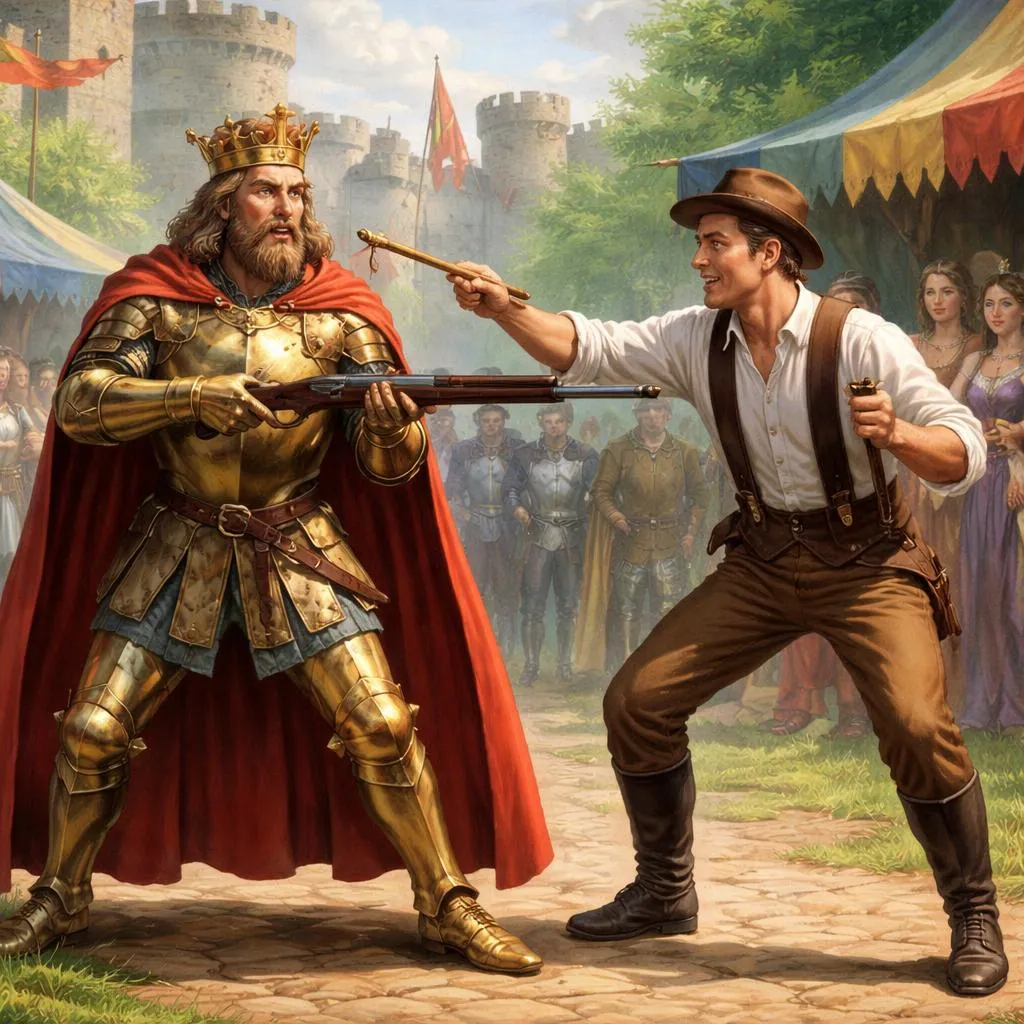

On the morning of the fourth day, when it was just sunrise, and we had been tramping an hour in the chill dawn, I came to a resolution: the king must be drilled; things could not go on so, he must be taken in hand and deliberately and conscientiously drilled, or we couldn’t ever venture to enter a dwelling; the very cats would know this masquerader for a humbug and no peasant. So I called a halt and said:
“Sire, as between clothes and countenance, you are all right, there is no discrepancy; but as between your clothes and your bearing, you are all wrong, there is a most noticeable discrepancy. Your soldierly stride, your lordly port—these will not do. You stand too straight, your looks are too high, too confident. The cares of a kingdom do not stoop the shoulders, they do not droop the chin, they do not depress the high level of the eye-glance, they do not put doubt and fear in the heart and hang out the signs of them in slouching body and unsure step. It is the sordid cares of the lowly born that do these things. You must learn the trick; you must imitate the trademarks of poverty, misery, oppression, insult, and the other several and common inhumanities that sap the manliness out of a man and make him a loyal and proper and approved subject and a satisfaction to his masters, or the very infants will know you for better than your disguise, and we shall go to pieces at the first hut we stop at. Pray try to walk like this.”
The king took careful note, and then tried an imitation.
“Pretty fair—pretty fair. Chin a little lower, please—there, very good. Eyes too high; pray don’t look at the horizon, look at the ground, ten steps in front of you. Ah—that is better, that is very good. Wait, please; you betray too much vigor, too much decision; you want more of a shamble. Look at me, please—this is what I mean.... Now you are getting it; that is the idea—at least, it sort of approaches it.... Yes, that is pretty fair. But! There is a great big something wanting, I don’t quite know what it is. Please walk thirty yards, so that I can get a perspective on the thing.... Now, then—your head’s right, speed’s right, shoulders right, eyes right, chin right, gait, carriage, general style right—everything’s right! And yet the fact remains, the aggregate’s wrong. The account don’t balance. Do it again, please.... Now I think I begin to see what it is. Yes, I’ve struck it. You see, the genuine spiritlessness is wanting; that’s what’s the trouble. It’s all amateur—mechanical details all right, almost to a hair; everything about the delusion perfect, except that it don’t delude.”
“What, then, must one do, to prevail?”
“Let me think... I can’t seem to quite get at it. In fact, there isn’t anything that can right the matter but practice. This is a good place for it: roots and stony ground to break up your stately gait, a region not liable to interruption, only one field and one hut in sight, and they so far away that nobody could see us from there. It will be well to move a little off the road and put in the whole day drilling you, sire.”
After the drill had gone on a little while, I said:
“Now, sire, imagine that we are at the door of the hut yonder, and the family are before us. Proceed, please—accost the head of the house.”
The king unconsciously straightened up like a monument, and said, with frozen austerity:
“Varlet, bring a seat; and serve to me what cheer ye have.”
“Ah, your grace, that is not well done.”
“In what lacketh it?”
“These people do not call each other varlets.”
“Nay, is that true?”
“Yes; only those above them call them so.”
“Then must I try again. I will call him villein.”
“No-no; for he may be a freeman.”
“Ah—so. Then peradventure I should call him goodman.”
“That would answer, your grace, but it would be still better if you said friend, or brother.”
“Brother!—to dirt like that?”
“Ah, but we are pretending to be dirt like that, too.”
“It is even true. I will say it. Brother, bring a seat, and thereto what cheer ye have, withal. Now ‘tis right.”
“Not quite, not wholly right. You have asked for one, not us —for one, not both; food for one, a seat for one.”
The king looked puzzled—he wasn’t a very heavy weight, intellectually. His head was an hour-glass; it could stow an idea, but it had to do it a grain at a time, not the whole idea at once.
“Would you have a seat also—and sit?”
“If I did not sit, the man would perceive that we were only pretending to be equals—and playing the deception pretty poorly, too.”
“It is well and truly said! How wonderful is truth, come it in whatsoever unexpected form it may! Yes, he must bring out seats and food for both, and in serving us present not ewer and napkin with more show of respect to the one than to the other.”
“And there is even yet a detail that needs correcting. He must bring nothing outside; we will go in—in among the dirt, and possibly other repulsive things,—and take the food with the household, and after the fashion of the house, and all on equal terms, except the man be of the serf class; and finally, there will be no ewer and no napkin, whether he be serf or free. Please walk again, my liege. There—it is better—it is the best yet; but not perfect. The shoulders have known no ignobler burden than iron mail, and they will not stoop.”
“Give me, then, the bag. I will learn the spirit that goeth with burdens that have not honor. It is the spirit that stoopeth the shoulders, I ween, and not the weight; for armor is heavy, yet it is a proud burden, and a man standeth straight in it.... Nay, but me no buts, offer me no objections. I will have the thing. Strap it upon my back.”
He was complete now with that knapsack on, and looked as little like a king as any man I had ever seen. But it was an obstinate pair of shoulders; they could not seem to learn the trick of stooping with any sort of deceptive naturalness. The drill went on, I prompting and correcting:
“Now, make believe you are in debt, and eaten up by relentless creditors; you are out of work—which is horse-shoeing, let us say—and can get none; and your wife is sick, your children are crying because they are hungry—”
And so on, and so on. I drilled him as representing in turn all sorts of people out of luck and suffering dire privations and misfortunes. But lord, it was only just words, words—they meant nothing in the world to him, I might just as well have whistled. Words realize nothing, vivify nothing to you, unless you have suffered in your own person the thing which the words try to describe. There are wise people who talk ever so knowingly and complacently about “the working classes,” and satisfy themselves that a day’s hard intellectual work is very much harder than a day’s hard manual toil, and is righteously entitled to much bigger pay. Why, they really think that, you know, because they know all about the one, but haven’t tried the other. But I know all about both; and so far as I am concerned, there isn’t money enough in the universe to hire me to swing a pickaxe thirty days, but I will do the hardest kind of intellectual work for just as near nothing as you can cipher it down—and I will be satisfied, too.
Intellectual “work” is misnamed; it is a pleasure, a dissipation, and is its own highest reward. The poorest paid architect, engineer, general, author, sculptor, painter, lecturer, advocate, legislator, actor, preacher, singer is constructively in heaven when he is at work; and as for the musician with the fiddle-bow in his hand who sits in the midst of a great orchestra with the ebbing and flowing tides of divine sound washing over him—why, certainly, he is at work, if you wish to call it that, but lord, it’s a sarcasm just the same. The law of work does seem utterly unfair—but there it is, and nothing can change it: the higher the pay in enjoyment the worker gets out of it, the higher shall be his pay in cash, also. And it’s also the very law of those transparent swindles, transmissible nobility and kingship.
背景介紹與作者介紹
這段文字出自馬克·吐溫的經典小說《王子與乞丐》,首次出版於 1881 年。 吐溫是美國最偉大的作家和幽默大師之一,他用這個故事來探討社會不平等、身份認同和同情心等主題。 這部小說講述了兩個男孩的故事——一個是王子,另一個是貧窮的乞丐——他們互換身份,體驗彼此截然不同的人生。 吐溫敏銳的智慧和敏銳的社會觀察,使這本書成為對階級區分和不公正的有力批判。
詳細解讀與意義
在這段摘錄中,敘述者正在指導王子如何令人信服地模仿貧窮平民的姿態和舉止。 王子天生的王者風範出賣了他,所以他必須學會像一個飽受苦難和貧困的人一樣走路和行事。 這種訓練不僅僅是關於外表,而是關於體現貧困所帶來的痛苦和謙卑的精神。
這一幕突出了在沒有親身經歷的情況下真正理解另一個人的經歷的困難。 敘述者強調,僅僅言語無法傳達苦難的現實; 只有親身經歷才能做到。 這是一堂關於同情心和膚淺理解的局限性的深刻教訓。
此外,這段文字批判了社會角色和階級區分的人為性。 王子必須學會表現得沮喪,才能被普通人接受,這表明社會的判斷是基於外在的表象和受社會地位影響的行為。
給學生的教訓和見解
-
透過經驗獲得同情心: 故事告訴我們,真正的同情心不僅僅是想像別人的處境,它需要付出巨大的努力去理解他們的情感和掙扎。 學生可以透過仔細傾聽並嘗試從他人的角度看世界來學習變得更有同情心。
-
謙卑的力量: 王子試圖謙卑自己,表明了謙卑在社會互動中的重要性。 認識到自己的特權和局限性可以培養對他人的尊重和友善。
-
對社會角色的批判性思考: 這部小說鼓勵讀者質疑社會結構和刻板印象。 學生可以反思外表和社會標籤如何影響我們對待他人的方式,以及他們如何挑戰不公平的判斷。
-
練習和毅力的價值: 王子反覆努力掌握乞丐的舉止,說明了學習新技能——無論是社會、情感還是智力——都需要耐心和毅力。
在日常生活中應用
-
在學校: 學生可以透過支持可能正在掙扎或感到被排斥的同學來運用同情心。 了解不同的背景可以改善團隊合作和友誼。
-
在社交場合: 練習謙卑和友善有助於建立更牢固的關係。 在不帶偏見的情況下意識到社會差異可以促進包容性。
-
在個人成長中: 像王子一樣,擁抱挑戰並練習新的行為,可以幫助學生培養韌性和適應能力。
從故事中培養積極的品質
-
同情心: 鼓勵學生閱讀不同的故事,並參與角色扮演活動,以更好地了解他人的經歷。
-
謙卑: 教導認識自己優缺點的價值,並尊重他人,無論其地位如何。
-
毅力: 像王子一樣,強調練習和從錯誤中學習的重要性,同時訓練融入新的社會角色。
-
批判意識: 促進關於公平、社會正義和刻板印象影響的討論,以培養有思想和具有社會意識的個體。
透過探索《王子與乞丐》,學生不僅可以欣賞一個引人入勝的故事,還可以獲得寶貴的人生教訓,幫助他們成長為富有同情心、謙遜且具有社會意識的個體。
