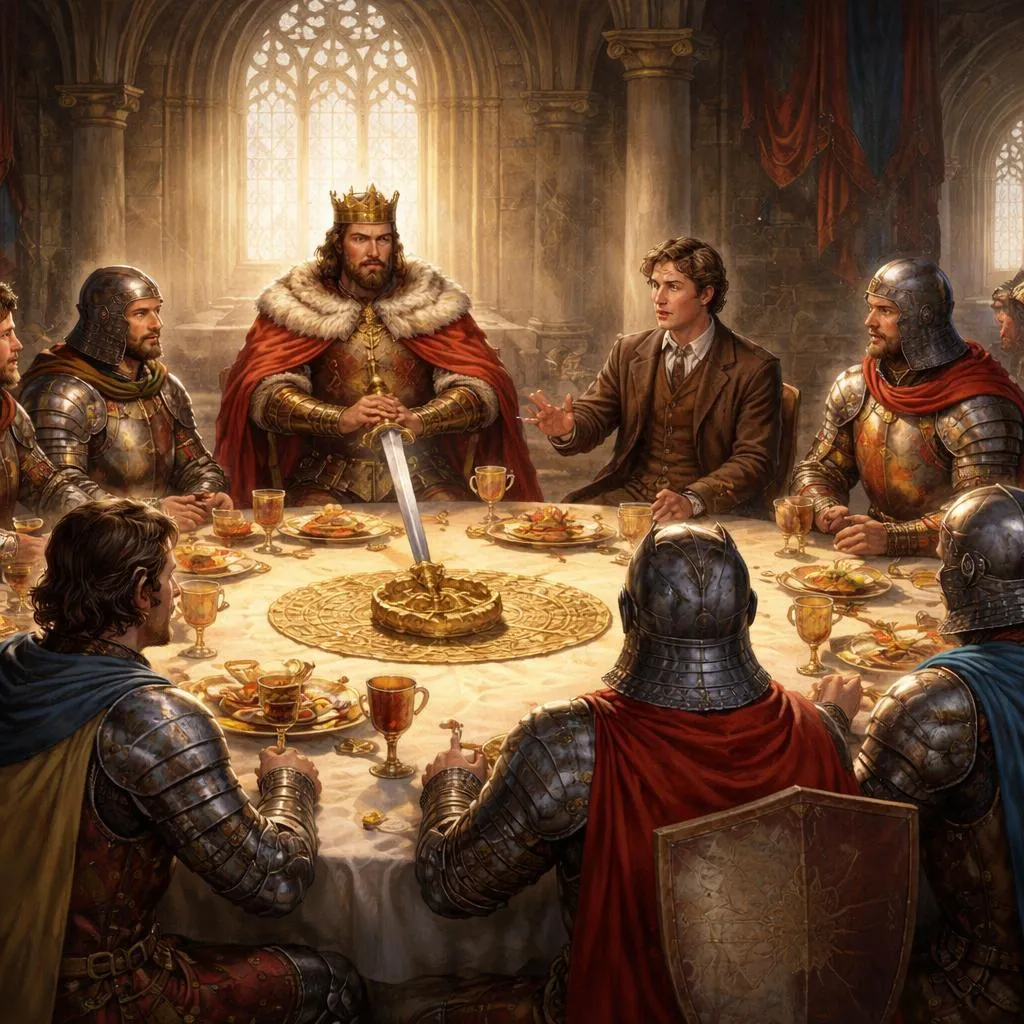

Mainly the Round Table talk was monologues—narrative accounts of the adventures in which these prisoners were captured and their friends and backers killed and stripped of their steeds and armor. As a general thing—as far as I could make out—these murderous adventures were not forays undertaken to avenge injuries, nor to settle old disputes or sudden fallings out; no, as a rule they were simply duels between strangers—duels between people who had never even been introduced to each other, and between whom existed no cause of offense whatever. Many a time I had seen a couple of boys, strangers, meet by chance, and say simultaneously, “I can lick you,” and go at it on the spot; but I had always imagined until now that that sort of thing belonged to children only, and was a sign and mark of childhood; but here were these big boobies sticking to it and taking pride in it clear up into full age and beyond. Yet there was something very engaging about these great simple-hearted creatures, something attractive and lovable. There did not seem to be brains enough in the entire nursery, so to speak, to bait a fish-hook with; but you didn’t seem to mind that, after a little, because you soon saw that brains were not needed in a society like that, and indeed would have marred it, hindered it, spoiled its symmetry—perhaps rendered its existence impossible.
There was a fine manliness observable in almost every face; and in some a certain loftiness and sweetness that rebuked your belittling criticisms and stilled them. A most noble benignity and purity reposed in the countenance of him they called Sir Galahad, and likewise in the king’s also; and there was majesty and greatness in the giant frame and high bearing of Sir Launcelot of the Lake.
There was presently an incident which centered the general interest upon this Sir Launcelot. At a sign from a sort of master of ceremonies, six or eight of the prisoners rose and came forward in a body and knelt on the floor and lifted up their hands toward the ladies’ gallery and begged the grace of a word with the queen. The most conspicuously situated lady in that massed flower-bed of feminine show and finery inclined her head by way of assent, and then the spokesman of the prisoners delivered himself and his fellows into her hands for free pardon, ransom, captivity, or death, as she in her good pleasure might elect; and this, as he said, he was doing by command of Sir Kay the Seneschal, whose prisoners they were, he having vanquished them by his single might and prowess in sturdy conflict in the field.
Surprise and astonishment flashed from face to face all over the house; the queen’s gratified smile faded out at the name of Sir Kay, and she looked disappointed; and the page whispered in my ear with an accent and manner expressive of extravagant derision—
“Sir Kay , forsooth! Oh, call me pet names, dearest, call me a marine! In twice a thousand years shall the unholy invention of man labor at odds to beget the fellow to this majestic lie!”
Every eye was fastened with severe inquiry upon Sir Kay. But he was equal to the occasion. He got up and played his hand like a major—and took every trick. He said he would state the case exactly according to the facts; he would tell the simple straightforward tale, without comment of his own; “and then,” said he, “if ye find glory and honor due, ye will give it unto him who is the mightiest man of his hands that ever bare shield or strake with sword in the ranks of Christian battle—even him that sitteth there!” and he pointed to Sir Launcelot. Ah, he fetched them; it was a rattling good stroke. Then he went on and told how Sir Launcelot, seeking adventures, some brief time gone by, killed seven giants at one sweep of his sword, and set a hundred and forty-two captive maidens free; and then went further, still seeking adventures, and found him (Sir Kay) fighting a desperate fight against nine foreign knights, and straightway took the battle solely into his own hands, and conquered the nine; and that night Sir Launcelot rose quietly, and dressed him in Sir Kay’s armor and took Sir Kay’s horse and gat him away into distant lands, and vanquished sixteen knights in one pitched battle and thirty-four in another; and all these and the former nine he made to swear that about Whitsuntide they would ride to Arthur’s court and yield them to Queen Guenever’s hands as captives of Sir Kay the Seneschal, spoil of his knightly prowess; and now here were these half dozen, and the rest would be along as soon as they might be healed of their desperate wounds.
Well, it was touching to see the queen blush and smile, and look embarrassed and happy, and fling furtive glances at Sir Launcelot that would have got him shot in Arkansas, to a dead certainty.
Everybody praised the valor and magnanimity of Sir Launcelot; and as for me, I was perfectly amazed, that one man, all by himself, should have been able to beat down and capture such battalions of practiced fighters. I said as much to Clarence; but this mocking featherhead only said:
“An Sir Kay had had time to get another skin of sour wine into him, ye had seen the accompt doubled.”
I looked at the boy in sorrow; and as I looked I saw the cloud of a deep despondency settle upon his countenance. I followed the direction of his eye, and saw that a very old and white-bearded man, clothed in a flowing black gown, had risen and was standing at the table upon unsteady legs, and feebly swaying his ancient head and surveying the company with his watery and wandering eye. The same suffering look that was in the page’s face was observable in all the faces around—the look of dumb creatures who know that they must endure and make no moan.
“Marry, we shall have it again,” sighed the boy; “that same old weary tale that he hath told a thousand times in the same words, and that he will tell till he dieth, every time he hath gotten his barrel full and feeleth his exaggeration-mill a-working. Would God I had died or I saw this day!”
“Who is it?”
“Merlin, the mighty liar and magician, perdition singe him for the weariness he worketh with his one tale! But that men fear him for that he hath the storms and the lightnings and all the devils that be in hell at his beck and call, they would have dug his entrails out these many years ago to get at that tale and squelch it. He telleth it always in the third person, making believe he is too modest to glorify himself—maledictions light upon him, misfortune be his dole! Good friend, prithee call me for evensong.”
The boy nestled himself upon my shoulder and pretended to go to sleep. The old man began his tale; and presently the lad was asleep in reality; so also were the dogs, and the court, the lackeys, and the files of men-at-arms. The droning voice droned on; a soft snoring arose on all sides and supported it like a deep and subdued accompaniment of wind instruments. Some heads were bowed upon folded arms, some lay back with open mouths that issued unconscious music; the flies buzzed and bit, unmolested, the rats swarmed softly out from a hundred holes, and pattered about, and made themselves at home everywhere; and one of them sat up like a squirrel on the king’s head and held a bit of cheese in its hands and nibbled it, and dribbled the crumbs in the king’s face with naive and impudent irreverence. It was a tranquil scene, and restful to the weary eye and the jaded spirit.
This was the old man’s tale. He said:
“Right so the king and Merlin departed, and went until an hermit that was a good man and a great leech. So the hermit searched all his wounds and gave him good salves; so the king was there three days, and then were his wounds well amended that he might ride and go, and so departed. And as they rode, Arthur said, I have no sword. No force,* [*Footnote from M.T.: No matter.] said Merlin, hereby is a sword that shall be yours and I may. So they rode till they came to a lake, the which was a fair water and broad, and in the midst of the lake Arthur was ware of an arm clothed in white samite, that held a fair sword in that hand. Lo, said Merlin, yonder is that sword that I spake of. With that they saw a damsel going upon the lake. What damsel is that? said Arthur. That is the Lady of the lake, said Merlin; and within that lake is a rock, and therein is as fair a place as any on earth, and richly beseen, and this damsel will come to you anon, and then speak ye fair to her that she will give you that sword. Anon withal came the damsel unto Arthur and saluted him, and he her again. Damsel, said Arthur, what sword is that, that yonder the arm holdeth above the water? I would it were mine, for I have no sword. Sir Arthur King, said the damsel, that sword is mine, and if ye will give me a gift when I ask it you, ye shall have it. By my faith, said Arthur, I will give you what gift ye will ask. Well, said the damsel, go ye into yonder barge and row yourself to the sword, and take it and the scabbard with you, and I will ask my gift when I see my time. So Sir Arthur and Merlin alight, and tied their horses to two trees, and so they went into the ship, and when they came to the sword that the hand held, Sir Arthur took it up by the handles, and took it with him. And the arm and the hand went under the water; and so they came unto the land and rode forth. And then Sir Arthur saw a rich pavilion. What signifieth yonder pavilion? It is the knight’s pavilion, said Merlin, that ye fought with last, Sir Pellinore, but he is out, he is not there; he hath ado with a knight of yours, that hight Egglame, and they have fought together, but at the last Egglame fled, and else he had been dead, and he hath chased him even to Carlion, and we shall meet with him anon in the highway. That is well said, said Arthur, now have I a sword, now will I wage battle with him, and be avenged on him. Sir, ye shall not so, said Merlin, for the knight is weary of fighting and chasing, so that ye shall have no worship to have ado with him; also, he will not lightly be matched of one knight living; and therefore it is my counsel, let him pass, for he shall do you good service in short time, and his sons, after his days. Also ye shall see that day in short space ye shall be right glad to give him your sister to wed. When I see him, I will do as ye advise me, said Arthur. Then Sir Arthur looked on the sword, and liked it passing well. Whether liketh you better, said Merlin, the sword or the scabbard? Me liketh better the sword, said Arthur. Ye are more unwise, said Merlin, for the scabbard is worth ten of the sword, for while ye have the scabbard upon you ye shall never lose no blood, be ye never so sore wounded; therefore, keep well the scabbard always with you. So they rode into Carlion, and by the way they met with Sir Pellinore; but Merlin had done such a craft that Pellinore saw not Arthur, and he passed by without any words. I marvel, said Arthur, that the knight would not speak. Sir, said Merlin, he saw you not; for and he had seen you ye had not lightly departed. So they came unto Carlion, whereof his knights were passing glad. And when they heard of his adventures they marveled that he would jeopard his person so alone. But all men of worship said it was merry to be under such a chieftain that would put his person in adventure as other poor knights did.”
背景介紹與作者導讀
您剛才閱讀的摘錄,靈感來自亞瑟王和他的圓桌騎士的傳奇故事,這是中世紀文學和民間傳說的核心主題。這些故事已被傳述了數個世紀,並由不同的作者撰寫了許多版本。與這些故事相關的最著名的中世紀作家是托馬斯·馬洛里爵士,他在 15 世紀編寫並撰寫了《亞瑟之死》。他的作品將各種亞瑟王傳說彙集成一個單一的敘事,塑造了現代對亞瑟王的宮廷、他的騎士以及他們的騎士冒險的看法。
這段文字反映了在中世紀社會中備受推崇的騎士精神理想,包括勇氣、榮譽和忠誠。它還介紹了蘭斯洛特爵士、凱爵士、格尼薇兒王后和梅林等主要人物,這些都是亞瑟王傳說中的重要角色。故事的背景是一個神話般的中世紀世界,騎士們參與任務和戰鬥,魔法和神秘主義與人類事務交織在一起。
詳細闡釋與意義
這段文字突出了幾個重要的主題:
-
騎士精神與榮譽: 騎士們的決鬥和戰鬥並非源於個人恩怨,而是源於榮譽守則和對榮耀的追求。這反映了中世紀的理想,即騎士應該勇敢而高貴,為正義而戰,保護弱者。
-
友誼與忠誠: 蘭斯洛特爵士的英勇事蹟,包括營救囚犯和單槍匹馬與多個敵人作戰,表明了他對同伴的忠誠以及對國王事業的奉獻。
-
魔法與神秘主義的作用: 梅林的存在以及湖中仙女的魔法劍引入了超自然元素,這是亞瑟王故事中反覆出現的主題。這增添了一層奇蹟,象徵著命運和命運引導著英雄。
-
人性與成長: 將孩童般的打鬥與騎士的決鬥進行比較,暗示了對人性的反思——驕傲和衝突如何持續到成年,以及這些特質如何被引導到高尚的追求中。
給學生的教訓和見解
閱讀關於圓桌騎士的故事為年輕讀者提供了寶貴的教訓:
-
面對逆境的勇氣: 蘭斯洛特爵士的勇敢鼓勵學生勇敢地面對挑戰,無論是在學校、體育運動還是個人生活中。
-
正直的重要性: 騎士們遵守行為準則,教導誠實、公平和尊重他人的價值觀。
-
團隊合作與支持: 騎士們互相依靠彼此的力量並互相保護,表明合作如何帶來成功。
-
尊重差異: 故事表明騎士們與陌生人戰鬥,但沒有個人仇恨,提醒讀者以公平的方式處理衝突,避免不必要的敵意。
-
欣賞歷史和文化: 了解亞瑟王傳說將學生與豐富的文學傳統聯繫起來,這種傳統影響了現代的講故事、電影和流行文化。
將這些價值觀應用於日常生活
學生可以通過多種方式應用這些故事的精神:
-
在學校: 以決心和誠實的態度學習。幫助同學並像騎士互相支持一樣,在項目上進行合作。
-
在友誼中: 練習忠誠和善良。為朋友挺身而出,和平解決衝突。
-
在個人成長中: 勇敢地面對恐懼和挑戰。從錯誤中學習並努力改進,就像騎士尋求新的冒險來證明自己一樣。
-
在社區中: 尊重他人,即使是那些不同或不熟悉的人。在社交互動中促進公平和善良。
培養受故事啟發的積極特質
為了培養騎士所展現的高貴品質,學生可以:
-
設定個人目標: 像騎士尋求任務一樣,為自己設定挑戰,以提高自己的技能和性格。
-
練習自律: 遵守規則並尊重他人,了解真正的力量來自於自控。
-
廣泛閱讀: 探索更多傳說和故事,以深入了解不同的文化和道德教訓。
-
參與團隊活動: 加入俱樂部、體育運動或小組項目,以建立團隊合作和領導能力。
-
反思行動: 思考你的選擇如何影響他人,並努力以善良和榮譽行事。
結論
亞瑟王和他的騎士的故事不僅僅是令人興奮的冒險;它們蘊含著關於勇氣、榮譽、友誼和人類精神的豐富教訓。通過閱讀和反思這些故事,學生可以找到靈感,以勇氣和正直面對自己的挑戰,建立牢固的關係,並成長為有思想、高尚的個體。這些永恆的傳說繼續教導我們如何在複雜的世界中活得有尊嚴和目標。
