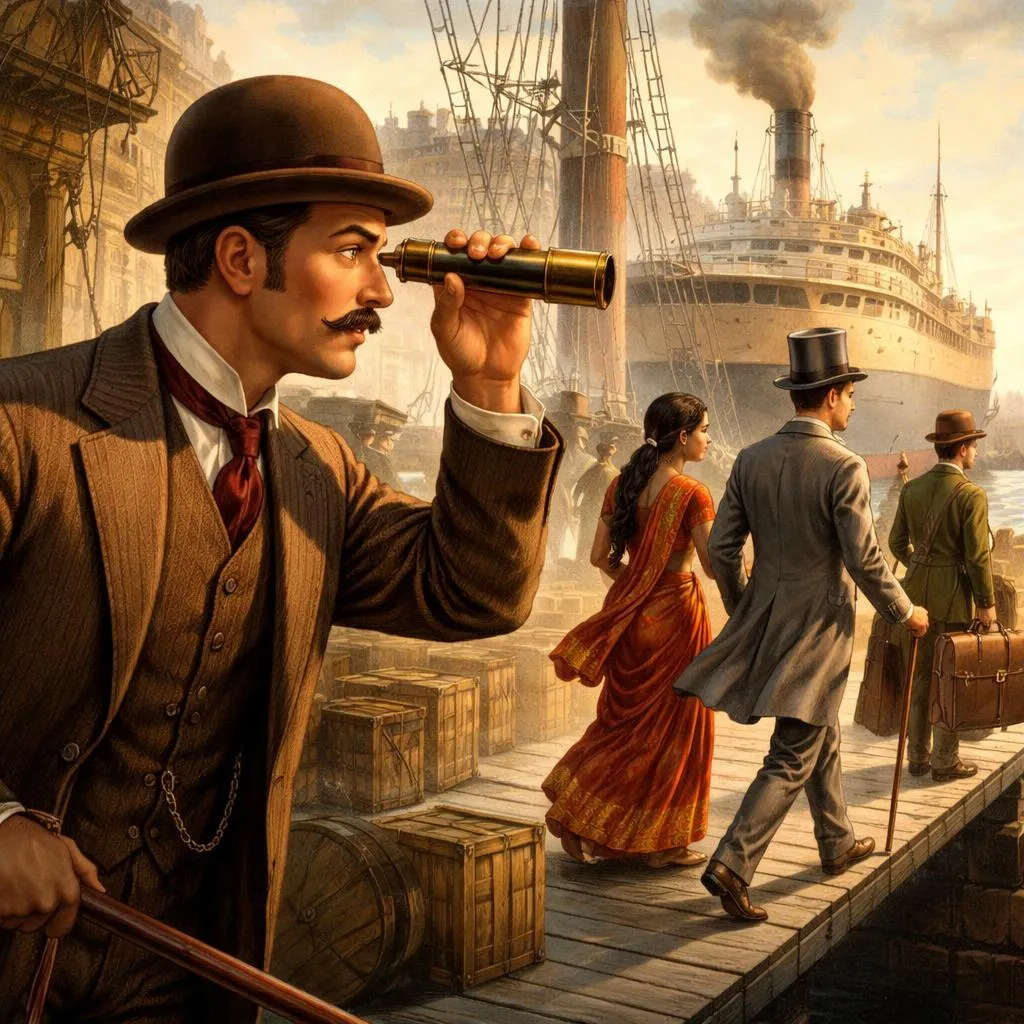

Phileas Fogg found himself twenty hours behind time. Passepartout, the involuntary cause of this delay, was desperate. He had ruined his master!
At this moment the detective approached Mr. Fogg, and, looking him intently in the face, said:
"Seriously, sir, are you in great haste?"
"Quite seriously."
"I have a purpose in asking," resumed Fix. "Is it absolutely necessary that you should be in New York on the 11th, before nine o'clock in the evening, the time that the steamer leaves for Liverpool?"
"It is absolutely necessary."
"And, if your journey had not been interrupted by these Indians, you would have reached New York on the morning of the 11th?"
"Yes; with eleven hours to spare before the steamer left."
"Good! you are therefore twenty hours behind. Twelve from twenty leaves eight. You must regain eight hours. Do you wish to try to do so?"
"On foot?" asked Mr. Fogg.
"No; on a sledge," replied Fix. "On a sledge with sails. A man has proposed such a method to me."
It was the man who had spoken to Fix during the night, and whose offer he had refused.
Phileas Fogg did not reply at once; but Fix, having pointed out the man, who was walking up and down in front of the station, Mr. Fogg went up to him. An instant after, Mr. Fogg and the American, whose name was Mudge, entered a hut built just below the fort.
There Mr. Fogg examined a curious vehicle, a kind of frame on two long beams, a little raised in front like the runners of a sledge, and upon which there was room for five or six persons. A high mast was fixed on the frame, held firmly by metallic lashings, to which was attached a large brigantine sail. This mast held an iron stay upon which to hoist a jib–sail. Behind, a sort of rudder served to guide the vehicle. It was, in short, a sledge rigged like a sloop. During the winter, when the trains are blocked up by the snow, these sledges make extremely rapid journeys across the frozen plains from one station to another. Provided with more sails than a cutter, and with the wind behind them, they slip over the surface of the prairies with a speed equal if not superior to that of the express trains.
Mr. Fogg readily made a bargain with the owner of this land–craft. The wind was favourable, being fresh, and blowing from the west. The snow had hardened, and Mudge was very confident of being able to transport Mr. Fogg in a few hours to Omaha. Thence the trains eastward run frequently to Chicago and New York. It was not impossible that the lost time might yet be recovered; and such an opportunity was not to be rejected.
Not wishing to expose Aouda to the discomforts of travelling in the open air, Mr. Fogg proposed to leave her with Passepartout at Fort Kearney, the servant taking upon himself to escort her to Europe by a better route and under more favourable conditions. But Aouda refused to separate from Mr. Fogg, and Passepartout was delighted with her decision; for nothing could induce him to leave his master while Fix was with him.
It would be difficult to guess the detective's thoughts. Was this conviction shaken by Phileas Fogg's return, or did he still regard him as an exceedingly shrewd rascal, who, his journey round the world completed, would think himself absolutely safe in England? Perhaps Fix's opinion of Phileas Fogg was somewhat modified; but he was nevertheless resolved to do his duty, and to hasten the return of the whole party to England as much as possible.
At eight o'clock the sledge was ready to start. The passengers took their places on it, and wrapped themselves up closely in their travelling–cloaks. The two great sails were hoisted, and under the pressure of the wind the sledge slid over the hardened snow with a velocity of forty miles an hour.
The distance between Fort Kearney and Omaha, as the birds fly, is at most two hundred miles. If the wind held good, the distance might be traversed in five hours; if no accident happened the sledge might reach Omaha by one o'clock.
What a journey! The travellers, huddled close together, could not speak for the cold, intensified by the rapidity at which they were going. The sledge sped on as lightly as a boat over the waves. When the breeze came skimming the earth the sledge seemed to be lifted off the ground by its sails. Mudge, who was at the rudder, kept in a straight line, and by a turn of his hand checked the lurches which the vehicle had a tendency to make. All the sails were up, and the jib was so arranged as not to screen the brigantine. A top–mast was hoisted, and another jib, held out to the wind, added its force to the other sails. Although the speed could not be exactly estimated, the sledge could not be going at less than forty miles an hour.
"If nothing breaks," said Mudge, "we shall get there!"
Mr. Fogg had made it for Mudge's interest to reach Omaha within the time agreed on, by the offer of a handsome reward.
The prairie, across which the sledge was moving in a straight line, was as flat as a sea. It seemed like a vast frozen lake. The railroad which ran through this section ascended from the south–west to the north–west by Great Island, Columbus, an important Nebraska town, Schuyler, and Fremont, to Omaha. It followed throughout the right bank of the Platte River. The sledge, shortening this route, took a chord of the arc described by the railway. Mudge was not afraid of being stopped by the Platte River, because it was frozen. The road, then, was quite clear of obstacles, and Phileas Fogg had but two things to fear—an accident to the sledge, and a change or calm in the wind.
But the breeze, far from lessening its force, blew as if to bend the mast, which, however, the metallic lashings held firmly. These lashings, like the chords of a stringed instrument, resounded as if vibrated by a violin bow. The sledge slid along in the midst of a plaintively intense melody.
"Those chords give the fifth and the octave," said Mr. Fogg.
These were the only words he uttered during the journey. Aouda, cosily packed in furs and cloaks, was sheltered as much as possible from the attacks of the freezing wind. As for Passepartout, his face was as red as the sun's disc when it sets in the mist, and he laboriously inhaled the biting air. With his natural buoyancy of spirits, he began to hope again. They would reach New York on the evening, if not on the morning, of the 11th, and there was still some chances that it would be before the steamer sailed for Liverpool.
Passepartout even felt a strong desire to grasp his ally, Fix, by the hand. He remembered that it was the detective who procured the sledge, the only means of reaching Omaha in time; but, checked by some presentiment, he kept his usual reserve. One thing, however, Passepartout would never forget, and that was the sacrifice which Mr. Fogg had made, without hesitation, to rescue him from the Sioux. Mr. Fogg had risked his fortune and his life. No! His servant would never forget that!
While each of the party was absorbed in reflections so different, the sledge flew past over the vast carpet of snow. The creeks it passed over were not perceived. Fields and streams disappeared under the uniform whiteness. The plain was absolutely deserted. Between the Union Pacific road and the branch which unites Kearney with Saint Joseph it formed a great uninhabited island. Neither village, station, nor fort appeared. From time to time they sped by some phantom–like tree, whose white skeleton twisted and rattled in the wind. Sometimes flocks of wild birds rose, or bands of gaunt, famished, ferocious prairie–wolves ran howling after the sledge. Passepartout, revolver in hand, held himself ready to fire on those which came too near. Had an accident then happened to the sledge, the travellers, attacked by these beasts, would have been in the most terrible danger; but it held on its even course, soon gained on the wolves, and ere long left the howling band at a safe distance behind.
About noon Mudge perceived by certain landmarks that he was crossing the Platte River. He said nothing, but he felt certain that he was now within twenty miles of Omaha. In less than an hour he left the rudder and furled his sails, whilst the sledge, carried forward by the great impetus the wind had given it, went on half a mile further with its sails unspread.
It stopped at last, and Mudge, pointing to a mass of roofs white with snow, said: "We have got there!"
Arrived! Arrived at the station which is in daily communication, by numerous trains, with the Atlantic seaboard!
Passepartout and Fix jumped off, stretched their stiffened limbs, and aided Mr. Fogg and the young woman to descend from the sledge. Phileas Fogg generously rewarded Mudge, whose hand Passepartout warmly grasped, and the party directed their steps to the Omaha railway station.
The Pacific Railroad proper finds its terminus at this important Nebraska town. Omaha is connected with Chicago by the Chicago and Rock Island Railroad, which runs directly east, and passes fifty stations.
A train was ready to start when Mr. Fogg and his party reached the station, and they only had time to get into the cars. They had seen nothing of Omaha; but Passepartout confessed to himself that this was not to be regretted, as they were not travelling to see the sights.
The train passed rapidly across the State of Iowa, by Council Bluffs, Des Moines, and Iowa City. During the night it crossed the Mississippi at Davenport, and by Rock Island entered Illinois. The next day, which was the 10th, at four o'clock in the afternoon, it reached Chicago, already risen from its ruins, and more proudly seated than ever on the borders of its beautiful Lake Michigan.
Nine hundred miles separated Chicago from New York; but trains are not wanting at Chicago. Mr. Fogg passed at once from one to the other, and the locomotive of the Pittsburgh, Fort Wayne, and Chicago Railway left at full speed, as if it fully comprehended that that gentleman had no time to lose. It traversed Indiana, Ohio, Pennsylvania, and New Jersey like a flash, rushing through towns with antique names, some of which had streets and car–tracks, but as yet no houses. At last the Hudson came into view; and, at a quarter–past eleven in the evening of the 11th, the train stopped in the station on the right bank of the river, before the very pier of the Cunard line.
The China, for Liverpool, had started three–quarters of an hour before!
背景介紹與作者介紹
這段摘錄出自儒勒·凡爾納的經典冒險小說《八十天環遊世界》,這位法國作家生活於19世紀。凡爾納常被稱為「科幻小說之父」,因為他的故事充滿想像力,將冒險與科學知識和探索結合在一起。這部小說於1873年出版,捕捉了工業革命的精神,當時鐵路和蒸汽船等新技術正在縮小世界,並為旅行開闢了新的可能性。
故事詳解與意義
故事講述了福克先生,一位精確而富有的英國紳士,他打賭自己可以在八十天內環遊世界。福克先生與他忠誠的法國僕人路路通和印度公主奧妲一起,遇到了無數的障礙,包括延誤、自然危險,以及一位名叫費克斯的疑神疑鬼的偵探,他錯誤地認為福克先生是罪犯。
在這段情節中,福克先生因意外延誤而落後了二十個小時。為了趕上進度,他乘坐帆力雪橇穿越了冰凍的美國平原,進行了一次大膽而創新的旅程。這一集突出了福克先生的足智多謀、沉著的決心,以及他願意採用非傳統方法來實現目標。
這部小說不僅僅是一場冒險;它探討了毅力、創造力、文化遭遇以及科技對社會的影響等主題。它也反映了維多利亞時代對旅行和發現的著迷,鼓勵讀者對世界充滿好奇。
給學生的教訓和啟示
-
毅力與解決問題: 福克先生不顧挫折繼續前進的決心,教導了在面對挑戰時保持專注並尋找創造性解決方案的重要性。學生們可以了解到,障礙是任何旅程的一部分,但堅持和靈活性可以幫助克服它們。
-
忠誠和友誼的價值: 路路通對福克先生的忠誠和奧妲拒絕離開福克先生身邊,表明了在困難時期忠誠和支持的力量。這向學生們展示了互相扶持和共同努力的重要性。
-
欣賞不同的文化: 旅程跨越了許多國家和文化,鼓勵年輕讀者對來自不同背景的人們保持開放的心態和尊重。
-
科技與創新的作用: 使用帆力雪橇作為一種創造性的交通方式,說明了如何適應科技來解決問題。學生們可以在自己的生活中受到啟發,進行創新性思考。
如何在日常生活中應用這些教訓
-
在學習中: 在學習時,學生可能會遇到困難的科目或概念。像福克先生一樣,他們應該不斷嘗試不同的方法,直到成功,而不是放棄。
-
在社交場合中: 路路通和奧妲所表現出的忠誠和善良,是建立牢固友誼和信任的品質。學生們可以練習同情心並支持同伴。
-
在個人成長中: 對世界和其他文化保持好奇心,有助於拓寬視野並培養尊重。廣泛閱讀和探索新想法可以培養這種好奇心。
-
在解決問題中: 鼓勵創造性思維和適應性,例如考慮新的工具或方法,可以幫助學生以創新的方式應對挑戰。
從故事中培養積極的價值觀
-
勇氣與鎮定: 福克先生在壓力下的鎮定舉止是優雅處理壓力的典範。
-
責任感: 福克先生願意為他的同伴冒險,表現出責任感和關懷。
-
樂觀: 儘管遇到困難,人物們仍然保持希望,提醒學生積極的態度可以帶來改變。
反思與欣賞
讀完這個故事後,學生們可能會反思他們面臨挑戰的時刻以及他們的回應方式。他們可以欣賞冒險的刺激和決心的重要性。這個故事鼓勵年輕讀者敢於夢想,勇敢,並充滿信心擁抱未知。
通過學習《八十天環遊世界》,學生們不僅獲得了一個令人興奮的故事,還獲得了寶貴的人生經驗,這些經驗可以指導他們的教育、人際關係和未來的努力。
