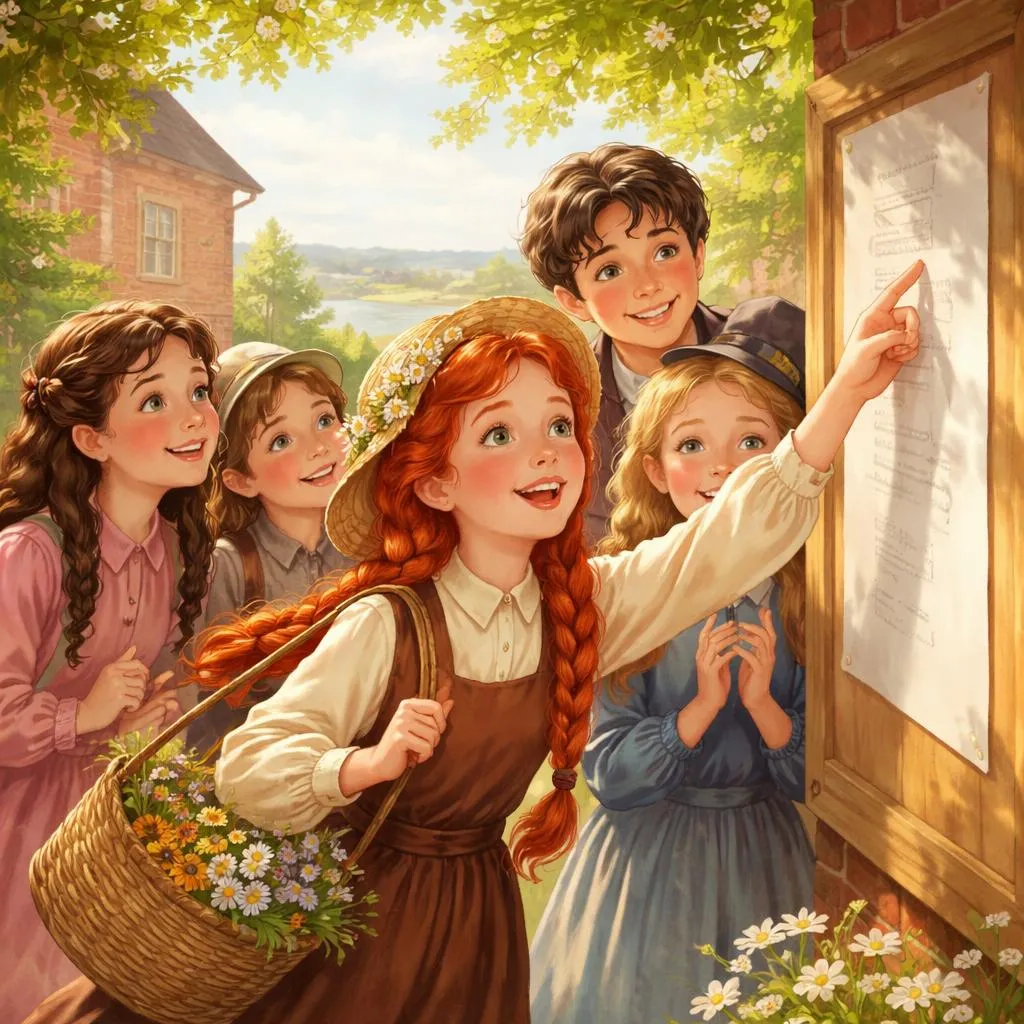

With the end of June came the close of the term and the close of Miss Stacy’s rule in Avonlea school. Anne and Diana walked home that evening feeling very sober indeed. Red eyes and damp handkerchiefs bore convincing testimony to the fact that Miss Stacy’s farewell words must have been quite as touching as Mr. Phillips’s had been under similar circumstances three years before. Diana looked back at the schoolhouse from the foot of the spruce hill and sighed deeply.
“It does seem as if it was the end of everything, doesn’t it?” she said dismally.
“You oughtn’t to feel half as badly as I do,” said Anne, hunting vainly for a dry spot on her handkerchief. “You’ll be back again next winter, but I suppose I’ve left the dear old school forever—if I have good luck, that is.”
“It won’t be a bit the same. Miss Stacy won’t be there, nor you nor Jane nor Ruby probably. I shall have to sit all alone, for I couldn’t bear to have another deskmate after you. Oh, we have had jolly times, haven’t we, Anne? It’s dreadful to think they’re all over.”
Two big tears rolled down by Diana’s nose.
“If you would stop crying I could,” said Anne imploringly. “Just as soon as I put away my hanky I see you brimming up and that starts me off again. As Mrs. Lynde says, ‘If you can’t be cheerful, be as cheerful as you can.’ After all, I dare say I’ll be back next year. This is one of the times I KNOW I’m not going to pass. They’re getting alarmingly frequent.”
“Why, you came out splendidly in the exams Miss Stacy gave.”
“Yes, but those exams didn’t make me nervous. When I think of the real thing you can’t imagine what a horrid cold fluttery feeling comes round my heart. And then my number is thirteen and Josie Pye says it’s so unlucky. I am NOT superstitious and I know it can make no difference. But still I wish it wasn’t thirteen.”
“I do wish I was going in with you,” said Diana. “Wouldn’t we have a perfectly elegant time? But I suppose you’ll have to cram in the evenings.”
“No; Miss Stacy has made us promise not to open a book at all. She says it would only tire and confuse us and we are to go out walking and not think about the exams at all and go to bed early. It’s good advice, but I expect it will be hard to follow; good advice is apt to be, I think. Prissy Andrews told me that she sat up half the night every night of her Entrance week and crammed for dear life; and I had determined to sit up AT LEAST as long as she did. It was so kind of your Aunt Josephine to ask me to stay at Beechwood while I’m in town.”
“You’ll write to me while you’re in, won’t you?”
“I’ll write Tuesday night and tell you how the first day goes,” promised Anne.
“I’ll be haunting the post office Wednesday,” vowed Diana.
Anne went to town the following Monday and on Wednesday Diana haunted the post office, as agreed, and got her letter.
“Dearest Diana” [wrote Anne],
“Here it is Tuesday night and I’m writing this in the library at Beechwood. Last night I was horribly lonesome all alone in my room and wished so much you were with me. I couldn’t “cram” because I’d promised Miss Stacy not to, but it was as hard to keep from opening my history as it used to be to keep from reading a story before my lessons were learned.
“This morning Miss Stacy came for me and we went to the Academy, calling for Jane and Ruby and Josie on our way. Ruby asked me to feel her hands and they were as cold as ice. Josie said I looked as if I hadn’t slept a wink and she didn’t believe I was strong enough to stand the grind of the teacher’s course even if I did get through. There are times and seasons even yet when I don’t feel that I’ve made any great headway in learning to like Josie Pye!
“When we reached the Academy there were scores of students there from all over the Island. The first person we saw was Moody Spurgeon sitting on the steps and muttering away to himself. Jane asked him what on earth he was doing and he said he was repeating the multiplication table over and over to steady his nerves and for pity’s sake not to interrupt him, because if he stopped for a moment he got frightened and forgot everything he ever knew, but the multiplication table kept all his facts firmly in their proper place!
“When we were assigned to our rooms Miss Stacy had to leave us. Jane and I sat together and Jane was so composed that I envied her. No need of the multiplication table for good, steady, sensible Jane! I wondered if I looked as I felt and if they could hear my heart thumping clear across the room. Then a man came in and began distributing the English examination sheets. My hands grew cold then and my head fairly whirled around as I picked it up. Just one awful moment—Diana, I felt exactly as I did four years ago when I asked Marilla if I might stay at Green Gables—and then everything cleared up in my mind and my heart began beating again—I forgot to say that it had stopped altogether!—for I knew I could do something with THAT paper anyhow.
“At noon we went home for dinner and then back again for history in the afternoon. The history was a pretty hard paper and I got dreadfully mixed up in the dates. Still, I think I did fairly well today. But oh, Diana, tomorrow the geometry exam comes off and when I think of it it takes every bit of determination I possess to keep from opening my Euclid. If I thought the multiplication table would help me any I would recite it from now till tomorrow morning.
“I went down to see the other girls this evening. On my way I met Moody Spurgeon wandering distractedly around. He said he knew he had failed in history and he was born to be a disappointment to his parents and he was going home on the morning train; and it would be easier to be a carpenter than a minister, anyhow. I cheered him up and persuaded him to stay to the end because it would be unfair to Miss Stacy if he didn’t. Sometimes I have wished I was born a boy, but when I see Moody Spurgeon I’m always glad I’m a girl and not his sister.
“Ruby was in hysterics when I reached their boardinghouse; she had just discovered a fearful mistake she had made in her English paper. When she recovered we went uptown and had an ice cream. How we wished you had been with us.
“Oh, Diana, if only the geometry examination were over! But there, as Mrs. Lynde would say, the sun will go on rising and setting whether I fail in geometry or not. That is true but not especially comforting. I think I’d rather it didn’t go on if I failed!
“Yours devotedly,
“Anne”
The geometry examination and all the others were over in due time and Anne arrived home on Friday evening, rather tired but with an air of chastened triumph about her. Diana was over at Green Gables when she arrived and they met as if they had been parted for years.
“You old darling, it’s perfectly splendid to see you back again. It seems like an age since you went to town and oh, Anne, how did you get along?”
“Pretty well, I think, in everything but the geometry. I don’t know whether I passed in it or not and I have a creepy, crawly presentiment that I didn’t. Oh, how good it is to be back! Green Gables is the dearest, loveliest spot in the world.”
“How did the others do?”
“The girls say they know they didn’t pass, but I think they did pretty well. Josie says the geometry was so easy a child of ten could do it! Moody Spurgeon still thinks he failed in history and Charlie says he failed in algebra. But we don’t really know anything about it and won’t until the pass list is out. That won’t be for a fortnight. Fancy living a fortnight in such suspense! I wish I could go to sleep and never wake up until it is over.”
Diana knew it would be useless to ask how Gilbert Blythe had fared, so she merely said:
“Oh, you’ll pass all right. Don’t worry.”
“I’d rather not pass at all than not come out pretty well up on the list,” flashed Anne, by which she meant—and Diana knew she meant—that success would be incomplete and bitter if she did not come out ahead of Gilbert Blythe.
With this end in view Anne had strained every nerve during the examinations. So had Gilbert. They had met and passed each other on the street a dozen times without any sign of recognition and every time Anne had held her head a little higher and wished a little more earnestly that she had made friends with Gilbert when he asked her, and vowed a little more determinedly to surpass him in the examination. She knew that all Avonlea junior was wondering which would come out first; she even knew that Jimmy Glover and Ned Wright had a bet on the question and that Josie Pye had said there was no doubt in the world that Gilbert would be first; and she felt that her humiliation would be unbearable if she failed.
But she had another and nobler motive for wishing to do well. She wanted to “pass high” for the sake of Matthew and Marilla—especially Matthew. Matthew had declared to her his conviction that she “would beat the whole Island.” That, Anne felt, was something it would be foolish to hope for even in the wildest dreams. But she did hope fervently that she would be among the first ten at least, so that she might see Matthew’s kindly brown eyes gleam with pride in her achievement. That, she felt, would be a sweet reward indeed for all her hard work and patient grubbing among unimaginative equations and conjugations.
At the end of the fortnight Anne took to “haunting” the post office also, in the distracted company of Jane, Ruby, and Josie, opening the Charlottetown dailies with shaking hands and cold, sinkaway feelings as bad as any experienced during the Entrance week. Charlie and Gilbert were not above doing this too, but Moody Spurgeon stayed resolutely away.
“I haven’t got the grit to go there and look at a paper in cold blood,” he told Anne. “I’m just going to wait until somebody comes and tells me suddenly whether I’ve passed or not.”
When three weeks had gone by without the pass list appearing Anne began to feel that she really couldn’t stand the strain much longer. Her appetite failed and her interest in Avonlea doings languished. Mrs. Lynde wanted to know what else you could expect with a Tory superintendent of education at the head of affairs, and Matthew, noting Anne’s paleness and indifference and the lagging steps that bore her home from the post office every afternoon, began seriously to wonder if he hadn’t better vote Grit at the next election.
But one evening the news came. Anne was sitting at her open window, for the time forgetful of the woes of examinations and the cares of the world, as she drank in the beauty of the summer dusk, sweet-scented with flower breaths from the garden below and sibilant and rustling from the stir of poplars. The eastern sky above the firs was flushed faintly pink from the reflection of the west, and Anne was wondering dreamily if the spirit of color looked like that, when she saw Diana come flying down through the firs, over the log bridge, and up the slope, with a fluttering newspaper in her hand.
Anne sprang to her feet, knowing at once what that paper contained. The pass list was out! Her head whirled and her heart beat until it hurt her. She could not move a step. It seemed an hour to her before Diana came rushing along the hall and burst into the room without even knocking, so great was her excitement.
“Anne, you’ve passed,” she cried, “passed the VERY FIRST—you and Gilbert both—you’re ties—but your name is first. Oh, I’m so proud!”
Diana flung the paper on the table and herself on Anne’s bed, utterly breathless and incapable of further speech. Anne lighted the lamp, oversetting the match safe and using up half a dozen matches before her shaking hands could accomplish the task. Then she snatched up the paper. Yes, she had passed—there was her name at the very top of a list of two hundred! That moment was worth living for.
“You did just splendidly, Anne,” puffed Diana, recovering sufficiently to sit up and speak, for Anne, starry eyed and rapt, had not uttered a word. “Father brought the paper home from Bright River not ten minutes ago—it came out on the afternoon train, you know, and won’t be here till tomorrow by mail—and when I saw the pass list I just rushed over like a wild thing. You’ve all passed, every one of you, Moody Spurgeon and all, although he’s conditioned in history. Jane and Ruby did pretty well—they’re halfway up—and so did Charlie. Josie just scraped through with three marks to spare, but you’ll see she’ll put on as many airs as if she’d led. Won’t Miss Stacy be delighted? Oh, Anne, what does it feel like to see your name at the head of a pass list like that? If it were me I know I’d go crazy with joy. I am pretty near crazy as it is, but you’re as calm and cool as a spring evening.”
“I’m just dazzled inside,” said Anne. “I want to say a hundred things, and I can’t find words to say them in. I never dreamed of this—yes, I did too, just once! I let myself think ONCE, ‘What if I should come out first?’ quakingly, you know, for it seemed so vain and presumptuous to think I could lead the Island. Excuse me a minute, Diana. I must run right out to the field to tell Matthew. Then we’ll go up the road and tell the good news to the others.”
They hurried to the hayfield below the barn where Matthew was coiling hay, and, as luck would have it, Mrs. Lynde was talking to Marilla at the lane fence.
“Oh, Matthew,” exclaimed Anne, “I’ve passed and I’m first—or one of the first! I’m not vain, but I’m thankful.”
“Well now, I always said it,” said Matthew, gazing at the pass list delightedly. “I knew you could beat them all easy.”
“You’ve done pretty well, I must say, Anne,” said Marilla, trying to hide her extreme pride in Anne from Mrs. Rachel’s critical eye. But that good soul said heartily:
“I just guess she has done well, and far be it from me to be backward in saying it. You’re a credit to your friends, Anne, that’s what, and we’re all proud of you.”
That night Anne, who had wound up the delightful evening with a serious little talk with Mrs. Allan at the manse, knelt sweetly by her open window in a great sheen of moonshine and murmured a prayer of gratitude and aspiration that came straight from her heart. There was in it thankfulness for the past and reverent petition for the future; and when she slept on her white pillow her dreams were as fair and bright and beautiful as maidenhood might desire.
背景介紹與作者介紹
這段摘錄自《清秀佳人》,是一部由露西·莫德·蒙哥馬利所著的深受喜愛的經典小說,於1908年首次出版。故事背景設定在加拿大愛德華王子島虛構的艾凡里村莊,講述了安妮·雪莉的故事,她是一位富有想像力和活力的孤兒女孩,被誤送到瑪麗拉和馬修·卡斯伯特那裡,這對兄妹原本打算收養一個男孩來幫助他們的農場。這部小說探討了安妮的冒險、成長和她適應新生活的挑戰。
露西·莫德·蒙哥馬利大量借鑒了她自己的童年經歷和愛德華王子島的風景,創造了一個生動而迷人的世界。她的作品以其豐富的描述、深刻的情感洞察力,以及她描繪人物時的溫暖和幽默而聞名。
詳細闡釋與意義
這段文字捕捉了安妮生命中一個令人心酸的時刻——她的學期結束以及圍繞著她即將到來的考試的焦慮和希望。它突出了這部小說的幾個關鍵主題:
-
**轉變與變化:**安妮和她的朋友們面臨著離開他們熟悉的校園生活的未知。與史黛西小姐的告別象徵著一個時代的結束以及成長的苦樂參半的本質。
-
**友誼與支持:**安妮和黛安娜之間親密的關係顯而易見,她們互相安慰,分享彼此的擔憂和希望。她們的友誼是力量和喜悅的源泉。
-
**毅力與勇氣:**安妮對考試的緊張以及她克服恐懼做好一切的決心,都表明了她的韌性。這個故事鼓勵讀者勇敢而樂觀地面對挑戰。
-
**自我反思:**安妮的內心獨白揭示了她的不安全感和希望,使她成為年輕讀者可以產生共鳴和鼓舞人心的角色。
敘述還觸及了學校生活的社會動態,例如競爭(安妮和吉爾伯特·布萊斯)、同伴壓力以及老師和導師的影響。
給學生的教訓和見解
從這個故事中,學生可以學到寶貴的教訓:
-
**友誼的重要性:**真正的朋友在困難時期提供安慰和鼓勵。互相支持可以使挑戰更容易面對。
-
**勇敢面對恐懼:**對考試或新體驗感到焦慮是很自然的,但毅力和積極的態度可以帶來成功。
-
**平衡努力與休息:**史黛西小姐避免死記硬背並在考試前好好休息的建議,教導了學習習慣中平衡的重要性。
-
**設定目標和良性競爭:**安妮渴望超越,尤其與吉爾伯特相比,表明競爭可以激勵我們進步,但應與善良和尊重相平衡。
-
**感恩與謙遜:**安妮的感恩祈禱反映了珍惜我們所擁有的東西以及努力在品格和精神上成長的價值。
在日常生活中的應用
-
**在學習中:**學生可以通過為考試穩步準備、管理壓力並尋求朋友和老師的支持來應用安妮的方法。
-
**在社會關係中:**建立像安妮和黛安娜那樣的牢固友誼可以提供情感支持並豐富生活。
-
**在個人成長中:**將變化和挑戰視為學習的機會,有助於培養韌性和自信。
-
**在品格培養中:**培養感恩、謙遜和善良,就像安妮所做的那樣,有助於積極和充實的生活。
從故事中培養積極的價值觀
-
**同情心:**理解他人的感受,就像安妮對穆迪·斯普金所做的那樣,有助於建立同情心。
-
**勇氣:**勇敢地面對恐懼和不確定性,即使感到緊張,也是成功的關鍵。
-
**樂觀:**保持樂觀的態度,受到林德太太盡可能保持快樂的建議的啟發,可以改善心理健康。
-
**努力工作和耐心:**安妮勤奮的學習和對回報的希望表明了奉獻的價值。
鼓勵反思和討論
老師和家長可以鼓勵學生思考:
-
你如何處理考試或重大活動前的焦慮?
-
在你遇到困難的時候,朋友在你生活中扮演什麼角色?
-
競爭可以是積極的嗎?你如何保持健康?
-
在日常生活中,有哪些方式可以表達感激之情?
-
你如何平衡工作和休息以做到最好?
通過參與《清秀佳人》,年輕的讀者不僅可以欣賞一個引人入勝的故事,還可以深入了解個人成長、友誼以及優雅而勇敢地面對生活中的挑戰。
