
“Put on your white organdy, by all means, Anne,” advised Diana decidedly.
They were together in the east gable chamber; outside it was only twilight—a lovely yellowish-green twilight with a clear-blue cloudless sky. A big round moon, slowly deepening from her pallid luster into burnished silver, hung over the Haunted Wood; the air was full of sweet summer sounds—sleepy birds twittering, freakish breezes, faraway voices and laughter. But in Anne’s room the blind was drawn and the lamp lighted, for an important toilet was being made.
The east gable was a very different place from what it had been on that night four years before, when Anne had felt its bareness penetrate to the marrow of her spirit with its inhospitable chill. Changes had crept in, Marilla conniving at them resignedly, until it was as sweet and dainty a nest as a young girl could desire.
The velvet carpet with the pink roses and the pink silk curtains of Anne’s early visions had certainly never materialized; but her dreams had kept pace with her growth, and it is not probable she lamented them. The floor was covered with a pretty matting, and the curtains that softened the high window and fluttered in the vagrant breezes were of pale-green art muslin. The walls, hung not with gold and silver brocade tapestry, but with a dainty apple-blossom paper, were adorned with a few good pictures given Anne by Mrs. Allan. Miss Stacy’s photograph occupied the place of honor, and Anne made a sentimental point of keeping fresh flowers on the bracket under it. Tonight a spike of white lilies faintly perfumed the room like the dream of a fragrance. There was no “mahogany furniture,” but there was a white-painted bookcase filled with books, a cushioned wicker rocker, a toilet table befrilled with white muslin, a quaint, gilt-framed mirror with chubby pink Cupids and purple grapes painted over its arched top, that used to hang in the spare room, and a low white bed.
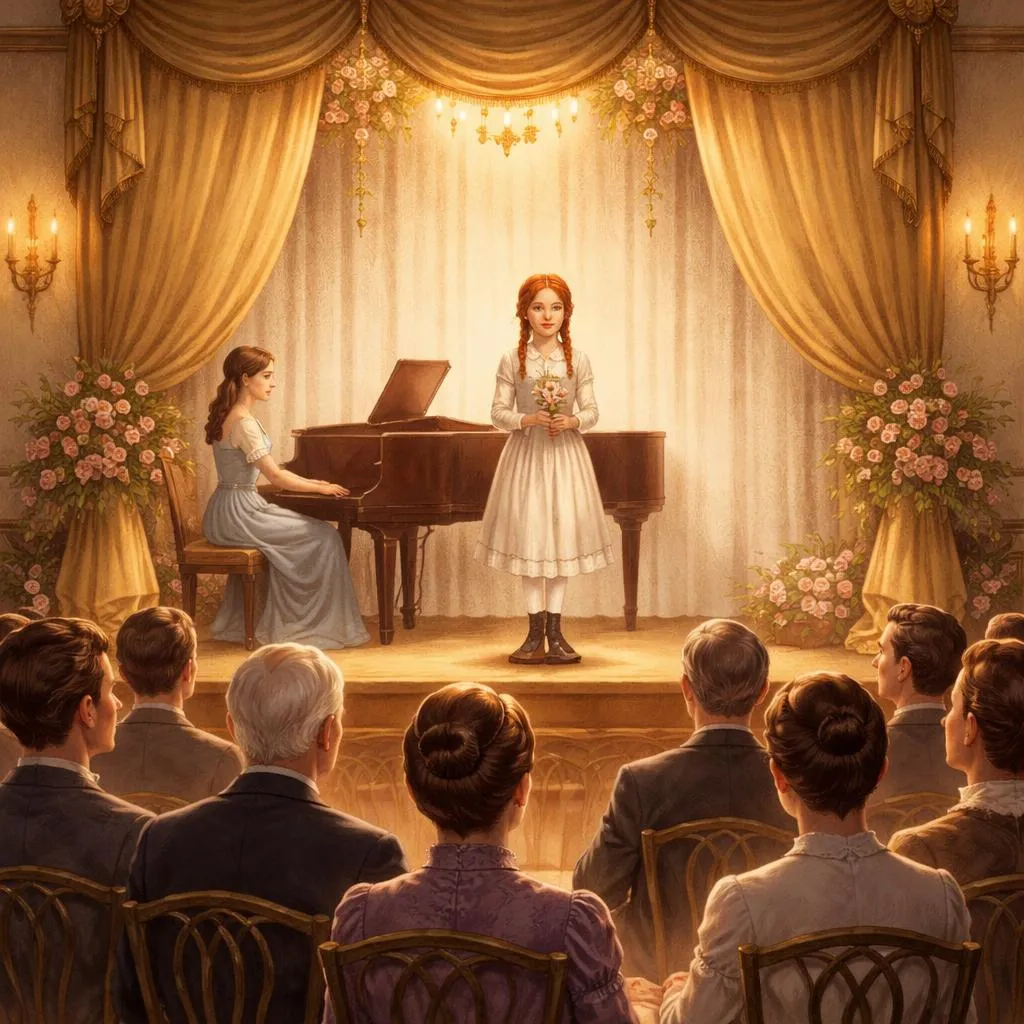
Anne was dressing for a concert at the White Sands Hotel. The guests had got it up in aid of the Charlottetown hospital, and had hunted out all the available amateur talent in the surrounding districts to help it along. Bertha Sampson and Pearl Clay of the White Sands Baptist choir had been asked to sing a duet; Milton Clark of Newbridge was to give a violin solo; Winnie Adella Blair of Carmody was to sing a Scotch ballad; and Laura Spencer of Spencervale and Anne Shirley of Avonlea were to recite.
As Anne would have said at one time, it was “an epoch in her life,” and she was deliciously athrill with the excitement of it. Matthew was in the seventh heaven of gratified pride over the honor conferred on his Anne and Marilla was not far behind, although she would have died rather than admit it, and said she didn’t think it was very proper for a lot of young folks to be gadding over to the hotel without any responsible person with them.
Anne and Diana were to drive over with Jane Andrews and her brother Billy in their double-seated buggy; and several other Avonlea girls and boys were going too. There was a party of visitors expected out from town, and after the concert a supper was to be given to the performers.
“Do you really think the organdy will be best?” queried Anne anxiously.“I don’t think it’s as pretty as my blue-flowered muslin—and itcertainly isn’t so fashionable.” and frilly and clinging. The muslin is stiff, and makes you look toodressed up. But the organdy seems as if it grew on you.” Anne sighed and yielded. Diana was beginning to have a reputation for notable taste in dressing, and her advice on such subjects was much sought after. She was looking very pretty herself on this particular night in a dress of the lovely wild-rose pink, from which Anne was forever debarred; but she was not to take any part in the concert, so her appearance was of minor importance. All her pains were bestowed upon Anne, who, she vowed, must, for the credit of Avonlea, be dressed and combed and adorned to the Queen’s taste.
"But it suits you ever so much better," said Diana. "It's so soft"
“Pull out that frill a little more—so; here, let me tie your sash; now for your slippers. I’m going to braid your hair in two thick braids, and tie them halfway up with big white bows—no, don’t pull out a single curl over your forehead—just have the soft part. There is no way you do your hair suits you so well, Anne, and Mrs. Allan says you look like a Madonna when you part it so. I shall fasten this little white house rose just behind your ear. There was just one on my bush, and I saved it for you.”
“Shall I put my pearl beads on?” asked Anne. “Matthew brought me a string from town last week, and I know he’d like to see them on me.”
Diana pursed up her lips, put her black head on one side critically, and finally pronounced in favor of the beads, which were thereupon tied around Anne’s slim milk-white throat.
“There’s something so stylish about you, Anne,” said Diana, with unenvious admiration. “You hold your head with such an air. I suppose it’s your figure. I am just a dumpling. I’ve always been afraid of it, and now I know it is so. Well, I suppose I shall just have to resign myself to it.”
“But you have such dimples,” said Anne, smiling affectionately into the pretty, vivacious face so near her own. “Lovely dimples, like little dents in cream. I have given up all hope of dimples. My dimple-dream will never come true; but so many of my dreams have that I mustn’t complain. Am I all ready now?”
“All ready,” assured Diana, as Marilla appeared in the doorway, a gaunt figure with grayer hair than of yore and no fewer angles, but with a much softer face. “Come right in and look at our elocutionist, Marilla. Doesn’t she look lovely?”
Marilla emitted a sound between a sniff and a grunt.
“She looks neat and proper. I like that way of fixing her hair. But I expect she’ll ruin that dress driving over there in the dust and dew with it, and it looks most too thin for these damp nights. Organdy’s the most unserviceable stuff in the world anyhow, and I told Matthew so when he got it. But there is no use in saying anything to Matthew nowadays. Time was when he would take my advice, but now he just buys things for Anne regardless, and the clerks at Carmody know they can palm anything off on him. Just let them tell him a thing is pretty and fashionable, and Matthew plunks his money down for it. Mind you keep your skirt clear of the wheel, Anne, and put your warm jacket on.”
Then Marilla stalked downstairs, thinking proudly how sweet Anne looked, with that
"One moonbeam from the forehead to the crown"
and regretting that she could not go to the concert herself to hear her girl recite.
“I wonder if it IS too damp for my dress,” said Anne anxiously.
“Not a bit of it,” said Diana, pulling up the window blind. “It’s a perfect night, and there won’t be any dew. Look at the moonlight.”
“I’m so glad my window looks east into the sunrising,” said Anne, going over to Diana. “It’s so splendid to see the morning coming up over those long hills and glowing through those sharp fir tops. It’s new every morning, and I feel as if I washed my very soul in that bath of earliest sunshine. Oh, Diana, I love this little room so dearly. I don’t know how I’ll get along without it when I go to town next month.”
“Don’t speak of your going away tonight,” begged Diana. “I don’t want to think of it, it makes me so miserable, and I do want to have a good time this evening. What are you going to recite, Anne? And are you nervous?”
“Not a bit. I’ve recited so often in public I don’t mind at all now. I’ve decided to give ‘The Maiden’s Vow.’ It’s so pathetic. Laura Spencer is going to give a comic recitation, but I’d rather make people cry than laugh.”
“What will you recite if they encore you?”
“They won’t dream of encoring me,” scoffed Anne, who was not without her own secret hopes that they would, and already visioned herself telling Matthew all about it at the next morning’s breakfast table. “There are Billy and Jane now—I hear the wheels. Come on.”
Billy Andrews insisted that Anne should ride on the front seat with him, so she unwillingly climbed up. She would have much preferred to sit back with the girls, where she could have laughed and chattered to her heart’s content. There was not much of either laughter or chatter in Billy. He was a big, fat, stolid youth of twenty, with a round, expressionless face, and a painful lack of conversational gifts. But he admired Anne immensely, and was puffed up with pride over the prospect of driving to White Sands with that slim, upright figure beside him.
Anne, by dint of talking over her shoulder to the girls and occasionally passing a sop of civility to Billy—who grinned and chuckled and never could think of any reply until it was too late—contrived to enjoy the drive in spite of all. It was a night for enjoyment. The road was full of buggies, all bound for the hotel, and laughter, silver clear, echoed and reechoed along it. When they reached the hotel it was a blaze of light from top to bottom. They were met by the ladies of the concert committee, one of whom took Anne off to the performers’ dressing room which was filled with the members of a Charlottetown Symphony Club, among whom Anne felt suddenly shy and frightened and countrified. Her dress, which, in the east gable, had seemed so dainty and pretty, now seemed simple and plain—too simple and plain, she thought, among all the silks and laces that glistened and rustled around her. What were her pearl beads compared to the diamonds of the big, handsome lady near her? And how poor her one wee white rose must look beside all the hothouse flowers the others wore! Anne laid her hat and jacket away, and shrank miserably into a corner. She wished herself back in the white room at Green Gables.
It was still worse on the platform of the big concert hall of the hotel, where she presently found herself. The electric lights dazzled her eyes, the perfume and hum bewildered her. She wished she were sitting down in the audience with Diana and Jane, who seemed to be having a splendid time away at the back. She was wedged in between a stout lady in pink silk and a tall, scornful-looking girl in a white-lace dress. The stout lady occasionally turned her head squarely around and surveyed Anne through her eyeglasses until Anne, acutely sensitive of being so scrutinized, felt that she must scream aloud; and the white-lace girl kept talking audibly to her next neighbor about the “country bumpkins” and “rustic belles” in the audience, languidly anticipating “such fun” from the displays of local talent on the program. Anne believed that she would hate that white-lace girl to the end of life.
Unfortunately for Anne, a professional elocutionist was staying at the hotel and had consented to recite. She was a lithe, dark-eyed woman in a wonderful gown of shimmering gray stuff like woven moonbeams, with gems on her neck and in her dark hair. She had a marvelously flexible voice and wonderful power of expression; the audience went wild over her selection. Anne, forgetting all about herself and her troubles for the time, listened with rapt and shining eyes; but when the recitation ended she suddenly put her hands over her face. She could never get up and recite after that—never. Had she ever thought she could recite? Oh, if she were only back at Green Gables!
At this unpropitious moment her name was called. Somehow Anne—who did not notice the rather guilty little start of surprise the white-lace girl gave, and would not have understood the subtle compliment implied therein if she had—got on her feet, and moved dizzily out to the front. She was so pale that Diana and Jane, down in the audience, clasped each other’s hands in nervous sympathy.
Anne was the victim of an overwhelming attack of stage fright. Often as she had recited in public, she had never before faced such an audience as this, and the sight of it paralyzed her energies completely. Everything was so strange, so brilliant, so bewildering—the rows of ladies in evening dress, the critical faces, the whole atmosphere of wealth and culture about her. Very different this from the plain benches at the Debating Club, filled with the homely, sympathetic faces of friends and neighbors. These people, she thought, would be merciless critics. Perhaps, like the white-lace girl, they anticipated amusement from her “rustic” efforts. She felt hopelessly, helplessly ashamed and miserable. Her knees trembled, her heart fluttered, a horrible faintness came over her; not a word could she utter, and the next moment she would have fled from the platform despite the humiliation which, she felt, must ever after be her portion if she did so.
But suddenly, as her dilated, frightened eyes gazed out over the audience, she saw Gilbert Blythe away at the back of the room, bending forward with a smile on his face—a smile which seemed to Anne at once triumphant and taunting. In reality it was nothing of the kind. Gilbert was merely smiling with appreciation of the whole affair in general and of the effect produced by Anne’s slender white form and spiritual face against a background of palms in particular. Josie Pye, whom he had driven over, sat beside him, and her face certainly was both triumphant and taunting. But Anne did not see Josie, and would not have cared if she had. She drew a long breath and flung her head up proudly, courage and determination tingling over her like an electric shock. She WOULD NOT fail before Gilbert Blythe—he should never be able to laugh at her, never, never! Her fright and nervousness vanished; and she began her recitation, her clear, sweet voice reaching to the farthest corner of the room without a tremor or a break. Self-possession was fully restored to her, and in the reaction from that horrible moment of powerlessness she recited as she had never done before. When she finished there were bursts of honest applause. Anne, stepping back to her seat, blushing with shyness and delight, found her hand vigorously clasped and shaken by the stout lady in pink silk.
“My dear, you did splendidly,” she puffed. “I’ve been crying like a baby, actually I have. There, they’re encoring you—they’re bound to have you back!”
“Oh, I can’t go,” said Anne confusedly. “But yet—I must, or Matthew will be disappointed. He said they would encore me.”
“Then don’t disappoint Matthew,” said the pink lady, laughing.
Smiling, blushing, limpid eyed, Anne tripped back and gave a quaint, funny little selection that captivated her audience still further. The rest of the evening was quite a little triumph for her.
When the concert was over, the stout, pink lady—who was the wife of an American millionaire—took her under her wing, and introduced her to everybody; and everybody was very nice to her. The professional elocutionist, Mrs. Evans, came and chatted with her, telling her that she had a charming voice and “interpreted” her selections beautifully. Even the white-lace girl paid her a languid little compliment. They had supper in the big, beautifully decorated dining room; Diana and Jane were invited to partake of this, also, since they had come with Anne, but Billy was nowhere to be found, having decamped in mortal fear of some such invitation. He was in waiting for them, with the team, however, when it was all over, and the three girls came merrily out into the calm, white moonshine radiance. Anne breathed deeply, and looked into the clear sky beyond the dark boughs of the firs.
Oh, it was good to be out again in the purity and silence of the night! How great and still and wonderful everything was, with the murmur of the sea sounding through it and the darkling cliffs beyond like grim giants guarding enchanted coasts.
“Hasn’t it been a perfectly splendid time?” sighed Jane, as they drove away. “I just wish I was a rich American and could spend my summer at a hotel and wear jewels and low-necked dresses and have ice cream and chicken salad every blessed day. I’m sure it would be ever so much more fun than teaching school. Anne, your recitation was simply great, although I thought at first you were never going to begin. I think it was better than Mrs. Evans’s.”
“Oh, no, don’t say things like that, Jane,” said Anne quickly, “because it sounds silly. It couldn’t be better than Mrs. Evans’s, you know, for she is a professional, and I’m only a schoolgirl, with a little knack of reciting. I’m quite satisfied if the people just liked mine pretty well.”
“I’ve a compliment for you, Anne,” said Diana. “At least I think it must be a compliment because of the tone he said it in. Part of it was anyhow. There was an American sitting behind Jane and me—such a romantic-looking man, with coal-black hair and eyes. Josie Pye says he is a distinguished artist, and that her mother’s cousin in Boston is married to a man that used to go to school with him. Well, we heard him say—didn’t we, Jane?—’Who is that girl on the platform with the splendid Titian hair? She has a face I should like to paint.’ There now, Anne. But what does Titian hair mean?”
“Being interpreted it means plain red, I guess,” laughed Anne. “Titian was a very famous artist who liked to paint red-haired women.”
“DID you see all the diamonds those ladies wore?” sighed Jane. “They were simply dazzling. Wouldn’t you just love to be rich, girls?”
“We ARE rich,” said Anne staunchly. “Why, we have sixteen years to our credit, and we’re happy as queens, and we’ve all got imaginations, more or less. Look at that sea, girls—all silver and shadow and vision of things not seen. We couldn’t enjoy its loveliness any more if we had millions of dollars and ropes of diamonds. You wouldn’t change into any of those women if you could. Would you want to be that white-lace girl and wear a sour look all your life, as if you’d been born turning up your nose at the world? Or the pink lady, kind and nice as she is, so stout and short that you’d really no figure at all? Or even Mrs. Evans, with that sad, sad look in her eyes? She must have been dreadfully unhappy sometime to have such a look. You KNOW you wouldn’t, Jane Andrews!”
“I DON’T know—exactly,” said Jane unconvinced. “I think diamonds would comfort a person for a good deal.”
“Well, I don’t want to be anyone but myself, even if I go uncomforted by diamonds all my life,” declared Anne. “I’m quite content to be Anne of Green Gables, with my string of pearl beads. I know Matthew gave me as much love with them as ever went with Madame the Pink Lady’s jewels.”
背景介紹與作者介紹
這段摘錄自《綠色莊園的安妮》,這是一部備受喜愛的經典小說,由加拿大作家露西·莫德·蒙哥馬利所著。該故事於1908年首次出版,講述了安妮·雪莉的故事,她是一位富有想像力和活力的孤兒女孩,被誤送到瑪麗拉和馬修·卡斯伯特那裡,他們是一對兄妹,原本打算收養一個男孩來幫助他們在愛德華王子島艾凡里鎮的農場。這部小說探討了安妮的冒險、成長以及她在新社區中建立的關係。
露西·莫德·蒙哥馬利從她在愛德華王子島的童年經歷中汲取靈感,將對大自然的生動描述和小鎮生活的描繪融入小說中。這本書已成為世界各地兒童文學的基石,因其溫暖、幽默和永恆的主題而受到讚譽。
詳細闡釋與意義
這段情節捕捉了安妮生命中的一個關鍵時刻:她在旅館音樂會上的準備和表演,這象徵著她從一個害羞、笨拙的女孩成長為一個自信的年輕女性。對她房間和服裝的詳細描述反映了她從困境走向舒適和自我表達的旅程。安妮卑微的出身與音樂會的迷人世界之間的對比突出了自我價值和勇氣的主題。
安妮最初的舞台恐懼症和隨後的勝利證明了她的韌性和決心。她克服恐懼並在令人生畏的觀眾面前出色表演的能力,是個人成長的一個鼓舞人心的例子。像黛安娜這樣的朋友的支持,以及馬修和瑪麗拉的自豪感,都強調了社區和鼓勵的重要性。
這個故事也微妙地批判了社會階級和外表。安妮對財富和幸福的反思提醒讀者,真正的富有在於想像力、愛和自我接納,而不是物質財富或社會地位。
給學生的教訓和啟發
-
**面對恐懼的勇氣:**安妮的經歷表明,感到緊張或害怕是很自然的,但只要有決心和支持,就能克服這些感受並取得成功。學生可以學會勇敢地面對挑戰,無論是在公開演講、考試還是社交場合。
-
**友誼和支持的價值:**黛安娜的關懷和瑪麗拉的默默自豪說明了朋友和家人如何幫助我們成長。建立牢固、積極的關係可以提供情感力量和信心。
-
**自我接納和內在價值:**安妮對財富和幸福的反思告訴我們,自我價值來自內心。學生應該欣賞自己獨特的品質和才能,而不是與他人比較或尋求外部認可。
-
**想像力和創造力:**安妮生動的想像力豐富了她的生活,並幫助她應對困難。鼓勵創造力可以提高解決問題的能力和情感韌性。
-
**謙遜和感恩:**儘管安妮取得了成功,但她仍然保持謙遜,並感謝她所得到的愛。培養感恩之心有助於保持積極的態度和堅強的性格。
在日常生活中應用這些教訓
- **在學習中:**當面對困難的科目或演示時,學生可以記住安妮的勇氣,並做好充分的準備,在需要時尋求支持。
- **在社交場合:**效仿安妮的善良和開放可以幫助建立友誼並應對同伴壓力。
- **在個人成長中:**反思自己的優勢並擁抱個性可以培養自信和幸福。
- **在創造力中:**參與藝術、寫作或富有想像力的遊戲可以培養情商和喜悅。
培養積極的精神和行為
為了培養安妮·雪莉所體現的積極品質,學生可以:
- 練習自我鼓勵和積極的自我對話。
- 支持同伴並慶祝他們的成功。
- 以開放的心態和學習的意願面對新的體驗。
- 誠實而富有創造性地表達自己。
- 定期反思他們感激的事情。
《綠色莊園的安妮》仍然是年輕讀者的永恆指南,鼓勵他們以勇氣、善良和快樂的想像力成長。
