
It’s a world of surprises. The king brooded; this was natural. What would he brood about, should you say? Why, about the prodigious nature of his fall, of course—from the loftiest place in the world to the lowest; from the most illustrious station in the world to the obscurest; from the grandest vocation among men to the basest. No, I take my oath that the thing that graveled him most, to start with, was not this, but the price he had fetched! He couldn’t seem to get over that seven dollars. Well, it stunned me so, when I first found it out, that I couldn’t believe it; it didn’t seem natural. But as soon as my mental sight cleared and I got a right focus on it, I saw I was mistaken; it was natural. For this reason: a king is a mere artificiality, and so a king’s feelings, like the impulses of an automatic doll, are mere artificialities; but as a man, he is a reality, and his feelings, as a man, are real, not phantoms. It shames the average man to be valued below his own estimate of his worth, and the king certainly wasn’t anything more than an average man, if he was up that high.
Confound him, he wearied me with arguments to show that in anything like a fair market he would have fetched twenty-five dollars, sure—a thing which was plainly nonsense, and full of the baldest conceit; I wasn’t worth it myself. But it was tender ground for me to argue on. In fact, I had to simply shirk argument and do the diplomatic instead. I had to throw conscience aside, and brazenly concede that he ought to have brought twenty-five dollars; whereas I was quite well aware that in all the ages, the world had never seen a king that was worth half the money, and during the next thirteen centuries wouldn’t see one that was worth the fourth of it. Yes, he tired me. If he began to talk about the crops; or about the recent weather; or about the condition of politics; or about dogs, or cats, or morals, or theology—no matter what —I sighed, for I knew what was coming; he was going to get out of it a palliation of that tiresome seven-dollar sale. Wherever we halted where there was a crowd, he would give me a look which said plainly: “if that thing could be tried over again now, with this kind of folk, you would see a different result.” Well, when he was first sold, it secretly tickled me to see him go for seven dollars; but before he was done with his sweating and worrying I wished he had fetched a hundred. The thing never got a chance to die, for every day, at one place or another, possible purchasers looked us over, and, as often as any other way, their comment on the king was something like this:
“Here’s a two-dollar-and-a-half chump with a thirty-dollar style. Pity but style was marketable.”
At last this sort of remark produced an evil result. Our owner was a practical person and he perceived that this defect must be mended if he hoped to find a purchaser for the king. So he went to work to take the style out of his sacred majesty. I could have given the man some valuable advice, but I didn’t; you mustn’t volunteer advice to a slave-driver unless you want to damage the cause you are arguing for. I had found it a sufficiently difficult job to reduce the king’s style to a peasant’s style, even when he was a willing and anxious pupil; now then, to undertake to reduce the king’s style to a slave’s style—and by force—go to! it was a stately contract. Never mind the details—it will save me trouble to let you imagine them. I will only remark that at the end of a week there was plenty of evidence that lash and club and fist had done their work well; the king’s body was a sight to see—and to weep over; but his spirit?—why, it wasn’t even phased. Even that dull clod of a slave-driver was able to see that there can be such a thing as a slave who will remain a man till he dies; whose bones you can break, but whose manhood you can’t. This man found that from his first effort down to his latest, he couldn’t ever come within reach of the king, but the king was ready to plunge for him, and did it. So he gave up at last, and left the king in possession of his style unimpaired. The fact is, the king was a good deal more than a king, he was a man; and when a man is a man, you can’t knock it out of him.
We had a rough time for a month, tramping to and fro in the earth, and suffering. And what Englishman was the most interested in the slavery question by that time? His grace the king! Yes; from being the most indifferent, he was become the most interested. He was become the bitterest hater of the institution I had ever heard talk. And so I ventured to ask once more a question which I had asked years before and had gotten such a sharp answer that I had not thought it prudent to meddle in the matter further. Would he abolish slavery?
His answer was as sharp as before, but it was music this time; I shouldn’t ever wish to hear pleasanter, though the profanity was not good, being awkwardly put together, and with the crash-word almost in the middle instead of at the end, where, of course, it ought to have been.
I was ready and willing to get free now; I hadn’t wanted to get free any sooner. No, I cannot quite say that. I had wanted to, but I had not been willing to take desperate chances, and had always dissuaded the king from them. But now—ah, it was a new atmosphere! Liberty would be worth any cost that might be put upon it now. I set about a plan, and was straightway charmed with it. It would require time, yes, and patience, too, a great deal of both. One could invent quicker ways, and fully as sure ones; but none that would be as picturesque as this; none that could be made so dramatic. And so I was not going to give this one up. It might delay us months, but no matter, I would carry it out or break something.
Now and then we had an adventure. One night we were overtaken by a snow-storm while still a mile from the village we were making for. Almost instantly we were shut up as in a fog, the driving snow was so thick. You couldn’t see a thing, and we were soon lost. The slave-driver lashed us desperately, for he saw ruin before him, but his lashings only made matters worse, for they drove us further from the road and from likelihood of succor. So we had to stop at last and slump down in the snow where we were. The storm continued until toward midnight, then ceased. By this time two of our feebler men and three of our women were dead, and others past moving and threatened with death. Our master was nearly beside himself. He stirred up the living, and made us stand, jump, slap ourselves, to restore our circulation, and he helped as well as he could with his whip.
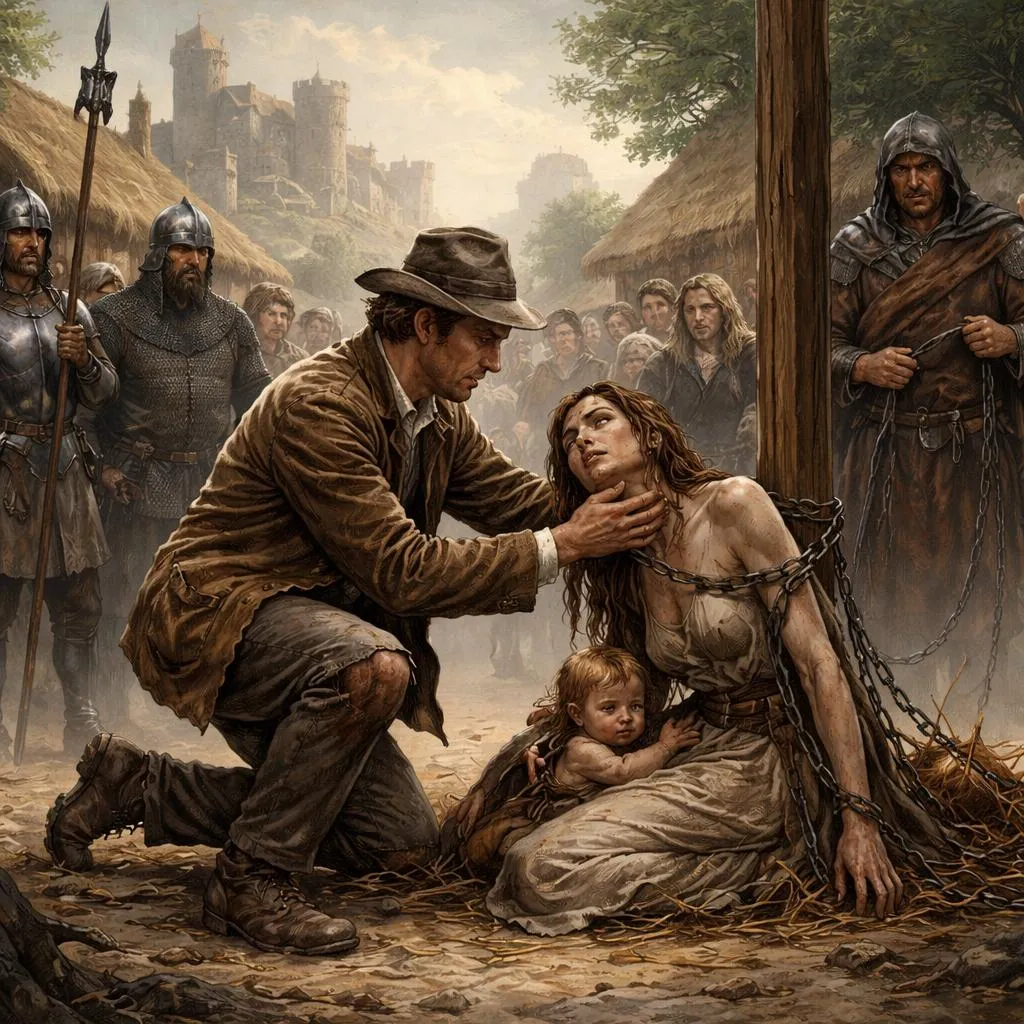
Now came a diversion. We heard shrieks and yells, and soon a woman came running and crying; and seeing our group, she flung herself into our midst and begged for protection. A mob of people came tearing after her, some with torches, and they said she was a witch who had caused several cows to die by a strange disease, and practiced her arts by help of a devil in the form of a black cat. This poor woman had been stoned until she hardly looked human, she was so battered and bloody. The mob wanted to burn her.
Well, now, what do you suppose our master did? When we closed around this poor creature to shelter her, he saw his chance. He said, burn her here, or they shouldn’t have her at all. Imagine that! They were willing. They fastened her to a post; they brought wood and piled it about her; they applied the torch while she shrieked and pleaded and strained her two young daughters to her breast; and our brute, with a heart solely for business, lashed us into position about the stake and warmed us into life and commercial value by the same fire which took away the innocent life of that poor harmless mother. That was the sort of master we had. I took his number. That snow-storm cost him nine of his flock; and he was more brutal to us than ever, after that, for many days together, he was so enraged over his loss.
We had adventures all along. One day we ran into a procession. And such a procession! All the riffraff of the kingdom seemed to be comprehended in it; and all drunk at that. In the van was a cart with a coffin in it, and on the coffin sat a comely young girl of about eighteen suckling a baby, which she squeezed to her breast in a passion of love every little while, and every little while wiped from its face the tears which her eyes rained down upon it; and always the foolish little thing smiled up at her, happy and content, kneading her breast with its dimpled fat hand, which she patted and fondled right over her breaking heart.
Men and women, boys and girls, trotted along beside or after the cart, hooting, shouting profane and ribald remarks, singing snatches of foul song, skipping, dancing—a very holiday of hellions, a sickening sight. We had struck a suburb of London, outside the walls, and this was a sample of one sort of London society. Our master secured a good place for us near the gallows. A priest was in attendance, and he helped the girl climb up, and said comforting words to her, and made the under-sheriff provide a stool for her. Then he stood there by her on the gallows, and for a moment looked down upon the mass of upturned faces at his feet, then out over the solid pavement of heads that stretched away on every side occupying the vacancies far and near, and then began to tell the story of the case. And there was pity in his voice —how seldom a sound that was in that ignorant and savage land! I remember every detail of what he said, except the words he said it in; and so I change it into my own words:
“Law is intended to mete out justice. Sometimes it fails. This cannot be helped. We can only grieve, and be resigned, and pray for the soul of him who falls unfairly by the arm of the law, and that his fellows may be few. A law sends this poor young thing to death—and it is right. But another law had placed her where she must commit her crime or starve with her child—and before God that law is responsible for both her crime and her ignominious death!
“A little while ago this young thing, this child of eighteen years, was as happy a wife and mother as any in England; and her lips were blithe with song, which is the native speech of glad and innocent hearts. Her young husband was as happy as she; for he was doing his whole duty, he worked early and late at his handicraft, his bread was honest bread well and fairly earned, he was prospering, he was furnishing shelter and sustenance to his family, he was adding his mite to the wealth of the nation. By consent of a treacherous law, instant destruction fell upon this holy home and swept it away! That young husband was waylaid and impressed, and sent to sea. The wife knew nothing of it. She sought him everywhere, she moved the hardest hearts with the supplications of her tears, the broken eloquence of her despair. Weeks dragged by, she watching, waiting, hoping, her mind going slowly to wreck under the burden of her misery. Little by little all her small possessions went for food. When she could no longer pay her rent, they turned her out of doors. She begged, while she had strength; when she was starving at last, and her milk failing, she stole a piece of linen cloth of the value of a fourth part of a cent, thinking to sell it and save her child. But she was seen by the owner of the cloth. She was put in jail and brought to trial. The man testified to the facts. A plea was made for her, and her sorrowful story was told in her behalf. She spoke, too, by permission, and said she did steal the cloth, but that her mind was so disordered of late by trouble that when she was overborne with hunger all acts, criminal or other, swam meaningless through her brain and she knew nothing rightly, except that she was so hungry! For a moment all were touched, and there was disposition to deal mercifully with her, seeing that she was so young and friendless, and her case so piteous, and the law that robbed her of her support to blame as being the first and only cause of her transgression; but the prosecuting officer replied that whereas these things were all true, and most pitiful as well, still there was much small theft in these days, and mistimed mercy here would be a danger to property—oh, my God, is there no property in ruined homes, and orphaned babes, and broken hearts that British law holds precious!—and so he must require sentence.
“When the judge put on his black cap, the owner of the stolen linen rose trembling up, his lip quivering, his face as gray as ashes; and when the awful words came, he cried out, ‘Oh, poor child, poor child, I did not know it was death!’ and fell as a tree falls. When they lifted him up his reason was gone; before the sun was set, he had taken his own life. A kindly man; a man whose heart was right, at bottom; add his murder to this that is to be now done here; and charge them both where they belong —to the rulers and the bitter laws of Britain. The time is come, my child; let me pray over thee—not for thee, dear abused poor heart and innocent, but for them that be guilty of thy ruin and death, who need it more.”
After his prayer they put the noose around the young girl’s neck, and they had great trouble to adjust the knot under her ear, because she was devouring the baby all the time, wildly kissing it, and snatching it to her face and her breast, and drenching it with tears, and half moaning, half shrieking all the while, and the baby crowing, and laughing, and kicking its feet with delight over what it took for romp and play. Even the hangman couldn’t stand it, but turned away. When all was ready the priest gently pulled and tugged and forced the child out of the mother’s arms, and stepped quickly out of her reach; but she clasped her hands, and made a wild spring toward him, with a shriek; but the rope—and the under-sheriff—held her short. Then she went on her knees and stretched out her hands and cried:
“One more kiss—oh, my God, one more, one more,—it is the dying that begs it!”
She got it; she almost smothered the little thing. And when they got it away again, she cried out:
“Oh, my child, my darling, it will die! It has no home, it has no father, no friend, no mother—”
“It has them all!” said that good priest. “All these will I be to it till I die.”
You should have seen her face then! Gratitude? Lord, what do you want with words to express that? Words are only painted fire; a look is the fire itself. She gave that look, and carried it away to the treasury of heaven, where all things that are divine belong.
背景介紹與作者介紹
這段文字出自《國王的故事》,一個深深植根於人類尊嚴、奴隸制、不公和韌性主題的敘事。這個故事反映了奴隸制的殘酷現實以及人類精神對壓迫的反抗。作者馬克·吐溫以其尖銳的社會評論和生動的敘事而聞名。吐溫的作品經常通過幽默和諷刺來批判社會不公,並探討人性的複雜性。這部作品寫於19世紀,當時奴隸制和社會不平等是緊迫的問題,這個故事有力地提醒了被奴役人民所面臨的掙扎以及人類尊嚴的重要性。
詳細闡釋與意義
故事的核心是一個強有力的寓言,講述了一個國王的衰落,他被剝奪了地位,僅以七美元的價格被賣掉。這種衰落象徵著奴役所帶來的權力和身份的喪失。國王在殘酷的待遇下仍然保持尊嚴的掙扎,突顯了人類精神的韌性。敘事也揭示了奴隸制的殘酷以及一個重視財產而非人類生命的社會的道德矛盾。
故事中的生動場景——例如暴風雪、燒女巫的暴民和處決遊行——說明了人物所處世界的殘酷和不公。年輕母親的悲慘命運,被迫犯罪和死亡的法律所譴責,突出了正義的失敗以及對同情和改革的需要。
給學生的教訓和見解
-
人類尊嚴和韌性: 國王拒絕在遭受身體虐待的情況下失去精神,這教導了我們內在的力量以及在逆境中保持尊嚴的重要性。
-
同情心和正義: 故事鼓勵讀者同情那些遭受不公的人,並質疑不公平的法律和社會制度。
-
壓迫的代價: 通過對奴隸制和社會殘酷的描繪,學生們了解了壓迫對個人和社區的毀滅性影響。
-
道德勇氣: 國王對奴隸制的日益憎恨以及對自由的渴望,激勵讀者站起來反抗不公,為正義而戰。
將故事的教訓應用於生活中
-
在學校: 學生可以通過學習不同的觀點和不公正的歷史來培養同情心。他們還可以像國王一樣,通過勇敢和尊嚴地面對挑戰來培養韌性。
-
在社交場合: 了解正義和同情心的重要性,可以幫助學生建立公平和支持性的關係。反對欺凌或不公平的待遇,反映了故事中展現的道德勇氣。
-
在個人成長中: 故事鼓勵自尊,拒絕讓他人貶低自己的價值。它也激勵在為長期目標努力時保持耐心和毅力,就像國王的自由計劃一樣。
培養積極的價值觀
為了培養故事中闡述的積極精神和行為,學生可以:
- 實踐善良,並為受到不公平待遇的人挺身而出。
- 反思內在力量和尊嚴的重要性。
- 參與關於正義、公平和人權的討論。
- 學習歷史和社會問題,以更好地理解這些故事的背景。
- 在面對困難時培養耐心和戰略思維。
通過學習這個故事,年輕的讀者不僅獲得了關於歷史上黑暗篇章的知識,還獲得了關於韌性、同情心和正義的寶貴人生教訓,這些教訓可以在他們的一生中引導他們。
