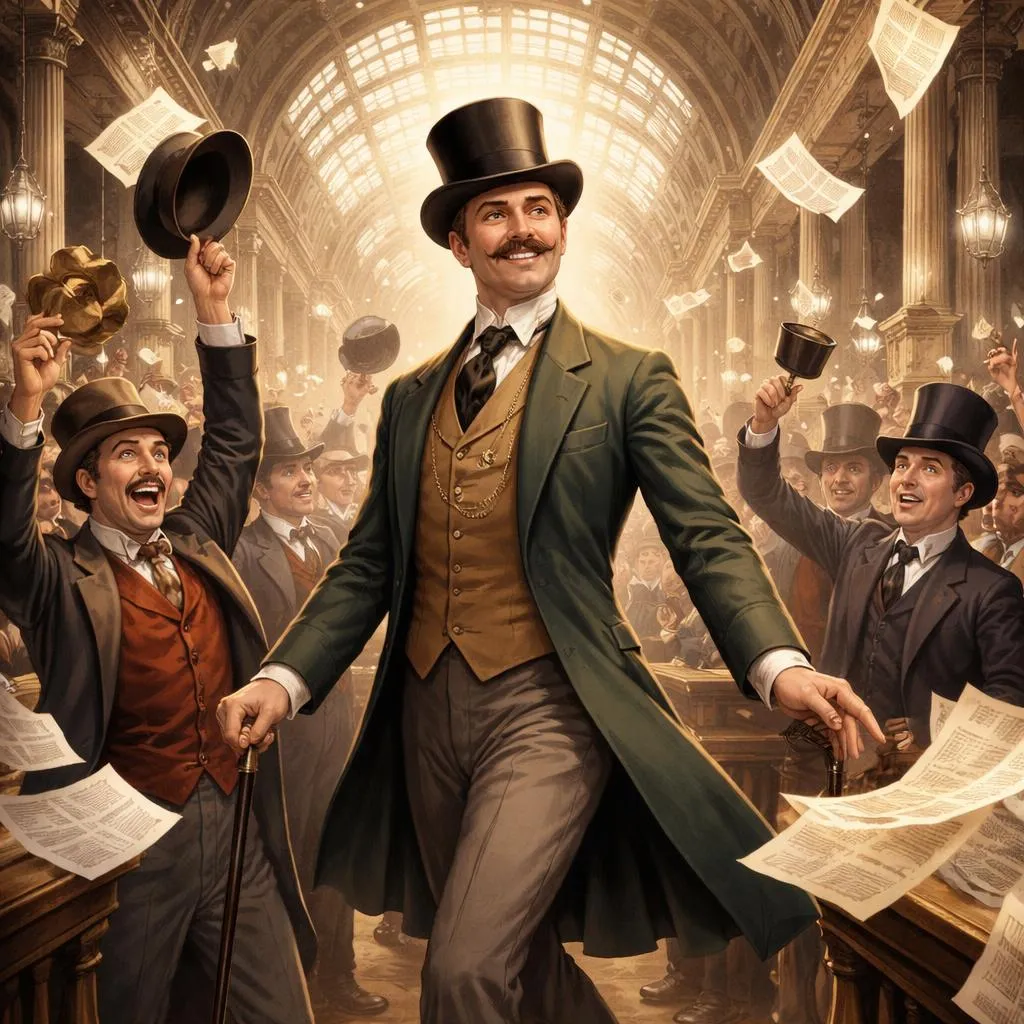

It is time to relate what a change took place in English public opinion when it transpired that the real bankrobber, a certain James Strand, had been arrested, on the 17th day of December, at Edinburgh. Three days before, Phileas Fogg had been a criminal, who was being desperately followed up by the police; now he was an honourable gentleman, mathematically pursuing his eccentric journey round the world.
The papers resumed their discussion about the wager; all those who had laid bets, for or against him, revived their interest, as if by magic; the "Phileas Fogg bonds" again became negotiable, and many new wagers were made. Phileas Fogg's name was once more at a premium on 'Change.
His five friends of the Reform Club passed these three days in a state of feverish suspense. Would Phileas Fogg, whom they had forgotten, reappear before their eyes! Where was he at this moment? The 17th of December, the day of James Strand's arrest, was the seventy–sixth since Phileas Fogg's departure, and no news of him had been received. Was he dead? Had he abandoned the effort, or was he continuing his journey along the route agreed upon? And would he appear on Saturday, the 21st of December, at a quarter before nine in the evening, on the threshold of the Reform Club saloon?
The anxiety in which, for three days, London society existed, cannot be described. Telegrams were sent to America and Asia for news of Phileas Fogg. Messengers were dispatched to the house in Saville Row morning and evening. No news. The police were ignorant what had become of the detective, Fix, who had so unfortunately followed up a false scent. Bets increased, nevertheless, in number and value. Phileas Fogg, like a racehorse, was drawing near his last turning–point. The bonds were quoted, no longer at a hundred below par, but at twenty, at ten, and at five; and paralytic old Lord Albemarle bet even in his favour.
A great crowd was collected in Pall Mall and the neighbouring streets on Saturday evening; it seemed like a multitude of brokers permanently established around the Reform Club. Circulation was impeded, and everywhere disputes, discussions, and financial transactions were going on. The police had great difficulty in keeping back the crowd, and as the hour when Phileas Fogg was due approached, the excitement rose to its highest pitch.
The five antagonists of Phileas Fogg had met in the great saloon of the club. John Sullivan and Samuel Fallentin, the bankers, Andrew Stuart, the engineer, Gauthier Ralph, the director of the Bank of England, and Thomas Flanagan, the brewer, one and all waited anxiously.
When the clock indicated twenty minutes past eight, Andrew Stuart got up, saying, "Gentlemen, in twenty minutes the time agreed upon between Mr. Fogg and ourselves will have expired."
"What time did the last train arrive from Liverpool?" asked Thomas Flanagan.
"At twenty–three minutes past seven," replied Gauthier Ralph; "and the next does not arrive till ten minutes after twelve."
"Well, gentlemen," resumed Andrew Stuart, "if Phileas Fogg had come in the 7:23 train, he would have got here by this time. We can, therefore, regard the bet as won."
"Wait; don't let us be too hasty," replied Samuel Fallentin. "You know that Mr. Fogg is very eccentric. His punctuality is well known; he never arrives too soon, or too late; and I should not be surprised if he appeared before us at the last minute."
"Why," said Andrew Stuart nervously, "if I should see him, I should not believe it was he."
"The fact is," resumed Thomas Flanagan, "Mr. Fogg's project was absurdly foolish. Whatever his punctuality, he could not prevent the delays which were certain to occur; and a delay of only two or three days would be fatal to his tour."
"Observe, too," added John Sullivan, "that we have received no intelligence from him, though there are telegraphic lines all along is route."
"He has lost, gentleman," said Andrew Stuart, "he has a hundred times lost! You know, besides, that the China the only steamer he could have taken from New York to get here in time arrived yesterday. I have seen a list of the passengers, and the name of Phileas Fogg is not among them. Even if we admit that fortune has favoured him, he can scarcely have reached America. I think he will be at least twenty days behind–hand, and that Lord Albemarle will lose a cool five thousand."
"It is clear," replied Gauthier Ralph; "and we have nothing to do but to present Mr. Fogg's cheque at Barings to–morrow."
At this moment, the hands of the club clock pointed to twenty minutes to nine.
"Five minutes more," said Andrew Stuart.
The five gentlemen looked at each other. Their anxiety was becoming intense; but, not wishing to betray it, they readily assented to Mr. Fallentin's proposal of a rubber.
"I wouldn't give up my four thousand of the bet," said Andrew Stuart, as he took his seat, "for three thousand nine hundred and ninety–nine."
The clock indicated eighteen minutes to nine.
The players took up their cards, but could not keep their eyes off the clock. Certainly, however secure they felt, minutes had never seemed so long to them!
"Seventeen minutes to nine," said Thomas Flanagan, as he cut the cards which Ralph handed to him.
Then there was a moment of silence. The great saloon was perfectly quiet; but the murmurs of the crowd outside were heard, with now and then a shrill cry. The pendulum beat the seconds, which each player eagerly counted, as he listened, with mathematical regularity.
"Sixteen minutes to nine!" said John Sullivan, in a voice which betrayed his emotion.
One minute more, and the wager would be won. Andrew Stuart and his partners suspended their game. They left their cards, and counted the seconds.
At the fortieth second, nothing. At the fiftieth, still nothing.
At the fifty–fifth, a loud cry was heard in the street, followed by applause, hurrahs, and some fierce growls.
The players rose from their seats.
At the fifty–seventh second the door of the saloon opened; and the pendulum had not beat the sixtieth second when Phileas Fogg appeared, followed by an excited crowd who had forced their way through the club doors, and in his calm voice, said, "Here I am, gentlemen!"
背景介紹與作者介紹
這段文字出自儒勒·凡爾納的經典冒險小說《八十天環遊世界》,這位法國作家以其在科幻和冒險文學方面的先驅性作品而聞名。這部小說寫於1873年,捕捉了19世紀的精神——一個科技快速發展和全球探索的時代。凡爾納富有想像力的敘事和細緻的描述使他的作品永恆,激勵了一代又一代的讀者去夢想遙遠的地方和勇敢的冒險。
詳細解讀與意義
故事圍繞著福克先生展開,這位精確而有條理的英國紳士打賭他能在短短八十天內環遊世界。這段摘錄捕捉了故事的高潮,公眾輿論隨著福克的命運岌岌可危而急劇變化。最初被懷疑犯罪,福克的榮譽和決心在真正的罪犯被抓獲時得以恢復。緊張感隨著時間的流逝而增加,直到打賭的最後一刻,最終以福克先生的凱旋歸來而告終。
這個場景突出了毅力、守時以及人類意志戰勝看似不可能的困難的主題。它也反映了維多利亞時代對進步、守時以及大英帝國擴張的著迷。這個故事巧妙地將冒險與對社會規範的微妙批判以及對外表和聲譽的重視結合起來。
給學生的教訓和啟發
-
毅力與決心: 福克先生的旅程教導了我們堅持目標的重要性,即使面臨挫折和懷疑。學生可以通過採用類似的心態來學習在學習和個人挑戰中堅持不懈。
-
時間管理與守時: 福克先生嚴格遵守他的時間表,這是一個關於如何有效管理時間可以帶來成功的有力例子。年輕的讀者可以反思計劃和守時如何幫助學業和日常責任。
-
批判性思維與判斷: 公眾對福克先生的搖擺不定的看法提醒我們不要根據不完整的信息妄下結論。學生應該培養批判性思維能力,避免對他人倉促判斷。
-
冒險的勇氣: 福克先生的打賭很大膽且充滿風險,但它促使他探索世界並成長。這鼓勵學生走出舒適區,擁抱促進學習和自我發現的挑戰。
-
社會和情感韌性: 儘管受到公眾的懷疑和打賭的壓力,福克先生仍然保持冷靜和鎮定。這教導了情感韌性以及在壓力下保持鎮定的價值。
在日常生活中應用這些教訓
-
在學習中: 學生可以為他們的作業設定明確的目標和截止日期,就像福克先生計劃他的旅程一樣。將大任務分解成更小的步驟並堅持時間表可以提高學業成績。
-
在社交互動中: 了解不要過早評判他人的重要性,有助於建立同情心和更好的關係。學生可以練習在形成觀點之前傾聽和收集事實。
-
在個人成長中: 進行有計劃的冒險,例如加入新的俱樂部或嘗試新的愛好,可以拓寬視野並建立信心。
-
在培養品格中: 效仿福克先生的冷靜和決心可以幫助學生以穩定的心態面對考試、比賽或個人挑戰。
從故事中培養積極的特質
老師和家長可以鼓勵孩子們:
- 通過設定個人目標來培養責任感。
- 通過創建日常作息來練習守時。
- 通過討論克服障礙的故事來建立韌性。
- 通過閱讀和探索來培養對世界的好奇心。
- 欣賞友誼和支持的價值,正如在福克先生的同伴中所看到的那樣。
總之,《八十天環遊世界》不僅是一場令人興奮的冒險;它也是一個豐富的生活教訓的來源,激勵年輕的讀者敢於夢想,努力工作,並以勇氣和正直面對生活的挑戰。
