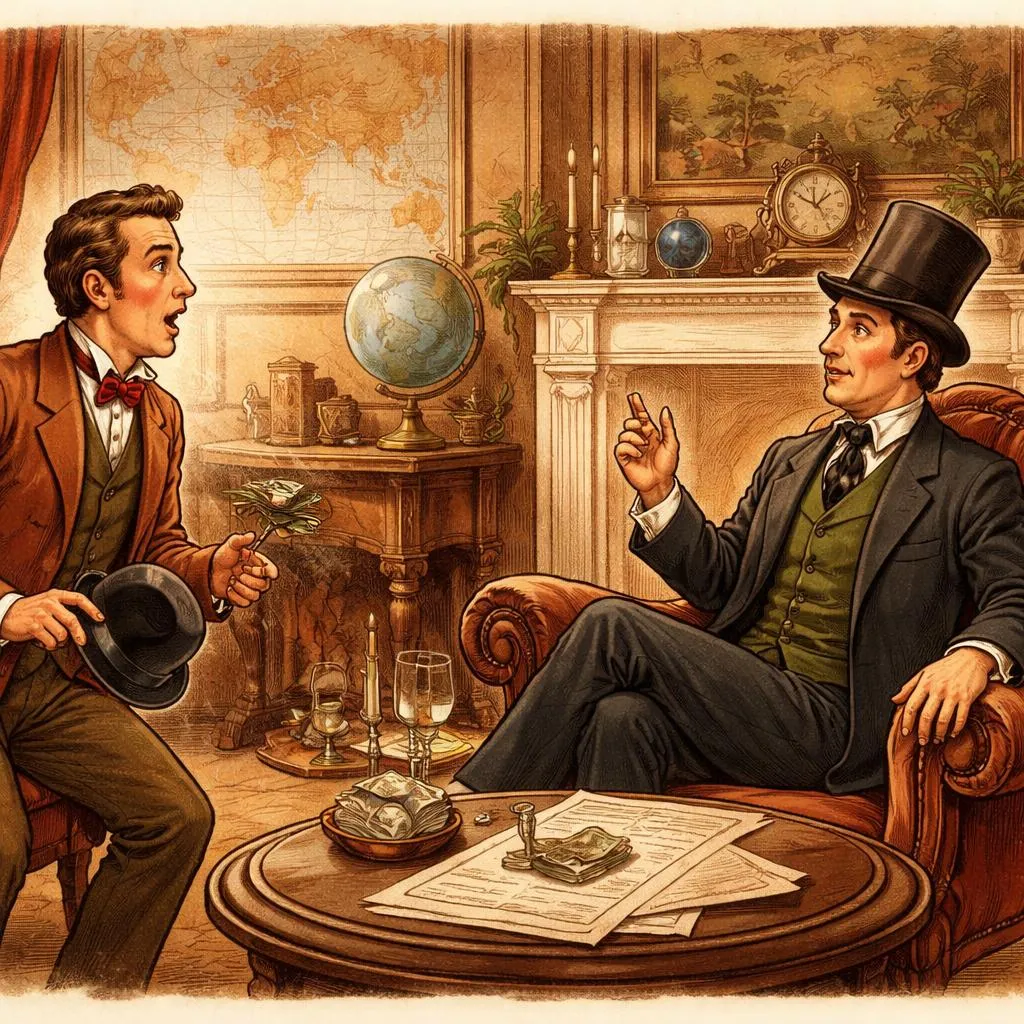

Having won twenty guineas at whist, and taken leave of his friends, Phileas Fogg, at twenty–five minutes past seven, left the Reform Club.
Passepartout, who had conscientiously studied the programme of his duties, was more than surprised to see his master guilty of the inexactness of appearing at this unaccustomed hour; for, according to rule, he was not due in Saville Row until precisely midnight.
Mr. Fogg repaired to his bedroom, and called out, "Passepartout!"
Passepartout did not reply. It could not be he who was called; it was not the right hour.
"Passepartout!" repeated Mr. Fogg, without raising his voice.
Passepartout made his appearance.
"I've called you twice," observed his master.
"But it is not midnight," responded the other, showing his watch.
"I know it; I don't blame you. We start for Dover and Calais in ten minutes."
A puzzled grin overspread Passepartout's round face; clearly he had not comprehended his master.
"Monsieur is going to leave home?"
"Yes," returned Phileas Fogg. "We are going round the world."
Passepartout opened wide his eyes, raised his eyebrows, held up his hands, and seemed about to collapse, so overcome was he with stupefied astonishment.
"Round the world!" he murmured.
"In eighty days," responded Mr. Fogg. "So we haven't a moment to lose."
"But the trunks?" gasped Passepartout, unconsciously swaying his head from right to left.
"We'll have no trunks; only a carpet–bag, with two shirts and three pairs of stockings for me, and the same for you. We'll buy our clothes on the way. Bring down my mackintosh and traveling–cloak, and some stout shoes, though we shall do little walking. Make haste!"
Passepartout tried to reply, but could not. He went out, mounted to his own room, fell into a chair, and muttered: "That's good, that is! And I, who wanted to remain quiet!"
He mechanically set about making the preparations for departure. Around the world in eighty days! Was his master a fool? No. Was this a joke, then? They were going to Dover; good! To Calais; good again! After all, Passepartout, who had been away from France five years, would not be sorry to set foot on his native soil again. Perhaps they would go as far as Paris, and it would do his eyes good to see Paris once more. But surely a gentleman so chary of his steps would stop there; no doubt—but, then, it was none the less true that he was going away, this so domestic person hitherto!
By eight o'clock Passepartout had packed the modest carpet–bag, containing the wardrobes of his master and himself; then, still troubled in mind, he carefully shut the door of his room, and descended to Mr. Fogg.
Mr. Fogg was quite ready. Under his arm might have been observed a red–bound copy of Bradshaw's Continental Railway Steam Transit and General Guide, with its timetables showing the arrival and departure of steamers and railways. He took the carpet–bag, opened it, and slipped into it a goodly roll of Bank of England notes, which would pass wherever he might go.
"You have forgotten nothing?" asked he.
"Nothing, monsieur."
"My mackintosh and cloak?"
"Here they are."
"Good! Take this carpet–bag," handing it to Passepartout. "Take good care of it, for there are twenty thousand pounds in it."
Passepartout nearly dropped the bag, as if the twenty thousand pounds were in gold, and weighed him down.
Master and man then descended, the street–door was double–locked, and at the end of Saville Row they took a cab and drove rapidly to Charing Cross. The cab stopped before the railway station at twenty minutes past eight. Passepartout jumped off the box and followed his master, who, after paying the cabman, was about to enter the station, when a poor beggar–woman, with a child in her arms, her naked feet smeared with mud, her head covered with a wretched bonnet, from which hung a tattered feather, and her shoulders shrouded in a ragged shawl, approached, and mournfully asked for alms.
Mr. Fogg took out the twenty guineas he had just won at whist, and handed them to the beggar, saying, "Here, my good woman. I'm glad that I met you;" and passed on.
Passepartout had a moist sensation about the eyes; his master's action touched his susceptible heart.
Two first–class tickets for Paris having been speedily purchased, Mr. Fogg was crossing the station to the train, when he perceived his five friends of the Reform.
"Well, gentlemen," said he, "I'm off, you see; and, if you will examine my passport when I get back, you will be able to judge whether I have accomplished the journey agreed upon."
"Oh, that would be quite unnecessary, Mr. Fogg," said Ralph politely. "We will trust your word, as a gentleman of honour."
"You do not forget when you are due in London again?" asked Stuart.
"In eighty days; on Saturday, the 21st of December, 1872, at a quarter before nine p.m. Good–bye, gentlemen."
Phileas Fogg and his servant seated themselves in a first–class carriage at twenty minutes before nine; five minutes later the whistle screamed, and the train slowly glided out of the station.
The night was dark, and a fine, steady rain was falling. Phileas Fogg, snugly ensconced in his corner, did not open his lips. Passepartout, not yet recovered from his stupefaction, clung mechanically to the carpet–bag, with its enormous treasure.
Just as the train was whirling through Sydenham, Passepartout suddenly uttered a cry of despair.
"What's the matter?" asked Mr. Fogg.
"Alas! In my hurry—I—I forgot—"
"What?"
"To turn off the gas in my room!"
"Very well, young man," returned Mr. Fogg, coolly; "it will burn—at your expense."
背景介紹與作者介紹
這段節選自儒勒·凡爾納的經典小說《八十天環遊世界》,儒勒·凡爾納是一位法國作家,以其冒險和科幻小說而聞名。這部小說寫於1873年,捕捉了19世紀對探索和技術進步的著迷。凡爾納生動的想像力和細緻的描述使他的作品永恆,激勵了一代又一代的讀者去夢想冒險和發現。
故事概述與重要性
故事講述了菲利斯·福克,一位精確而富有的英國紳士,他打賭自己可以在八十天內環遊世界。福克與他忠誠的法國僕人路路通一起,踏上了一段充滿挑戰、意外事件和文化遭遇的旅程。這段文字介紹了他們雄心勃勃的旅行的開始,突出了福克的守時、決心和慷慨,以及路路通的驚訝和日益增長的欽佩之情。
這部小說不僅是一場驚險的冒險,也是對人類智慧、勇氣和決心力量的反映。它探討了時間管理、技術的影響(如鐵路和輪船)以及善良和信任的重要性等主題。
給學生的教訓和見解
-
決心和規劃的價值
菲利斯·福克的自信和詳細的規劃表明,設定明確的目標並仔細準備如何幫助克服最具挑戰性的挑戰。學生可以學會以類似的專注和紀律來應對他們的學習和個人目標。 -
適應性和開放的心態
在整個旅程中,福克和路路通必須適應新的文化、意想不到的延誤和障礙。這教導了在生活中保持靈活性和開放的心態的重要性,尤其是在面對變化或不確定性時。 -
慷慨和同情心
福克儘管行程緊張,還是給一位可憐的女人二十幾尼的行為提醒我們,即使我們很忙,也不應忘記善良。可以鼓勵學生在日常生活中 practice 培養同情心和慷慨。 -
冒險的勇氣
福克決定在緊湊的日程安排下環遊世界是一個大膽的冒險。這鼓勵年輕讀者走出自己的舒適區,擁抱挑戰作為成長的機會。
如何在生活中應用這些教訓
- 在學習中: 就像福克一絲不苟的規劃一樣,學生可以組織他們的學習時間表並設定切實可行的目標以取得學術上的成功。
- 在社交場合: 像福克一樣表現出善良和理解,有助於建立牢固的友誼和積極的關係。
- 在個人成長中: 樂於接受新的體驗和文化可以拓寬視野,培養對多樣性的尊重。
- 在解決問題中: 當出現意想不到的問題時,保持冷靜並富有創造性地思考,就像福克一樣,可以找到有效的解決方案。
從故事中培養積極的特質
- 守時和責任感: 福克嚴格遵守時間,教導了守時和負責任的重要性。
- 忠誠和支持: 路路通的奉獻精神表明了支持我們所關心的人的價值。
- 好奇心和冒險精神: 鼓勵好奇心可以激勵學生探索新的想法和地方。
- 慷慨: 善行豐富了施予者和接受者,培養了一個充滿關懷的社區。
反思與欣賞
閱讀《八十天環遊世界》邀請年輕讀者想像旅行和發現的興奮,同時學習毅力和善良。故事中冒險和道德教訓的結合使其成為學生發展想像力和性格的絕佳選擇。通過反思福克的旅程,學生可以在自己的生活中欣賞勇氣、規劃和同情的回報。
