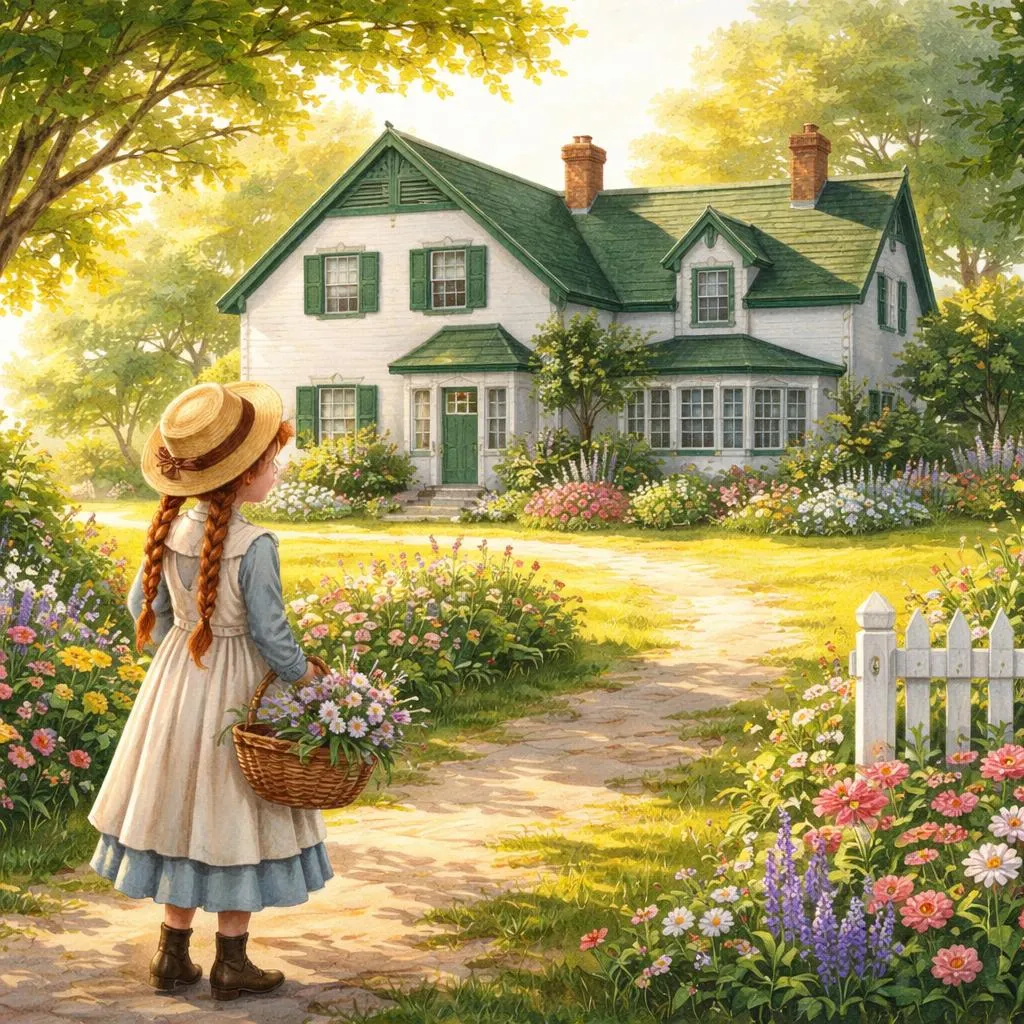

It was broad daylight when Anne awoke and sat up in bed, staring confusedly at the window through which a flood of cheery sunshine was pouring and outside of which something white and feathery waved across glimpses of blue sky.
For a moment she could not remember where she was. First came a delightful thrill, as something very pleasant; then a horrible remembrance. This was Green Gables and they didn’t want her because she wasn’t a boy!
But it was morning and, yes, it was a cherry-tree in full bloom outside of her window. With a bound she was out of bed and across the floor. She pushed up the sash—it went up stiffly and creakily, as if it hadn’t been opened for a long time, which was the case; and it stuck so tight that nothing was needed to hold it up.
Anne dropped on her knees and gazed out into the June morning, her eyes glistening with delight. Oh, wasn’t it beautiful? Wasn’t it a lovely place? Suppose she wasn’t really going to stay here! She would imagine she was. There was scope for imagination here.
A huge cherry-tree grew outside, so close that its boughs tapped against the house, and it was so thick-set with blossoms that hardly a leaf was to be seen. On both sides of the house was a big orchard, one of apple-trees and one of cherry-trees, also showered over with blossoms; and their grass was all sprinkled with dandelions. In the garden below were lilac-trees purple with flowers, and their dizzily sweet fragrance drifted up to the window on the morning wind.
Below the garden a green field lush with clover sloped down to the hollow where the brook ran and where scores of white birches grew, upspringing airily out of an undergrowth suggestive of delightful possibilities in ferns and mosses and woodsy things generally. Beyond it was a hill, green and feathery with spruce and fir; there was a gap in it where the gray gable end of the little house she had seen from the other side of the Lake of Shining Waters was visible.
Off to the left were the big barns and beyond them, away down over green, low-sloping fields, was a sparkling blue glimpse of sea.
Anne’s beauty-loving eyes lingered on it all, taking everything greedily in. She had looked on so many unlovely places in her life, poor child; but this was as lovely as anything she had ever dreamed.
She knelt there, lost to everything but the loveliness around her, until she was startled by a hand on her shoulder. Marilla had come in unheard by the small dreamer.
“It’s time you were dressed,” she said curtly.
Marilla really did not know how to talk to the child, and her uncomfortable ignorance made her crisp and curt when she did not mean to be.
Anne stood up and drew a long breath.
“Oh, isn’t it wonderful?” she said, waving her hand comprehensively at the good world outside.
“It’s a big tree,” said Marilla, “and it blooms great, but the fruit don’t amount to much never—small and wormy.”
“Oh, I don’t mean just the tree; of course it’s lovely—yes, it’s RADIANTLY lovely—it blooms as if it meant it—but I meant everything, the garden and the orchard and the brook and the woods, the whole big dear world. Don’t you feel as if you just loved the world on a morning like this? And I can hear the brook laughing all the way up here. Have you ever noticed what cheerful things brooks are? They’re always laughing. Even in winter-time I’ve heard them under the ice. I’m so glad there’s a brook near Green Gables. Perhaps you think it doesn’t make any difference to me when you’re not going to keep me, but it does. I shall always like to remember that there is a brook at Green Gables even if I never see it again. If there wasn’t a brook I’d be HAUNTED by the uncomfortable feeling that there ought to be one. I’m not in the depths of despair this morning. I never can be in the morning. Isn’t it a splendid thing that there are mornings? But I feel very sad. I’ve just been imagining that it was really me you wanted after all and that I was to stay here for ever and ever. It was a great comfort while it lasted. But the worst of imagining things is that the time comes when you have to stop and that hurts.”
“You’d better get dressed and come down-stairs and never mind your imaginings,” said Marilla as soon as she could get a word in edgewise. “Breakfast is waiting. Wash your face and comb your hair. Leave the window up and turn your bedclothes back over the foot of the bed. Be as smart as you can.”
Anne could evidently be smart to some purpose for she was down-stairs in ten minutes’ time, with her clothes neatly on, her hair brushed and braided, her face washed, and a comfortable consciousness pervading her soul that she had fulfilled all Marilla’s requirements. As a matter of fact, however, she had forgotten to turn back the bedclothes.
“I’m pretty hungry this morning,” she announced as she slipped into the chair Marilla placed for her. “The world doesn’t seem such a howling wilderness as it did last night. I’m so glad it’s a sunshiny morning. But I like rainy mornings real well, too. All sorts of mornings are interesting, don’t you think? You don’t know what’s going to happen through the day, and there’s so much scope for imagination. But I’m glad it’s not rainy today because it’s easier to be cheerful and bear up under affliction on a sunshiny day. I feel that I have a good deal to bear up under. It’s all very well to read about sorrows and imagine yourself living through them heroically, but it’s not so nice when you really come to have them, is it?”
“For pity’s sake hold your tongue,” said Marilla. “You talk entirely too much for a little girl.”
Thereupon Anne held her tongue so obediently and thoroughly that her continued silence made Marilla rather nervous, as if in the presence of something not exactly natural. Matthew also held his tongue,—but this was natural,—so that the meal was a very silent one.
As it progressed Anne became more and more abstracted, eating mechanically, with her big eyes fixed unswervingly and unseeingly on the sky outside the window. This made Marilla more nervous than ever; she had an uncomfortable feeling that while this odd child’s body might be there at the table her spirit was far away in some remote airy cloudland, borne aloft on the wings of imagination. Who would want such a child about the place?
Yet Matthew wished to keep her, of all unaccountable things! Marilla felt that he wanted it just as much this morning as he had the night before, and that he would go on wanting it. That was Matthew’s way—take a whim into his head and cling to it with the most amazing silent persistency—a persistency ten times more potent and effectual in its very silence than if he had talked it out.
When the meal was ended Anne came out of her reverie and offered to wash the dishes.
“Can you wash dishes right?” asked Marilla distrustfully.
“Pretty well. I’m better at looking after children, though. I’ve had so much experience at that. It’s such a pity you haven’t any here for me to look after.”
“I don’t feel as if I wanted any more children to look after than I’ve got at present. YOU’RE problem enough in all conscience. What’s to be done with you I don’t know. Matthew is a most ridiculous man.”
“I think he’s lovely,” said Anne reproachfully. “He is so very sympathetic. He didn’t mind how much I talked—he seemed to like it. I felt that he was a kindred spirit as soon as ever I saw him.”
“You’re both queer enough, if that’s what you mean by kindred spirits,” said Marilla with a sniff. “Yes, you may wash the dishes. Take plenty of hot water, and be sure you dry them well. I’ve got enough to attend to this morning for I’ll have to drive over to White Sands in the afternoon and see Mrs. Spencer. You’ll come with me and we’ll settle what’s to be done with you. After you’ve finished the dishes go up-stairs and make your bed.”
Anne washed the dishes deftly enough, as Marilla who kept a sharp eye on the process, discerned. Later on she made her bed less successfully, for she had never learned the art of wrestling with a feather tick. But is was done somehow and smoothed down; and then Marilla, to get rid of her, told her she might go out-of-doors and amuse herself until dinner time.
Anne flew to the door, face alight, eyes glowing. On the very threshold she stopped short, wheeled about, came back and sat down by the table, light and glow as effectually blotted out as if some one had clapped an extinguisher on her.
“What’s the matter now?” demanded Marilla.
“I don’t dare go out,” said Anne, in the tone of a martyr relinquishing all earthly joys. “If I can’t stay here there is no use in my loving Green Gables. And if I go out there and get acquainted with all those trees and flowers and the orchard and the brook I’ll not be able to help loving it. It’s hard enough now, so I won’t make it any harder. I want to go out so much—everything seems to be calling to me, ‘Anne, Anne, come out to us. Anne, Anne, we want a playmate’—but it’s better not. There is no use in loving things if you have to be torn from them, is there? And it’s so hard to keep from loving things, isn’t it? That was why I was so glad when I thought I was going to live here. I thought I’d have so many things to love and nothing to hinder me. But that brief dream is over. I am resigned to my fate now, so I don’t think I’ll go out for fear I’ll get unresigned again. What is the name of that geranium on the window-sill, please?”
“That’s the apple-scented geranium.”
“Oh, I don’t mean that sort of a name. I mean just a name you gave it yourself. Didn’t you give it a name? May I give it one then? May I call it—let me see—Bonny would do—may I call it Bonny while I’m here? Oh, do let me!”
“Goodness, I don’t care. But where on earth is the sense of naming a geranium?”
“Oh, I like things to have handles even if they are only geraniums. It makes them seem more like people. How do you know but that it hurts a geranium’s feelings just to be called a geranium and nothing else? You wouldn’t like to be called nothing but a woman all the time. Yes, I shall call it Bonny. I named that cherry-tree outside my bedroom window this morning. I called it Snow Queen because it was so white. Of course, it won’t always be in blossom, but one can imagine that it is, can’t one?”
“I never in all my life say or heard anything to equal her,” muttered Marilla, beating a retreat down to the cellar after potatoes. “She is kind of interesting as Matthew says. I can feel already that I’m wondering what on earth she’ll say next. She’ll be casting a spell over me, too. She’s cast it over Matthew. That look he gave me when he went out said everything he said or hinted last night over again. I wish he was like other men and would talk things out. A body could answer back then and argue him into reason. But what’s to be done with a man who just LOOKS?”
Anne had relapsed into reverie, with her chin in her hands and her eyes on the sky, when Marilla returned from her cellar pilgrimage. There Marilla left her until the early dinner was on the table.
“I suppose I can have the mare and buggy this afternoon, Matthew?” said Marilla.
Matthew nodded and looked wistfully at Anne. Marilla intercepted the look and said grimly:
“I’m going to drive over to White Sands and settle this thing. I’ll take Anne with me and Mrs. Spencer will probably make arrangements to send her back to Nova Scotia at once. I’ll set your tea out for you and I’ll be home in time to milk the cows.”
Still Matthew said nothing and Marilla had a sense of having wasted words and breath. There is nothing more aggravating than a man who won’t talk back—unless it is a woman who won’t.
Matthew hitched the sorrel into the buggy in due time and Marilla and Anne set off. Matthew opened the yard gate for them and as they drove slowly through, he said, to nobody in particular as it seemed:
“Little Jerry Buote from the Creek was here this morning, and I told him I guessed I’d hire him for the summer.”
Marilla made no reply, but she hit the unlucky sorrel such a vicious clip with the whip that the fat mare, unused to such treatment, whizzed indignantly down the lane at an alarming pace. Marilla looked back once as the buggy bounced along and saw that aggravating Matthew leaning over the gate, looking wistfully after them.
背景與作者介紹
這段文字選自《清秀佳人》,這是加拿大作家露西·莫德·蒙哥馬利於1908年創作的一部深受喜愛的經典小說。故事背景設定在加拿大愛德華王子島上的虛構村莊艾凡里。它講述了安妮·雪莉的冒險故事,安妮·雪莉是一位充滿想像力且健談的孤兒,她被誤送到馬里拉和馬修·卡斯伯特家,而他們原本打算收養一個男孩來幫助他們的農場。
露西·莫德·蒙哥馬利受到她自己童年經歷和愛德華王子島美麗風景的啟發。她對大自然的生動描述以及她創造的充滿活力、複雜的女主角,使《清秀佳人》成為一部深受世界各地讀者珍愛的不朽之作。
詳細闡釋與意義
這段摘錄捕捉了安妮在綠色莊園的第一個早晨,充滿了驚奇和希望,但也籠罩著她對被拒絕的恐懼。盛開的櫻花樹、芬芳的丁香花和歡笑的溪流的生動意象,象徵著新開始的美好和希望。安妮豐富的想像力將她的周圍環境轉變成一個神奇的世界,反映了她克服困難過去的韌性和樂觀精神。
馬里拉務實、不苟言笑的態度與安妮夢幻的性格形成了鮮明對比,突出了現實與想像之間的緊張關係。馬修默默的支持暗示了他內斂外表下溫柔的善良。對話揭示了安妮對歸屬感和愛的渴望,以及她對失去和被拋棄的恐懼。
這段文字強調了希望、想像力和尋找家的主題。安妮即使對未來不確定,也能在她的環境中找到美和喜悅,這激勵讀者欣賞他們周圍的小奇蹟,並在逆境中保持希望。
給學生的啟示和靈感
-
想像力的力量: 安妮的想像力幫助她應對孤獨和不確定性。學生可以學習創造力和積極思考如何改變困難的情況並開啟新的可能性。
-
面對挑戰的韌性: 儘管有恐懼,安妮還是勇敢地面對她的新生活。這教導年輕讀者在遇到變化時,韌性和適應能力的重要性。
-
對自然的欣賞: 詳細的描述鼓勵學生觀察和欣賞自然世界,培養正念和敬畏感。
-
同情心和理解: 安妮與馬里拉和馬修的互動展示了人際關係的複雜性。學生可以反思耐心、善良和溝通在建立聯繫中的重要性。
-
在小事中尋找快樂: 安妮對櫻花樹和小溪的喜悅提醒讀者,幸福可以在日常生活中找到。
在生活、學習和社交場合中的應用
-
在生活中: 像安妮一樣,學生可以學會以好奇和希望的心態擁抱新環境,即使面對不確定性。培養積極的態度有助於克服恐懼和建立自信。
-
在學習中: 想像力和創造力是學習的寶貴工具。學生可以使用這些技能更深入地參與他們的科目並創新地解決問題。
-
在社交場合中: 安妮的故事鼓勵同情心和坦誠。學生可以練習理解他人的感受和觀點,從而培養更牢固的友誼和團隊合作。
從故事中培養積極的特質
-
想像力: 鼓勵寫日記、講故事或創意藝術,以培養像安妮一樣的想像力。
-
韌性: 教授應對挫折的策略,強調挑戰是成長的一部分。
-
好奇心: 像安妮一樣,促進對世界的探索和提問。
-
善良和耐心: 示範和練習尊重的溝通,即使其他人看起來很難相處。
反思與欣賞
閱讀《清秀佳人》邀請學生反思他們自己的歸屬感和身份感。安妮的旅程提醒我們,家不僅僅是一個地方,而是一種由愛、接納和希望創造的感覺。她的故事是對青春、想像力和持久的人類精神的讚頌,激勵讀者在自己的生活中找到美和喜悅。
