
It seemed to me that this quaint lie was most simply and beautifully told; but then I had heard it only once, and that makes a difference; it was pleasant to the others when it was fresh, no doubt.
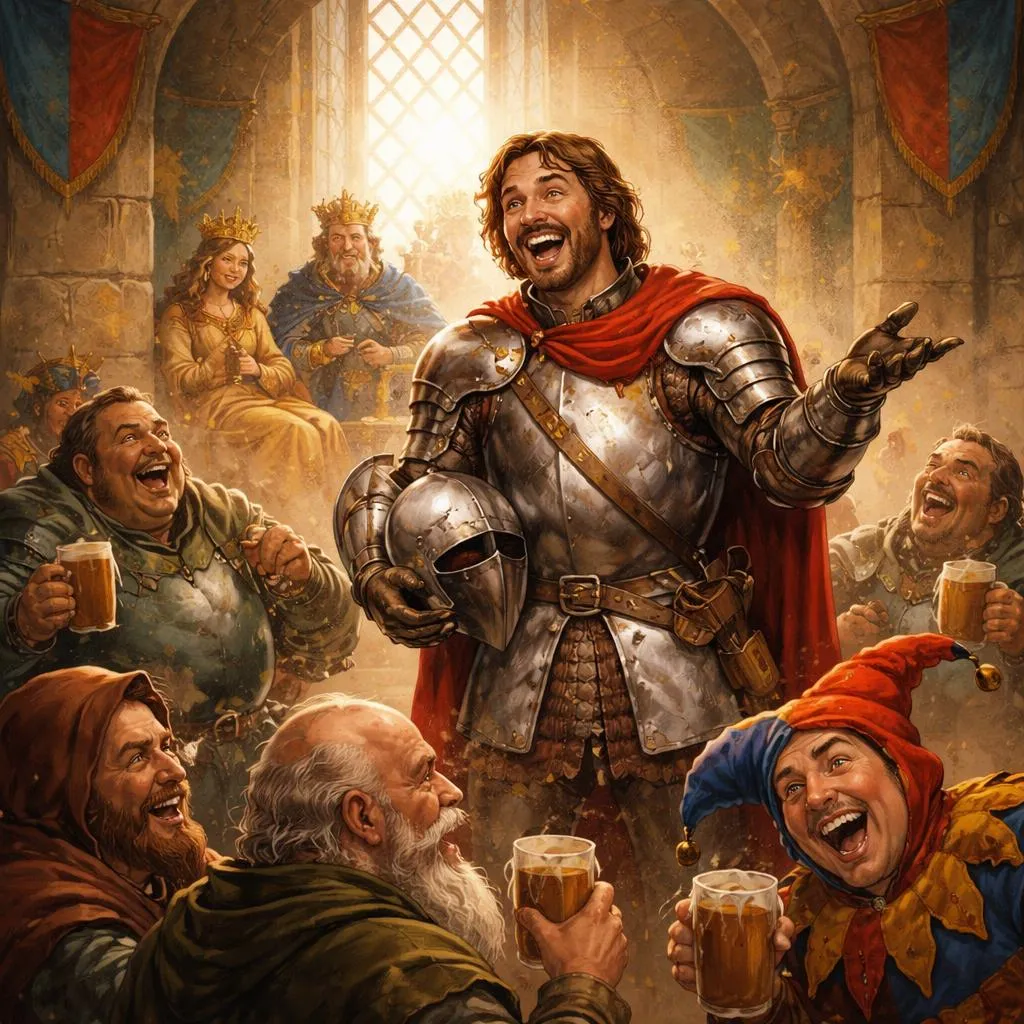
Sir Dinadan the Humorist was the first to awake, and he soon roused the rest with a practical joke of a sufficiently poor quality. He tied some metal mugs to a dog’s tail and turned him loose, and he tore around and around the place in a frenzy of fright, with all the other dogs bellowing after him and battering and crashing against everything that came in their way and making altogether a chaos of confusion and a most deafening din and turmoil; at which every man and woman of the multitude laughed till the tears flowed, and some fell out of their chairs and wallowed on the floor in ecstasy. It was just like so many children. Sir Dinadan was so proud of his exploit that he could not keep from telling over and over again, to weariness, how the immortal idea happened to occur to him; and as is the way with humorists of his breed, he was still laughing at it after everybody else had got through. He was so set up that he concluded to make a speech —of course a humorous speech. I think I never heard so many old played-out jokes strung together in my life. He was worse than the minstrels, worse than the clown in the circus. It seemed peculiarly sad to sit here, thirteen hundred years before I was born, and listen again to poor, flat, worm-eaten jokes that had given me the dry gripes when I was a boy thirteen hundred years afterwards. It about convinced me that there isn’t any such thing as a new joke possible. Everybody laughed at these antiquities —but then they always do; I had noticed that, centuries later. However, of course the scoffer didn’t laugh—I mean the boy. No, he scoffed; there wasn’t anything he wouldn’t scoff at. He said the most of Sir Dinadan’s jokes were rotten and the rest were petrified. I said “petrified” was good; as I believed, myself, that the only right way to classify the majestic ages of some of those jokes was by geologic periods. But that neat idea hit the boy in a blank place, for geology hadn’t been invented yet. However, I made a note of the remark, and calculated to educate the commonwealth up to it if I pulled through. It is no use to throw a good thing away merely because the market isn’t ripe yet.
Now Sir Kay arose and began to fire up on his history-mill with me for fuel. It was time for me to feel serious, and I did. Sir Kay told how he had encountered me in a far land of barbarians, who all wore the same ridiculous garb that I did—a garb that was a work of enchantment, and intended to make the wearer secure from hurt by human hands. However he had nullified the force of the enchantment by prayer, and had killed my thirteen knights in a three hours’ battle, and taken me prisoner, sparing my life in order that so strange a curiosity as I was might be exhibited to the wonder and admiration of the king and the court. He spoke of me all the time, in the blandest way, as “this prodigious giant,” and “this horrible sky-towering monster,” and “this tusked and taloned man-devouring ogre”, and everybody took in all this bosh in the naivest way, and never smiled or seemed to notice that there was any discrepancy between these watered statistics and me. He said that in trying to escape from him I sprang into the top of a tree two hundred cubits high at a single bound, but he dislodged me with a stone the size of a cow, which “all-to brast” the most of my bones, and then swore me to appear at Arthur’s court for sentence. He ended by condemning me to die at noon on the 21st; and was so little concerned about it that he stopped to yawn before he named the date.
I was in a dismal state by this time; indeed, I was hardly enough in my right mind to keep the run of a dispute that sprung up as to how I had better be killed, the possibility of the killing being doubted by some, because of the enchantment in my clothes. And yet it was nothing but an ordinary suit of fifteen-dollar slop-shops. Still, I was sane enough to notice this detail, to wit: many of the terms used in the most matter-of-fact way by this great assemblage of the first ladies and gentlemen in the land would have made a Comanche blush. Indelicacy is too mild a term to convey the idea. However, I had read “Tom Jones,” and “Roderick Random,” and other books of that kind, and knew that the highest and first ladies and gentlemen in England had remained little or no cleaner in their talk, and in the morals and conduct which such talk implies, clear up to a hundred years ago; in fact clear into our own nineteenth century—in which century, broadly speaking, the earliest samples of the real lady and real gentleman discoverable in English history—or in European history, for that matter—may be said to have made their appearance. Suppose Sir Walter, instead of putting the conversations into the mouths of his characters, had allowed the characters to speak for themselves? We should have had talk from Rebecca and Ivanhoe and the soft lady Rowena which would embarrass a tramp in our day. However, to the unconsciously indelicate all things are delicate. King Arthur’s people were not aware that they were indecent and I had presence of mind enough not to mention it.
They were so troubled about my enchanted clothes that they were mightily relieved, at last, when old Merlin swept the difficulty away for them with a common-sense hint. He asked them why they were so dull—why didn’t it occur to them to strip me. In half a minute I was as naked as a pair of tongs! And dear, dear, to think of it: I was the only embarrassed person there. Everybody discussed me; and did it as unconcernedly as if I had been a cabbage. Queen Guenever was as naively interested as the rest, and said she had never seen anybody with legs just like mine before. It was the only compliment I got—if it was a compliment.
Finally I was carried off in one direction, and my perilous clothes in another. I was shoved into a dark and narrow cell in a dungeon, with some scant remnants for dinner, some moldy straw for a bed, and no end of rats for company.
背景介紹與作者介紹
這段文字出自馬克·吐溫的小說《亞瑟王宮廷裡的康涅狄格州美國佬》,該小說於1889年首次出版。吐溫是美國最偉大的幽默作家和社會評論家之一,他用這個故事融合了幻想、諷刺和歷史小說。這部小說講述了一位19世紀的美國工程師,他神秘地穿越時空回到了亞瑟王的時代。吐溫利用這個富有想像力的設定來探討進步、科技、社會正義和人性的主題。
詳細解讀與意義
這段文字捕捉了現代世界與中世紀世界之間幽默且常常荒誕的衝突。主角是一位來自未來的人,他帶著嘲諷和不信任的混合情緒觀察著亞瑟王傳說中的騎士和貴族。迪納丹爵士的惡作劇和凱爵士誇大的故事突出了騎士精神理想與其背後常常荒謬的現實之間的對比。
吐溫的敘事風格結合了幽默的語氣和尖銳的社會評論。 「古怪的謊言」和「陳腐的笑話」象徵著故事和傳統如何隨著時間的推移而扭曲或失去意義。主角對過去的語言和禮儀的反思揭示了吐溫對社會偽裝和虛偽的批判,無論是在中世紀的背景下還是在他自己的時代。
附魔的衣服和主角的監禁說明了迷信與理智之間的緊張關係,這是小說中反覆出現的主題。梅林的角色給予主角脫掉衣服以打破魔咒的實用建議,代表了常識戰勝盲目信仰。
給學生的啟示和見解
-
批判性思維和懷疑精神: 故事鼓勵讀者質疑被接受的真理和傳統。正如主角懷疑騎士們的故事和魔法的力量一樣,學生們應該學會批判性地思考信息,而不是全盤接受。
-
幽默作為反思的工具: 吐溫對幽默的運用有助於揭露人類的愚蠢和社會的缺陷。學生們可以欣賞笑聲和諷刺如何成為理解和批判周圍世界的有力方式。
-
理解歷史背景: 小說將歷史傳說與現代思想相結合,展示了觀點如何隨著時間的推移而變化。這鼓勵學生以開放的心態探索歷史,並認識到文化和時間對故事和信仰的影響。
-
對知識和進步的尊重: 主角作為工程師的背景象徵著科學技術在推動社會進步方面的重要性。學生們可以受到啟發,重視教育和創新,同時尊重過去的教訓。
-
同理心和開放的心態: 主角作為陌生人在一個陌生世界中的經歷,教會了同理心和適應能力的重要性。學生們可以學會欣賞不同的文化和觀點,這在當今多元化的社會中至關重要。
在日常生活中應用故事的精神
-
在學習中: 擁抱好奇心並質疑假設。以懷疑和開放的平衡態度來學習,就像主角在一個陌生的世界中航行一樣。
-
在社交互動中: 善意地運用幽默來緩解緊張氣氛並建立聯繫,但要注意他人的感受。就像迪納丹爵士的笑話一樣,幽默可以在深思熟慮地使用時團結人們。
-
在應對挑戰時: 運用理性和常識來解決問題,正如梅林所建議的那樣。不要害怕去除不必要的複雜性以找到清晰的解決方案。
-
在培養性格時: 培養韌性和適應能力。主角的旅程表明,意想不到的情況需要勇氣和靈活性。
鼓勵積極的價值觀
學生們可以從主角的經歷中學習,培養誠實、勇敢和謙遜等美德。以幽默和優雅的方式認識到自己和他人的缺點,有助於建立堅強的性格。這部小說也提倡為正義而奮鬥、質疑不公正以及負責任地運用知識的價值觀。
通過閱讀和反思《亞瑟王宮廷裡的康涅狄格州美國佬》,年輕的讀者不僅獲得了娛樂,而且對歷史、社會和人性的理解也更加深刻。他們被邀請獨立思考,欣賞講故事的力量,並在自己的生活中傳承求知和善良的精神。
