
[Footnote: I have called the ruin here spoken of a “sugar mill” for no better reason than because that is the name commonly applied to it by the residents of the town. When this sketch was written, I had never heard of a theory since broached in some of our Northern newspapers,—I know not by whom,—that the edifice in question was built as a chapel, perhaps by Columbus himself! I should be glad to believe it, and can only add my hope that he will be shown to have built also the so-called sugar mill a few miles north of New Smyrna, in the Dunlawton hammock behind Port Orange. In that, to be sure, there is still much old machinery, but perhaps its presence would prove no insuperable objection to a theory so pleasing. In matters of this kind, much depends upon subjective considerations; in one sense, at least, “all things are possible to him that believeth.” For my own part, I profess no opinion. I am neither an archaeologist nor an ecclesiastic, and speak simply as a chance observer.]
On the third or fourth day of my sojourn at the Live Oak Inn, the lady of the house, noticing my peripatetic habits, I suppose, asked whether I had been to the old sugar mill. The ruin is mentioned in the guide-books as one of the historic features of the ancient settlement of New Smyrna, but I had forgotten the fact, and was thankful to receive a description of the place, as well as of the road thither,—a rather blind road, my informant said, with no houses at which to inquire the way.
Two or three mornings afterward, I set out in the direction indicated. If the route proved to be half as vague as my good lady’s account of it had sounded, I should probably never find the mill; but the walk would be pleasant, and that, after all, was the principal consideration, especially to a man who just then cared more, or thought he did, for a new bird or a new song than for an indefinite number of eighteenth-century relics.
For the first half-mile the road follows one of the old Turnbull canals dug through the coquina stone which underlies the soil hereabout; then, after crossing the railway, it strikes to the left through a piece of truly magnificent wood, known as the cotton-shed hammock, because, during the war, cotton was stored here in readiness for the blockade runners of Mosquito Inlet. Better than anything I had yet seen, this wood answered to my idea of a semi-tropical forest: live-oaks, magnolias, palmettos, sweet gums, maples, and hickories, with here and there a long-leaved pine overtopping all the rest. The palmettos, most distinctively Southern of them all, had been badly used by their hardier neighbors; they looked stunted, and almost without exception had been forced out of their normal perpendicular attitude. The live-oaks, on the other hand, were noble specimens; lofty and wide-spreading, elm-like in habit, it seemed to me, though not without the sturdiness which belongs as by right to all oaks, and seldom or never to the American elm.
What gave its peculiar tropical character to the wood, however, was not so much the trees as the profusion of plants that covered them and depended from them: air-plants (Tillandsia), large and small,—like pineapples, with which they claim a family relationship,—the exuberant hanging moss, itself another air-plant, ferns, and vines. The ferns, a species of polypody (“resurrection ferns,” I heard them called), completely covered the upper surface of many of the larger branches, while the huge vines twisted about the trunks, or, quite as often, dropped straight from the treetops to the ground.
In the very heart of this dense, dark forest (a forest primeval, I should have said, but I was assured that the ground had been under cultivation so recently that, to a practiced eye, the cotton-rows were still visible) stood a grove of wild orange-trees, the handsome fruit glowing like lamps amid the deep green foliage. There was little other brightness. Here and there in the undergrowth were yellow jessamine vines, but already—March 11—they were past flowering. Almost or quite the only blossom just now in sight was the faithful round-leaved houstonia, growing in small flat patches in the sand on the edge of the road, with budding partridge-berry—a Yankee in Florida—to keep it company. Warblers and titmice twittered in the leafy treetops, and butterflies of several kinds, notably one gorgeous creature in yellow and black, like a larger and more resplendent Turnus, went fluttering through the underwoods. I could have believed myself in the heart of a limitless forest; but Florida hammocks, so far as I have seen, are seldom of great extent, and the road presently crossed another railway track, and then, in a few rods more, came out into the sunny pine-woods, as one might emerge from a cathedral into the open day. Two men were approaching in a wagon (except on Sunday, I am not certain that I ever met a foot passenger in the flat-woods), and I improved the opportunity to make sure of my course. “Go about fifty yards,” said one of them, “and turn to the right; then about fifty yards more, and turn to the left. That road will take you to the mill.” Here was a man who had traveled in the pine lands,—where, of all places, it is easy to get lost and hard to find yourself,—and not only appreciated the value of explicit instructions, but, being a Southerner, had leisure enough and politeness enough to give them. I thanked him, and sauntered on. The day was before me, and the place was lively with birds. Pine-wood sparrows, pine warblers, and red-winged blackbirds were in song; two red-shouldered hawks were screaming, a flicker was shouting, a red-bellied woodpecker cried kur-r-r-r, brown-headed nuthatches were gossiping in the distance, and suddenly I heard, what I never thought to hear in a pinery, the croak of a green heron. I turned quickly and saw him. It was indeed he. What a friend is ignorance, mother of all those happy surprises which brighten existence as they pass, like the butterflies of the wood. The heron was at home, and I was the stranger. For there was water near, as there is everywhere in Florida; and subsequently, in this very place, I met not only the green heron, but three of his relatives,—the great blue, the little blue, and the dainty Louisiana, more poetically known (and worthy to wear the name) as the “Lady of the Waters.”
On this first occasion, however, the green heron was speedily forgotten; for just then I heard another note, unlike anything I had ever heard before,—as if a great Northern shrike had been struck with preternatural hoarseness, and, like so many other victims of the Northern winter, had betaken himself to a sunnier clime. I looked up. In the leafy top of a pine sat a boat-tailed grackle, splendidly iridescent, engaged in a musical performance which afterward became almost too familiar to me, but which now, as a novelty, was as interesting as it was grotesque. This, as well as I can describe it, is what the bird was doing. He opened his bill,—set it, as it were, wide apart,—and holding it thus, emitted four or five rather long and very loud grating, shrikish notes; then instantly shook his wings with an extraordinary flapping noise, and followed that with several highly curious and startling cries, the concluding one of which sometimes suggested the cackle of a robin. All this he repeated again and again with the utmost fervor. He could not have been more enthusiastic if he had been making the sweetest music in the world. And I confess that I thought he had reason to be proud of his work. The introduction of wing-made sounds in the middle of a vocal performance was of itself a stroke of something like genius. It put me in mind of the firing of cannons as an accompaniment to the Anvil Chorus. Why should a creature of such gifts be named for his bodily dimensions, or the shape of his tail? Why not Quiscalus gilmorius, Gilmore’s grackle?
That the sounds were wing-made I had no thought of questioning. I had seen the thing done,—seen it and heard it; and what shall a man trust, if not his own eyes and ears, especially when each confirms the other? Two days afterward, nevertheless, I began to doubt. I heard a grackle “sing” in the manner just described, wing-beats and all, while flying from one tree to another; and later still, in a country where boat-tailed grackles were an every-day sight near the heart of the village, I more than once saw them produce the sounds in question without any perceptible movement of the wings, and furthermore, their mandibles could be seen moving in time with the beats. So hard is it to be sure of a thing, even when you see it and hear it.
“Oh yes,” some sharp-witted reader will say, “you saw the wings flapping,—beating time,—and so you imagined that the sounds were like wing-beats.” But for once the sharp-witted reader is in the wrong. The resemblance is not imaginary. Mr. F.M. Chapman, in “A List of Birds Observed at Gainesville, Florida”,[1] says of the boat-tailed grackle (Quiscalus major): “A singular note of this species greatly resembles the flapping of wings, as of a coot tripping over the water; this sound was very familiar to me, but so excellent is the imitation that for a long time I attributed it to one of the numerous coots which abound in most places favored by Q. major.”
[Footnote 1: The Auk, vol. v. p. 273.]
If the sounds are not produced by the wings, the question returns, of course, why the wings are shaken just at the right instant. To that I must respond with the time-honored formula, “Not prepared.” The reader may believe, if he will, that the bird is aware of the imitative quality of the notes, and amuses itself by heightening the delusion of the looker-on. My own more commonplace conjecture is that the sounds are produced by snappings and gratings of the big mandibles (“He is gritting his teeth,” said a shrewd unornithological Yankee, whose opinion I had solicited), and that the wing movements may be nothing but involuntary accompaniments of this almost convulsive action of the beak. But perhaps the sounds are wing-made, after all.
On the day of which I am writing, at any rate, I was troubled by no misgivings. I had seen something new, and was only desirous to see more of it. Who does not love an original character? For at least half an hour the old mill was forgotten, while I chased the grackle about, as he flew hither and thither, sometimes with a loggerhead shrike in furious pursuit. Once I had gone a few rods into the palmetto scrub, partly to be nearer the bird, but still more to enjoy the shadow of a pine, and was standing under the tree, motionless, when a man came along the road in a gig. “Surveying?” he asked, reining in his horse.
“No, sir; I am looking at a bird in the tree yonder.” I wished him to go on, and thought it best to gratify his curiosity at once.
He was silent a moment; then he said, “Looking at the old sugar house from there?”
That was too preposterous, and I answered with more voice, and perhaps with a touch of impatience, “No, no; I am trying to see a bird in that pine-tree.” He was silent again. Then he gathered up the reins.
“I’m so deaf I can’t hear you,” he said, and drove on.
“Good-by,” I remarked, in a needless undertone; “you’re a good man, I’ve no doubt, but deaf people shouldn’t be inquisitive at long range.”
The advice was sound enough, in itself considered; properly understood, it might be held to contain, or at least to suggest, one of the profoundest, and at the same time one of the most practical, truths of all devout philosophy; but the testiness of its tone was little to my credit. He was a good man,—and the village doctor,—and more than once afterward put me under obligation. One of his best appreciated favors was unintended and indirect. I was driving with him through the hammock, and we passed a bit of swamp. “There are some pretty flowers,“ he exclaimed; “I think I must get them.” At the word he jumped out of the gig, bade me do the same, hitched his horse, a half-broken stallion, to a sapling, and plunged into the thicket. I strolled elsewhere; and by and by he came back, a bunch of common blue iris in one hand, and his shoes and stockings in the other. “They are very pretty,” he explained (he spoke of the flowers), “and it is early for them.” After that I had no doubt of his goodness, and in case of need would certainly have called him rather than his younger rival at the opposite end of the village.
When I tired of chasing the grackle, or the shrike had driven him away (I do not remember now how the matter ended), I started again toward the old sugar mill. Presently a lone cabin came into sight. The grass-grown road led straight to it, and stopped at the gate.
Two women and a brood of children stood in the door, and in answer to my inquiry one of the women (the children had already scampered out of sight) invited me to enter the yard. “Go round the house,” she said, “and you will find a road that runs right down to the mill.”
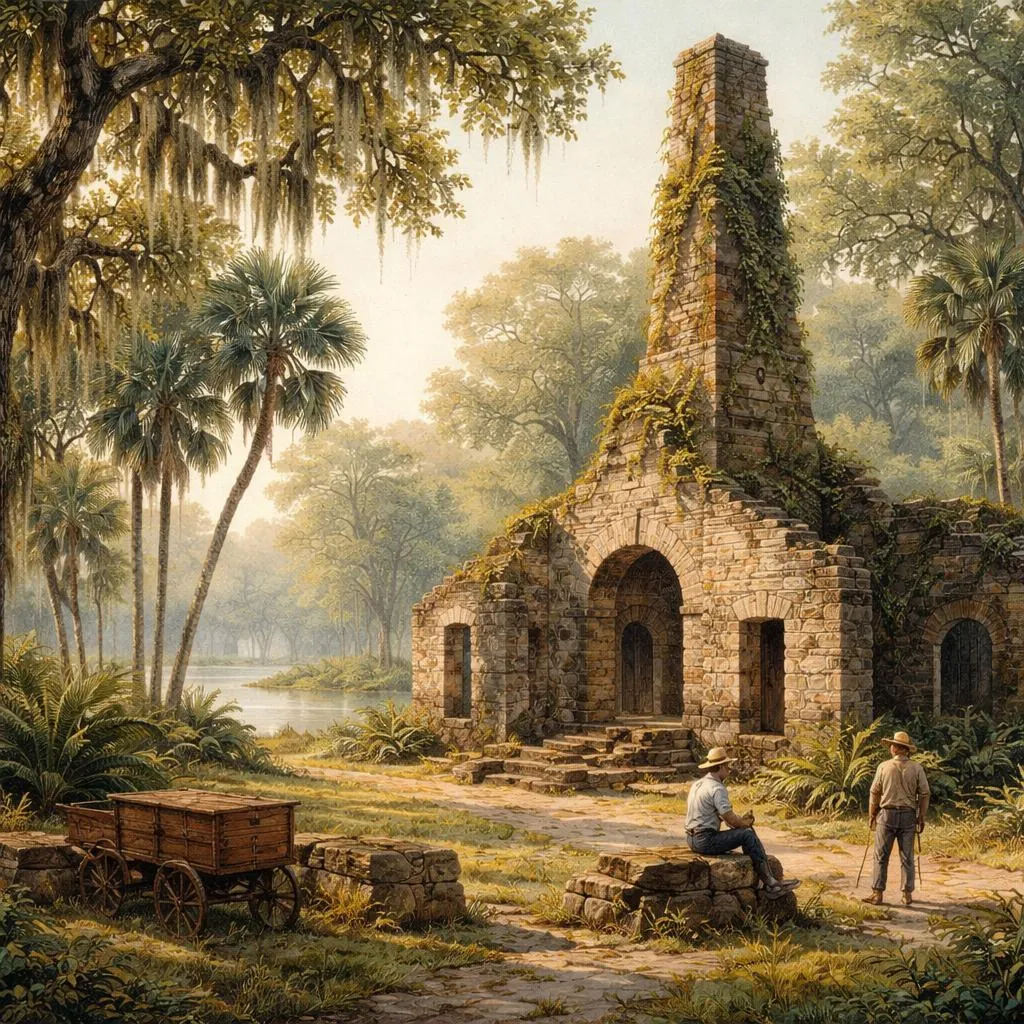
The mill, as it stands, is not much to look at: some fragments of wall built of coquina stone, with two or three arched windows and an arched door, the whole surrounded by a modern plantation of orange-trees, now almost as much a ruin as the mill itself. But the mill was built more than a hundred years ago, and serves well enough the principal use of abandoned and decaying things,—to touch the imagination. For myself, I am bound to say, it was a precious two hours that I passed beside it, seated on a crumbling stone in the shade of a dying orange-tree.
Behind me a redbird was whistling (cardinal grosbeak, I have been accustomed to call him, but I like the Southern name better, in spite of its ambiguity), now in eager, rapid tones, now slowly and with a dying fall. Now his voice fell almost to a whisper, now it rang out again; but always it was sweet and golden, and always the bird was out of sight in the shrubbery. The orange-trees were in bloom; the air was full of their fragrance, full also of the murmur of bees. All at once a deeper note struck in, and I turned to look. A humming-bird was hovering amid the white blossoms and glossy leaves. I saw his flaming throat, and the next instant he was gone, like a flash of light,—the first hummer of the year. I was far from home, and expectant of new things. That, I dare say, was the reason why I took the sound at first for the boom of a bumble-bee; some strange Floridian bee, with a deeper and more melodious bass than any Northern insect is master of.
It is good to be here, I say to myself, and we need no tabernacle. All things are in harmony. A crow in the distance says caw, caw in a meditative voice, as if he, too, were thinking of days past; and not even the scream of a hen-hawk, off in the pine-woods, breaks the spell that is upon us. A quail whistles,—a true Yankee Bob White, to judge him by his voice,—and the white-eyed chewink (he is not a Yankee) whistles and sings by turns. The bluebird’s warble and the pine warbler’s trill could never be disturbing to the quietest mood. Only one voice seems out of tune: the white-eyed vireo, even to-day, cannot forget his saucy accent. But he soon falls silent. Perhaps, after all, he feels himself an intruder.
The morning is cloudless and warm, till suddenly, as if a door had been opened eastward, the sea breeze strikes me. Henceforth the temperature is perfect as I sit in the shadow. I think neither of heat nor of cold. I catch a glimpse of a beautiful leaf-green lizard on the gray trunk of an orange-tree, but it is gone (I wonder where) almost before I can say I saw it. Presently a brown one, with light-colored stripes and a bluish tail, is seen traveling over the crumbling wall, running into crannies and out again. Now it stops to look at me with its jewel of an eye. And there, on the rustic arbor, is a third one, matching the unpainted wood in hue. Its throat is white, but when it is inflated, as happens every few seconds, it turns to the loveliest rose color. This inflated membrane should be a vocal sac, I think, but I hear no sound. Perhaps the chameleon’s voice is too fine for dull human sense.
On two sides of me, beyond the orange-trees, is a thicket of small oaks and cabbage palmettos,—hammock, I suppose it is called. In all other directions are the pine-woods, with their undergrowth of saw palmetto. The cardinal sings from the hammock, and so does the Carolina wren. The chewinks, the blackbirds (a grackle just now flies over, and a fish-hawk, also), with the bluebirds and the pine warblers, are in the pinery. From the same place comes the song of a Maryland yellow-throat. There, too, the hen-hawks are screaming.
At my feet are blue violets and white houstonia. Vines, thinly covered with fresh leaves, straggle over the walls,—Virginia creeper, poison ivy, grapevine, and at least one other, the name of which I do not know. A clump of tall blackberry vines is full of white blossoms, “bramble roses faint and pale,” and in one corner is a tuft of scarlet blooms,—sage, perhaps, or something akin to it. For the moment I feel no curiosity. But withal the place is unkempt, as becomes a ruin. “Winter’s ragged hand” has been rather heavy upon it. Withered palmetto leaves and leaf-stalks litter the ground, and of course, being in Florida, there is no lack of orange-peel lying about. Ever since I entered the state a new scripture text has been running in my head: In the place where the orange-peel falleth, there shall it lie.
The mill, as I said, is now the centre of an orange grove. There must be hundreds of trees. All of them are small, but the greater part are already dead, and the rest are dying. Those nearest the walls are fullest of leaves, as if the walls somehow gave them protection. The forest is creeping into the inclosure. Here and there the graceful palm-like tassel of a young long-leaved pine rises above the tall winter-killed grass. It is not the worst thing about the world that it tends to run wild.
Now the quail sings again, this time in two notes, and now the hummer is again in the orange-tree. And all the while the redbird whistles in the shrubbery. He feels the beauty of the day. If I were a bird, I would sing with him. From far away comes the chant of a pine-wood sparrow. I can just hear it.
This is a place for dreams and quietness. Nothing else seems worth the having. Let us feel no more the fever of life. Surely they are the wise who seek Nirvana; who insist not upon themselves, but wait absorption —reabsorption—into the infinite. The dead have the better part. I think of the stirring, adventurous man who built these walls and dug these canals. His life was full of action, full of journeyings and fightings. Now he is at peace, and his works do follow him—into the land of forgetfulness. Blessed are the dead. Blessed, too, are the bees, the birds, the butterflies, and the lizards. Next to the dead, perhaps, they are happy. And I also am happy, for I too am under the spell. To me also the sun and the air are sweet, and I too, for to-day at least, am careless of the world and all its doings.
So I sat dreaming, when suddenly there was a stir in the grass at my feet. A snake was coming straight toward me. Only the evening before a cracker had filled my ears with stories of “rattlers” and “moccasins.” He seemed to have seen them everywhere, and to have killed them as one kills mosquitoes. I looked a second time at the moving thing in the grass. It was clothed in innocent black; but, being a son of Adam, I rose with involuntary politeness to let it pass. An instant more, and it slipped into the masonry at my side, and I sat down again. It had been out taking the sun, and had come back to its hole in the wall. How like the story of my own day,—of my whole winter vacation! Nay, if we choose to view it so, how like the story of human life itself!
As I started homeward, leaving the mill and the cabin behind me, some cattle were feeding in the grassy road. At sight of my umbrella (there are few places where a sunshade is more welcome than in a Florida pine-wood) they scampered away into the scrub. Poor, wild-eyed, hungry-looking things! I thought of Pharaoh’s lean kine. They were like the country itself, I was ready to say. But perhaps I misjudged both, seeing both, as I did, in the winter season. With the mercury at 80 deg., or thereabout, it is hard for the Northern tourist to remember that he is looking at a winter landscape. He compares a Florida winter with a New England summer, and can hardly find words to tell you how barren and poverty-stricken the country looks.
After this I went more than once to the sugar mill. Morning and afternoon I visited it, but somehow I could never renew the joy of my first visit. Moods are not to be had for the asking, nor earned by a walk. The place was still interesting, the birds were there, the sunshine was pleasant, and the sea breeze fanned me. The orange blossoms were still sweet, and the bees still hummed about them; but it was another day, or I was another man. In memory, none the less, all my visits blend in one, and the ruined mill in the dying orchard remains one of the bright spots in that strange Southern world which, almost from the moment I left it behind me, began to fade into indistinctness, like the landscape of a dream.
背景和作者介紹
這篇引人入勝的敘述,是觀察者探索佛羅里達州新士麥那附近古老糖廠廢墟時,生動的遊記式反思。作者是一位敏銳的自然學家和旅行家,他對景觀、植物、動物和當地人的詳細觀察,描繪了一幅歷史與自然交織在一起的豐富畫面。雖然這裡沒有明確提到作者的名字,但其風格和內容表明,這是一位深愛自然歷史和被遺忘地方的寧靜之美的19世紀或20世紀初的作家。
這個故事捕捉了美國南方荒野和歷史遺跡共存的時刻,邀請讀者放慢腳步,欣賞自然界的微妙奇蹟,以及人類努力的迴響,這些迴響如今已消逝在記憶中。
詳細闡釋和意義
從本質上講,這個故事是關於發現——包括外部和內部的發現。作者出發去尋找歷史遺跡,但在途中,他遇到了生機勃勃的世界:鳥類、植物、昆蟲和大自然的節奏。旅程的重點不再是目的地,而是體驗本身。古老的糖廠是過去人類工業的遺物,靜靜地佇立在橘子園和野林之中,象徵著時間的流逝和自然的必然回歸。
敘述還探討了感知和知識的主題。作者最初對黑琴雞翅膀聲音的確定性,受到了進一步觀察的挑戰,這說明了學習是一個不斷質疑和發現的過程。與當地人的互動,包括聾啞醫生和小屋附近的婦女,為故事增添了人性的溫暖和複雜性,提醒我們每個地方都是由居住在那裡的人塑造的。
學生可以學到什麼
-
對自然和歷史的欣賞: 學生可以學會仔細觀察周圍環境,並欣賞歷史與自然環境之間的聯繫。這個故事鼓勵人們對過去的好奇心和對自然世界的尊重。
-
批判性思維和開放的心態: 作者對黑琴雞聲音的觀點變化,教導了質疑假設和接受新證據的重要性。
-
耐心和正念: 敘述展示了耐心的價值——靜靜地等待觀鳥或感受某個地方的氛圍。這種正念可以幫助學生在學習和日常生活中培養專注和鎮靜。
-
尊重不同的觀點: 故事中包含不同的角色,每個人都有自己的知識和局限性,例如聾啞醫生。這教導了在社會互動中的同情心和理解。
在生活、學習和社交場合中的應用
-
在學習中: 學生可以將作者的好奇心和仔細觀察應用於自己的學習中,無論是在科學、歷史還是文學方面。花時間探索細節並質疑最初的想法,可以帶來更深入的理解。
-
在社交生活中: 故事為禮貌和尊重的交流樹立了榜樣,即使在發生誤解時也是如此。它鼓勵在與可能具有不同能力或知識的其他人打交道時,要友善和耐心。
-
在個人成長中: 擁抱探索和開放的精神,可以幫助年輕人培養韌性和適應能力,這是在快速變化的世界中非常有價值的特質。
從故事中培養積極的品質
-
好奇心: 像作者一樣,學生應該培養對發現的熱愛,以熱情探索新的地方、想法和體驗。
-
對自然的尊重: 通過了解所描述的植物和動物,學生可以培養環境意識和保護自然棲息地的責任感。
-
謙遜: 認識到知識總是在不斷發展,這鼓勵了謙遜和願意向他人學習。
-
對歷史的欣賞: 了解每個地方都有一個故事,可以幫助學生與自己的社區和文化聯繫起來。
反思與欣賞
閱讀這個故事邀請學生放慢腳步,反思他們周圍的美麗和時間的流逝。它鼓勵人們對簡單的事物產生寧靜的喜悅:鳥兒的歌聲、橘子樹的盛開、陽光的溫暖。這些時刻可以激發感恩和寧靜的心態,這對心理和情緒健康非常有價值。
總之,這篇敘述不僅僅是一篇旅行遊記;它也是對生活、自然和人類精神的冥想。它為年輕讀者提供了一個發展觀察技能、批判性思維、同情心和更深入地欣賞世界微妙奇蹟的機會。
