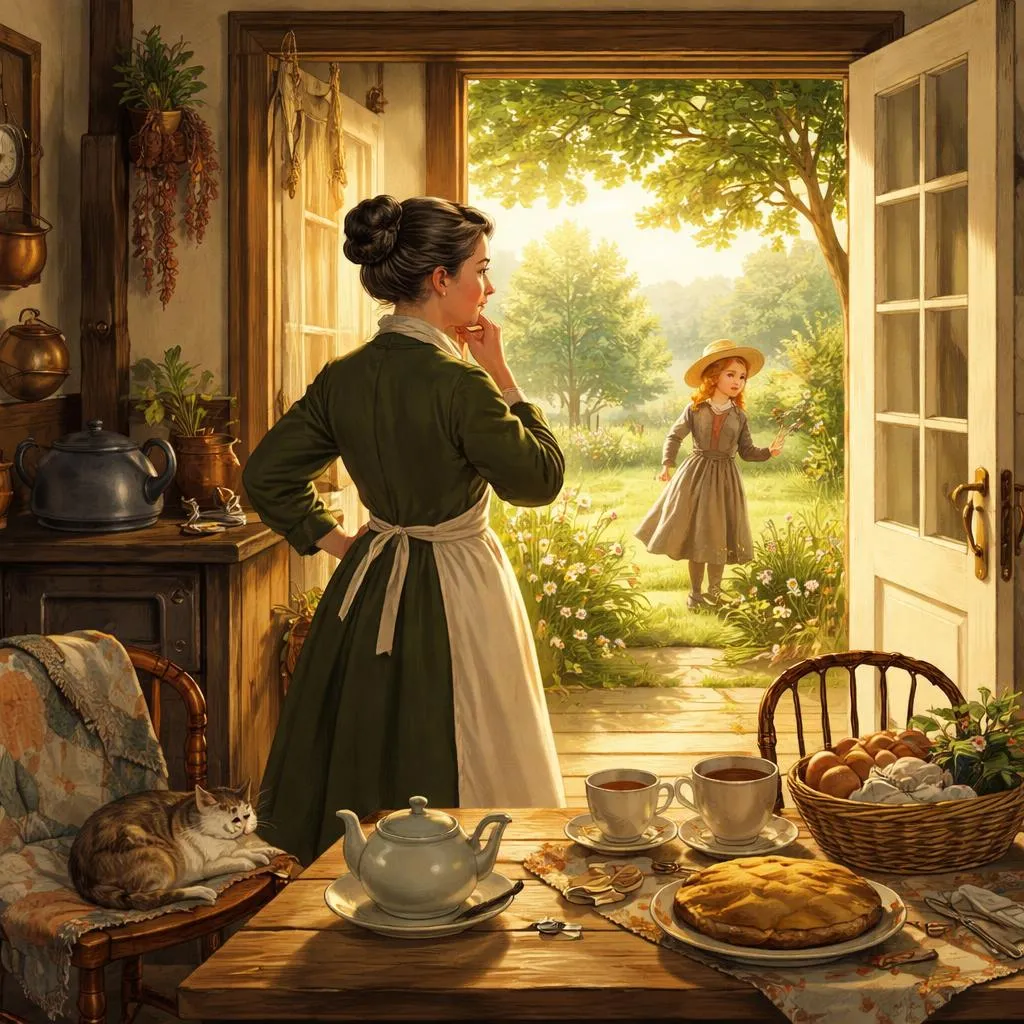

Get there they did, however, in due season. Mrs. Spencer lived in a big yellow house at White Sands Cove, and she came to the door with surprise and welcome mingled on her benevolent face.
“Dear, dear,” she exclaimed, “you’re the last folks I was looking for today, but I’m real glad to see you. You’ll put your horse in? And how are you, Anne?”
“I’m as well as can be expected, thank you,” said Anne smilelessly. A blight seemed to have descended on her.
“I suppose we’ll stay a little while to rest the mare,” said Marilla, “but I promised Matthew I’d be home early. The fact is, Mrs. Spencer, there’s been a queer mistake somewhere, and I’ve come over to see where it is. We send word, Matthew and I, for you to bring us a boy from the asylum. We told your brother Robert to tell you we wanted a boy ten or eleven years old.”
“Marilla Cuthbert, you don’t say so!” said Mrs. Spencer in distress. “Why, Robert sent word down by his daughter Nancy and she said you wanted a girl—didn’t she Flora Jane?” appealing to her daughter who had come out to the steps.
“She certainly did, Miss Cuthbert,” corroborated Flora Jane earnestly.
“I’m dreadful sorry,” said Mrs. Spencer. “It’s too bad; but it certainly wasn’t my fault, you see, Miss Cuthbert. I did the best I could and I thought I was following your instructions. Nancy is a terrible flighty thing. I’ve often had to scold her well for her heedlessness.”
“It was our own fault,” said Marilla resignedly. “We should have come to you ourselves and not left an important message to be passed along by word of mouth in that fashion. Anyhow, the mistake has been made and the only thing to do is to set it right. Can we send the child back to the asylum? I suppose they’ll take her back, won’t they?”
“I suppose so,” said Mrs. Spencer thoughtfully, “but I don’t think it will be necessary to send her back. Mrs. Peter Blewett was up here yesterday, and she was saying to me how much she wished she’d sent by me for a little girl to help her. Mrs. Peter has a large family, you know, and she finds it hard to get help. Anne will be the very girl for you. I call it positively providential.”
Marilla did not look as if she thought Providence had much to do with the matter. Here was an unexpectedly good chance to get this unwelcome orphan off her hands, and she did not even feel grateful for it.
She knew Mrs. Peter Blewett only by sight as a small, shrewish-faced woman without an ounce of superfluous flesh on her bones. But she had heard of her. “A terrible worker and driver,” Mrs. Peter was said to be; and discharged servant girls told fearsome tales of her temper and stinginess, and her family of pert, quarrelsome children. Marilla felt a qualm of conscience at the thought of handing Anne over to her tender mercies.
“Well, I’ll go in and we’ll talk the matter over,” she said.
“And if there isn’t Mrs. Peter coming up the lane this blessed minute!” exclaimed Mrs. Spencer, bustling her guests through the hall into the parlor, where a deadly chill struck on them as if the air had been strained so long through dark green, closely drawn blinds that it had lost every particle of warmth it had ever possessed. “That is real lucky, for we can settle the matter right away. Take the armchair, Miss Cuthbert. Anne, you sit here on the ottoman and don’t wiggle. Let me take your hats. Flora Jane, go out and put the kettle on. Good afternoon, Mrs. Blewett. We were just saying how fortunate it was you happened along. Let me introduce you two ladies. Mrs. Blewett, Miss Cuthbert. Please excuse me for just a moment. I forgot to tell Flora Jane to take the buns out of the oven.”
Mrs. Spencer whisked away, after pulling up the blinds. Anne sitting mutely on the ottoman, with her hands clasped tightly in her lap, stared at Mrs Blewett as one fascinated. Was she to be given into the keeping of this sharp-faced, sharp-eyed woman? She felt a lump coming up in her throat and her eyes smarted painfully. She was beginning to be afraid she couldn’t keep the tears back when Mrs. Spencer returned, flushed and beaming, quite capable of taking any and every difficulty, physical, mental or spiritual, into consideration and settling it out of hand.
“It seems there’s been a mistake about this little girl, Mrs. Blewett,” she said. “I was under the impression that Mr. and Miss Cuthbert wanted a little girl to adopt. I was certainly told so. But it seems it was a boy they wanted. So if you’re still of the same mind you were yesterday, I think she’ll be just the thing for you.”
Mrs. Blewett darted her eyes over Anne from head to foot.
“How old are you and what’s your name?” she demanded.
“Anne Shirley,” faltered the shrinking child, not daring to make any stipulations regarding the spelling thereof, “and I’m eleven years old.”
“Humph! You don’t look as if there was much to you. But you’re wiry. I don’t know but the wiry ones are the best after all. Well, if I take you you’ll have to be a good girl, you know—good and smart and respectful. I’ll expect you to earn your keep, and no mistake about that. Yes, I suppose I might as well take her off your hands, Miss Cuthbert. The baby’s awful fractious, and I’m clean worn out attending to him. If you like I can take her right home now.”
Marilla looked at Anne and softened at sight of the child’s pale face with its look of mute misery—the misery of a helpless little creature who finds itself once more caught in the trap from which it had escaped. Marilla felt an uncomfortable conviction that, if she denied the appeal of that look, it would haunt her to her dying day. More-over, she did not fancy Mrs. Blewett. To hand a sensitive, “highstrung” child over to such a woman! No, she could not take the responsibility of doing that!
“Well, I don’t know,” she said slowly. “I didn’t say that Matthew and I had absolutely decided that we wouldn’t keep her. In fact I may say that Matthew is disposed to keep her. I just came over to find out how the mistake had occurred. I think I’d better take her home again and talk it over with Matthew. I feel that I oughtn’t to decide on anything without consulting him. If we make up our mind not to keep her we’ll bring or send her over to you tomorrow night. If we don’t you may know that she is going to stay with us. Will that suit you, Mrs. Blewett?”
“I suppose it’ll have to,” said Mrs. Blewett ungraciously.
During Marilla’s speech a sunrise had been dawning on Anne’s face. First the look of despair faded out; then came a faint flush of hope; here eyes grew deep and bright as morning stars. The child was quite transfigured; and, a moment later, when Mrs. Spencer and Mrs. Blewett went out in quest of a recipe the latter had come to borrow she sprang up and flew across the room to Marilla.
“Oh, Miss Cuthbert, did you really say that perhaps you would let me stay at Green Gables?” she said, in a breathless whisper, as if speaking aloud might shatter the glorious possibility. “Did you really say it? Or did I only imagine that you did?”
“I think you’d better learn to control that imagination of yours, Anne, if you can’t distinguish between what is real and what isn’t,” said Marilla crossly. “Yes, you did hear me say just that and no more. It isn’t decided yet and perhaps we will conclude to let Mrs. Blewett take you after all. She certainly needs you much more than I do.”
“I’d rather go back to the asylum than go to live with her,” said Anne passionately. “She looks exactly like a—like a gimlet.”
Marilla smothered a smile under the conviction that Anne must be reproved for such a speech.
“A little girl like you should be ashamed of talking so about a lady and a stranger,” she said severely. “Go back and sit down quietly and hold your tongue and behave as a good girl should.”
“I’ll try to do and be anything you want me, if you’ll only keep me,” said Anne, returning meekly to her ottoman.
When they arrived back at Green Gables that evening Matthew met them in the lane. Marilla from afar had noted him prowling along it and guessed his motive. She was prepared for the relief she read in his face when he saw that she had at least brought back Anne back with her. But she said nothing, to him, relative to the affair, until they were both out in the yard behind the barn milking the cows. Then she briefly told him Anne’s history and the result of the interview with Mrs. Spencer.
“I wouldn’t give a dog I liked to that Blewett woman,” said Matthew with unusual vim.
“I don’t fancy her style myself,” admitted Marilla, “but it’s that or keeping her ourselves, Matthew. And since you seem to want her, I suppose I’m willing—or have to be. I’ve been thinking over the idea until I’ve got kind of used to it. It seems a sort of duty. I’ve never brought up a child, especially a girl, and I dare say I’ll make a terrible mess of it. But I’ll do my best. So far as I’m concerned, Matthew, she may stay.”
Matthew’s shy face was a glow of delight.
“Well now, I reckoned you’d come to see it in that light, Marilla,” he said. “She’s such an interesting little thing.”
“It’d be more to the point if you could say she was a useful little thing,” retorted Marilla, “but I’ll make it my business to see she’s trained to be that. And mind, Matthew, you’re not to go interfering with my methods. Perhaps an old maid doesn’t know much about bringing up a child, but I guess she knows more than an old bachelor. So you just leave me to manage her. When I fail it’ll be time enough to put your oar in.”
“There, there, Marilla, you can have your own way,” said Matthew reassuringly. “Only be as good and kind to her as you can without spoiling her. I kind of think she’s one of the sort you can do anything with if you only get her to love you.”
Marilla sniffed, to express her contempt for Matthew’s opinions concerning anything feminine, and walked off to the dairy with the pails.
“I won’t tell her tonight that she can stay,” she reflected, as she strained the milk into the creamers. “She’d be so excited that she wouldn’t sleep a wink. Marilla Cuthbert, you’re fairly in for it. Did you ever suppose you’d see the day when you’d be adopting an orphan girl? It’s surprising enough; but not so surprising as that Matthew should be at the bottom of it, him that always seemed to have such a mortal dread of little girls. Anyhow, we’ve decided on the experiment and goodness only knows what will come of it.”
背景與作者介紹
這段摘錄自《綠山牆的安妮》,這是一部由加拿大作家露西·莫德·蒙哥馬利撰寫的經典小說,於1908年首次出版。故事背景設定在加拿大愛德華王子島上的虛構村莊艾凡利,講述了安妮·雪莉的冒險故事,她是一位富有想像力和活力的孤兒女孩,被誤送到瑪麗拉和馬修·卡斯伯特那裡,這對兄妹原本打算收養一個男孩來幫助他們的農場。
露西·莫德·蒙哥馬利創作這部深受喜愛的小說,靈感來自於她自己的童年和愛德華王子島的自然美景。她生動的描述和豐富的人物塑造使《綠山牆的安妮》成為一部深受全球讀者喜愛的永恆之作。
詳細解讀與意義
這段情節捕捉了故事中的一個關鍵時刻,卡斯伯特一家發現了他們收養請求中的混亂,並第一次見到了安妮。它突出了誤解、意想不到的挑戰以及一段轉型關係的開始等主題。瑪麗拉最初的猶豫和安妮的脆弱為小說中將要發展的成長和相互理解奠定了基礎。
這個故事探討了家庭、歸屬感和接納的重要性。安妮富有想像力的精神和韌性在她艱難的過去中閃耀,而卡斯伯特一家逐漸接受她反映了愛和耐心的力量。
給學生的教訓和見解
-
擁抱意想不到: 生活常常會帶來驚喜和錯誤,就像這個故事中的混亂一樣。學會適應並在意想不到的情況中找到美好,是一項寶貴的技能。
-
同情心和理解: 瑪麗拉在送走安妮還是留下她之間的內心掙扎,教會了讀者同情心以及超越第一印象的重要性。
-
韌性和希望: 安妮即使在逆境中也充滿希望的反應,展現了積極態度的力量和希望的力量。
-
溝通很重要: 混亂的部分原因是溝通不暢。這提醒學生在互動中要清晰、直接,以避免誤解。
在日常生活中應用
-
在學校: 當學生面臨意想不到的挑戰或變化時,他們可以記住安妮的韌性並保持積極。他們還可以與老師和同學練習清晰的溝通。
-
在社交場合: 像瑪麗拉最終做的那樣,對新的或不同的人表現出友善,有助於建立包容性的友誼和社區。
-
在家裡: 理解家人的感受並保持耐心,即使情況很困難,也能加強家庭紐帶。
從故事中培養積極的特質
-
想像力和創造力: 安妮生動的想像力是快樂和力量的源泉。應鼓勵學生通過閱讀、寫作和藝術活動來培養他們的創造力。
-
善良和耐心: 瑪麗拉最終接受安妮表明耐心和善良可以改善人際關係。培養這些特質有助於結交和維持朋友。
-
責任和成長: 安妮承諾“你想讓我做什麼都可以”反映了她願意成長和學習。學生可以採用這種心態來提高自己並迎接挑戰。
反思與欣賞
《綠山牆的安妮》不僅僅是一個關於孤兒女孩的故事;它頌揚了人類精神、成長以及生活可能帶來的意想不到的喜悅。閱讀這段情節的學生可以欣賞安妮和卡斯伯特一家即將面臨的深刻人物塑造和情感旅程。它鼓勵讀者超越外表,擁抱變化,並相信新開始的可能性。
通過參與這個故事,學生不僅可以享受豐富的敘事,還可以深入了解同情心、韌性以及家庭和友誼的價值——這些都是他們個人發展和社交互動必不可少的教訓。
