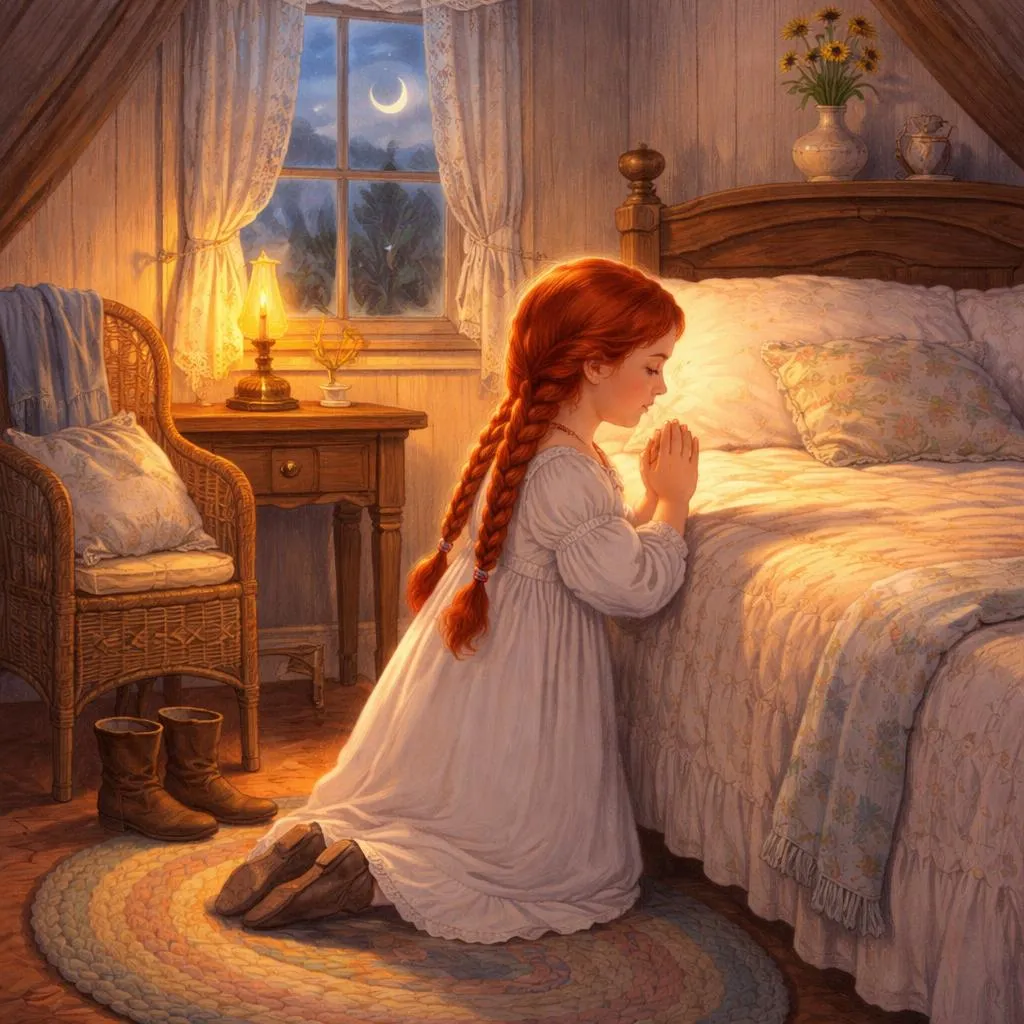

When Marilla took Anne up to bed that night she said stiffly:
“Now, Anne, I noticed last night that you threw your clothes all about the floor when you took them off. That is a very untidy habit, and I can’t allow it at all. As soon as you take off any article of clothing fold it neatly and place it on the chair. I haven’t any use at all for little girls who aren’t neat.”
“I was so harrowed up in my mind last night that I didn’t think about my clothes at all,” said Anne. “I’ll fold them nicely tonight. They always made us do that at the asylum. Half the time, though, I’d forget, I’d be in such a hurry to get into bed nice and quiet and imagine things.”
“You’ll have to remember a little better if you stay here,” admonished Marilla. “There, that looks something like. Say your prayers now and get into bed.”
“I never say any prayers,” announced Anne.
Marilla looked horrified astonishment.
“Why, Anne, what do you mean? Were you never taught to say your prayers? God always wants little girls to say their prayers. Don’t you know who God is, Anne?”
”’God is a spirit, infinite, eternal and unchangeable, in His being, wisdom, power, holiness, justice, goodness, and truth,’” responded Anne promptly and glibly.
Marilla looked rather relieved.
“So you do know something then, thank goodness! You’re not quite a heathen. Where did you learn that?”
“Oh, at the asylum Sunday-school. They made us learn the whole catechism. I liked it pretty well. There’s something splendid about some of the words. ‘Infinite, eternal and unchangeable.’ Isn’t that grand? It has such a roll to it—just like a big organ playing. You couldn’t quite call it poetry, I suppose, but it sounds a lot like it, doesn’t it?”
“We’re not talking about poetry, Anne—we are talking about saying your prayers. Don’t you know it’s a terrible wicked thing not to say your prayers every night? I’m afraid you are a very bad little girl.”
“You’d find it easier to be bad than good if you had red hair,” said Anne reproachfully. “People who haven’t red hair don’t know what trouble is. Mrs. Thomas told me that God made my hair red ON PURPOSE, and I’ve never cared about Him since. And anyhow I’d always be too tired at night to bother saying prayers. People who have to look after twins can’t be expected to say their prayers. Now, do you honestly think they can?”
Marilla decided that Anne’s religious training must be begun at once. Plainly there was no time to be lost.
“You must say your prayers while you are under my roof, Anne.”
“Why, of course, if you want me to,” assented Anne cheerfully. “I’d do anything to oblige you. But you’ll have to tell me what to say for this once. After I get into bed I’ll imagine out a real nice prayer to say always. I believe that it will be quite interesting, now that I come to think of it.”
“You must kneel down,” said Marilla in embarrassment.
Anne knelt at Marilla’s knee and looked up gravely.
“Why must people kneel down to pray? If I really wanted to pray I’ll tell you what I’d do. I’d go out into a great big field all alone or into the deep, deep, woods, and I’d look up into the sky—up—up—up—into that lovely blue sky that looks as if there was no end to its blueness. And then I’d just FEEL a prayer. Well, I’m ready. What am I to say?”
Marilla felt more embarrassed than ever. She had intended to teach Anne the childish classic, “Now I lay me down to sleep.” But she had, as I have told you, the glimmerings of a sense of humor—which is simply another name for a sense of fitness of things; and it suddenly occurred to her that that simple little prayer, sacred to white-robed childhood lisping at motherly knees, was entirely unsuited to this freckled witch of a girl who knew and cared nothing bout God’s love, since she had never had it translated to her through the medium of human love.
“You’re old enough to pray for yourself, Anne,” she said finally. “Just thank God for your blessings and ask Him humbly for the things you want.”
“Well, I’ll do my best,” promised Anne, burying her face in Marilla’s lap. “Gracious heavenly Father—that’s the way the ministers say it in church, so I suppose it’s all right in private prayer, isn’t it?” she interjected, lifting her head for a moment.
"Gracious heavenly Father, I thank Thee for the White Way of Delight and the Lake of Shining Waters and Bonny and the Snow Queen. I'm really extremely grateful for them. And that's all the blessings I can think of just now to thank Thee for. As for the things I want, they're so numerous that it would take a great deal of time to name them all so I will only mention the two most important. Please let me stay at Green Gables; and please let me be good-looking when I grow up. I remain,"
Yours respectfully, Anne Shirley.
“There, did I do all right?” she asked eagerly, getting up. “I could have made it much more flowery if I’d had a little more time to think it over.”
Poor Marilla was only preserved from complete collapse by remembering that it was not irreverence, but simply spiritual ignorance on the part of Anne that was responsible for this extraordinary petition. She tucked the child up in bed, mentally vowing that she should be taught a prayer the very next day, and was leaving the room with the light when Anne called her back.
“I’ve just thought of it now. I should have said, ‘Amen’ in place of ‘yours respectfully,’ shouldn’t I?—the way the ministers do. I’d forgotten it, but I felt a prayer should be finished off in some way, so I put in the other. Do you suppose it will make any difference?”
“I—I don’t suppose it will,” said Marilla. “Go to sleep now like a good child. Good night.”
“I can only say good night tonight with a clear conscience,” said Anne, cuddling luxuriously down among her pillows.
Marilla retreated to the kitchen, set the candle firmly on the table, and glared at Matthew.
“Matthew Cuthbert, it’s about time somebody adopted that child and taught her something. She’s next door to a perfect heathen. Will you believe that she never said a prayer in her life till tonight? I’ll send her to the manse tomorrow and borrow the Peep of the Day series, that’s what I’ll do. And she shall go to Sunday-school just as soon as I can get some suitable clothes made for her. I foresee that I shall have my hands full. Well, well, we can’t get through this world without our share of trouble. I’ve had a pretty easy life of it so far, but my time has come at last and I suppose I’ll just have to make the best of it.”
背景介紹與作者介紹
這段文字摘自《清秀佳人》,這是一部深受喜愛的經典小說,由加拿大作家露西·莫德·蒙哥馬利所著,於1908年首次出版。故事講述了安妮·雪莉,一個富有想像力和活力的孤兒女孩,她被誤送到瑪麗拉和馬修·卡斯伯特那裡,這對兄妹原本打算收養一個男孩來幫忙他們的農場。故事發生在愛德華王子島上虛構的艾凡里村莊,這部小說探討了歸屬感、身份認同和想像力的力量等主題。
露西·莫德·蒙哥馬利大量借鑒了她在加拿大鄉村長大的經歷,將大自然生動的描寫和強烈的社區意識融入到故事中。她對安妮性格的刻畫——熱情、富有創造力,有時也很固執——吸引了全球一代又一代的讀者。
詳細解讀與意義
這段摘錄突出了安妮融入新家以及隨之而來的期望的關鍵時刻。瑪麗拉是一位嚴格而務實的女性,她試圖在安妮的生活中灌輸紀律和秩序,而安妮富有想像力和情感的天性與這些要求發生了衝突。關於祈禱的對話揭示了安妮缺乏正式的宗教教育,但也揭示了她獨特的、發自內心的與精神世界聯繫的方式。
安妮的祈禱,雖然不落俗套,而且帶有幽默感,但卻表現出她真誠的感激和願望,反映了她的天真和希望。瑪麗拉的反應突顯了彌合不同生活經歷和觀點的挑戰。這一幕生動地闡釋了成長的主題——包括個人和精神上的成長——以及在培養孩子的發展過程中理解和耐心的重要性。
給學生的教訓和見解
-
想像力和個性的價值: 安妮對祈禱和生活的富有想像力的方式鼓勵年輕讀者擁抱他們獨特的個性和創造力,即使面對嚴格的規則或期望。
-
適應和成長的重要性: 像安妮一樣,學生們經常面臨新的環境和挑戰。學會在個人表達與社會規範之間取得平衡是成長的關鍵技能。
-
理解和同情: 瑪麗拉對安妮不斷變化的態度教會了我們耐心和同情——認識到人們來自不同的背景,需要時間和指導來適應。
-
感恩和反思: 安妮的祈禱提醒我們,要感謝我們生活中的祝福,無論它們看起來多麼渺小或不尋常。
在日常生活中應用
-
在學校: 學生可以學會在尊重規則和常規的同時,找到表達個性的方法。安妮的故事鼓勵在紀律和創造力之間取得平衡。
-
在社交場合: 了解他人的背景和觀點可以培養善良,減少判斷,就像瑪麗拉學會接受安妮的怪癖一樣。
-
個人成長: 培養像感恩和反思這樣的習慣,就像安妮嘗試用她的祈禱一樣,可以幫助學生建立積極的心態和情感韌性。
從故事中培養積極的品質
-
好奇心和想像力: 鼓勵寫作、繪畫或講故事來培養創造力。
-
責任感和整潔: 就像瑪麗拉堅持整潔一樣,學生可以練習整理他們的個人空間和物品。
-
精神和情感意識: 無論是通過祈禱、冥想還是靜靜地反思,學生都可以培養對自己感受和價值的更深層次的理解。
-
耐心和同情心: 對自己和他人,認識到成長是一個過程。
結論
《清秀佳人》提供了一種永恆的智慧,包裹在一個迷人的敘事中。這段文字尤其邀請讀者欣賞成長的複雜性以及將想像力與紀律融為一體的魅力。對於學生和年輕讀者來說,安妮的旅程是一個靈感來源,讓他們在學習以善良、感恩和勇氣應對世界的同時,忠於自己。
