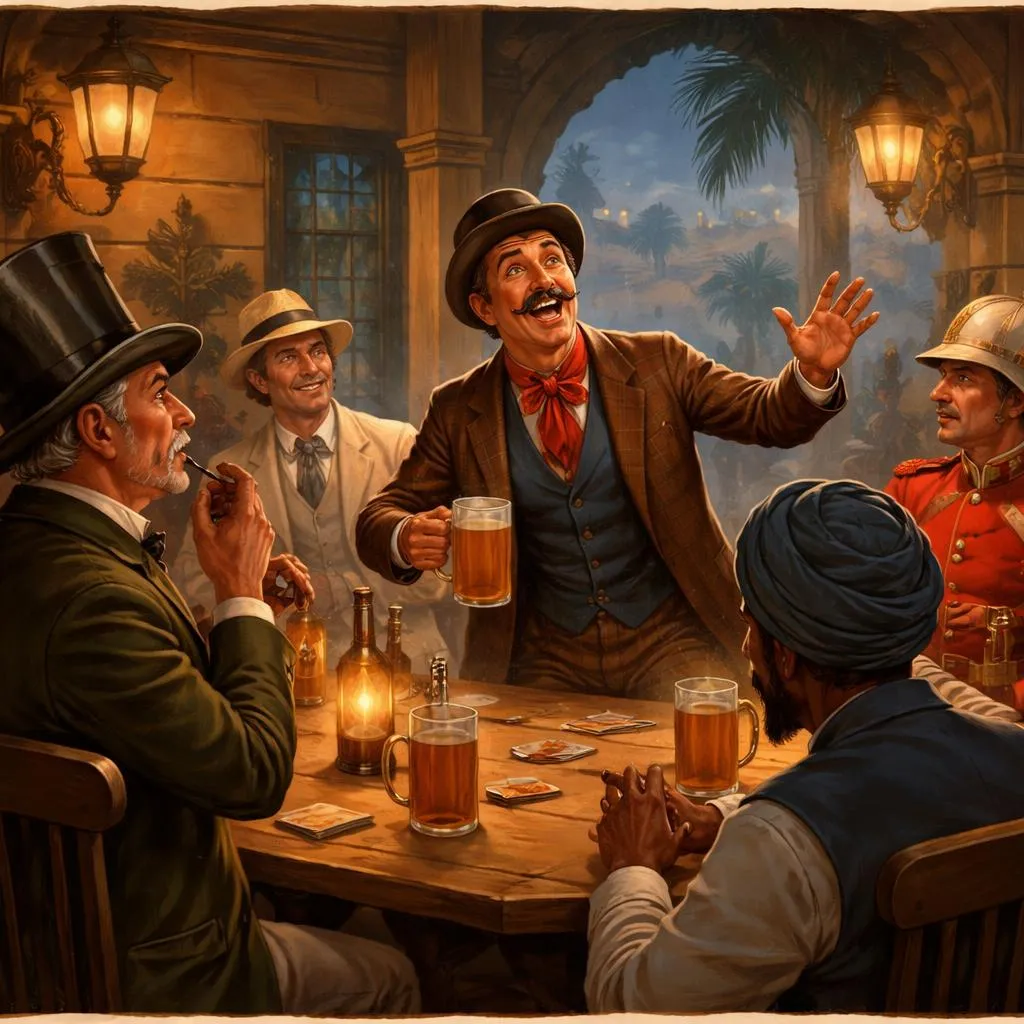

Fix soon rejoined Passepartout, who was lounging and looking about on the quay, as if he did not feel that he, at least, was obliged not to see anything.
"Well, my friend," said the detective, coming up with him, "is your passport visaed?"
"Ah, it's you, is it, monsieur?" responded Passepartout. "Thanks, yes, the passport is all right."
"And you are looking about you?"
"Yes; but we travel so fast that I seem to be journeying in a dream. So this is Suez?"
"Yes."
"In Egypt?"
"Certainly, in Egypt."
"And in Africa?"
"In Africa."
"In Africa!" repeated Passepartout. "Just think, monsieur, I had no idea that we should go farther than Paris; and all that I saw of Paris was between twenty minutes past seven and twenty minutes before nine in the morning, between the Northern and the Lyons stations, through the windows of a car, and in a driving rain! How I regret not having seen once more Pere la Chaise and the circus in the Champs Elysees!"
"You are in a great hurry, then?"
"I am not, but my master is. By the way, I must buy some shoes and shirts. We came away without trunks, only with a carpet–bag."
"I will show you an excellent shop for getting what you want."
"Really, monsieur, you are very kind."
And they walked off together, Passepartout chatting volubly as they went along.
"Above all," said he; "don't let me lose the steamer."
"You have plenty of time; it's only twelve o'clock."
Passepartout pulled out his big watch. "Twelve!" he exclaimed; "why, it's only eight minutes before ten."
"Your watch is slow."
"My watch? A family watch, monsieur, which has come down from my great–grandfather! It doesn't vary five minutes in the year. It's a perfect chronometer, look you."
"I see how it is," said Fix. "You have kept London time, which is two hours behind that of Suez. You ought to regulate your watch at noon in each country."
"I regulate my watch? Never!"
"Well, then, it will not agree with the sun."
"So much the worse for the sun, monsieur. The sun will be wrong, then!"
And the worthy fellow returned the watch to its fob with a defiant gesture. After a few minutes silence, Fix resumed: "You left London hastily, then?"
"I rather think so! Last Friday at eight o'clock in the evening, Monsieur Fogg came home from his club, and three–quarters of an hour afterwards we were off."
"But where is your master going?"
"Always straight ahead. He is going round the world."
"Round the world?" cried Fix.
"Yes, and in eighty days! He says it is on a wager; but, between us, I don't believe a word of it. That wouldn't be common sense. There's something else in the wind."
"Ah! Mr. Fogg is a character, is he?"
"I should say he was."
"Is he rich?"
"No doubt, for he is carrying an enormous sum in brand new banknotes with him. And he doesn't spare the money on the way, either: he has offered a large reward to the engineer of the Mongolia if he gets us to Bombay well in advance of time."
"And you have known your master a long time?"
"Why, no; I entered his service the very day we left London."
The effect of these replies upon the already suspicious and excited detective may be imagined. The hasty departure from London soon after the robbery; the large sum carried by Mr. Fogg; his eagerness to reach distant countries; the pretext of an eccentric and foolhardy bet—all confirmed Fix in his theory. He continued to pump poor Passepartout, and learned that he really knew little or nothing of his master, who lived a solitary existence in London, was said to be rich, though no one knew whence came his riches, and was mysterious and impenetrable in his affairs and habits. Fix felt sure that Phileas Fogg would not land at Suez, but was really going on to Bombay.
"Is Bombay far from here?" asked Passepartout.
"Pretty far. It is a ten days' voyage by sea."
"And in what country is Bombay?"
"India."
"In Asia?"
"Certainly."
"The deuce! I was going to tell you there's one thing that worries me—my burner!"
"What burner?"
"My gas–burner, which I forgot to turn off, and which is at this moment burning at my expense. I have calculated, monsieur, that I lose two shillings every four and twenty hours, exactly sixpence more than I earn; and you will understand that the longer our journey—"
Did Fix pay any attention to Passepartout's trouble about the gas? It is not probable. He was not listening, but was cogitating a project. Passepartout and he had now reached the shop, where Fix left his companion to make his purchases, after recommending him not to miss the steamer, and hurried back to the consulate. Now that he was fully convinced, Fix had quite recovered his equanimity.
"Consul," said he, "I have no longer any doubt. I have spotted my man. He passes himself off as an odd stick who is going round the world in eighty days."
"Then he's a sharp fellow," returned the consul, "and counts on returning to London after putting the police of the two countries off his track."
"We'll see about that," replied Fix.
"But are you not mistaken?"
"I am not mistaken."
"Why was this robber so anxious to prove, by the visa, that he had passed through Suez?"
"Why? I have no idea; but listen to me."
He reported in a few words the most important parts of his conversation with Passepartout.
"In short," said the consul, "appearances are wholly against this man. And what are you going to do?"
"Send a dispatch to London for a warrant of arrest to be dispatched instantly to Bombay, take passage on board the Mongolia, follow my rogue to India, and there, on English ground, arrest him politely, with my warrant in my hand, and my hand on his shoulder."
Having uttered these words with a cool, careless air, the detective took leave of the consul, and repaired to the telegraph office, whence he sent the dispatch which we have seen to the London police office. A quarter of an hour later found Fix, with a small bag in his hand, proceeding on board the Mongolia; and, ere many moments longer, the noble steamer rode out at full steam upon the waters of the Red Sea.
背景介紹與作者介紹
這段摘錄出自儒勒·凡爾納的經典小說《八十天環遊世界》,這位法國作家以其冒險和科幻小說而聞名。這部小說寫於1872年,捕捉了探索的精神和19世紀科技進步的奇蹟,例如蒸汽船和鐵路,這些都使得全球旅行比以往任何時候都更容易。凡爾納常被稱為「科幻小說之父」,因為他富有想像力和遠見的作品。
詳細解讀與意義
故事講述了菲利斯·福克,一位精確而富有的英國紳士,他打賭自己能在短短八十天內環遊世界。他忠誠的法國僕人路路通陪伴著他。這段情節向我們介紹了這些人物,以及費克斯,一位懷疑福克是逃犯的偵探。人物之間的緊張關係和快速的旅行節奏突出了時間、信任以及外表與現實之間的衝突等主題。
故事的這部分也強調了那個時代旅行的刺激和挑戰。路路通第一次看到蘇伊士和埃及等地方時的驚訝,與他最初對旅程的狹隘期望形成了對比。偵探的懷疑增加了一層神秘感和懸念,說明誤解和假設如何導致衝突。
給學生的教訓和見解
-
**好奇心和開放的心態:**路路通對他所參觀的新地方的驚奇鼓勵讀者擁抱好奇心並欣賞世界的多樣性。學生可以學會對新的體驗和文化持開放態度,這可以擴大他們的理解和同情心。
-
**批判性思維和判斷:**費克斯對福克的懷疑提醒讀者要質疑外表,並在做出判斷之前尋求證據。它教導了批判性思維的重要性,以及不要根據不完整的信息妄下結論。
-
**時間管理和規劃:**福克的旅程是關於精心規劃和時間管理價值的教訓。學生可以反思如何設定目標和有效地管理時間可以幫助他們完成困難的任務。
-
**忠誠和服務:**路路通對主人的奉獻表明了忠誠和責任的重要性。它突出了支持他人如何既是一種責任,也是個人成長的源泉。
-
**適應性:**故事展示了適應意外情況的必要性,例如快速旅行和應對新環境。學生可以學會在變化面前保持靈活和韌性。
在日常生活中應用這些教訓
- **在學習中:**就像福克仔細規劃他的路線一樣,學生可以規劃他們的學習時間表並設定明確的目標,以有效地管理他們的工作量。
- **在社交場合:**像路路通一樣保持開放的心態,有助於建立跨文化和背景的友誼。
- **在解決問題中:**像費克斯一樣運用批判性思維,可以幫助學生在採取行動之前徹底分析情況。
- **在個人成長中:**在團隊合作或家庭生活中表現出忠誠和責任感,可以增強人際關係和信任。
- **在面對挑戰時:**擁抱適應性可以幫助學生克服障礙,並在困難時期保持積極態度。
從故事中培養積極的品質
為了培養故事中展現的美德,學生可以:
- 通過探索新的科目或愛好來練習好奇心。
- 在評判他人之前反思,試圖理解他們的觀點。
- 設定個人目標並制定計劃以實現它們。
- 以善良和可靠的方式支持朋友和家人。
- 擁抱變化,將其視為學習和成長的機會。
通過閱讀《八十天環遊世界》,學生不僅可以享受一次激動人心的冒險,還可以獲得寶貴的生活技能,為他們自己的旅程做好準備——無論是在學習、友誼還是個人挑戰方面。
