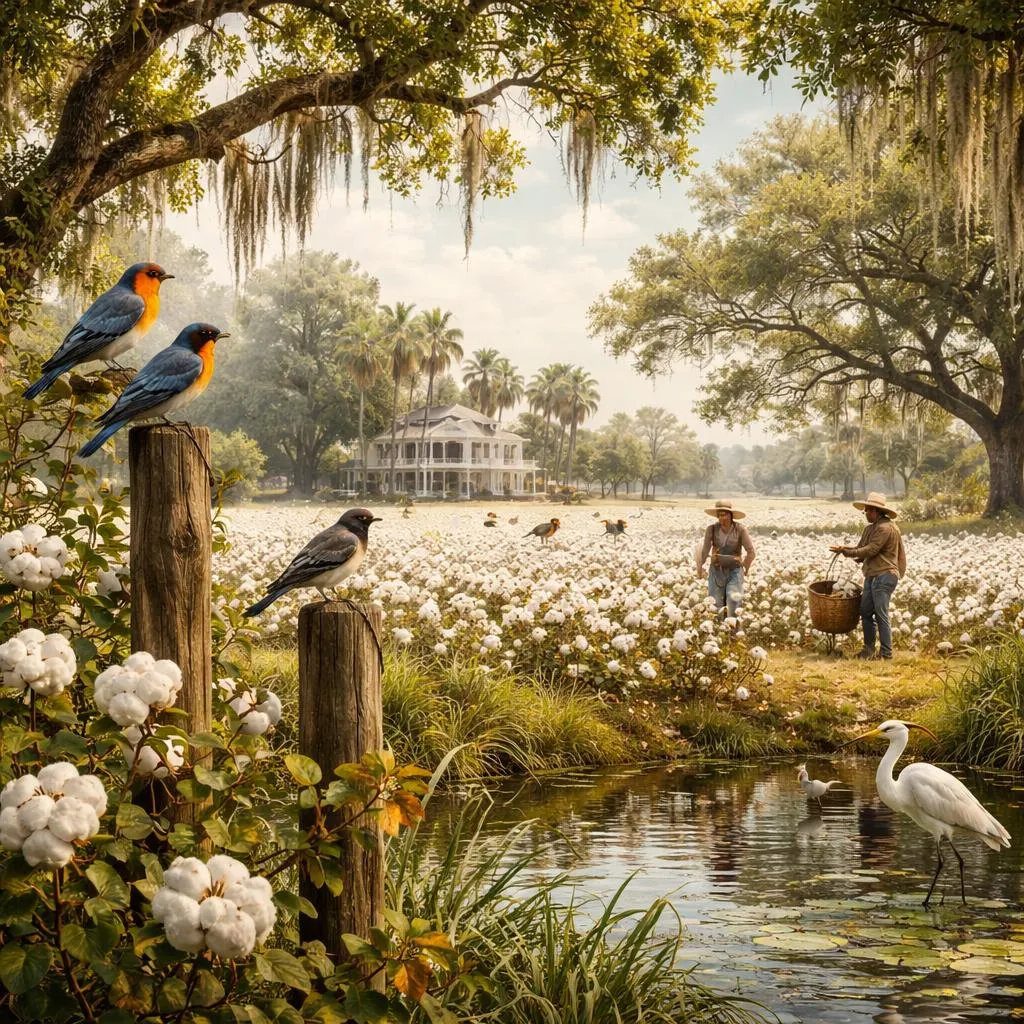

On one of my first jaunts into the suburbs of Tallahassee I noticed not far from the road a bit of swamp,—shallow pools with muddy borders and flats. It was a likely spot for “waders,” and would be worth a visit. To reach it, indeed, I must cross a planted field surrounded by a lofty barbed-wire fence and placarded against trespassers; but there was no one in sight, or no one who looked at all like a land-owner; and, besides, it could hardly be accounted a trespass—defined by Blackstone as an “unwarranted entry on another’s soil”—to step carefully over the cotton rows on so legitimate an errand. Ordinarily I call myself a simple bird-gazer, an amateur, a field naturalist, if you will; but on occasions like the present I assume—with myself, that is—all the rights and titles of an ornithologist proper, a man of science strictly so called. In the interest of science, then, I climbed the fence and picked my way across the field. True enough, about the edges of the water were two or three solitary sandpipers, and at least half a dozen of the smaller yellowlegs,—two additions to my Florida list,—not to speak of a little blue heron and a green heron, the latter in most uncommonly green plumage. It was well I had interpreted the placard a little generously. “The letter killeth” is a pretty good text in emergencies of this kind. So I said to myself. The herons, meanwhile, had taken French leave, but the smaller birds were less suspicious; I watched them at my leisure, and left them still feeding.
Two days later I was there again, but it must be acknowledged that this time I tarried in the road till a man on horseback had disappeared round the next turn. It would have been manlier, without doubt, to pay no attention to him; but something told me that he was the cotton-planter himself, and, for better or worse, prudence carried the day with me. Finding nothing new, though the sandpipers and yellowlegs were still present, with a very handsome little blue heron and plenty of blackbirds, I took the road again and went further, and an hour or two afterward, on getting back to the same place, was overtaken again by the horseman. He pulled up his horse and bade me good-afternoon. Would I lend him my opera-glass, which happened to be in my hand at the moment? “I should like to see how my house looks from here,” he said; and he pointed across the field to a house on the hill some distance beyond.
“Ah,” said I, glad to set myself right by a piece of frankness that under the circumstances could hardly work to my disadvantage; “then it is your land on which I have been trespassing.”
“How so?” he asked, with a smile; and I explained that I had been across his cotton-field a little while before. “That is no trespass,” he answered (so the reader will perceive that I had been quite correct in my understanding of the law); and when I went on to explain my object in visiting his cane-swamp (for such it was, he said, but an unexpected freshet had ruined the crop when it was barely out of the ground), he assured me that I was welcome to visit it as often as I wished. He himself was very fond of natural history, and often regretted that he had not given time to it in his youth. As it was, he protected the birds on his plantation, and the place was full of them. I should find his woods interesting, he felt sure. Florida was extremely rich in birds; he believed there were some that had never been classified. “We have orioles here,” he added; and so far, at any rate, he was right; I had seen perhaps twenty that day (orchard orioles, that is), and one sat in a tree before us at the moment. His whole manner was most kindly and hospitable,—as was that of every Tallahassean with whom I had occasion to speak,—and I told him with sincere gratitude that I should certainly avail myself of his courtesy and stroll through his woods.
I approached them, two mornings afterward, from the opposite side, where, finding no other place of entrance, I climbed a six-barred, tightly locked gate—feeling all the while like “a thief and a robber”—in front of a deserted cabin. Then I had only to cross a grassy field, in which meadow larks were singing, and I was in the woods. I wandered through them without finding anything more unusual or interesting than summer tanagers and yellow-throated warblers, which were in song there, as they were in every such place, and after a while came out into a pleasant glade, from which different parts of the plantation could be seen, and through which ran a plantation road. Here was a wooden fence,—a most unusual thing,—and I lost no time in mounting it, to rest and look about me. It is one of the marks of a true Yankee, I suspect, to like such a perch. My own weakness in that direction is a frequent subject of mirth with chance fellow travelers. The attitude is comfortable and conducive to meditation; and now that I was seated and at my ease, I felt that this was one of the New England luxuries which, almost without knowing it, I had missed ever since I left home.
Of my meditations on this particular occasion I remember nothing; but that is no sign they were valueless; as it is no sign that yesterday’s dinner did me no good because I have forgotten what it was. In the latter case, indeed, and perhaps in the former as well, it would seem more reasonable to draw an exactly opposite inference. But, quibbles apart, one thing I do remember: I sat for some time on the fence, in the shade of a tree, with an eye upon the cane-swamp and an ear open for bird-voices. Yes, and it comes to me at this moment that here I heard the first and only bull-frog that I heard anywhere in Florida. It was like a voice from home, and belonged with the fence. Other frogs I had heard in other places. One chorus brought me out of bed in Daytona—in the evening—after a succession of February dog-day showers. “What is that noise outside?” I inquired of the landlady as I hastened downstairs.
“That?” said she, with a look of amusement; “that’s frogs.”
“It may be,” I thought, but I followed the sounds till they led me in the darkness to the edge of a swamp. No doubt the creatures were frogs, but of some kind new to me, with voices more lugubrious and homesick than I should have supposed could possibly belong to any batrachian. A week or two later, in the New Smyrna flat-woods, I heard in the distance a sound which I took for the grunting of pigs. I made a note of it, mentally, as a cheerful token, indicative of a probable scarcity of rattlesnakes; but by and by, as I drew nearer, the truth of the matter began to break upon me. A man was approaching, and when we met I asked him what was making that noise yonder.
“Frogs,” he said. At another time, in the flat-woods of Port Orange (I hope I am not taxing my reader’s credulity too far, or making myself out a man of too imaginative an ear), I heard the bleating of sheep.
Busy with other things, I did not stop to reflect that it was impossible there should be sheep in that quarter, and the occurrence had quite passed out of my mind when, one day, a cracker, talking about frogs, happened to say, “Yes, and we have one kind that makes a noise exactly like the bleating of sheep.” That, without question, was what I had heard in the flat-woods. But this frog in the sugar-cane swamp was the same fellow that on summer evenings, ever and ever so many years ago, in sonorous bass that could be heard a quarter of a mile away, used to call from Reuben Loud’s pond, “Pull him in! Pull him in!” or sometimes (the inconsistent amphibian), “Jug o’ rum! Jug o’ rum!”
I dismounted from my perch at last, and was sauntering idly along the path (idleness like this is often the best of ornithological industry), when suddenly I had a vision! Before me, in the leafy top of an oak sapling, sat a blue grosbeak. I knew him on the instant. But I could see only his head and neck, the rest of his body being hidden by the leaves. It was a moment of feverish excitement. Here was a new bird, a bird about which I had felt fifteen years of curiosity; and, more than that, a bird which here and now was quite unexpected, since it was not included in either of the two Florida lists that I had brought with me from home. For perhaps five seconds I had my opera-glass on the blue head and the thick-set, dark bill, with its lighter-colored under mandible. Then I heard the clatter of a horse’s hoofs, and lifted my eyes. My friend the owner of the plantation was coming down the road at a gallop, straight upon me. If I was to see the grosbeak and make sure of him, it must be done at once. I moved to bring him fully into view, and he flew into the thick of a pine-tree out of sight. But the tree was not far off, and if Mr. —— would pass me with a nod, the case was still far from hopeless. A bright thought came to me. I ran from the path with a great show of eager absorption, leveled my glass upon the pine-tree, and stood fixed. Perhaps Mr. —— would take the hint. Alas! He had too much courtesy to pass his own guest without speaking. “Still after the birds?” he said, as he checked his horse. I responded, as I hope, without any symptom of annoyance. Then, of course, he wished to know what I was looking at, and I told him that a blue grosbeak had just flown into that pine-tree, and that I was most distressingly anxious to see more of him. He looked at the pine-tree. “I can’t see him,” he said. No more could I. “It wasn’t a blue jay, was it?” he asked. And then we talked of one thing and another, I have no idea what, till he rode away to another part of the plantation where a gang of women were at work. By this time the grosbeak had disappeared utterly. Possibly he had gone to a bit of wood on the opposite side of the cane-swamp. I scaled a barbed-wire fence and made in that direction, but to no purpose. The grosbeak was gone for good. Probably I should never see another. Could the planter have read my thoughts just then he would perhaps have been angry with himself, and pretty certainly he would have been angry with me. That a Yankee should accept his hospitality, and then load him with curses and call him all manner of names! How should he know that I was so insane a hobbyist as to care more for the sight of a new bird than for all the laws and customs of ordinary politeness? As my feelings cooled, I saw that I was stepping over hills or rows of some strange-looking plants just out of the ground. Peanuts, I guessed; but to make sure I called to a colored woman who was hoeing not far off.
“What are these?”
“Pinders,” she answered. I knew she meant peanuts,—otherwise “ground-peas” and “goobers,”—and now that I once more have a dictionary at my elbow I learn that the word, like “goober,” is, or is supposed to be, of African origin.
I was preparing to surmount the barbed-wire fence again, when the planter returned and halted for another chat. It was evident that he took a genuine and amiable interest in my researches. There were a great many kinds of sparrows in that country, he said, and also of woodpeckers. He knew the ivory-bill, but, like other Tallahasseans, he thought I should have to go into Lafayette County (all Florida people say Lafayette) to find it. “That bird calling now is a bee-bird,” he said, referring to a kingbird; “and we have a bird that is called the French mocking-bird; he catches other birds.” The last remark was of interest for its bearing upon a point about which I had felt some curiosity, and, I may say, some skepticism, as I had seen many loggerhead shrikes, but had observed no indication that other birds feared them or held any grudge against them. As he rode off he called my attention to a great blue heron just then flying over the swamp. “They are very shy,” he said. Then, from further away, he shouted once more to ask if I heard the mocking-bird singing yonder, pointing with his whip in the direction of the singer.
For some time longer I hung about the glade, vainly hoping that the grosbeak would again favor my eyes. Then I crossed more planted fields,—climbing more barbed-wire fences, and stopping on the way to enjoy the sweetly quaint music of a little chorus of white-crowned sparrows,—and skirted once more the muddy shore of the cane-swamp, where the yellowlegs and sandpipers were still feeding. That brought me to the road from which I had made my entry to the place some days before; but, being still unable to forego a splendid possibility, I recrossed the plantation, tarried again in the glade, sat again on the wooden fence (if that grosbeak only would show himself!), and thence went on, picking a few heads of handsome buffalo clover, the first I had ever seen, and some sprays of penstemon, till I came again to the six-barred gate and the Quincy road. At that point, as I now remember, the air was full of vultures (carrion crows), a hundred or more, soaring over the fields in some fit of gregariousness. Along the road were white-crowned and white-throated sparrows (it was the 12th of April), orchard orioles, thrashers, summer tanagers, myrtle and palm warblers, cardinal grosbeaks, mocking-birds, kingbirds, logger-heads, yellow—throated vireos, and sundry others, but not the blue grosbeak, which would have been worth them all.
Once back at the hotel, I opened my Coues’s Key to refresh my memory as to the exact appearance of that bird. “Feathers around base of bill black,” said the book. I had not noticed that. But no matter; the bird was a blue grosbeak, for the sufficient reason that it could not be anything else. A black line between the almost black beak and the dark-blue head would be inconspicuous at the best, and quite naturally would escape a glimpse so hasty as mine had been. And yet, while I reasoned in this way, I foresaw plainly enough that, as time passed, doubt would get the better of assurance, as it always does, and I should never be certain that I had not been the victim of some illusion. At best, the evidence was worth nothing for others. If only that excellent Mr. ——, for whose kindness I was unfeignedly thankful (and whose pardon I most sincerely beg if I seem to have been a bit too free in this rehearsal of the story),—if only Mr. —— could have left me alone for ten minutes longer!
The worry and the imprecations were wasted, after all, as, Heaven be thanked, they so often are; for within two or three days I saw other blue grosbeaks and heard them sing. But that was not on a cotton plantation, and is part of another story.
背景介紹與作者介紹
這個故事生動地描述了一位博物學家在佛羅里達州塔拉哈西郊外的早期探險經歷。它是由一位敏銳的自然觀察者所寫,他深深欣賞鳥類和大自然的寧靜之美。作者很可能是19世紀或20世紀初的博物學家,他的作品常常將科學的好奇心與個人反思和溫和的幽默感融為一體。他的敘事風格邀請讀者分享發現的喜悅、觀鳥所需的耐心,以及與當地地主建立的意想不到的友誼。
詳細闡釋與意義
從本質上講,這個故事是關於探索、對自然的尊重,以及人類界限與野外世界之間微妙的平衡。作者進入沼澤地的旅程不僅僅是一場身體上的冒險,更是對知識的追求以及在小而靜謐的時刻中找到的喜悅的隱喻。敘事強調了耐心、細緻的觀察以及對財產和人的尊重的重要性。
與棉花種植者的相遇尤其有意義。它表明了開放和共同的興趣如何在陌生人之間建立橋樑。種植者的善良以及他對其土地上鳥類的保護提醒我們,保護常常是一種社區努力,植根於尊重和理解。
這個故事也觸及了自然之聲的奇妙——牛蛙的叫聲讓作者想起了家,平原森林中令人驚訝的聲音,以及難以捉摸的藍色雀,它象徵著發現的刺激和稍縱即逝的時刻的苦樂參半的本質。
給學生的教訓和反思
-
好奇心和耐心: 作者對觀鳥的謹慎態度教導學生耐心和專注的價值。有時,最有價值的發現來自於安靜的觀察,而不是匆忙行事。
-
尊重他人: 故事表明了尊重他人財產和界限的重要性,即使是在追求激情時。作者對地主的誠實和他的禮貌行為打開了機會之門,並創造了機會。
-
與自然的聯繫: 學生可以學會欣賞周圍的自然世界,注意到鳥鳴、植物名稱和動物行為等細節。這種聯繫培養了同情心和對環境的責任感。
-
小事中的喜悅: 作者在鳥類和青蛙的簡單存在中找到了興奮,提醒學生,如果我們花時間去觀察,就可以在日常時刻中找到奇蹟。
將故事的精神應用於日常生活
-
在學習中: 像作者一樣,通過提問和仔細觀察來培養好奇心。無論是在科學課上還是閱讀文學作品,耐心和對細節的關注都能加深理解。
-
在社交場合中: 像作者與地主的尊重互動一樣,學生應該在與新朋友見面時練習誠實、禮貌和開放。這些品質可以建立信任和友誼。
-
在環境意識中: 鼓勵學生探索當地的公園或花園,聆聽鳥鳴,並了解本地植物和動物。這培養了對自然的終生尊重。
-
在個人成長中: 故事中堅持不懈的主題——等待藍色雀的出現——可以激勵學生即使在沒有立即成功的情況下也要繼續嘗試。
培養積極的態度和行為
-
尊重和禮貌: 始終尋求許可,並誠實地說明你的意圖,就像作者在解釋他在種植者土地上的存在時所做的那樣。
-
耐心和觀察: 練習保持靜止和安靜,以便真正看到和聽到你周圍的事物。這種技能不僅在自然界中很有價值,而且在理解人和情況方面也很有價值。
-
感恩和謙遜: 感謝他人的善良和自然的饋贈。作者對種植者的感激之情反映了對他人慷慨的謙卑認可。
-
對學習的熱情: 讓你的興趣引導你,但要平衡熱情與尊重和責任。
通過接受這些教訓,學生可以成長為思想周全、好奇和尊重的人,他們在學習和關愛周圍的世界中找到喜悅。
