
As we drove along, my spirits revived again, and I turned, with pleasure, to the contemplation of the new life upon which I was entering. But though it was not far past the middle of September, the heavy clouds and strong north–easterly wind combined to render the day extremely cold and dreary; and the journey seemed a very long one, for, as Smith observed, the roads were ‘very heavy’; and certainly, his horse was very heavy too: it crawled up the hills, and crept down them, and only condescended to shake its sides in a trot where the road was at a dead level or a very gentle slope, which was rarely the case in those rugged regions; so that it was nearly one o’clock before we reached the place of our destination. Yet, after all, when we entered the lofty iron gateway, when we drove softly up the smooth, well–rolled carriage–road, with the green lawn on each side, studded with young trees, and approached the new but stately mansion of Wellwood, rising above its mushroom poplar–groves, my heart failed me, and I wished it were a mile or two farther off. For the first time in my life I must stand alone: there was no retreating now. I must enter that house, and introduce myself among its strange inhabitants. But how was it to be done? True, I was near nineteen; but, thanks to my retired life and the protecting care of my mother and sister, I well knew that many a girl of fifteen, or under, was gifted with a more womanly address, and greater ease and self–possession, than I was. Yet, if Mrs. Bloomfield were a kind, motherly woman, I might do very well, after all; and the children, of course, I should soon be at ease with them—and Mr. Bloomfield, I hoped, I should have but little to do with.
‘Be calm, be calm, whatever happens,’ I said within myself; and truly I kept this resolution so well, and was so fully occupied in steadying my nerves and stifling the rebellious flutter of my heart, that when I was admitted into the hall and ushered into the presence of Mrs. Bloomfield, I almost forgot to answer her polite salutation; and it afterwards struck me, that the little I did say was spoken in the tone of one half–dead or half–asleep. The lady, too, was somewhat chilly in her manner, as I discovered when I had time to reflect. She was a tall, spare, stately woman, with thick black hair, cold grey eyes, and extremely sallow complexion.
With due politeness, however, she showed me my bedroom, and left me there to take a little refreshment. I was somewhat dismayed at my appearance on looking in the glass: the cold wind had swelled and reddened my hands, uncurled and entangled my hair, and dyed my face of a pale purple; add to this my collar was horridly crumpled, my frock splashed with mud, my feet clad in stout new boots, and as the trunks were not brought up, there was no remedy; so having smoothed my hair as well as I could, and repeatedly twitched my obdurate collar, I proceeded to clomp down the two flights of stairs, philosophizing as I went; and with some difficulty found my way into the room where Mrs. Bloomfield awaited me.
She led me into the dining–room, where the family luncheon had been laid out. Some beefsteaks and half–cold potatoes were set before me; and while I dined upon these, she sat opposite, watching me (as I thought) and endeavouring to sustain something like a conversation—consisting chiefly of a succession of commonplace remarks, expressed with frigid formality: but this might be more my fault than hers, for I really could NOT converse. In fact, my attention was almost wholly absorbed in my dinner: not from ravenous appetite, but from distress at the toughness of the beefsteaks, and the numbness of my hands, almost palsied by their five–hours’ exposure to the bitter wind. I would gladly have eaten the potatoes and let the meat alone, but having got a large piece of the latter on to my plate, I could not be so impolite as to leave it; so, after many awkward and unsuccessful attempts to cut it with the knife, or tear it with the fork, or pull it asunder between them, sensible that the awful lady was a spectator to the whole transaction, I at last desperately grasped the knife and fork in my fists, like a child of two years old, and fell to work with all the little strength I possessed. But this needed some apology—with a feeble attempt at a laugh, I said, ‘My hands are so benumbed with the cold that I can scarcely handle my knife and fork.’
‘I daresay you would find it cold,’ replied she with a cool, immutable gravity that did not serve to reassure me.
When the ceremony was concluded, she led me into the sitting–room again, where she rang and sent for the children.
‘You will find them not very far advanced in their attainments,’ said she, ‘for I have had so little time to attend to their education myself, and we have thought them too young for a governess till now; but I think they are clever children, and very apt to learn, especially the little boy; he is, I think, the flower of the flock—a generous, noble–spirited boy, one to be led, but not driven, and remarkable for always speaking the truth. He seems to scorn deception’ (this was good news). ‘His sister Mary Ann will require watching,’ continued she, ‘but she is a very good girl upon the whole; though I wish her to be kept out of the nursery as much as possible, as she is now almost six years old, and might acquire bad habits from the nurses. I have ordered her crib to be placed in your room, and if you will be so kind as to overlook her washing and dressing, and take charge of her clothes, she need have nothing further to do with the nursery maid.’
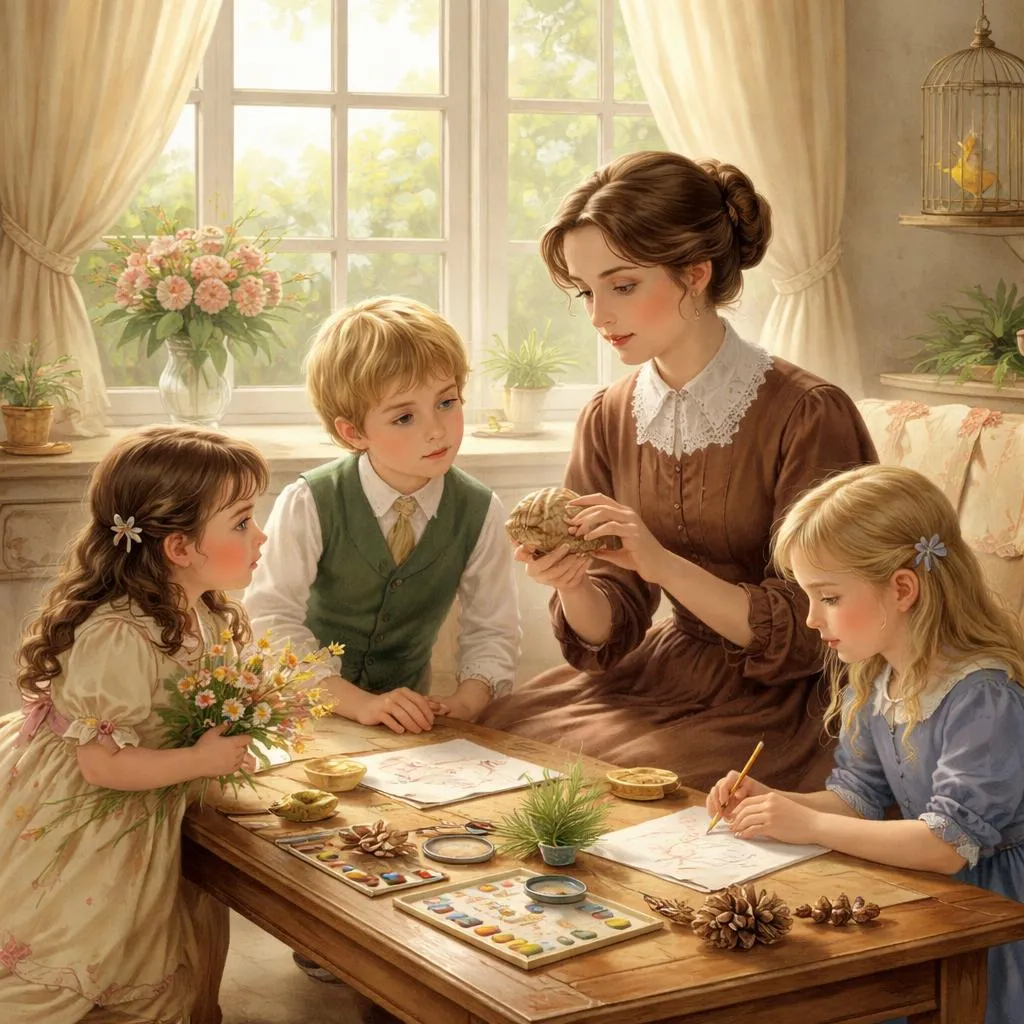
I replied I was quite willing to do so; and at that moment my young pupils entered the apartment, with their two younger sisters. Master Tom Bloomfield was a well–grown boy of seven, with a somewhat wiry frame, flaxen hair, blue eyes, small turned–up nose, and fair complexion. Mary Ann was a tall girl too, somewhat dark like her mother, but with a round full face and a high colour in her cheeks. The second sister was Fanny, a very pretty little girl; Mrs. Bloomfield assured me she was a remarkably gentle child, and required encouragement: she had not learned anything yet; but in a few days, she would be four years old, and then she might take her first lesson in the alphabet, and be promoted to the schoolroom. The remaining one was Harriet, a little broad, fat, merry, playful thing of scarcely two, that I coveted more than all the rest—but with her I had nothing to do.
I talked to my little pupils as well as I could, and tried to render myself agreeable; but with little success I fear, for their mother’s presence kept me under an unpleasant restraint. They, however, were remarkably free from shyness. They seemed bold, lively children, and I hoped I should soon be on friendly terms with them—the little boy especially, of whom I had heard such a favourable character from his mamma. In Mary Ann there was a certain affected simper, and a craving for notice, that I was sorry to observe. But her brother claimed all my attention to himself; he stood bolt upright between me and the fire, with his hands behind his back, talking away like an orator, occasionally interrupting his discourse with a sharp reproof to his sisters when they made too much noise.
‘Oh, Tom, what a darling you are!’ exclaimed his mother. ‘Come and kiss dear mamma; and then won’t you show Miss Grey your schoolroom, and your nice new books?’
‘I won’t kiss YOU, mamma; but I WILL show Miss Grey my schoolroom, and my new books.’
‘And MY schoolroom, and MY new books, Tom,’ said Mary Ann. ‘They’re mine too.’
‘They’re MINE,’ replied he decisively. ‘Come along, Miss Grey— I’ll escort you.’
When the room and books had been shown, with some bickerings between the brother and sister that I did my utmost to appease or mitigate, Mary Ann brought me her doll, and began to be very loquacious on the subject of its fine clothes, its bed, its chest of drawers, and other appurtenances; but Tom told her to hold her clamour, that Miss Grey might see his rocking–horse, which, with a most important bustle, he dragged forth from its corner into the middle of the room, loudly calling on me to attend to it. Then, ordering his sister to hold the reins, he mounted, and made me stand for ten minutes, watching how manfully he used his whip and spurs. Meantime, however, I admired Mary Ann’s pretty doll, and all its possessions; and then told Master Tom he was a capital rider, but I hoped he would not use his whip and spurs so much when he rode a real pony.
‘Oh, yes, I will!’ said he, laying on with redoubled ardour. ‘I’ll cut into him like smoke! Eeh! my word! but he shall sweat for it.’
This was very shocking; but I hoped in time to be able to work a reformation.
‘Now you must put on your bonnet and shawl,’ said the little hero, ‘and I’ll show you my garden.’
‘And MINE,’ said Mary Ann.
Tom lifted his fist with a menacing gesture; she uttered a loud, shrill scream, ran to the other side of me, and made a face at him.
‘Surely, Tom, you would not strike your sister! I hope I shall NEVER see you do that.’
‘You will sometimes: I’m obliged to do it now and then to keep her in order.’
‘But it is not your business to keep her in order, you know—that is for—’
‘Well, now go and put on your bonnet.’
‘I don’t know—it is so very cloudy and cold, it seems likely to rain;—and you know I have had a long drive.’
‘No matter—you MUST come; I shall allow of no excuses,’ replied the consequential little gentleman. And, as it was the first day of our acquaintance, I thought I might as well indulge him. It was too cold for Mary Ann to venture, so she stayed with her mamma, to the great relief of her brother, who liked to have me all to himself.
The garden was a large one, and tastefully laid out; besides several splendid dahlias, there were some other fine flowers still in bloom: but my companion would not give me time to examine them: I must go with him, across the wet grass, to a remote sequestered corner, the most important place in the grounds, because it contained HIS garden. There were two round beds, stocked with a variety of plants. In one there was a pretty little rose–tree. I paused to admire its lovely blossoms.
‘Oh, never mind that!’ said he, contemptuously. ‘That’s only Mary Ann’s garden; look, THIS is mine.’
After I had observed every flower, and listened to a disquisition on every plant, I was permitted to depart; but first, with great pomp, he plucked a polyanthus and presented it to me, as one conferring a prodigious favour. I observed, on the grass about his garden, certain apparatus of sticks and corn, and asked what they were.
‘Traps for birds.’
‘Why do you catch them?’
‘Papa says they do harm.’
‘And what do you do with them when you catch them?’
‘Different things. Sometimes I give them to the cat; sometimes I cut them in pieces with my penknife; but the next, I mean to roast alive.’
‘And why do you mean to do such a horrible thing?’
‘For two reasons: first, to see how long it will live—and then, to see what it will taste like.’
‘But don’t you know it is extremely wicked to do such things? Remember, the birds can feel as well as you; and think, how would you like it yourself?’
‘Oh, that’s nothing! I’m not a bird, and I can’t feel what I do to them.’
‘But you will have to feel it some time, Tom: you have heard where wicked people go to when they die; and if you don’t leave off torturing innocent birds, remember, you will have to go there, and suffer just what you have made them suffer.’
‘Oh, pooh! I shan’t. Papa knows how I treat them, and he never blames me for it: he says it is just what HE used to do when HE was a boy. Last summer, he gave me a nest full of young sparrows, and he saw me pulling off their legs and wings, and heads, and never said anything; except that they were nasty things, and I must not let them soil my trousers: end Uncle Robson was there too, and he laughed, and said I was a fine boy.’
‘But what would your mamma say?’
‘Oh, she doesn’t care! she says it’s a pity to kill the pretty singing birds, but the naughty sparrows, and mice, and rats, I may do what I like with. So now, Miss Grey, you see it is NOT wicked.’
‘I still think it is, Tom; and perhaps your papa and mamma would think so too, if they thought much about it. However,’ I internally added, ‘they may say what they please, but I am determined you shall do nothing of the kind, as long as I have power to prevent it.’
He next took me across the lawn to see his mole–traps, and then into the stack–yard to see his weasel–traps: one of which, to his great joy, contained a dead weasel; and then into the stable to see, not the fine carriage–horses, but a little rough colt, which he informed me had been bred on purpose for him, and he was to ride it as soon as it was properly trained. I tried to amuse the little fellow, and listened to all his chatter as complacently as I could; for I thought if he had any affections at all, I would endeavour to win them; and then, in time, I might be able to show him the error of his ways: but I looked in vain for that generous, noble spirit his mother talked of; though I could see he was not without a certain degree of quickness and penetration, when he chose to exert it.
When we re–entered the house it was nearly tea–time. Master Tom told me that, as papa was from home, he and I and Mary Ann were to have tea with mamma, for a treat; for, on such occasions, she always dined at luncheon–time with them, instead of at six o’clock. Soon after tea, Mary Ann went to bed, but Tom favoured us with his company and conversation till eight. After he was gone, Mrs. Bloomfield further enlightened me on the subject of her children’s dispositions and acquirements, and on what they were to learn, and how they were to be managed, and cautioned me to mention their defects to no one but herself. My mother had warned me before to mention them as little as possible to HER, for people did not like to be told of their children’s faults, and so I concluded I was to keep silence on them altogether. About half–past nine, Mrs. Bloomfield invited me to partake of a frugal supper of cold meat and bread. I was glad when that was over, and she took her bedroom candlestick and retired to rest; for though I wished to be pleased with her, her company was extremely irksome to me; and I could not help feeling that she was cold, grave, and forbidding—the very opposite of the kind, warm–hearted matron my hopes had depicted her to be.
背景介紹與作者介紹
這段文字出自一部經典小說,探討了進入人生新階段的挑戰,特別是透過一位年輕女家庭教師的視角,她來到了一個新的家庭。故事背景設定在一個鄉村,環境有些孤立,反映了19世紀的社會和文化規範。作者是一位敏銳的人性觀察者和社會動態觀察者,她使用詳細的描述和對話,生動地描繪了主角的內心掙扎以及她所遇到的複雜關係。
作者以其對人物的深刻描繪而聞名,尤其是年輕女性如何應對社會期望和個人成長。她的作品經常強調韌性、道德以及同情心和理解在人際互動中的重要性。
詳細解讀與意義
這個故事生動地捕捉了進入一個陌生環境的情感動盪,以及獨自面對不確定性的勇氣。主角的反思揭示了她的脆弱性和決心,使她成為那些經歷過類似轉變的讀者的可信人物。寒冷、陰沉的天氣和緩慢、艱難的旅程象徵著她必須克服的障礙,無論是外部的還是內部的。
布魯姆菲爾德夫人的冷漠態度和孩子們不同的性格,引入了女家庭教師必須應對的社會挑戰。希望的期望與家庭生活的現實之間的對比,突出了適應和毅力的主題。孩子們,尤其是湯姆,體現了天真與令人不安的行為的混合,促使讀者思考教養和道德教育的複雜性。
敘事也提出了重要的倫理問題,例如對待動物和培養同情心。湯姆對鳥類的殘忍意圖和女家庭教師溫柔的告誡,鼓勵讀者反思善良和責任。
給學生的教訓和見解
-
在新情況下的勇氣: 主角的經歷教會學生在面對新環境時要勇敢,無論是新學校、新城市還是新社交團體。感到緊張是正常的,但迎難而上是成長的重要組成部分。
-
同情心和善良: 故事強調理解他人感受的重要性,包括動物。學生可以學會更加富有同情心和對自己的行為負責,認識到所有生物都值得尊重。
-
自我反思和改進: 女家庭教師對自己缺點的認識以及她對社會和情感改善的渴望,鼓勵學生進行自我反思,並努力實現個人發展。
-
處理難相處的人: 布魯姆菲爾德夫人的冷漠和湯姆的挑戰性行為表明,並非所有人都容易相處。學生可以學習耐心、外交和在困難的社交場合中保持自身正直的策略。
-
道德責任: 故事邀請年輕讀者思考對與錯,特別是在教養和影響的背景下。它鼓勵堅持正義,即使它不受歡迎或很困難。
將這些教訓應用於生活
-
在學校: 當開始新班級或加入新團體時,學生可以記住女家庭教師的勇氣,並嘗試對他人開放和耐心。他們也可以練習善良,反對欺凌或殘酷行為。
-
在社交場合: 了解人們有不同的個性和背景,有助於學生培養同情心和更好的溝通技巧。他們可以學會優雅地應對社交挑戰。
-
在個人成長中: 反思自己的行為並尋求改進是一個終生的過程。學生可以寫日記或與信任的成年人談論他們的感受和經歷。
-
在關愛他人中: 無論是寵物、同學還是家人,表現出善良和責任感都至關重要。故事中關於對待動物的同情心的信息可以擴展到所有關係。
培養積極的品質
為了培養故事中展現或期望的積極特質,學生可以:
- 練習正念以管理緊張和壓力。
- 參與關於倫理困境的角色扮演或討論,以增強道德推理能力。
- 志願或參與涉及關愛他人的活動。
- 廣泛閱讀以了解不同的觀點和人類經驗。
- 尋求老師、家人或輔導員的指導,以建立自信和社交技能。
這段文字及其主題為反思和討論提供了豐富的材料,幫助年輕讀者不僅在學業上,而且在情感和道德上成長。
