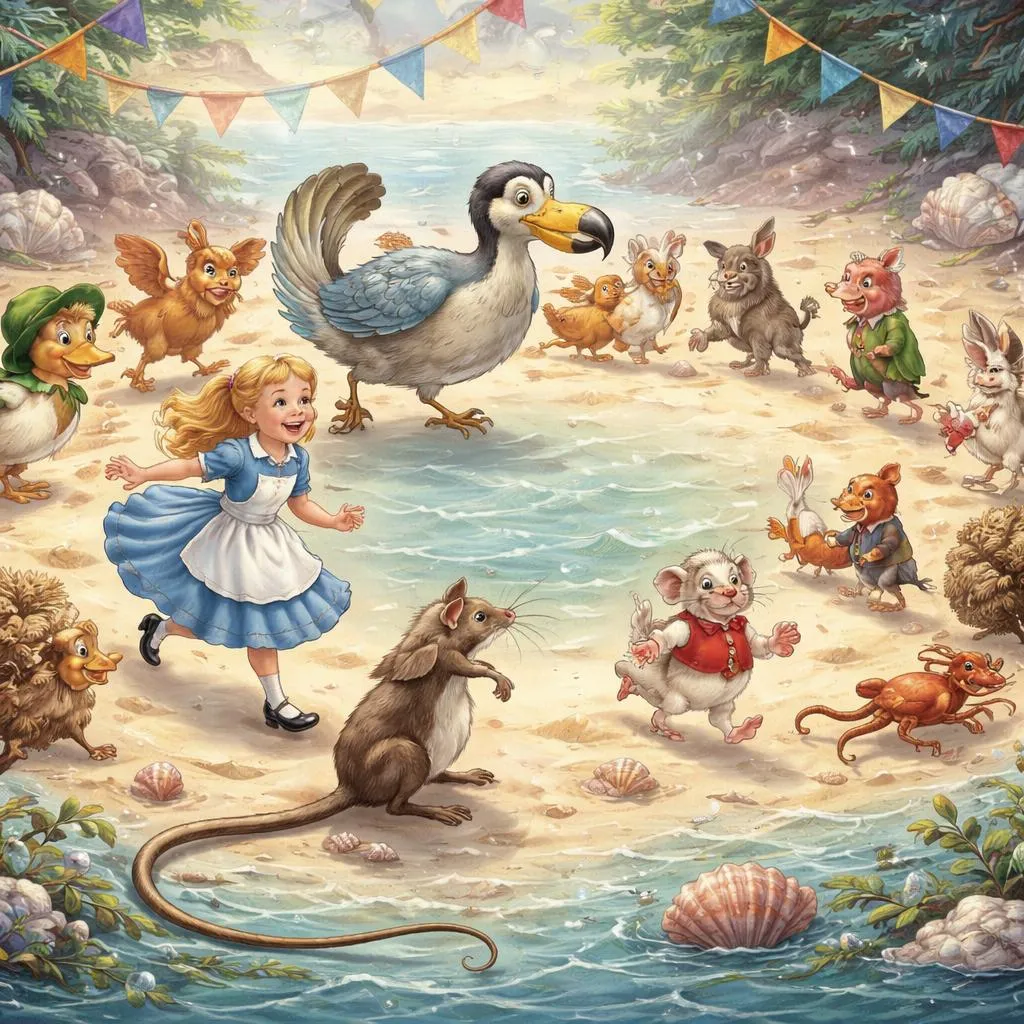

They were indeed a queer–looking party that assembled on the bank—the birds with draggled feathers, the animals with their fur clinging close to them, and all dripping wet, cross, and uncomfortable.
The first question of course was, how to get dry again: they had a consultation about this, and after a few minutes it seemed quite natural to Alice to find herself talking familiarly with them, as if she had known them all her life. Indeed, she had quite a long argument with the Lory, who at last turned sulky, and would only say, 'I am older than you, and must know better'; and this Alice would not allow without knowing how old it was, and, as the Lory positively refused to tell its age, there was no more to be said.
At last the Mouse, who seemed to be a person of authority among them, called out, 'Sit down, all of you, and listen to me! I'LL soon make you dry enough!' They all sat down at once, in a large ring, with the Mouse in the middle. Alice kept her eyes anxiously fixed on it, for she felt sure she would catch a bad cold if she did not get dry very soon.
'Ahem!' said the Mouse with an important air, 'are you all ready? This is the driest thing I know. Silence all round, if you please! "William the Conqueror, whose cause was favoured by the pope, was soon submitted to by the English, who wanted leaders, and had been of late much accustomed to usurpation and conquest. Edwin and Morcar, the earls of Mercia and Northumbria—"'
'Ugh!' said the Lory, with a shiver.
'I beg your pardon!' said the Mouse, frowning, but very politely: 'Did you speak?'
'Not I!' said the Lory hastily.
'I thought you did,' said the Mouse. '—I proceed. "Edwin and Morcar, the earls of Mercia and Northumbria, declared for him: and even Stigand, the patriotic archbishop of Canterbury, found it advisable—"'
'Found WHAT?' said the Duck.
'Found IT,' the Mouse replied rather crossly: 'of course you know what "it" means.'
'I know what "it" means well enough, when I find a thing,' said the Duck: 'it's generally a frog or a worm. The question is, what did the archbishop find?'
The Mouse did not notice this question, but hurriedly went on, '"—found it advisable to go with Edgar Atheling to meet William and offer him the crown. William's conduct at first was moderate. But the insolence of his Normans—" How are you getting on now, my dear?' it continued, turning to Alice as it spoke.
'As wet as ever,' said Alice in a melancholy tone: 'it doesn't seem to dry me at all.'
'In that case,' said the Dodo solemnly, rising to its feet, 'I move that the meeting adjourn, for the immediate adoption of more energetic remedies—'
'Speak English!' said the Eaglet. 'I don't know the meaning of half those long words, and, what's more, I don't believe you do either!' And the Eaglet bent down its head to hide a smile: some of the other birds tittered audibly.
'What I was going to say,' said the Dodo in an offended tone, 'was, that the best thing to get us dry would be a Caucus–race.'
'What IS a Caucus–race?' said Alice; not that she wanted much to know, but the Dodo had paused as if it thought that SOMEBODY ought to speak, and no one else seemed inclined to say anything.
'Why,' said the Dodo, 'the best way to explain it is to do it.' (And, as you might like to try the thing yourself, some winter day, I will tell you how the Dodo managed it.)
First it marked out a race–course, in a sort of circle, ('the exact shape doesn't matter,' it said,) and then all the party were placed along the course, here and there. There was no 'One, two, three, and away,' but they began running when they liked, and left off when they liked, so that it was not easy to know when the race was over. However, when they had been running half an hour or so, and were quite dry again, the Dodo suddenly called out 'The race is over!' and they all crowded round it, panting, and asking, 'But who has won?'
This question the Dodo could not answer without a great deal of thought, and it sat for a long time with one finger pressed upon its forehead (the position in which you usually see Shakespeare, in the pictures of him), while the rest waited in silence. At last the Dodo said, 'EVERYBODY has won, and all must have prizes.'
'But who is to give the prizes?' quite a chorus of voices asked.
'Why, SHE, of course,' said the Dodo, pointing to Alice with one finger; and the whole party at once crowded round her, calling out in a confused way, 'Prizes! Prizes!'
Alice had no idea what to do, and in despair she put her hand in her pocket, and pulled out a box of comfits, (luckily the salt water had not got into it), and handed them round as prizes. There was exactly one a–piece all round.
'But she must have a prize herself, you know,' said the Mouse.
'Of course,' the Dodo replied very gravely. 'What else have you got in your pocket?' he went on, turning to Alice.
'Only a thimble,' said Alice sadly.
'Hand it over here,' said the Dodo.
Then they all crowded round her once more, while the Dodo solemnly presented the thimble, saying 'We beg your acceptance of this elegant thimble'; and, when it had finished this short speech, they all cheered.
Alice thought the whole thing very absurd, but they all looked so grave that she did not dare to laugh; and, as she could not think of anything to say, she simply bowed, and took the thimble, looking as solemn as she could.
The next thing was to eat the comfits: this caused some noise and confusion, as the large birds complained that they could not taste theirs, and the small ones choked and had to be patted on the back. However, it was over at last, and they sat down again in a ring, and begged the Mouse to tell them something more.
'You promised to tell me your history, you know,' said Alice, 'and why it is you hate—C and D,' she added in a whisper, half afraid that it would be offended again.
'Mine is a long and a sad tale!' said the Mouse, turning to Alice, and sighing.
'It IS a long tail, certainly,' said Alice, looking down with wonder at the Mouse's tail; 'but why do you call it sad?' And she kept on puzzling about it while the Mouse was speaking, so that her idea of the tale was something like this:—
'Fury said to a mouse, That he met in the house, "Let us both go to law: I will prosecute YOU.—Come, I'll take no denial; We must have a trial: For really this morning I've nothing to do." Said the mouse to the cur, "Such a trial, dear Sir, With no jury or judge, would be wasting our breath." "I'll be judge, I'll be jury," Said cunning old Fury: "I'll try the whole cause, and condemn you to death."'
'You are not attending!' said the Mouse to Alice severely. 'What are you thinking of?'
'I beg your pardon,' said Alice very humbly: 'you had got to the fifth bend, I think?'
'I had NOT!' cried the Mouse, sharply and very angrily.
'A knot!' said Alice, always ready to make herself useful, and looking anxiously about her. 'Oh, do let me help to undo it!'
'I shall do nothing of the sort,' said the Mouse, getting up and walking away. 'You insult me by talking such nonsense!'
'I didn't mean it!' pleaded poor Alice. 'But you're so easily offended, you know!'
The Mouse only growled in reply.
'Please come back and finish your story!' Alice called after it; and the others all joined in chorus, 'Yes, please do!' but the Mouse only shook its head impatiently, and walked a little quicker.
'What a pity it wouldn't stay!' sighed the Lory, as soon as it was quite out of sight; and an old Crab took the opportunity of saying to her daughter 'Ah, my dear! Let this be a lesson to you never to lose YOUR temper!' 'Hold your tongue, Ma!' said the young Crab, a little snappishly. 'You're enough to try the patience of an oyster!'
'I wish I had our Dinah here, I know I do!' said Alice aloud, addressing nobody in particular. 'She'd soon fetch it back!'
'And who is Dinah, if I might venture to ask the question?' said the Lory.
Alice replied eagerly, for she was always ready to talk about her pet: 'Dinah's our cat. And she's such a capital one for catching mice you can't think! And oh, I wish you could see her after the birds! Why, she'll eat a little bird as soon as look at it!'
This speech caused a remarkable sensation among the party. Some of the birds hurried off at once: one old Magpie began wrapping itself up very carefully, remarking, 'I really must be getting home; the night–air doesn't suit my throat!' and a Canary called out in a trembling voice to its children, 'Come away, my dears! It's high time you were all in bed!' On various pretexts they all moved off, and Alice was soon left alone.
'I wish I hadn't mentioned Dinah!' she said to herself in a melancholy tone. 'Nobody seems to like her, down here, and I'm sure she's the best cat in the world! Oh, my dear Dinah! I wonder if I shall ever see you any more!' And here poor Alice began to cry again, for she felt very lonely and low–spirited. In a little while, however, she again heard a little pattering of footsteps in the distance, and she looked up eagerly, half hoping that the Mouse had changed his mind, and was coming back to finish his story.
背景介紹和作者介紹
這段摘錄出自《愛麗絲夢遊仙境》,這是一部由路易斯·卡羅爾(查爾斯·路特維奇·道奇森的筆名)所寫的經典小說,於 1865 年首次出版。卡羅爾是一位數學家、邏輯學家和作家,以其對語言和邏輯謎題的巧妙運用而聞名。故事講述了一個名叫愛麗絲的年輕女孩掉進兔子洞,進入一個充滿奇特生物和異想天開的冒險的奇幻世界。
詳細解讀和意義
在這段文字中,愛麗絲和一群濕漉漉、衣衫襤褸的動物和鳥類在掉入水中後聚集在河岸邊。這些角色就歷史和政治展開了一場幽默而荒誕的討論,很快變成了一場異想天開的「混亂賽跑」——一場沒有明確規則或獲勝者的比賽,象徵著某些社會或政治進程的荒謬性。老鼠試圖講故事,卻被愛麗絲的好奇心和誤解打斷,這說明了貫穿全書的嬉鬧混亂。
這個場景突出了卡羅爾利用諷刺和荒誕來嘲諷維多利亞時代社會的形式和慣例。這些動物的行為反映了人類的特徵,例如固執、不耐煩和對秩序的渴望,但卻是以一種顛三倒四、不合邏輯的方式。愛麗絲的互動表現了她的天真和好奇心,以及她試圖理解這個混亂世界的嘗試。
給兒童和學生的教訓和見解
-
好奇心和批判性思維: 愛麗絲的提問態度鼓勵年輕讀者保持好奇心,並批判性地思考他們收到的信息。她質疑鸚鵡因年長而自以為是的說法,並質疑老鼠的故事,表明提出問題和尋求理解是可以的。
-
想像力的價值: 奇幻的環境和角色邀請讀者運用他們的想像力,這對於現實生活中的創造力和解決問題至關重要。
-
理解荒誕和幽默: 認識到幽默和胡說八道可以幫助孩子們培養靈活的思維方式,學會從不同的角度看待混亂或令人沮喪的情況,從而應對這些情況。
-
社交互動和同理心: 故事展示了不同的個性以及它們如何互動——有些人脾氣暴躁,有些人驕傲,有些人害羞。理解這些特徵可以幫助孩子們培養同理心和更好的社交技能。
-
耐心和情緒控制: 老鼠的惱怒以及老螃蟹關於不要發脾氣的建議,教導孩子們在社交場合中保持耐心和管理情緒的重要性。
在日常生活中應用這些教訓
-
在學習中: 學生可以效仿愛麗絲的好奇心,在課堂上提問,而不是盲目接受信息。他們也可以運用想像力來增強寫作、藝術和解決問題的任務。
-
在社交場合: 認識到不同的個性有助於結交朋友和解決衝突。孩子們可以學會耐心和尊重,即使其他人表現不同。
-
在情感成長中: 了解在某些時候感到困惑或沮喪是正常的,而幽默或新的視角可以提供幫助,這是一項寶貴的情感技能。
從故事中鼓勵積極的行為
- 保持好奇: 像愛麗絲一樣,隨時準備探索和質疑你周圍的世界。
- 保持開放的心態: 接受並非所有事情都能立即理解;有時,事情只是愚蠢或奇怪。
- 練習善良: 即使其他人脾氣暴躁或難以相處,也要嘗試理解和耐心。
- 運用想像力: 讓創造力引導你學習和玩耍。
- 管理情緒: 學會控制你的脾氣並平靜地表達感受。
通過閱讀《愛麗絲夢遊仙境》,兒童和青少年不僅可以欣賞一個神奇的故事,還可以獲得對人性、社會互動和想像力力量的寶貴見解,這些見解可以豐富他們的個人和學術生活。
