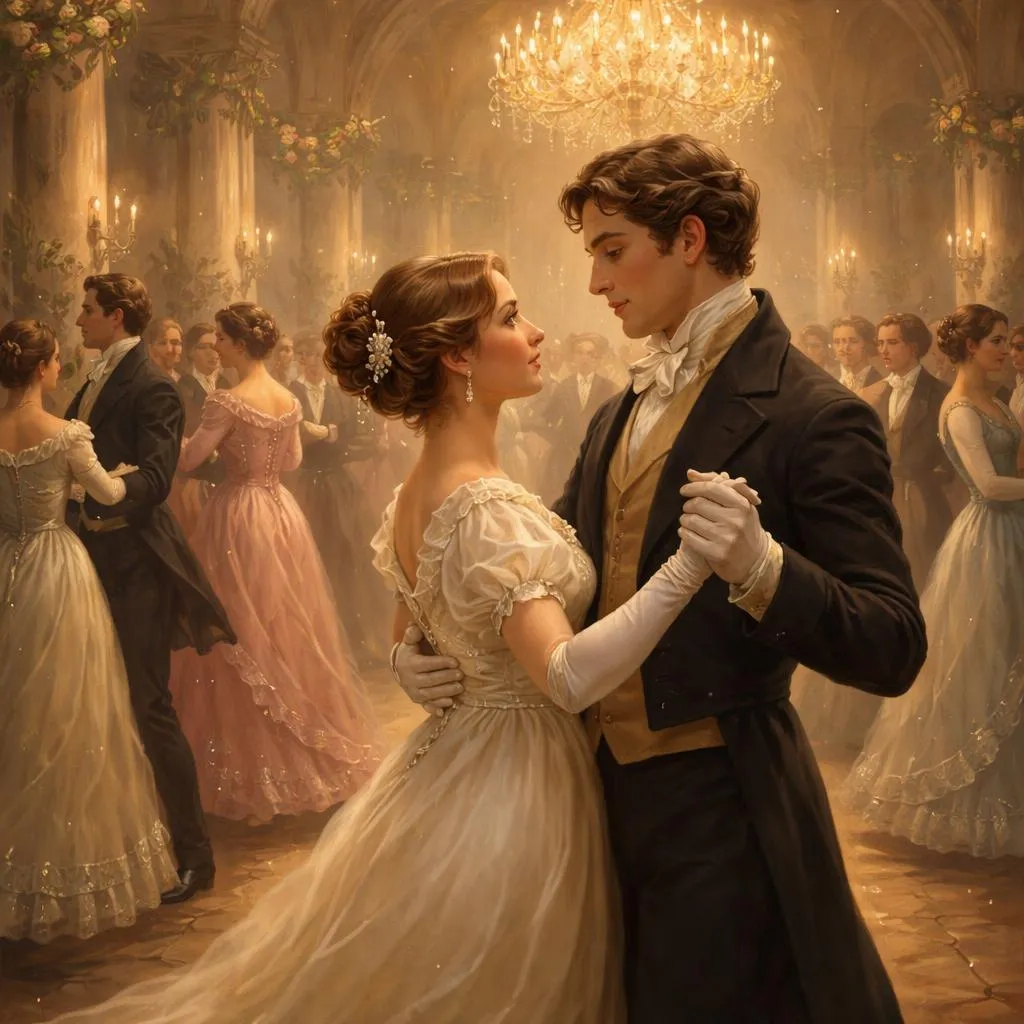

‘Now, Miss Grey,’ exclaimed Miss Murray, immediately I entered the schoolroom, after having taken off my outdoor garments, upon returning from my four weeks’ recreation, ‘Now—shut the door, and sit down, and I’ll tell you all about the ball.’
‘No—damn it, no!’ shouted Miss Matilda. ‘Hold your tongue, can’t ye? and let me tell her about my new mare—SUCH a splendour, Miss Grey! a fine blood mare—’
‘Do be quiet, Matilda; and let me tell my news first.’
‘No, no, Rosalie; you’ll be such a damned long time over it—she shall hear me first—I’ll be hanged if she doesn’t!’
‘I’m sorry to hear, Miss Matilda, that you’ve not got rid of that shocking habit yet.’
‘Well, I can’t help it: but I’ll never say a wicked word again, if you’ll only listen to me, and tell Rosalie to hold her confounded tongue.’
Rosalie remonstrated, and I thought I should have been torn in pieces between them; but Miss Matilda having the loudest voice, her sister at length gave in, and suffered her to tell her story first: so I was doomed to hear a long account of her splendid mare, its breeding and pedigree, its paces, its action, its spirit, &c., and of her own amazing skill and courage in riding it; concluding with an assertion that she could clear a five–barred gate ‘like winking,’ that papa said she might hunt the next time the hounds met, and mamma had ordered a bright scarlet hunting–habit for her.
‘Oh, Matilda! what stories you are telling!’ exclaimed her sister.
‘Well,’ answered she, no whit abashed, ‘I know I COULD clear a five–barred gate, if I tried, and papa WILL say I may hunt, and mamma WILL order the habit when I ask it.’
‘Well, now get along,’ replied Miss Murray; ‘and do, dear Matilda, try to be a little more lady–like. Miss Grey, I wish you would tell her not to use such shocking words; she will call her horse a mare: it is so inconceivably shocking! and then she uses such dreadful expressions in describing it: she must have learned it from the grooms. It nearly puts me into fits when she begins.’
‘I learned it from papa, you ass! and his jolly friends,’ said the young lady, vigorously cracking a hunting–whip, which she habitually carried in her hand. ‘I’m as good judge of horseflesh as the best of ‘m.’
‘Well, now get along, you shocking girl! I really shall take a fit if you go on in such a way. And now, Miss Grey, attend to me; I’m going to tell you about the ball. You must be dying to hear about it, I know. Oh, SUCH a ball! You never saw or heard, or read, or dreamt of anything like it in all your life. The decorations, the entertainment, the supper, the music were indescribable! and then the guests! There were two noblemen, three baronets, and five titled ladies, and other ladies and gentlemen innumerable. The ladies, of course, were of no consequence to me, except to put me in a good humour with myself, by showing how ugly and awkward most of them were; and the best, mamma told me,—the most transcendent beauties among them, were nothing to me. As for me, Miss Grey—I’m so SORRY you didn’t see me! I was CHARMING—wasn’t I, Matilda?’
‘Middling.’
‘No, but I really was—at least so mamma said—and Brown and Williamson. Brown said she was sure no gentleman could set eyes on me without falling in love that minute; and so I may be allowed to be a little vain. I know you think me a shocking, conceited, frivolous girl; but then, you know, I don’t attribute it ALL to my personal attractions: I give some praise to the hairdresser, and some to my exquisitely lovely dress—you must see it to–morrow— white gauze over pink satin—and so SWEETLY made! and a necklace and bracelet of beautiful, large pearls!’
‘I have no doubt you looked very charming: but should that delight you so very much?’
‘Oh, no!—not that alone: but, then, I was so much admired; and I made so MANY conquests in that one night—you’d be astonished to hear—’
‘But what good will they do you?’
‘What good! Think of any woman asking that!’
‘Well, I should think one conquest would be enough; and too much, unless the subjugation were mutual.’
‘Oh, but you know I never agree with you on those points. Now, wait a bit, and I’ll tell you my principal admirers—those who made themselves very conspicuous that night and after: for I’ve been to two parties since. Unfortunately the two noblemen, Lord G—– and Lord F—–, were married, or I might have condescended to be particularly gracious to THEM; as it was, I did not: though Lord F—–, who hates his wife, was evidently much struck with me. He asked me to dance with him twice—he is a charming dancer, by–the–by, and so am I: you can’t think how well I did—I was astonished at myself. My lord was very complimentary too—rather too much so in fact—and I thought proper to be a little haughty and repellent; but I had the pleasure of seeing his nasty, cross wife ready to perish with spite and vexation—’
‘Oh, Miss Murray! you don’t mean to say that such a thing could really give you pleasure? However cross or—’
‘Well, I know it’s very wrong;—but never mind! I mean to be good some time—only don’t preach now, there’s a good creature. I haven’t told you half yet. Let me see. Oh! I was going to tell you how many unmistakeable admirers I had:– Sir Thomas Ashby was one,—Sir Hugh Meltham and Sir Broadley Wilson are old codgers, only fit companions for papa and mamma. Sir Thomas is young, rich, and gay; but an ugly beast, nevertheless: however, mamma says I should not mind that after a few months’ acquaintance. Then, there was Henry Meltham, Sir Hugh’s younger son; rather good–looking, and a pleasant fellow to flirt with: but BEING a younger son, that is all he is good for; then there was young Mr. Green, rich enough, but of no family, and a great stupid fellow, a mere country booby! and then, our good rector, Mr. Hatfield: an HUMBLE admirer he ought to consider himself; but I fear he has forgotten to number humility among his stock of Christian virtues.’
‘Was Mr. Hatfield at the ball?’
‘Yes, to be sure. Did you think he was too good to go?’
‘I thought be might consider it unclerical.’
‘By no means. He did not profane his cloth by dancing; but it was with difficulty he could refrain, poor man: he looked as if he were dying to ask my hand just for ONE set; and—oh! by–the–by— he’s got a new curate: that seedy old fellow Mr. Bligh has got his long–wished–for living at last, and is gone.’
‘And what is the new one like?’
‘Oh, SUCH a beast! Weston his name is. I can give you his description in three words—an insensate, ugly, stupid blockhead. That’s four, but no matter—enough of HIM now.’
Then she returned to the ball, and gave me a further account of her deportment there, and at the several parties she had since attended; and further particulars respecting Sir Thomas Ashby and Messrs. Meltham, Green, and Hatfield, and the ineffaceable impression she had wrought upon each of them.
‘Well, which of the four do you like best?’ said I, suppressing my third or fourth yawn.
‘I detest them all!’ replied she, shaking her bright ringlets in vivacious scorn.
‘That means, I suppose, “I like them all”—but which most?’
‘No, I really detest them all; but Harry Meltham is the handsomest and most amusing, and Mr. Hatfield the cleverest, Sir Thomas the wickedest, and Mr. Green the most stupid. But the one I’m to have, I suppose, if I’m doomed to have any of them, is Sir Thomas Ashby.’
‘Surely not, if he’s so wicked, and if you dislike him?’
‘Oh, I don’t mind his being wicked: he’s all the better for that; and as for disliking him—I shouldn’t greatly object to being Lady Ashby of Ashby Park, if I must marry. But if I could be always young, I would be always single. I should like to enjoy myself thoroughly, and coquet with all the world, till I am on the verge of being called an old maid; and then, to escape the infamy of that, after having made ten thousand conquests, to break all their hearts save one, by marrying some high–born, rich, indulgent husband, whom, on the other hand, fifty ladies were dying to have.’
‘Well, as long as you entertain these views, keep single by all means, and never marry at all: not even to escape the infamy of old–maidenhood.’
背景與作者介紹
這段摘錄來自一部19世紀的經典小說,探討了社會禮儀、年輕人的生活,以及貴族生活的複雜性。故事背景設定在一個社會地位、外貌和聲譽至關重要的時代,尤其對於在社會中摸索的年輕女性而言。作者以其敏銳的智慧和對社會動態的敏銳觀察而聞名,經常描繪個人慾望與社會期望之間的衝突。她的作品以其生動的人物刻畫和對她所處時代女性所扮演的角色和限制的深刻評論而聞名。
詳細分析與解讀
這段文字生動地捕捉了米勒小姐和瑪蒂爾達小姐兩姐妹爭奪注意力的熱鬧場景,她們通過講述最近的經歷來互相競爭。瑪蒂爾達吹噓她的新馬和騎術,而羅莎莉(米勒小姐)則以她對她參加的盛大舞會的詳細描述佔據了談話的主導地位。她們的對話揭示了她們的個性:瑪蒂爾達粗魯而不拘小節,使用粗俗的語言並炫耀她的體力,而羅莎莉(米勒小姐)則更關心社會地位、外貌和浪漫的征服。
這個故事突出了競爭、虛榮和年輕女性為符合某些美麗和行為理想而面臨的社會壓力等主題。米勒小姐對舞會、客人和她的仰慕者的詳細描述,突出了社交聚會作為建立聯盟、留下印象和確保有利婚姻的場所的重要性。
人物對婚姻和關係的態度反映了當時女性可選擇的有限性。米勒小姐對愛情和婚姻的玩世不恭但具有策略性的看法——將其視為征服和社會進步的遊戲——與更傳統或浪漫的理想形成對比。這種緊張關係促使讀者質疑所描繪的社會的價值觀,並考慮這種生活方式的個人代價。
給學生的教訓和見解
-
理解社會背景: 這個故事提供了一個了解過去時代的社會習俗和期望的窗口。學生可以了解歷史背景如何塑造人物的行為和社會規範。
-
人物分析: 姐妹們的鮮明對比鼓勵讀者批判性地思考語言、行為和態度如何揭示更深層次的特徵和價值觀。
-
虛榮和競爭的主題: 對話表明了虛榮和兄弟姐妹之間的競爭如何影響人際關係和自我認知。學生可以反思這些特徵在他們自己生活中的後果。
-
批判性地思考社會角色: 這個故事促使讀者質疑分配給女性的角色以及對外貌和社會地位的重視。它鼓勵人們思考性別角色和社會期望,無論是在歷史上還是在今天。
在日常生活和學習中的應用
-
社交技巧: 通過研究人物的互動,學生可以學習尊重性的溝通以及言語和態度對人際關係的影響。
-
自我意識和謙遜: 這個故事提醒人們要平衡自信與謙遜,避免傲慢或膚淺的判斷。
-
對歷史和文學的欣賞: 了解故事的背景豐富了學生對文學作為對人性和社會的反映的欣賞。
-
同情心和觀點: 學生可以通過考慮人物所面臨的壓力以及這些壓力如何與他們自己社會環境中的挑戰相關聯來練習同情心。
培養受故事啟發的積極行為
-
尊重的對話: 鼓勵學生耐心傾聽並尊重他人的觀點,避免打斷或輕蔑的語言。
-
平衡的自尊: 培養一種健康的自我價值感,這種價值感不完全基於外貌或外部認可。
-
批判性反思: 教導學生批判性地評估社會規範,並培養自己的價值觀,而不是盲目追隨潮流。
-
社會意識: 幫助學生認識到善良和真誠的關係比膚淺的受歡迎程度或地位更重要。
通過參與這個故事及其主題,學生可以培養對人類行為、社會動態以及在複雜的社會世界中保持個人正直的重要性的更豐富的理解。
