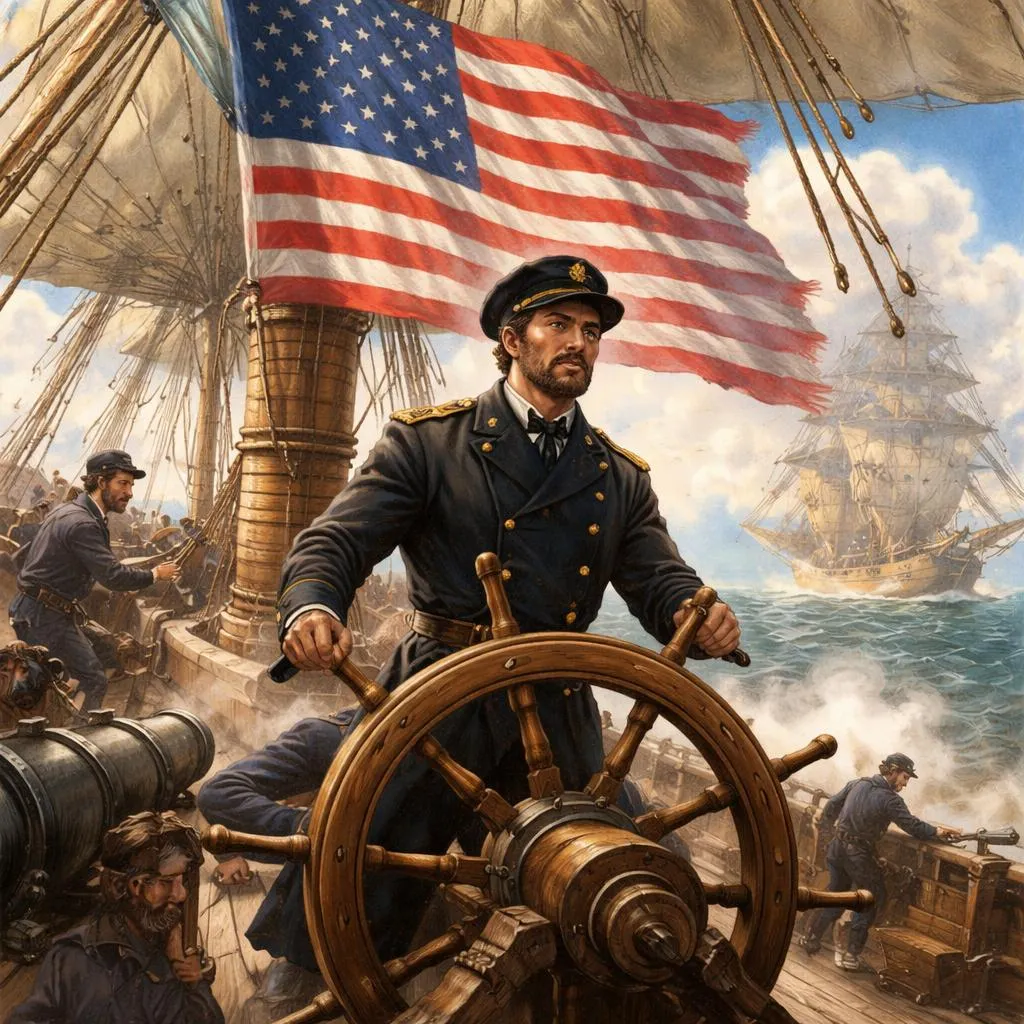

Weeks and his companions divided up as they had been ordered to do in coming to the fort, and departed in different directions. The lieutenant pointed out to them the locality of the bivouac where he had passed so much of the evening, so that they might avoid it. It was about one o’clock in the morning when they left, and Christy calculated that they would reach the ship in an hour and a half, which would give the commander ample time to get up steam from the banked fires, and move down four or five miles to the southward of his present position.
The chief of the expedition had sent no message to the captain of the Bellevite in regard to his own movements, but simply that he would report to him later. He had already grasped an idea, though he had had no time to work it up in detail. It looked practicable to him, and he had jumped to a conclusion as soon as he was in possession of the facts covering the situation in the vicinity of Fort Morgan.
With only a plan not yet matured in his mind, perhaps he had been more rash than usual in sending away the whaleboat before he had provided for his own retreat from the enemy’s territory; but he had considered this difficulty, and had come to the conclusion that the Trafalgar must be captured if possible, even if he and his associates were sent to a Confederate prison.
But he did not anticipate any such result. He had three pairs of the seamen left; and the party still consisted of eight men, all well armed. If the plan he had considered should fail, he had force enough to carry a light boat from Pilot Town, or any other point on the inner shore, in which they could make their escape to the Bellevite or some other blockader. He did not feel, therefore, that he had “burned his bridges,” and left open no means of retreat in case of disaster.
Christy and Graines were left alone in the darkness and the fog, a bank of which was just then sweeping over the point; but they could hear the violent talk of Captain Sullendine in the distance, as he declaimed against the perfidy of his mate and the three seamen just at the point where he needed them most. Evidently he could not reconcile himself to the idea of being left behind by the Trafalgar, which seemed to be inevitable under present circumstances.
“The skipper of the West Wind seems to be in an ocean of trouble, and he is apparently resolved not to submit to the misfortune which has overtaken him,” said Christy, as he led the way towards the knot of men who were the auditors of the rebellious captain.
“He may jaw as much as he pleases, if it makes him feel any better, but I don’t see how he can help himself,” replied Graines. “The schooner looked like a rather large one when I got a sight of her just before I came back to you, which I did as soon as I saw the four men leave you.”
“I sent Weeks as a messenger to Captain Breaker, to inform him that the Trafalgar would sail at three in the morning,” added Christy.
“I concluded that was the mission upon which you sent him,” replied the engineer; and, whatever doubts the lieutenant’s action might have raised in his mind, he asked no questions.
Every man on board of the Bellevite was well acquainted with the record and reputation of the executive officer; and he concluded at once that Christy had already arranged his method of operations. It was not “in good form” to ask his superior any questions in regard to his intentions.
“Did you go down to the shore, Charley?” asked Christy, as they walked in that direction.
“I did not, but I went far enough to hear what the captain of the West Wind was talking about. I had no orders, and as soon as I saw the four men leave you, I thought I had better rejoin you,” answered Graines.
“Quite right,” said the lieutenant as he halted; for they were as near the group on the shore as it was prudent to go, for the fog was lifting. “What did the captain say?”
“He offered ten dollars apiece for the recovery of the men who had deserted, if they were brought back within two hours,” replied Graines. “He did an immense amount of heavy swearing; and it was plain that he was mad all the way through, from the crown of his head to the sole of his foot.”
“Was any one inclined to accept his offer, and go in search of the runaways?”
“I can’t say, but I saw no one leave on that or any other mission. I was there but a few minutes, and the fog dropped down on the party so that I could not see them at all.”
“We must join that assemblage, and we may be able to help Captain Sullendine out of his dilemma,” said Christy.
“Help him out of it!” exclaimed Graines.
“Not a word more, Charley. I have an idea or two left, but it is not prudent to say a word about it here,” replied the lieutenant cautiously. “You know the cut of my jib in my present rig, and I want you to keep an eye on me, for we must separate now. When you see me take off this old soft hat with my left hand, and scratch my head with my right, moving off a minute later, you will follow me. By that time I shall know what we are to do.”
“All right, Christy; I will follow the direction to the letter,” added Graines.
“While you go off to the left of that pile of rubbish yonder, I will go to the right of it. If you speak to any of our men, do so with the utmost caution.”
“They have been down there some time, and they have full information in regard to what is going on in this locality,” suggested Graines.
“Use your own judgment, Charley, only be careful not to give us away,” replied the lieutenant, as he moved towards the pile of rubbish.
A walk of a few minutes brought him to the group on the shore, which consisted of not more than a dozen persons, and half of them belonged to the Bellevite. Christy halted before he reached the assemblage, in order to listen to the eloquence of the captain of the West Wind. He talked very glibly; and it did not take his outside auditor long to perceive that he had been drinking somewhat freely, though he was not what non-temperance men would have called intoxicated.
“I use my men well, and give ‘em enough to eat and drink, and what’s good enough,” the nautical orator declaimed with a double-handed gesture. “Why, my friends, I gave each of the villains that deserted the schooner a bottle of apple-jack. I don’t drink it myself, but it is good enough for niggers and sailors; in fact, my men liked it better’n whiskey, because it’s stronger. They served me a mighty mean trick, and I’ll give ten dollars apiece to have ‘em fetched back to me. That’s a good chance for some on you to make some money tonight.”
His audience listened to him as they would have done to a preacher with whom they had no sympathy, and no one was tempted by the reward to go in search of the deserters. Christy moved up nearer to the speaker. In his disguise, with his face smooched with some of the color he had received as a present from Mr. Gilfleur, the French detective, with whom he had been associated on his cruise some months before, he did not appear at all different from most of those who listened to Captain Sullendine. He had laid aside his gentlemanly gait and bearing, and acted as though he had lately joined the “awkward squad.”
“How d’e?” called the orator to him, as he saw him join the group of listeners. “I see you come from the other side of the p’int.”
“Well, is that agin the laws o’ war?” demanded Christy.
“Not a bit on’t,” replied the captain pleasantly, as though his potations of whiskey were still in full effect upon him. “If you come from that way, have you seen anything of my four men that deserted the schooner?”
“I wasn’t lookin’ for ‘em; didn’t know ye’d lost some men,” replied Christy, staring with his mouth half open at the orator. “Was one on ‘em the mate?”
“Yes!” exclaimed the captain eagerly.
“Well, I hain’t seen nothin’ on em,” added Christy in a mumbling tone.
“I’ll bet you have!” protested the skipper of the West Wind. “How’d you know one on ‘em was the mate if you didn’t see ‘em?”
“I didn’t know one on ‘em was the mate; I only axed yer so’s ter know.”
“I reckon you know sunthin about my men,” persisted the captain; and by this time the attention of all the party had been directed to him.
“I don’t know nothin’ about yer men, and I hain’t been interduced to ‘em. If you want to ship a new crew, I’m ready to jine with yer.”
“One man ain’t enough,” added the skipper.
“Some o’ these men’ll jine too, I reckon,” suggested Christy, who had proceeded in this manner in order to attract the attention of the disconsolate master of the West Wind.
“I don’t reckon they can ship, ’cause most on ‘em belongs to the Tallahatchie, and they can’t leave.”
“That’s so,” shouted several of the group, including some of the crew of the Bellevite.
“What’s the Talla-what-you-call-her?” demanded Christy.
“She’s the steamer you can see when the fog lifts,” answered Captain Sullendine. “The Tallahatchie is her name. Are you a sailor, my lively lad?”
“I reckon I know the bobstay from the mainmast.”
“You know sumthin about my mate and men, my jolly tar, and I’ll give you five dollars apiece for any news on ‘em that will help me to ketch ‘em; and I’ll ship you into the bargain, for I want more hands,” the captain proceeded in a more business-like manner, though at the expense of his oratory.
Just at this moment three short and sharp whistles sounded from off the shore, and about half of the skipper’s audience turned upon their heels and walked down to the water, where they embarked in a boat. They were evidently members of the ship’s company of the Tallahatchie, on shore on leave, and the whistles were the signal for their return. The remainder of the group, with two or three exceptions, were the seamen of the blockader.
“Where’d you come from, my hearty?” demanded the captain of the schooner, turning to Christy again.
“I was tooken in a blockader, eight on us. We done stole a whaleboat and comed ashore,” replied Christy, enlarging upon the story he had told the bivouackers.
“Eight on you!” exclaimed the master of the schooner. “Where’s the rest on ye?”
“They’re all about here somewhar, and I reckon I kin find em. They’re lookin for sunthin t’eat. They all want to ship, and the mate of the Rattler’s one on ‘em,” continued Christy, guiding himself by the circumstances as they were developed to him.
“What’s your name, my man?”
“My name’s Jerry Sandman; and I ain’t ashamed on’t.”
“Are your men all sailors, Jerry?”
“Every one on ‘em.”
“I want eight good men, Jerry, the mate bein’ one on ‘em.”
“Then we kin fix you like a ’possum in a hole.”
“I’ve got two boats on the shore; the deserters stole one on ‘em, and I come ashore in t’other arter ‘em. I reckon I’ll get a steamer in Nassau, and I want all the good men I can find to man her. I’ll ship the whole on you. Find your men, Jerry, and fetch ‘em down to the boats. I’ll give ‘em all sumthin t’eat. Now be lively about it,” said Captain Sullendine, as he walked away towards the shore.
“I’ll find ‘em in no time,” replied Christy, as he removed his soft hat with his left hand, and scratched his head with the other.
The rest of the party scattered, and Graines joined the lieutenant.
“THE canoes are gone!” cried Worth. “It looks like it,” replied Sumner, in an equally dismayed tone.
“Are you sure this is where we left them?” “Yes; sure. There is the stern line that we made fast to the Cupid or what is left of it.”
Sure enough, there was a portion of the light line still fast to the tree, and as Sumner pulled it in, both boys bent over to examine it. It had been broken, and not cut. From its length it must also have been broken close to the canoe.
“Oh, Sumner, what shall we do?” asked Worth, in a tone of such despair that the former at once realized the necessity of some immediate action to divert his comrade’s thoughts.
“Do?” he cried. “There’s plenty to do. First, we’ll go down to that point and take a look to seaward; for, as the tide is running out, they are more likely to have gone in that direction than any other. It would be a comfort even to catch a glimpse of them. Then, perhaps, they have only drifted away, and are stranded on some bar near by. Besides looking for the canoes, we must build some kind of a shelter for the night, cook supper, and discuss our plans for the future. Oh yes, we’ve plenty to do!” While he spoke, the boys were making their way to the point in question, and when they reached it, they eagerly scanned every foot of water in sight. Diagonally to the right from where they stood stretched the long reach of Lower Metacumba, desolate and uninhabited as they knew. Almost directly in front, but several miles away, rose the palm-crowned rocks of Indian Key, with its two or three old shedlike buildings in plain view. These had been used and abandoned years before by the builders of Alligator Light, the slender tower of which they could see rising from the distant waters above the outer reef. Diagonally on the left was the tiny green form of Tea Table Key, and dimly beyond it they could make out the coast of Upper Metacumba, which Sumner said was inhabited. In all this far-reaching view, however, there were no signs of the missing canoes.
“I’m glad of it!” said Sumner, after his long searching gaze had failed to reveal them. “It would be rough to have them in sight but out of reach.”
Already the sun was sinking behind the treetops of Lower Metacumba, fish were leaping in the placid waters, and a few pelican were soaring with steady poise above them. Every now and then these would swoop swiftly down, with a heavy splash that generally sealed the fate of one or more mullet off which the great birds were making their evening meal. A flock of black cormorants, uttering harsh cries, flew overhead with a rushing sound, returning from a day’s fishing to their roosts in the distant Everglades. With these exceptions, and the faint boom of the surf on the outer reef, all was silence and desertion. Besides the lighthouse tower there was no sign of human life, not even the distant glimmer of a sail. While the boys still looked longingly for some trace of their canoes, the sun set, and a red flash, followed at short intervals by two white ones, shot out from the vanishing form of Alligator Light.
“Come!” cried Sumner, heedful of this warning. “Night is almost here, and we have too much to do in every precious minute of twilight to be standing idle. I’ll take the bucket and run to the pond for water, while you cut all the palmetto leaves you possibly can, and carry them to the place where we landed.”
“The bucket?” repeated Worth, looming about him inquiringly. “Where are you going to find it?” Without answering, Sumner sprang down the rocks to the water’s edge, where he had noticed a stranded bamboo, and quickly cut out a short section of it with the hatchet that he had thrust into his belt before leaving the canoes. As he made the cuts just below two of the joints, his section was a hollow cylinder, open at one end, but having a tight bottom and capable of holding several quarts of water. With this he plunged into the forest in the direction of the pond, handing Worth the hatchet as he passed, and bidding him be spry with his palmetto leaves.
A few minutes later, as Sumner emerged from the trees, carrying his full water bucket, and breathless with his haste, he indistinctly saw the form of some animal at the very place where they had left their guns and birds. As the boy dashed forward, uttering a loud cry, the alarmed animal scuttled off into the bushes.
“Oh, you villain!” gasped Sumner as he reached the place, “I’ll settle with you tomorrow, see if I don’t.
Four of the doves had disappeared, and the head was torn from one of the ducks.
“What is it?” cried Worth, in alarm, as he entered the clearing from the opposite side, staggering beneath an immense load of cabbage palm leaves.
“A rascally thieving ’coon,” answered Sumner, “and he has got away with the best part of our provisions, too; but I’ll get even with him yet. Now give me the hatchet, and then pick up all the driftwood you can find, while I build a house.”
Worth would gladly have helped erect the house, as Sumner called it, for he was very curious as to what sort of a structure could be built of leaves, but he realized the necessity of doing as he was bidden, and at once set to work gathering wood. Sumner, after carefully propping his water bucket between two rocks, so as to insure the safety of its contents, began cutting a number of slender saplings, and turning them into poles. The stoutest of these he bound with withes to two trees that stood about six feet apart. He fastened it to their trunks as high as he could reach. Then he bound one end of the longer poles to it, allowing them to slant to the ground behind. Crosswise of these, and about a foot apart, he tied a number of still more slender poles, and over these laid the broad leaves. He would have tied these securely in place if he had had time. As he had not, for it was quite dark before he finished even this rude shelter, he was forced to leave them so, and hope that a wind would not arise during the night. For himself alone he would not have built any shelter, but would have found a comfortable resting place under a tree. Knowing, however, that Worth had never in his life slept without a roof of some kind above him, he thought it best to provide one, and thereby relieve their situation of a portion of the terror with which the city-bred boy was inclined to regard it.
It was curious and interesting to note how a sense of responsibility, and the care of one younger and much more helpless than himself, was developing Sumner’s character. Already the selfishness to which he was inclined had very nearly disappeared, while almost every thought was for the comfort and happiness of his companion. Worth, accustomed to being cared for and having every wish gratified, hardly appreciated this as yet; but the emergencies of their situation were teaching him valuable lessons of prompt obedience and self reliance that he could have gained in no other way.
As Sumner finished his rude lean-to, and placed the guns within its shelter for protection from the heavy night dews, Worth Came up from the beach with his last load of driftwood. It was now completely dark, and the notes of chuckwills-widows were mingling with the “whoo, whoo, whoo ah-h!” of a great hoot owl in the forest behind them.
“’Now for a fire and some supper,” cried Sumner, cheerily. You’ve got some matches, haven’t you?” “I don’t believe I have,” replied Worth, anxiously feeling in his pockets. I thought you must have some.”
“No, I haven’t a sign of one!” exclaimed Sumner, and an accent of hopelessness was for the first time allowed to enter his voice. “They are all aboard the canoes, and without a fire we are in a pretty pickle sure enough. I wonder how hungry we’ll get before we make up our minds to eat raw duck This is worse than losing the canoes. I declare I don’t know what to do.”
“Couldn’t we somehow make a fire with a gun? Seems to me I have read of something of that kind,” suggested Worth.
“Of course we can!” shouted Sumner, springing to his feet. “What a gump I was not to think of it! If we collect a lot of dry stuff and shoot into it, there is bound to be a spark or two that we can capture and coax into a flame.”
So, with infinite pains, they felt around in the dark until they had collected a considerable pile of dry leaves, sticks, and other rubbish that they imagined would easily take fire. Then, throwing a loaded shell into a barrel of his gun, and placing the muzzle close to the collected kindlings, Sumner pulled the trigger. There was a blinding flash, a loud report that rolled far and wide through the heavy night air, and the heap of rubbish was blown into space. Not a leaf remained to show where it had been, and not the faintest spark relieved the darkness that instantly shut in more dense than ever.
“One cartridge spent in buying experience,” remarked Sumner, as soon as he discovered the attempt to be a failure. “Now we’ll try another. If you will kindly collect another pile of kindling, I’ll prepare some fireworks on a different plan.”
Thus saying, he spread his handkerchief on the ground, cut off the crimping of another shell with his pocket knife, carefully extracted the shot and half the powder, and confined the remainder in the bottom of the shell with one of the wads. Then he moistened the powder that he had taken out, and rubbed it thoroughly into the handkerchief, which he placed in the second pile of sticks and leaves that Worth had by this time gathered. A shot taken at this with the lightly charged blank cartridge produced the desired effect. Five minutes later the cheerful blaze of a crackling fire illumined the scene, and banished a cloud of anxiety from the minds of the young castaways.
背景與作者介紹
這段摘錄來自一個經典的冒險故事,它讓讀者沉浸在年輕主角們面對危險、不確定性和生存挑戰的驚險經歷中。這類故事通常起源於19世紀末或20世紀初,當時冒險小說深受渴望了解勇氣和探索故事的年輕讀者歡迎。作者與他的許多同時代人一樣,旨在通過描繪在艱難情況下表現出勇氣、足智多謀和忠誠的角色來激勵年輕人。
敘事背景設定在一個緊張時期,可能反映了涉及封鎖和海軍衝突的歷史事件,為人物的勇敢事蹟提供了豐富的背景。故事的風格結合了生動的描述和懸疑的對話,使其對年輕讀者具有吸引力,同時也提供了關於策略和團隊合作的經驗教訓。
詳細闡釋與意義
從本質上講,這個故事探討了勇氣、領導力和友誼的主題。以克里斯蒂中尉為首的角色們,在穿越敵對領土和不確定條件時,展現了決心和快速的思維。他們在壓力下計劃、適應和互相支持的能力,突出了團隊合作和信任的重要性。
與薩倫丁船長的互動揭示了忠誠和權威的複雜性,展示了領導力如何受到挑戰,以及個人有時必須使用狡猾來實現其目標。同時,薩姆納和沃思的生存場景強調了自力更生和創造力,因為男孩們在資源有限的情況下建造住所、尋找水源和生火。
這個敘事鼓勵讀者批判性地思考解決問題和韌性。它也微妙地呈現了戰爭或衝突期間面臨的道德困境,例如逃兵的風險和在脅迫下做出的決定的後果。
給學生的經驗教訓和見解
-
勇氣和主動性: 角色們沒有被動地等待救援或簡單的解決方案。相反,他們採取了大胆的步驟,表明勇氣通常涉及面對恐懼並果斷行動。
-
團隊合作和溝通: 他們任務的成功取決於清晰的溝通和合作。學生可以學習共同工作、分享信息和支持同伴的價值。
-
適應性: 在情況發生變化時調整計劃的能力至關重要。這個故事教導說,靈活性和創造性思維是學校和生活中都至關重要的技能。
-
責任感和領導力: 薩姆納對沃思日益增長的責任感表明,關心他人如何幫助培養領導素質。學生可以反思承擔責任如何建立性格和信任。
-
解決問題的技能: 男孩們創造住所和生火的創造性方式鼓勵學生在面對挑戰時富有創造性地思考並堅持不懈。
在日常生活中應用故事的價值觀
-
在學習中: 學生可以通過以勇氣和毅力擁抱學習中的挑戰來應用故事的經驗教訓,不怕犯錯,而是從錯誤中學習。
-
在社交場合: 故事中展現的團隊合作和同情心的重要性可以激勵學生成為支持性的朋友和有效的合作者。
-
在個人成長中: 培養適應性和責任感,就像角色們所做的那樣,可以幫助年輕人成長為成熟、可靠的個體。
-
在面對逆境時: 故事鼓勵韌性——當事情出錯時,保持冷靜、富有創造性地思考並繼續嘗試非常重要。
從故事中培養積極的特質
-
勇敢: 鼓勵學生走出舒適區,無論是在公開演講、嘗試新活動還是堅持正確的事情。
-
領導力: 為學生提供在小組項目或社區活動中採取主動性的機會,培養責任感。
-
足智多謀: 挑戰學生找到解決問題的創新方案,明智地利用可用資源。
-
同情心和支持: 教導學生關心他人,就像薩姆納關心沃思一樣,建立牢固、關懷的關係。
這個故事充滿了冒險和道德教訓,提供的遠不止娛樂。它是年輕讀者培養重要生活技能和價值觀的指南,這些技能和價值觀將在學校、友誼和更廣闊的世界中為他們提供幫助。通過反思角色們的經歷和選擇,學生可以學會以勇氣、智慧和善良來應對自己的挑戰。
