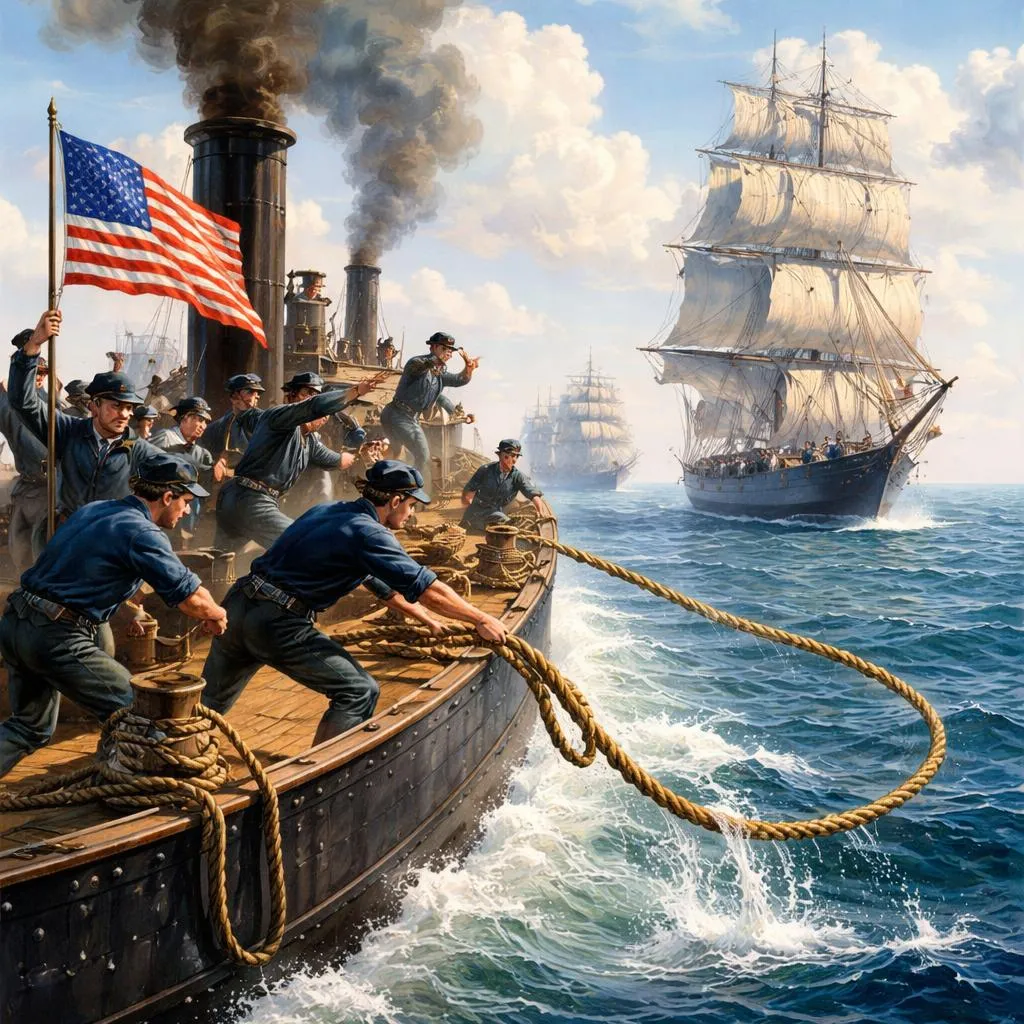

Christy Passford had been through this channel at least half a dozen times in the Bellevite, and knew all the courses and bearings, though the latter did not count in the dense fog which had settled down on the vicinity of the fort. The lights in the binnacle of the West Wind had not been put out, though they could not be noticed outside of the schooner. The great fortress could not be seen, and it was as silent as a tomb.
“How does she head, Christy?” asked Graines, as they met at the wheel.
“South a quarter west,” replied the lieutenant, “which is the correct course. The fog is very dense just now. I think we have passed the obstructions by this time, though I do not know precisely where they are placed.”
“I should call it mighty ticklish navigation just here,” added the engineer.
“It is all of that, or will be in five or ten minutes more. Sand Island Lighthouse is not more than a quarter of a mile from the middle of the channel, and at that point the course changes. Perhaps the pilot can make out the lighthouse in the fog. If he don’t he will run into five or six feet of water in a few minutes, out of eight fathoms or more.”
“I suppose you are prepared to let go the towline if anything goes wrong, Mr. Passford?” added the engineer, perhaps as a suggestion rather than as a question.
“I hope it will not come to that, for the schooner might get aground on the Knoll before we could make sail,” replied Christy.
“The steamer has shifted her helm,” said Graines, to the great relief of the lieutenant. “The fog is lifting again, and the pilot must have seen the lighthouse. We are headed more to the eastward now.”
“The course is south by west, three-quarters west, when the lighthouse bears west by south. We are out of the woods now, and there will be no trouble at all till some blockader stirs up the waters,” said Christy.
“I wonder where the Bellevite is just now,” added Graines, as he looked all about him as the fog lifted a little more, though it was still too thick to make out any vessel, if there were any near.
“If my messenger reached the ship in time, she will be found somewhere near the channel,” replied Christy. “Call Lines, if you please, Mr. Graines.”
The seaman presently appeared; and the lieutenant directed him to take the wheel, French instructing him how to keep the vessel in line with the steamer.
“I believe you have sailed a schooner, French,” said Christy, when he had taken the man to the quarter.
“Yes, sir; I was mate of a coaster for three years, and I should have become master of her if the war had not come, and I felt that I ought to go into the navy, though I haven’t got ahead much yet, as I expected I should; but I am satisfied to fight for my country where I am.”
“That is patriotic; and I hope a higher position will be found for you. But we have not time to talk about that now,” continued Christy. “It may be necessary or advisable for Mr. Graines and myself to leave the West Wind at any moment now. In that case I shall place this vessel in your charge, and you will take her off where the Bellevite was moored last night, and come to anchor.”
“Thank you, sir; and I will endeavor to do my duty faithfully,” replied French, touching his cap.
“Now call the men aft, and I will explain the matter to them.”
The lieutenant explained the situation, and directed the other five seamen to respect and obey the man he had selected as captain. Then he directed French to cast off the stops from the foresail and mainsail, and have the jib and flying-jib ready to set at a moment’s notice.
“I don’t think Captain Sullendine can get out of his stateroom, where he has been confined, or Bokes out of the deck-house; but if either of them should do so, you must secure them as you think best,” continued Christy. “Do you fully understand your orders, French?”
“Perfectly, Mr. Passford; and I will do my duty as well as I know how,” answered the able seaman, who, like many others in the service, deserved a better position.
The new officer and crew went to work on the sails, and in a few minutes they were ready to be set. Another bank of fog was rolling up, in which the two vessels would soon be involved. But the Tallahatchie was in a position where it was plain sailing now, and her future troubles would all come from the blockaders.
“There you are!” exclaimed the engineer, as the peal of a gun boomed over the water from the westward. “The steamer has been seen by a blockader, and she will catch it now.”
“I don’t believe that was one of the Bellevite’s guns,” added Christy. “Captain Breaker would not take a position over to the westward, for that would give him the outside track, and he always goes at anything by the shortest way.”
“We have the fog again for the next ten or fifteen minutes. The blockader that fired that shot must have got a sight at the steamer, and she is still pegging away at her. We may get knocked over by our own guns,” continued Graines.
“There is no danger at present. She can’t hit anything in this fog except by a chance shot.”
“And one of them sometimes does the most mischief. The fog is heavier just now than it has been at any time during the night. I can’t see the Tallahatchie just now.”
“It is blacker than a stack of blackbirds,” added Christy. “I am confident that we are at least a mile south of the lighthouse, and we will take advantage of the gloom to hoist the mainsail, and then the foresail if it holds as it is now;” and he gave the order to French, who was assisted by the engineer in the work.
The lieutenant took the wheel, and sent Lines to assist the others. The blockader to the westward continued to discharge her guns; but her people could see nothing, and her solid shot began to fall astern of the West Wind, and the Tallahatchie took no notice of her or her guns. Christy saw that the fog was lifting again, and this would reveal to the steamer ahead what he had been doing. Besides, he had gone in tow as long as he intended. Graines reported the two sails as set.
“Stand by to hoist the jib!” he shouted, deeming it no longer necessary to conceal his movements.
“What are you doing there?” demanded the officer, who seemed to be in charge of the after part of the steamer; and his tones, with the flood of profanity he poured out, indicated that he was in a violent fit of anger.
“I reckon we won’t tow any farther,” replied Christy, who was still at the wheel, and the officer yelled loud enough for him to hear at the helm; but French repeated his answer.
“All ready to hoist the jib,” Graines reported.
“Cast off the towline!” shouted Christy at the top of his lungs. “Hoist the jib!”
“Towline all clear!” called the engineer a moment later, and the jib went up in a hurry.
The jib filled on the starboard tack, and the West Wind went off to the south-east as Christy put up the helm. The fog lifted just enough to enable the officer at the stern of the steamer to see the West Wind as she went off on her new course. No one on the former could have suspected that the latter had changed hands; for French had answered for Captain Sullendine every time a call was made, and his voice was not unlike that of the master of the schooner.
Christy could not understand why the officer who used so many expletives should be dissatisfied, for the Tallahatchie could certainly make better time when no longer encumbered by the towing of the West Wind. But it must look to him just as though the schooner would be captured by the steamer to the westward, which had been uselessly firing at the blockade-runners in the densest of the fog. He could not help seeing that the vessel in tow had set her sails, and therefore the casting off of the wire rope could not have been caused by an accident.
The action of the captain of the schooner, for they had no reason to suppose the change on board of the schooner was not made by him, must have bewildered the officers of the Tallahatchie. But the fog was lifting, the steamer to windward was now under way, though moving very slowly, and her solid shot fell very near to the Confederate vessel.
By this time the sails of the West Wind were all drawing full, and the craft was making very good headway through the water. The fog bank had scattered, and appeared now to be in a dozen smaller masses, floating off in the direction of Mobile Point. Christy still retained the wheel, while Graines was putting everything in order forward and in the waist, after setting the sails.
“Send French aft to take the wheel, Mr. Graines,” called Christy, as the engineer came aft to see the main sheet.
This man, who was the captain of the forecastle, one of the most important and best-paid of the petty officers, hastened aft to relieve the chief of the expedition, who went to work with his own hands when the exigency of the service required.
“Make the course south-west, French,” said Christy, as he abandoned the wheel to the petty officer.
“South-west, sir,” repeated the seaman.
“Can you make out the Bellevite, Mr. Graines?” asked he, as he met the engineer on the quarterdeck.
“I have kept a sharp lookout for her, Mr. Passford, but I have not seen her yet,” replied Graines, as he looked earnestly in the direction in which the schooner was headed.
“If Captain Breaker received my message sent by Weeks, the ship must have taken a position somewhere below the entrance to the channel, and that is about four miles south of the fort, and out of the reach of any of its guns,” added the lieutenant.
“There are half a dozen of those fog banks floating about near the water in that direction, and she may be there,’ replied Graines, as he took a spy-glass from the brackets in the companion. “Very likely she is down that way somewhere, and the Tallahatchie may run right into her.”
“I don’t think Captain Breaker would place his ship where anything of this kind would be likely to happen,” replied Christy. “It is still as dark as Egypt ahead, and I think we shall see the Bellevite very soon.”
The Confederate steamer had sensibly increased her speed, and gave no attention whatever to the schooner or the blockader to the westward of her. Captain Rombold seemed to be possessed of a supreme confidence in the speed of his steamer, and a complete assurance that he should escape unscathed from all pursuers, if any attempted to follow him. He was not aware that the Bellevite had recently had her bottom cleaned, and her engine put in thoroughly good condition, so that she could make as many knots in an hour as ever before; and that was saying more than could be said of any other craft in the navy.
“I would give my month’s pay to know what the Tallahatchie has for a midship gun,” said Christy, still gazing at the Confederate vessel as she continued to increase her speed.
Suddenly, without saying anything, Graines, who had been at his side, left him, and hastened to the companion, where he stooped down and gazed into the cabin. Christy had heard nothing to attract his attention, but he concluded that Captain Sullendine had escaped from his prison, and he called the two men who had been stationed in the waist to the quarter-deck to render such assistance as the engineer might need; but this officer remained at the entrance to the cabin, and made no further movement.
背景介紹與作者介紹
這段文字出自一部經典的海上冒險故事,背景設定在海軍衝突時期,考慮到提到了南方邦聯的船隻和封鎖者,很可能是在美國內戰時期。作者在19世紀寫作,以其對航海細節的描述和驚險的海上敘事而聞名,這些故事捕捉了海戰和航海的緊張和戲劇性。這類故事因其冒險、策略和英雄主義的結合而受到年輕讀者和成年人的歡迎。
詳細故事分析與意義
故事講述了克里斯蒂·帕斯福德中尉和他的船員穿越濃霧籠罩的危險海峽,面臨敵方封鎖者的威脅。敘事充滿了航海術語和戰術,強調了在危險情況下操縱船隻所需的技能和勇氣。隨著霧氣遮蔽視線,敵人的炮火盲目開火,船員們必須依靠他們的知識、團隊合作和快速思考來生存,緊張氣氛不斷加劇。
這段文字闡釋了領導力、責任感和愛國主義的主題。克里斯蒂沉著的指揮和對船員的信任,特別是將控制權交給法國人,突出了授權和對他人的信心的重要性。霧象徵著不確定性和危險,但船員的決心和準備使他們能夠成功穿越。
給學生的教訓和見解
-
領導力和團隊合作: 克里斯蒂的領導力表明,一個好的領導者必須信任並授權他們的團隊。法國人隨時準備接管的態度反映了責任感和準備的重要性。學生們可以學到,成功往往取決於與他人合作良好並信任隊友。
-
在壓力下的勇氣: 在濃霧和敵人的炮火中航行需要勇氣和鎮定。這教導學生在生活中面臨挑戰時保持鎮定和專注的重要性,無論是在學校、社交場合還是個人困難中。
-
愛國主義和責任: 法國人願意為他的國家服務,儘管遭遇挫折,這表明了奉獻和犧牲。學生們可以反思為他們的社區做出貢獻並捍衛他們的信仰的價值。
-
適應性和解決問題的能力: 船員們迅速決定改變航向、揚帆起航並為緊急情況做好準備,這表明適應性至關重要。這鼓勵學生在情況意外變化時保持靈活並進行批判性思考。
在日常生活中的應用
-
在學習中: 就像船員們準備揚帆起航並調整航向一樣,學生們應該為考試做好準備,並在需要時調整學習策略。積極主動並準備好面對困難有助於實現目標。
-
在社交場合中: 像克里斯蒂和他的船員一樣,信任朋友並一起工作可以更有效地解決問題。可以通過鼓勵和支持同伴來展現領導力。
-
在個人成長中: 勇敢地面對恐懼和不確定性可以建立韌性。學生們可以練習在壓力或焦慮時保持鎮定並清晰思考。
從故事中培養積極的價值觀
- 責任感: 像法國人一樣負責任務,有助於建立自信和可靠性。
- 尊重: 船員們互相尊重他們的領導者和彼此,表明相互尊重如何創造一個強大的團隊。
- 耐心和毅力: 在濃霧和危險中航行需要耐心——學生們可以學會在克服障礙時堅持不懈。
- 戰略思維: 了解環境並相應地規劃是在學術和生活決策中的一項寶貴技能。
通過學習這樣的故事,學生們不僅可以享受令人興奮的冒險,還可以深入了解性格發展和為他們應對現實世界挑戰做好準備的實用技能。
