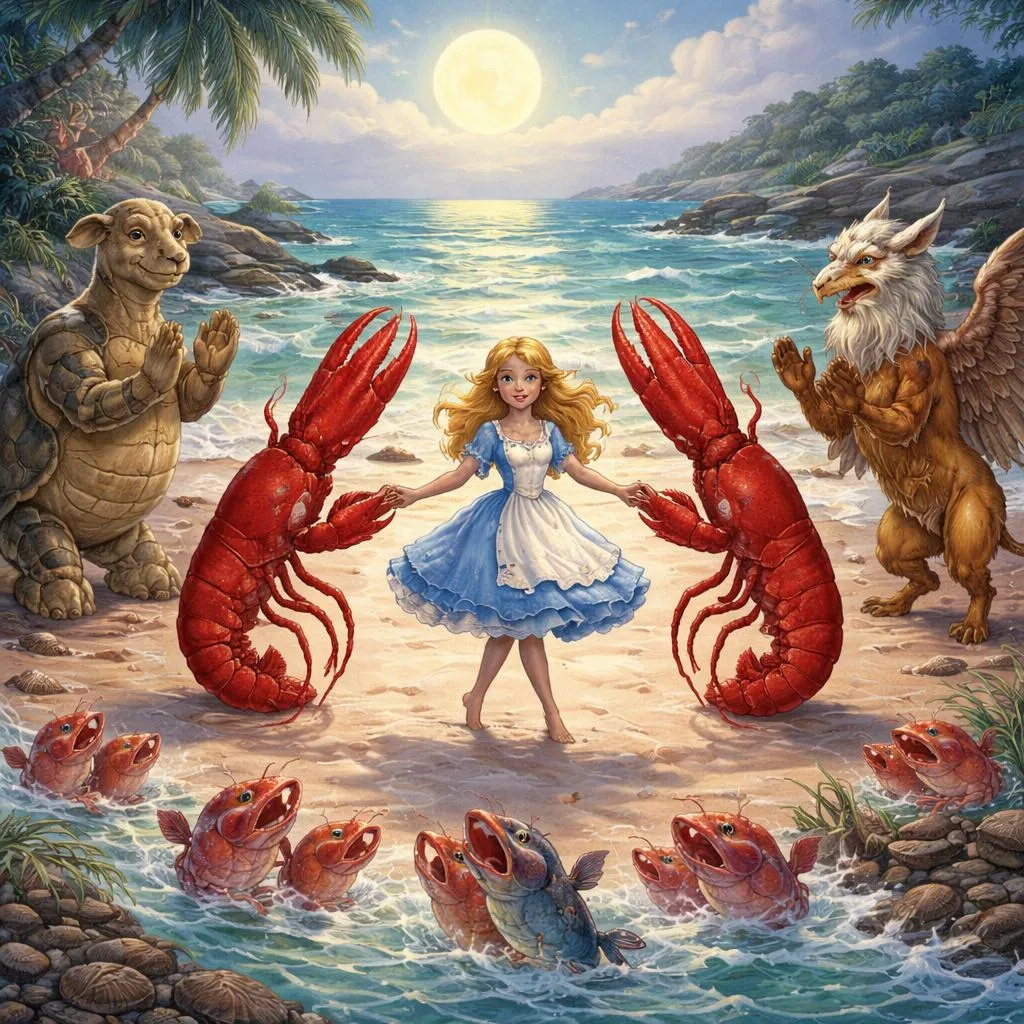

The Mock Turtle sighed deeply, and drew the back of one flapper across his eyes. He looked at Alice, and tried to speak, but for a minute or two sobs choked his voice. 'Same as if he had a bone in his throat,' said the Gryphon: and it set to work shaking him and punching him in the back. At last the Mock Turtle recovered his voice, and, with tears running down his cheeks, he went on again:—
'You may not have lived much under the sea—' ('I haven't,' said Alice)—'and perhaps you were never even introduced to a lobster—' (Alice began to say 'I once tasted—' but checked herself hastily, and said 'No, never') '—so you can have no idea what a delightful thing a Lobster Quadrille is!'
'No, indeed,' said Alice. 'What sort of a dance is it?'
'Why,' said the Gryphon, 'you first form into a line along the sea–shore—'
'Two lines!' cried the Mock Turtle. 'Seals, turtles, salmon, and so on; then, when you've cleared all the jelly–fish out of the way—'
'THAT generally takes some time,' interrupted the Gryphon.
'—you advance twice—'
'Each with a lobster as a partner!' cried the Gryphon.
'Of course,' the Mock Turtle said: 'advance twice, set to partners—'
'—change lobsters, and retire in same order,' continued the Gryphon.
'Then, you know,' the Mock Turtle went on, 'you throw the—'
'The lobsters!' shouted the Gryphon, with a bound into the air.
'—as far out to sea as you can—'
'Swim after them!' screamed the Gryphon.
'Turn a somersault in the sea!' cried the Mock Turtle, capering wildly about.
'Change lobsters again!' yelled the Gryphon at the top of its voice.
'Back to land again, and that's all the first figure,' said the Mock Turtle, suddenly dropping his voice; and the two creatures, who had been jumping about like mad things all this time, sat down again very sadly and quietly, and looked at Alice.
'It must be a very pretty dance,' said Alice timidly.
'Would you like to see a little of it?' said the Mock Turtle.
'Very much indeed,' said Alice.
'Come, let's try the first figure!' said the Mock Turtle to the Gryphon. 'We can do without lobsters, you know. Which shall sing?'
'Oh, YOU sing,' said the Gryphon. 'I've forgotten the words.'
So they began solemnly dancing round and round Alice, every now and then treading on her toes when they passed too close, and waving their forepaws to mark the time, while the Mock Turtle sang this, very slowly and sadly:—
'"Will you walk a little faster?" said a whiting to a snail. "There's a porpoise close behind us, and he's treading on my tail.
See how eagerly the lobsters and the turtles all advance! They are waiting on the shingle—will you come and join the dance?
Will you, won't you, will you, won't you, will you join the dance? Will you, won't you, will you, won't you, won't you join the dance?
"You can really have no notion how delightful it will be When they take us up and throw us, with the lobsters, out to sea!" But the snail replied "Too far, too far!" and gave a look askance— Said he thanked the whiting kindly, but he would not join the dance.
Would not, could not, would not, could not, would not join the dance. Would not, could not, would not, could not, could not join the dance.
'"What matters it how far we go?" his scaly friend replied. "There is another shore, you know, upon the other side. The further off from England the nearer is to France— Then turn not pale, beloved snail, but come and join the dance.
Will you, won't you, will you, won't you, will you join the dance? Will you, won't you, will you, won't you, won't you join the dance?"'
'Thank you, it's a very interesting dance to watch,' said Alice, feeling very glad that it was over at last: 'and I do so like that curious song about the whiting!'
'Oh, as to the whiting,' said the Mock Turtle, 'they—you've seen them, of course?'
'Yes,' said Alice, 'I've often seen them at dinn—' she checked herself hastily.
'I don't know where Dinn may be,' said the Mock Turtle, 'but if you've seen them so often, of course you know what they're like.'
'I believe so,' Alice replied thoughtfully. 'They have their tails in their mouths—and they're all over crumbs.'
'You're wrong about the crumbs,' said the Mock Turtle: 'crumbs would all wash off in the sea. But they HAVE their tails in their mouths; and the reason is—' here the Mock Turtle yawned and shut his eyes.—'Tell her about the reason and all that,' he said to the Gryphon.
'The reason is,' said the Gryphon, 'that they WOULD go with the lobsters to the dance. So they got thrown out to sea. So they had to fall a long way. So they got their tails fast in their mouths. So they couldn't get them out again. That's all.'
'Thank you,' said Alice, 'it's very interesting. I never knew so much about a whiting before.'
'I can tell you more than that, if you like,' said the Gryphon. 'Do you know why it's called a whiting?'
'I never thought about it,' said Alice. 'Why?'
'IT DOES THE BOOTS AND SHOES.' the Gryphon replied very solemnly.
Alice was thoroughly puzzled. 'Does the boots and shoes!' she repeated in a wondering tone.
'Why, what are YOUR shoes done with?' said the Gryphon. 'I mean, what makes them so shiny?'
Alice looked down at them, and considered a little before she gave her answer. 'They're done with blacking, I believe.'
'Boots and shoes under the sea,' the Gryphon went on in a deep voice, 'are done with a whiting. Now you know.'
'And what are they made of?' Alice asked in a tone of great curiosity.
'Soles and eels, of course,' the Gryphon replied rather impatiently: 'any shrimp could have told you that.'
'If I'd been the whiting,' said Alice, whose thoughts were still running on the song, 'I'd have said to the porpoise, "Keep back, please: we don't want YOU with us!"'
'They were obliged to have him with them,' the Mock Turtle said: 'no wise fish would go anywhere without a porpoise.'
'Wouldn't it really?' said Alice in a tone of great surprise.
'Of course not,' said the Mock Turtle: 'why, if a fish came to ME, and told me he was going a journey, I should say "With what porpoise?"'
'Don't you mean "purpose"?' said Alice.
'I mean what I say,' the Mock Turtle replied in an offended tone. And the Gryphon added 'Come, let's hear some of YOUR adventures.'
'I could tell you my adventures—beginning from this morning,' said Alice a little timidly: 'but it's no use going back to yesterday, because I was a different person then.'
'Explain all that,' said the Mock Turtle.
'No, no! The adventures first,' said the Gryphon in an impatient tone: 'explanations take such a dreadful time.'
So Alice began telling them her adventures from the time when she first saw the White Rabbit. She was a little nervous about it just at first, the two creatures got so close to her, one on each side, and opened their eyes and mouths so VERY wide, but she gained courage as she went on. Her listeners were perfectly quiet till she got to the part about her repeating 'YOU ARE OLD, FATHER WILLIAM,' to the Caterpillar, and the words all coming different, and then the Mock Turtle drew a long breath, and said 'That's very curious.'
'It's all about as curious as it can be,' said the Gryphon.
'It all came different!' the Mock Turtle repeated thoughtfully. 'I should like to hear her try and repeat something now. Tell her to begin.' He looked at the Gryphon as if he thought it had some kind of authority over Alice.
'Stand up and repeat "'TIS THE VOICE OF THE SLUGGARD,"' said the Gryphon.
'How the creatures order one about, and make one repeat lessons!' thought Alice; 'I might as well be at school at once.' However, she got up, and began to repeat it, but her head was so full of the Lobster Quadrille, that she hardly knew what she was saying, and the words came very queer indeed:—
''Tis the voice of the Lobster; I heard him declare, "You have baked me too brown, I must sugar my hair." As a duck with its eyelids, so he with his nose Trims his belt and his buttons, and turns out his toes.'
[later editions continued as follows] When the sands are all dry, he is gay as a lark, And will talk in contemptuous tones of the Shark, But, when the tide rises and sharks are around, His voice has a timid and tremulous sound.
'That's different from what I used to say when I was a child,' said the Gryphon.
'Well, I never heard it before,' said the Mock Turtle; 'but it sounds uncommon nonsense.'
Alice said nothing; she had sat down with her face in her hands, wondering if anything would EVER happen in a natural way again.
'I should like to have it explained,' said the Mock Turtle.
'She can't explain it,' said the Gryphon hastily. 'Go on with the next verse.'
'But about his toes?' the Mock Turtle persisted. 'How COULD he turn them out with his nose, you know?'
'It's the first position in dancing.' Alice said; but was dreadfully puzzled by the whole thing, and longed to change the subject.
'Go on with the next verse,' the Gryphon repeated impatiently: 'it begins "I passed by his garden."'
Alice did not dare to disobey, though she felt sure it would all come wrong, and she went on in a trembling voice:—
'I passed by his garden, and marked, with one eye, How the Owl and the Panther were sharing a pie—'
[later editions continued as follows] The Panther took pie–crust, and gravy, and meat, While the Owl had the dish as its share of the treat. When the pie was all finished, the Owl, as a boon, Was kindly permitted to pocket the spoon: While the Panther received knife and fork with a growl, And concluded the banquet—]
'What IS the use of repeating all that stuff,' the Mock Turtle interrupted, 'if you don't explain it as you go on? It's by far the most confusing thing I ever heard!'
'Yes, I think you'd better leave off,' said the Gryphon: and Alice was only too glad to do so.
'Shall we try another figure of the Lobster Quadrille?' the Gryphon went on. 'Or would you like the Mock Turtle to sing you a song?'
'Oh, a song, please, if the Mock Turtle would be so kind,' Alice replied, so eagerly that the Gryphon said, in a rather offended tone, 'Hm! No accounting for tastes! Sing her "Turtle Soup," will you, old fellow?'
The Mock Turtle sighed deeply, and began, in a voice sometimes choked with sobs, to sing this:—
'Beautiful Soup, so rich and green, Waiting in a hot tureen! Who for such dainties would not stoop? Soup of the evening, beautiful Soup! Soup of the evening, beautiful Soup! Beau—ootiful Soo—oop! Beau—ootiful Soo—oop! Soo—oop of the e—e—evening, Beautiful, beautiful Soup! 'Beautiful Soup! Who cares for fish, Game, or any other dish? Who would not give all else for two Pennyworth only of beautiful Soup? Pennyworth only of beautiful Soup? Beau—ootiful Soo—oop! Beau—ootiful Soo—oop! Soo—oop of the e—e—evening, Beautiful, beauti—FUL SOUP!'
'Chorus again!' cried the Gryphon, and the Mock Turtle had just begun to repeat it, when a cry of 'The trial's beginning!' was heard in the distance.
'Come on!' cried the Gryphon, and, taking Alice by the hand, it hurried off, without waiting for the end of the song.
'What trial is it?' Alice panted as she ran; but the Gryphon only answered 'Come on!' and ran the faster, while more and more faintly came, carried on the breeze that followed them, the melancholy words:—
'Soo—oop of the e—e—evening, Beautiful, beautiful Soup!'
背景介紹與作者介紹
這段迷人的摘錄出自路易斯·卡羅爾於 1865 年撰寫的經典小說《愛麗絲夢遊仙境》。卡羅爾的真名是查爾斯·勒特威吉·道奇森,是一位英國數學家、邏輯學家和作家。他創作了這個充滿想像力的故事,旨在娛樂和挑戰兒童和成人的邏輯思維。故事講述了一個名叫愛麗絲的年輕女孩,她掉進兔子洞,進入了一個充滿奇異生物和荒誕冒險的異想世界。假海龜和獅鷲是愛麗絲遇到的眾多奇幻角色中的兩個,它們都為定義這部小說的荒誕和機智的豐富紋理做出了貢獻。
詳細闡釋和意義
在這段文字中,假海龜和獅鷲向愛麗絲介紹了龍蝦四對舞,這是一種由海洋生物表演的奇特舞蹈。舞蹈本身是對維多利亞時代英國流行的社交舞蹈的戲仿,充滿了荒誕的指令和幽默的意象。假海龜憂鬱的歌聲和獅鷲充滿活力的打斷突出了貫穿整個故事的奇思妙想和憂鬱的融合。
愛麗絲和這些生物之間的對話也展示了卡羅爾對文字遊戲和雙關語的熱愛,例如獅鷲解釋白魚「擦鞋」,這是一個關於魚的名字和擦鞋行為的雙關語。這些角色荒誕的解釋邀請讀者質疑邏輯和語言,鼓勵想像力的思考。
這個場景也反映了好奇心和學習的主題。愛麗絲渴望理解舞蹈和這些生物的故事,這反映了孩子天生就想探索世界並理解世界的願望,即使面對混亂或矛盾的資訊。
給學生的教訓和見解
-
想像力和創造力: 卡羅爾的故事鼓勵讀者擁抱想像力。龍蝦四對舞,以其愚蠢的舞步和奇怪的舞伴,提醒我們創造力可以打破規則,並且仍然令人愉快。學生可以學會跳出框框思考,並欣賞發明新想法的樂趣。
-
語言遊戲: 這段文字充滿了雙關語、韻律和有趣的語言。這可以激勵學生創造性地探索語言,提高他們的詞彙量,並理解單詞的含義和聲音。
-
擁抱好奇心: 愛麗絲的提問和願意傾聽,即使答案令人困惑,也教導了好奇心和開放心態在學習中的價值。
-
處理困惑: 故事表明,不必立即理解所有內容是可以的。愛麗絲困惑的反應鼓勵學生在學習新的或複雜的科目時保持耐心和毅力。
-
社交互動: 愛麗絲、假海龜和獅鷲之間的互動展示了不同的溝通方式——有些嚴肅,有些有趣。學生可以學習如何尊重地與他人互動,並享受將樂趣與學習相結合的對話。
在日常生活中應用這些教訓
-
在學校: 學生可以使用好奇心和創造力的精神,以熱情的方式學習文學、科學或藝術等科目。嘗試在語言中尋找幽默或模式可以使學習更愉快。
-
在社交場合: 像愛麗絲一樣,學生可以練習仔細傾聽和提問,以便更好地理解他人。他們還可以學會欣賞不同的個性和溝通方式。
-
在個人成長中: 故事鼓勵將困惑和錯誤視為學習的一部分。學生可以通過認識到並非一次性了解所有內容是自然的,並且是一個成長的機會來培養韌性。
從故事中培養積極的價值觀
-
開放的心態: 愛麗絲願意與奇怪的生物和想法互動,這教導了對多樣性和新體驗的接受。
-
學習的樂趣: 故事的幽默基調提醒學生,學習可以很有趣,而不仅仅是严肃或困难。
-
創造力和幽默: 卡羅爾對胡說八道和異想天開的使用表明,幽默和想像力是解決問題和表達自我的寶貴工具。
-
尊重他人: 儘管這些角色的行為很奇怪,但愛麗絲對他們很好,為尊重和耐心樹立了榜樣。
反思與欣賞
閱讀這段文字邀請學生反思故事的力量,將我們帶到新的世界並挑戰我們的思維。它鼓勵他們欣賞文學作品,不僅僅是為了它的情節,還為了它的語言、幽默和更深層次的訊息。參與《愛麗絲夢遊仙境》可以激發終生的好奇心、創造力和同情心——這些都是在學校和生活中取得成功的必備素質。
通過探索這個故事,學生可以學會用驚奇和可能的視角看待世界,理解有時最有意義的教訓來自最意想不到的地方。
