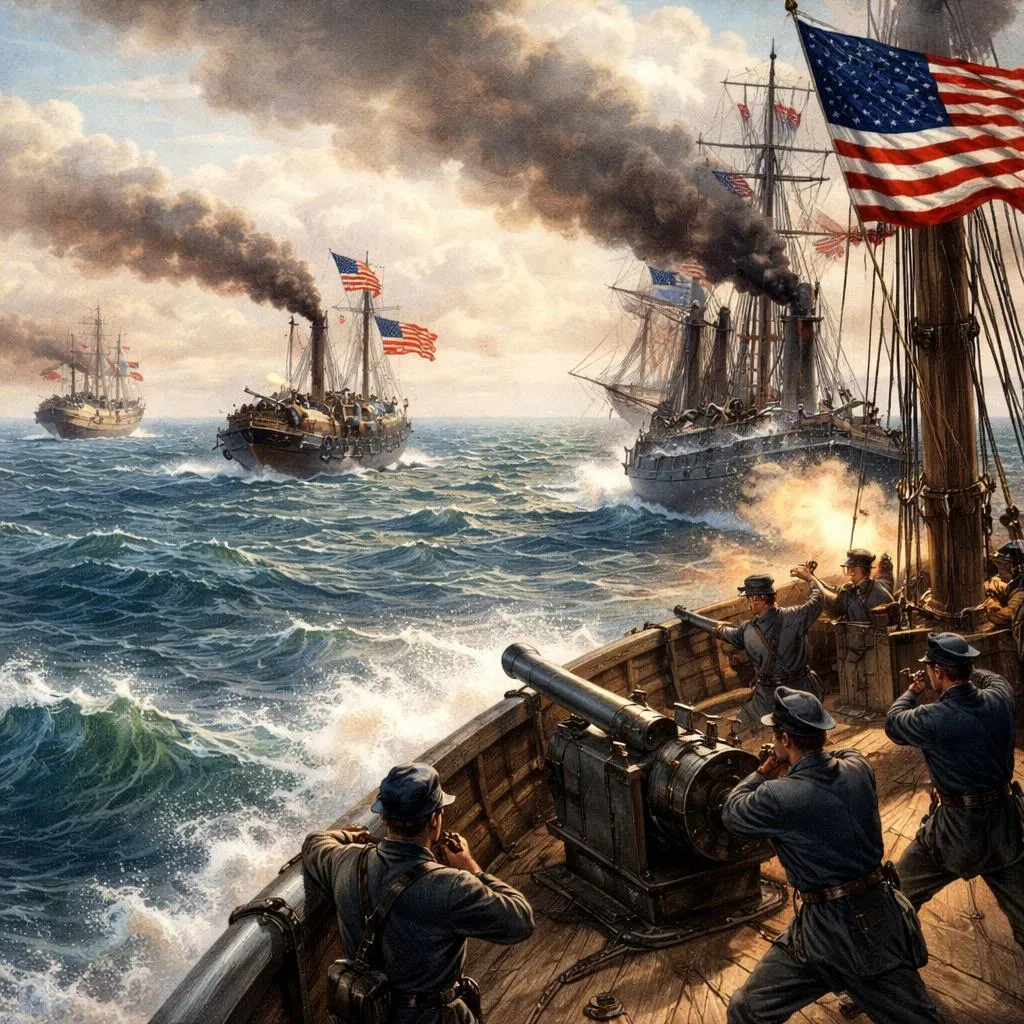

Captain Breaker had been in the main rigging with his night-glass, watching the movements of the chase; but he recognized the voice of Christy when he shouted to French to pick up the quarter-boat of the schooner, as he could no longer make out the Tallahatchie in the fog.
“Good-morning, Mr. Passford,” said he, as he met Christy when he descended from the rail. “I am glad to see you again.”
“Good-morning, Captain Breaker,” replied the lieutenant, as he took the offered hand of the commander. “I hope all is well on board, sir.”
“Entirely well, and your messenger came on board in good time, so that we were in position to get the first sight of the Trafalgar when she showed herself off Sand Island Lighthouse,” replied the captain, as he led the way to his cabin. “Mr. Ballard, keep a sharp lookout for the chase,” he added to the acting executive officer.
“Will you allow me to put on my uniform, Captain?” asked Christy. “I don’t feel quite at home on board the ship in the rigout I have worn all night.”
“Certainly; for I do not wish you to show yourself to the ship’s company while you look so little like a naval officer,” replied the captain, as he went to take another look at the darkness ahead.
The lieutenant hastened to his stateroom, and in a very short time he had washed off the smut from his face and hands, and dressed himself in his uniform, so that he looked like quite another person, Graines had gone to his room in the steerage for the same purpose, for neither of them desired to show himself as he had appeared before Captain Sullendine.
Christy hurried to the deck as soon as he had made the change, and met the commander on the quarter-deck. Lookouts were stationed aloft and on the top-gallant forecastle, and all hands were in a state of healthy excitement in view of the stirring event which was likely to transpire before the lapse of many hours; and doubtless some of the men were moved by the prospect of prize-money, not only from the proceeds of the sale of the steamer they were chasing, but from the full freight of cotton on board of the schooner, the deck load of which had been noted by some of the crew.
The schooner which had come so close aboard of the Bellevite was a mystery to all, from the captain down to the humblest seaman; but the American ensign over the Confederate flag had been observed by a few, and this settled her status. Not more than half of the seamen were aware that an expedition had left the ship at ten o’clock the evening before, and they had had no opportunity to notice the absence of the executive officer during the night; and even yet all hands had not been called, for the regular watch was enough to get the ship under way.
The commander conducted the executive officer to his own cabin, again reminding Mr. Ballard to keep a sharp lookout for the chase. Christy felt like himself again in his neat uniform, and his vigorous and well knit, as well as graceful form, did more to show off the dress than the dress did to adorn his person.
“I am very glad to see you again, Christy,” said Captain Breaker, seating himself and pointing to an arm-chair for the lieutenant, while he came down from the stately dignity of the commander of a man-of-war to the familiarity with which he treated his chief officer when they were alone. “I had no doubt that you would give a good account of yourself, as you always do. You were going on the enemy’s territory, and you were in peril all the time. Now you come off in a schooner, which appears to be loaded with cotton, and how or where you picked her up is a mystery to me;” and the commander indulged in a laugh at the oddity of the young officer’s reappearance. “Your messenger reported that the Trafalgar would sail at three o’clock in the morning, and I judge that she left at about that hour.”
“Within ten minutes of it, and probably made an arrangement with the commandant of the fort to that effect,” added Christy. “But they do not call her the Trafalgar now; though Weeks was not aware of the fact when I sent him on board. She is now the Tallahatchie, though I noticed that some in the vicinity of the fort still called her by her old name.”
“Never mind the name; she will answer our purpose as well under one appellation as another. When I asked your messenger about you and the other six men of your party, he was unable to give me any information in regard to your movements; and he could not tell me how you had ascertained the hour at which the steamer was to sail,” continued the captain.
“Graines and myself separated from the party as soon as we landed on the point; and we had obtained our information before we joined them again on the shore of Mobile Bay, sir. At the same time we had learned all about the West Wind”—
“The what?” interposed the commander.
“I mean the schooner West Wind, the one from which we came on board of the Bellevite, which was to be towed out by the Tallahatchie, and which was towed out by her till we on board of her cast off the towline.”
“Perhaps you had better narrate the events of your expedition seriatim, for all you say in this disconnected manner only thickens the mystery,” said the commander: and he knew that his officer had an excellent command of the English language, and could make a verbal report in a very attractive and telling style, though perhaps his fatherly interest in the young man had something to do with the matter.
Christy began his narrative with the departure from the ship, passing lightly over the minor details till he came to the meeting with the deserters from the West Wind, bivouacking in the hollow. He described the drinking bout which followed, in which he and Graines had pretended to join, stating the information he had obtained from them. He rehearsed a portion of Captain Sullendine’s speech, adding that most of his auditors were the seamen from the Bellevite, though he had sent four of them back to the ship before he reached the shore.
He detailed his interview with the master of the West Wind, explaining how he had shipped the new crew with him. The scenes in the cabin were described in full; in fact, every incident of any importance which had transpired during the night was related. The commander was deeply interested, and listened without comment to the narrative up to the moment when the narrator had come on board of the Bellevite. He was not sparing in his praise of the engineer, and separated what he had said and done as far as he could from his own words and actions.
The commander then questioned him in regard to the armament of the Tallahatchie, and he repeated the meagre information he had obtained from Bokes. Some conversation concerning Armstrong guns followed; but both of them were well posted in regard to this long-range piece. Christy read the satisfaction with which the captain heard his statements on his face.
A knock at the door of the cabin disturbed the conference, and the lieutenant was directed to open the door. The shaking and straining of the ship had for some time indicated that Paul Vapoor was fully alive to the importance of getting the Bellevite’s best speed out of her on the present occasion; and he did not intrust the duty to his subordinates. Christy opened the cabin door, and Midshipman Walters asked for the commander, and was admitted.
“Mr. Ballard directs me to inform you, sir, that we are gaining on the chase,” said the young officer. “The fog has lifted again, and we can make her out very clearly. The Holyoke has abandoned the chase, and appears to be headed for the schooner that came to on the starboard of the ship.”
“Tell Mr. Ballard to keep the ship as she is, headed for the Tallahatchie,” replied Captain Breaker.
“The Tallahatchie, sir?” queried the midshipman.
“Formerly the Trafalgar,” added the commander.
The young officer touched his cap and retired.
“This Captain Sullendine is still secured in his stateroom on board of the West Wind, is he?” asked the captain, rising from his arm-chair.
“He was when I left the schooner, sir,” replied Christy. “French, the captain of the forecastle, is in charge of the vessel, with orders to anchor her a couple of miles to the eastward of the lighthouse. I have already commended French to your attention, Captain, as a faithful and reliable man, and I think he deserves promotion.”
“Your recommendation will go a great way to procure it for him," added the commander with a significant smile.
“He is a thorough seaman, has been the mate of a large coaster, and would have become master of her if his patriotic duty had not led him to ship in the navy.”
“He is a resolute and brave fellow in action, as I have had occasion to observe, and I shall remember him. When you are writing to your father it would be well for you to mention him; and the thing will be done at your request if not at mine.”
“It certainly would not be done without your indorsement, for my father will not indulge in any favoritism aside from real merit," protested the lieutenant, with some warmth.
“You are quite right, Christy. We must go on deck now,” added Captain Breaker, as he moved towards the door. “You have been up all night, my boy; it will be some hours before we come within reach of the chase, and you can turn in and get a little sleep before anything stirring takes place on board.”
The excitement which had animated the young officer during the night had subsided with the rendering of his report, and the responsibility of a command no longer rested upon him, and for the first time since he embarked in the whaleboat, he began to feel tired and sleepy. He went on deck with the commander, and took a survey, first of the chase, then of the Holyoke, and finally of the West Wind.
Captain Breaker thought the Tallahatchie was about five miles distant. Seen through the glass, for the fog had all blown away, and the daylight had begun to obscure the stars, the steamer seemed to be doing her best. The Holyoke was headed to the eastward, evidently intending to chase the West Wind, for she could not yet make out her flags, indicating that she was already a prize. She need not have troubled herself to pursue the schooner if she had known the facts in regard to her, for she was entitled to a share of the prize as a member of the blockading fleet at the time of her capture. But she could prevent her from being retaken by any boat expedition sent from the shore, as her lonely position where the Bellevite had been for several days might tempt some enterprising Confederate officer to do.
Although the last heaving of the log showed twenty knots, it was a quiet time of the deck of the Bellevite, and all the excitement on board was confined to the engine and fire rooms. With sundry gapes Christy had taken in the situation, and then he concluded to avail himself of the commander’s permission to retire to his stateroom, where he was soon in a sound slumber.
Just before, Captain Breaker had retired to his cabin, where he had a chart of the Gulf of Mexico spread out on his table. Assuming the point where the Tallahatchie had changed her course to the south-west, he drew a line in that direction, and realized that the chase could not go clear of the Passes of the Mississippi River; and she was likely to sight some Federal steamer in that locality.
As the daylight increased the weather improved so far as the fog was concerned and it promised to be a clear day, for the stars had not been obscured at any time during the night. The only alternative the commander could see for the chase, as he studied the chart, was to go to the southward before he could sight the Pass à l’Outre. He was so confident that this must be his course, that he decided to take advantage of the situation, and he went on deck at once, where he ordered the officer of the deck to make the course south south-west.
背景介紹與作者介紹
這段摘錄出自一部經典的海軍冒險故事,它捕捉了蒸汽動力船隻和帆船時代海戰的緊張和刺激。故事背景設定在美國內戰時期,當時海軍封鎖和勇敢的遠征對戰爭至關重要。作者以其細膩的敘事風格和生動的描述,使海洋世界栩栩如生,他以將歷史準確性與驚險的敘事融為一體而聞名。他的作品經常強調勇敢、忠誠和戰略思維等主題,使其成為年輕讀者和歷史愛好者的持久最愛。
詳細故事分析與意義
這段情節圍繞著布雷克船長和克里斯蒂中尉,他們參與了一場高風險的海軍追逐,涉及帆船塔拉哈奇號(原名特拉法加號)和其他船隻。敘事展開充滿懸念、策略和人物互動,闡釋了海戰的複雜性以及領導力和快速決策的重要性。
這個故事中有幾個關鍵要素脫穎而出:
-
領導力和責任感: 布雷克船長展現了冷靜和果斷的領導力,平衡了警惕的需要和對船員的關懷。克里斯蒂中尉從疲憊、偽裝的人物轉變為穿著制服的自信軍官,象徵著秩序和權威的恢復。
-
勇氣和足智多謀: 克里斯蒂勇敢地潛入敵方領土,並收集關鍵情報的能力,展示了勇氣和創造力,這些都是在充滿挑戰的環境中取得成功的必要素質。
-
團隊合作和信任: 軍官和船員之間的互動反映了在實現共同目標時信任和合作的重要性,尤其是在危險的環境中。
-
歷史背景: 故事提供了對內戰期間海軍行動的見解,例如封鎖、獎金激勵以及蒸汽動力和帆船的使用。
給學生的教訓和啟發
學生可以從這個故事中學到很多東西,不僅是關於歷史,還有關於性格和價值觀:
-
逆境中的韌性: 克里斯蒂不顧危險和疲勞的毅力,教導了在面對挑戰時韌性和決心的價值。
-
準備的力量: 布雷克船長船員的精心計劃和準備工作,突出了準備和注重細節如何帶來成功。
-
正直和功績: 基於功績而非偏袒的晉升建議,強調了公平的重要性,以及通過努力工作和能力贏得尊重。
-
戰略思維: 指揮官使用地圖和預測敵人的行動,鼓勵批判性思維和計劃技能。
將故事的精神應用於日常生活
-
在學習中: 學生可以效仿克里斯蒂的好奇心和奉獻精神,為他們的學習做好充分準備,並勇敢地應對困難的科目。
-
在社交場合: 故事對信任和團隊合作的強調,可以激勵學生與同伴和老師建立牢固、支持性的關係。
-
在個人成長中: 勇敢和正直的主題鼓勵年輕人堅持正義,即使在壓力下也要負責任地行事。
-
在領導力方面: 無論是在學校項目還是社區活動中,學生都可以通過保持冷靜、公平,並鼓勵小組成員之間的合作來練習領導力。
從故事中培養積極的品質
-
勇敢: 像克里斯蒂一樣,勇敢地面對恐懼並自信地進入新的角色,可以幫助學生增強自信。
-
紀律: 保持專注和鎮定,正如軍官們所展示的那樣,是實現目標的關鍵。
-
同情和支持: 像布雷克船長對弗倫奇一樣,認識並重視他人的貢獻,可以營造積極和包容的環境。
-
適應性: 隨時準備更改計劃並響應新信息,就像船員調整航向一樣,是一項基本的生活技能。
結論
這個海軍冒險故事不僅是一個關於海上追逐和戰時策略的令人興奮的故事;它也是關於勇氣、領導力和正直的豐富的教訓來源。通過探索其人物和主題,學生可以獲得靈感,以決心和公平地面對自己的挑戰。這個故事鼓勵年輕讀者培養在學校、友誼和未來職業中對他們有益的品質,使其成為任何教育課程的寶貴補充。
