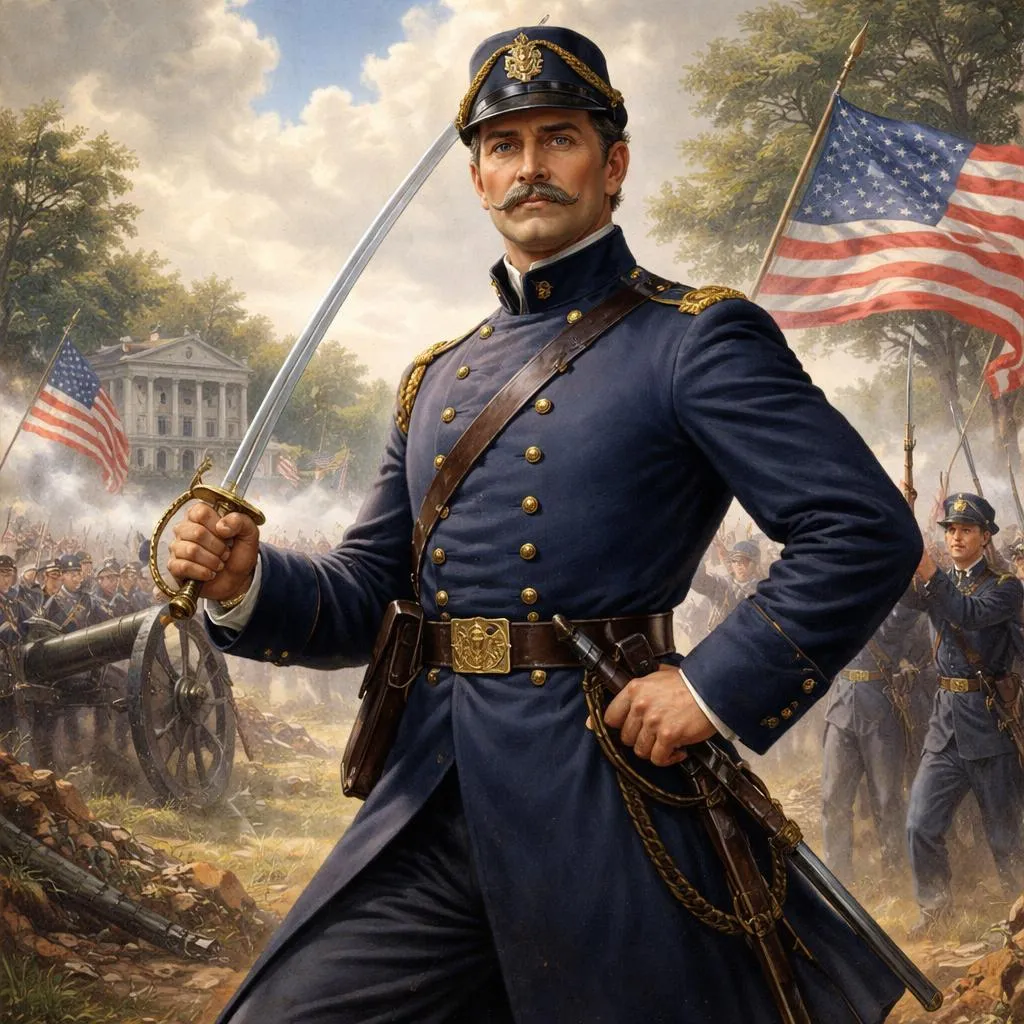

As soon as the battle on the deck of the Tallahatchie had been decided, Graines, in command of the flanking party, had returned to the engine room of the Bellevite. He and his men had fought bravely and effectively in the action, though the full effect of the movement under his charge could not be realized in the change of circumstances. The engine of the ship had now cooled off, and Paul Vapoor hastened to the deck to see his friend and crony, the news of whose wound had been conveyed to the engine room in due time.
He was heartily rejoiced to find that it was no worse, and he had news for the patient. Just before the burial of the dead he had been sent by the commander to examine and report upon the condition of the engine of the prize. Captain Rombold had protected it with chain cables dropped over the side, so that it remained uninjured, and the British engineers declared that it was in perfect working order.
“But whom do you suppose I saw on board the prize, Christy?” asked the chief engineer, after he had incidentally stated the condition of the engine.
“I cannot guess; but it may have been my cousin Corny Passford, though he has always been in the military service of the Confederacy,” replied the wounded lieutenant.
“It was not Corny, but his father,” added Paul.
“His father!” exclaimed Christy. “Uncle Homer Passford?”
“It was he; I know him well, for I used to meet him at Glenfield in other days. I am as familiar with his face as with that of your father, though I have not seen either of them for over three years.”
“Where was he? What was he doing?” asked Christy curiously.
“He was just coming up from below; and Mr. Hungerford, the second lieutenant, told me he had been turned out of the captain’s cabin, which had been made into a hospital for the wounded,” added Paul. “I had no opportunity to speak to him, for he averted his gaze and moved off in another direction as soon as he saw me. He looked pale and thin, as though he had recently been very sick.”
“Poor Uncle Homer!” exclaimed the lieutenant. “He has been very unfortunate. The last time I saw him, I conducted him to my father’s place at Bonnydale, after he had been a prisoner on board of the Chateaugay. He was on parole then, and I suppose he and Captain Rombold were both exchanged.”
“Doubtless he will tell you all about it when you see him, as you will soon.”
“He had his eyes opened when he passed through New York City with me, for he did not find the grass growing in the streets, as he had expected, in spite of all I had said to him at sea. He was astonished and confounded when he found business more lively than ever before there; but he remained as virulent a rebel as ever; and I am sure he regards it as a pious duty to stand by the Southern Confederacy as long as there is anything left of it. I know no man more sincerely religious than Uncle Homer.”
“He is as good a man as ever walked the earth,” added Paul heartily.
“For his sake, if for no other reason, I shall rejoice when this war is over,” said Christy, with a very sad expression on his pale face.
“Was Mr. Graines of any use to you on deck, Christy?” asked the chief engineer, as he turned to take his leave.
“He behaved himself like a loyal officer, and fought like a tiger on the deck of the Tallahatchie. I shall give a very good report of him to the captain for his conduct in the action, and for his valuable services in the expedition last night. I did not over-estimate him when I selected him for both of the positions to which he was appointed.”
“He wants to see you, and I told him he should come on deck when I returned,” added Paul, as he took the hand of Christy and retired.
“How do you feel now, Mr. Passford?” asked Captain Breaker, coming to his side the moment the chief engineer left him.
“I feel quite weak, but my arm does not bother me much. The Confederate surgeon did a good job when he dressed it,” replied Christy with a smile.
“I will get him to send you a second dose of the restorative that strengthened you before,” said the commander, as he pencilled a note, which he tore out of his memorandum book, and sent it by Punch to Dr. Davidson.
“Mr. Vapoor brought me a piece of news, Captain,” continued Christy. "Uncle Homer Passford is on board of the Tallahatchie.”
“Your uncle!” exclaimed the commander. “I supposed he was still on parole at the house of your father.”
“I did not know to the contrary myself, for I have had no letter from my father for a long time. He and Captain Rombold must have been exchanged some time ago. Mr. Vapoor says my uncle looks pale and thin, as though he had recently been very sick.”
“I am very sorry for him, for he was the equal of your father in every respect, except his loyalty to his true country,” added the captain.
“Poor Uncle Homer!” exclaimed Christy, as he wiped a tear from his eye. “He was the guest of Captain Rombold; but he has been turned out of his cabin to make room for the wounded.”
“Dr. Linscott with his two mates has gone to the assistance of Dr. Davidson, whose hands are more than full, and perhaps he will see your uncle. Where is he now?” inquired the captain.
“Mr. Vapoor saw him on the deck, but he did not speak to him, for Uncle Homer avoided him. The ward room of the prize has at least two wounded officers in it, and I don’t know how many more, so that my poor uncle has no place to lay his head if he is sick,” said Christy, full of sympathy for his father’s brother.
“That will never do!” exclaimed the commander bruskly. “He shall have a place to lay his head, sick or well. Captain Rombold occupies one of the staterooms in my cabin, and your uncle shall have the other.”
“But where will you berth, captain?” demanded Christy.
“No matter where! I will go and find your uncle at once;” and Christy saw him next mounting the gangway steps.
The commander had no difficulty in finding the gentleman he sought; for he was wandering about the deck of the prize, and no one seemed to take any notice of him. He had been the honored guest of Captain Rombold, though he had hardly shown himself on deck since the steamer left Mobile, and few of the ship’s company seemed to know who he was.
“Good-morning, Colonel Passford,” said Captain Breaker, as he confronted him in the midst of the ruins of the spare wheel, the wrecks of the mizzen mast, and the bulwarks on the quarterdeck.
“Good-morning, Captain Breaker,” replied the planter, taking the offered hand of the commander, with a feeble effort to smile. “Of course I knew that you were near, for you have given abundant proofs of your presence on board of this vessel.”
“But we meet now as friends, and not as enemies. I know that you have done your duty to your country as you understand it, and I have done the same,” continued the commander, still holding the hand of the colonel.
“You have been very kind to Captain Rombold, Gill informs me, and”—
“He set the example for me, and I have striven to follow it,” interposed the captain. “But his generosity was first exercised in behalf of your nephew, Christy.”
“The steward informed me that Christy had been wounded; and Captain Rombold assured me that the Tallahatchie was captured in consequence of a very daring act on the part of my nephew,” added the planter.
“I should not state it quite so strongly as that, though his action certainly enabled us to capture the ship sooner, and with less loss on our part than would otherwise have been the case. As to the ultimate result of the battle, Captain Rombold and myself would disagree. But with your assent, Colonel Passford, I think we had better cease to discuss the action, which is now an event of the past. I am informed that you have been compelled to leave the captain’s cabin.”
“And I cannot find a resting place in the ward room or steerage,” added the planter.
“I have come on board of the prize to invite you to share my cabin with Captain Rombold, for I have two staterooms,” said Captain Breaker, suddenly changing the subject of conversation.
“You are very kind, my dear sir; but your arrangement would incommode yourself,” suggested the colonel.
“My cabin is quite large, and I shall be able to make ample accommodations for myself,” persisted the commander, as he took the arm of the planter. “Permit me to conduct you to your new quarters.”
“As I am once more a prisoner”—
“Hardly,” interposed the captain, as he led the planter to the gangway, “I shall regard you as a non-combatant, at least for the present; and I desire only to make you comfortable. The flag-officer must decide upon your status.”
Colonel Passford allowed himself to be conducted to the deck of the Bellevite; and he was no stranger on board of the ship, for when she was a yacht he had made several excursions in her in company with his family. The first person he observed was his nephew, seated in his arm-chair where he could overlook all that took place on the deck. He hastened to him, detaching his arm from the hand of the captain, and gave him an affectionate greeting.
“I was very sorry to learn that you were wounded, Christy,” said he, holding the right hand of the young officer.
“Not badly wounded, Uncle Homer,” replied Christy. “I hope you are well.”
“I am not very well, though I do not call myself sick. Have you heard from your father lately, Christy?” asked his uncle.
“Not for a long time, for no store-ship or other vessel has come to our squadron for several months, though we are waiting for a vessel at the present time. You look very pale and thin, Uncle Homer.”
“Perhaps I look worse than I feel,” replied the planter with a faint smile. “But I have suffered a great deal of anxiety lately.”
“Excuse me, Colonel Passford, but if you will allow me to install you in your stateroom, you will have abundance of time to talk with your nephew afterwards,” interposed Captain Breaker, who was very busy.
“Certainly, Captain; pardon me for detaining you. I am a prisoner, and I shall need my trunk, which is in my stateroom on board of the Tallahatchie. Gill will bring it on board if you send word to him to do so,” replied the colonel.
He followed the captain to his cabin. The door of the Confederate commander’s room was open, and the planter exchanged a few words with him. He was shown to the other stateroom, and Punch was ordered to do all that he could for the comfort of the passenger. Captain Breaker spoke a few pleasant words with the wounded commander, and then hastened on deck.
Mr. Ballard, the second lieutenant, had again been duly installed as temporary executive officer; Mr. Walbrook had been moved up, and Mr. Bostwick, master, had become third lieutenant. As usual, the engineers were Englishmen, who had come over in the Trafalgar, as well as the greater part of the crew, though the other officers were Southern gentlemen who had “retired” from the United States Navy. The foreigners were willing to remain in the engine room, and promised to do their duty faithfully as long as their wages were paid; but Leon Bolter, the first assistant engineer of the Bellevite, was sent on board of the prize to insure their fidelity.
Ensigns Palmer Drake and Richard Leyton, who were serving on board of the steamer while waiting for positions, were sent to the Tallahatchie, the first named as prizemaster, and the other as his first officer, with a prize crew of twenty men, and the two steamers got under way.
背景和作者介紹
這段摘錄來自一個歷史海軍故事,背景設定在美國內戰時期,這段時期標誌著聯邦和邦聯之間激烈的衝突。故事圍繞著一艘名為塔拉哈奇號的船隻的捕獲,以及在戰爭中掙扎的軍官和家人之間的複雜關係。敘事突出了忠誠、責任和戰爭的人力成本等主題。
作者以 19 世紀冒險和戰爭小說的典型風格寫作,將海軍行動的詳細描述與個人戲劇相結合。這些故事因其對戰爭中勇氣和榮譽的驚險描繪而廣受歡迎,為讀者提供了刺激和道德反思。
詳細闡釋和意義
故事生動地描繪了海戰,強調了勇敢和戰略思維。像格雷恩斯和克里斯蒂這樣的角色表現出忠誠和勇氣,儘管受傷和艱難困苦,仍然奮力作戰。像荷馬·帕斯福德叔叔這樣,在對立陣營的家人,增加了情感深度,展示了戰爭如何分裂親密的親戚。
敘事還探討了敵人之間的同情和尊重的主題。布雷克船長向帕斯福德上校提供他的船艙,儘管他們分屬對立陣營,這說明了一種超越衝突的榮譽準則。這突出了戰爭期間人際關係的複雜性,即使在暴力之中,尊重和人道主義依然存在。
給學生的教訓和見解
-
勇氣和忠誠: 角色們對其職責的奉獻,即使在受傷或面臨巨大危險時,也教導了堅守自己的責任和信念的重要性。
-
衝突中的同情心: 布雷克船長對帕斯福德上校的待遇表明,即使對那些被視為對手的人,也應保持友善和尊重。這是在同情心和公平方面的寶貴一課。
-
家庭與戰爭: 故事揭示了戰爭如何緊張家庭關係,鼓勵讀者珍惜和平和家庭團結的價值。
-
韌性: 儘管受傷和挫折,角色們仍然繼續履行他們的職責,表現出韌性和決心——這些是克服生活中挑戰的必要品質。
在日常生活和學習中的應用
-
在學校: 學生可以學會在面對學業挑戰時勇敢,並忠於自己的原則,就像角色們堅守自己的事業一樣。
-
在社交場合: 故事鼓勵以友善和尊重的態度對待他人,即使出現分歧,也能促進更好的溝通和理解。
-
在個人成長中: 角色們表現出的韌性可以激勵學生在學習新技能或處理個人問題時堅持不懈。
從故事中培養積極的價值觀
-
榮譽和正直: 在日常行動中效仿角色們的責任感和誠實。
-
同情心: 練習理解他人的觀點,即使與自己的觀點不同。
-
勇敢: 積極主動,自信地迎接挑戰,從挫折中學習,而不是氣餒。
-
尊重家人和朋友: 重視人際關係,努力維持和諧,尤其是在困難時期。
通過學習這樣的故事,年輕的讀者可以對歷史、人性、和道德價值觀有更深刻的理解,這將幫助他們成長為有思想、勇敢和富有同情心的人。
