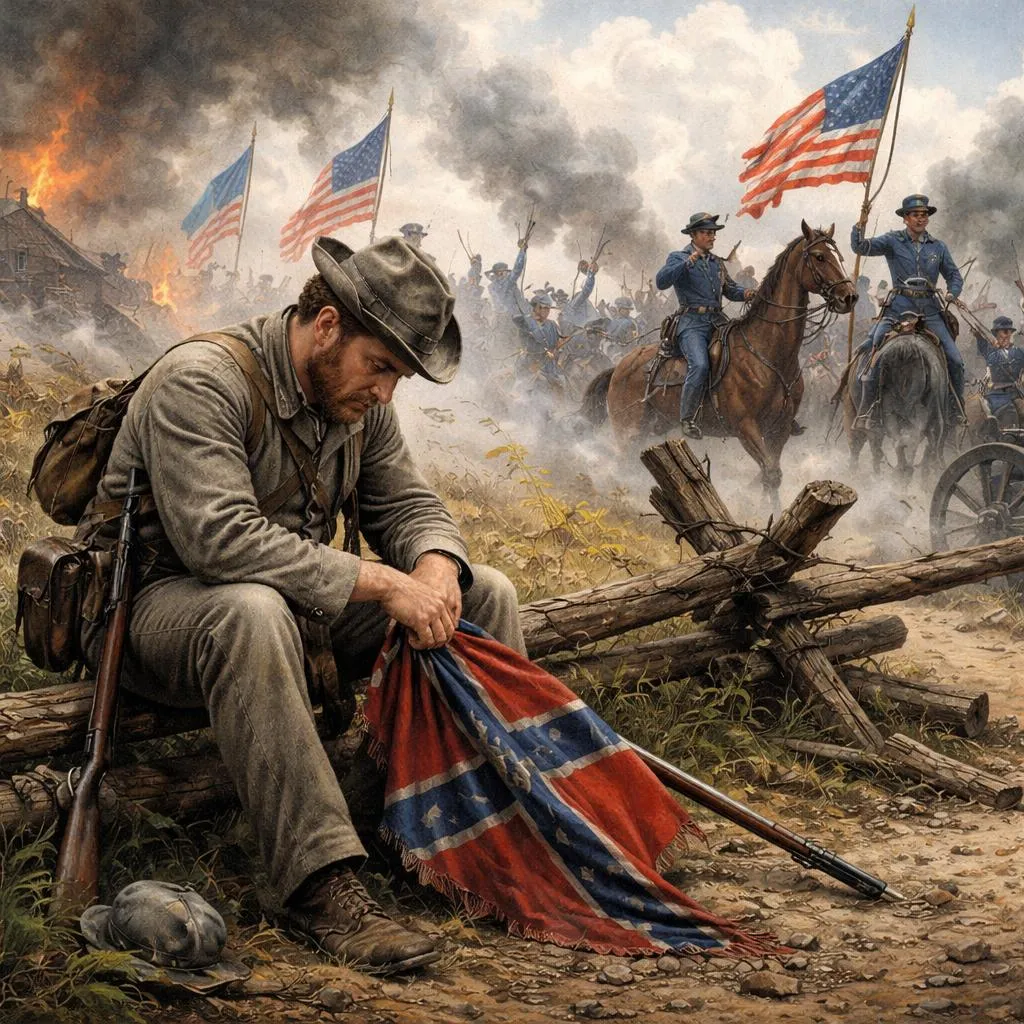

Notwithstanding his military title, Colonel Homer Passford was not a soldier, though he had once been a sort of honorary head of a regiment of militia. His brother, Captain Horatio Passford, Christy’s father, was a millionaire in the tenth degree. More than twenty years before the war he had assisted Homer to all the money he required to buy a plantation in Alabama, near Mobile, where he had prospered exceedingly, though his possessions had never been a tenth part of those of his wealthy brother.
Homer had married in the South, and was the father of a son and daughter, now approaching their maturity, and Corny, the son, was a soldier in the Confederate army. The most affectionate relations had always subsisted between the two families; and before the war the Bellevite had always visited Glenfield, the plantation of the colonel, at least twice a year.
Florry Passford, the captain’s daughter, being somewhat out of health, had passed the winter before the beginning of the war at Glenfield, and was there when the enemy’s guns opened upon Fort Sumter. Captain Passford had not supposed that his brother in Alabama would take part with the South in the Rebellion, and with great difficulty and risk he had gone to Glenfield in the Bellevite, for the purpose of conveying his daughter to his home at Bonnydale on the Hudson, not doubting that Homer and his family would be his passengers on the return to the North.
He was entirely mistaken in regard to the political sentiments of the colonel, and found that he was one of the most devoted and determined advocates of the Southern cause. The southern brother did not conceal his opinions, and it was plain enough to the captain that he was entirely sincere, and believed with all his mind, heart, and soul, that it was his religious, moral, and social duty to espouse what he called his country’s cause; and he had done so with all his influence and his fortune. He had even gone so far in his devotion to his duty as he understood it, as to attempt to hand over the Bellevite, though she was not in Mobile Bay on a warlike mission, to the new government of the South, and had taken part personally in an expedition extended to capture her.
The steam-yacht had been armed at the Bermudas, and fought her way out of the bay; and on her return to New York her owner presented her to the Government of the United States. She had done good service, and Christy had begun his brilliant career as a naval officer in the capacity of a midshipman on board of her. In spite of the hostile political attitude of the brothers to each other, the same affectionate relations had continued between the two families, for each of them believed that social and family ties should not interfere with his patriotic duty to his country.
The commander of the Confederate forces at Hilton Head—one of the highest-toned and most estimable gentlemen one could find in the North or the South—informed the author that his own brother was in command of one of the Federal ships that were bombarding his works. While Commodore Wilkes, of Mason and Slidell memory, was capturing the Southern representatives who had to be given up, his son was in the Confederate navy, and then or later was casting guns at Charlotte for the use of the South: and the writer never met a more reasonable and kindly man. Fortunately our two brothers were not called upon to confront each other as foes on the battlefield or on the sea, though both of them would have done their duty in such positions.
The last time Christy had seen his Uncle Homer was when he was captured on board of the Dornoch with Captain Rombold, as he was endeavoring to obtain a passage to England as a Confederate agent for the purchase of suitable vessels to prey upon the mercantile marine of the United States. He and the commander of the Tallahatchie had been exchanged at about the same time; and they had proceeded to Nassau, where they embarked for England in a cotton steamer. There they had purchased and fitted out the Trafalgar; for the agent’s drafts, in which the last of his fortune had been absorbed, could not be made available to his captors. Colonel Passford had an interview with Captain Rombold after Gill had brought his trunk on board; and it was a very sad occasion to the planter, if not to the naval officer. They had not had an opportunity to consider the disaster that had overtaken the Confederate steamer, which had promised such favorable results for their cause; for the commander had been entirely occupied till he received his wound, and even then he had attended to his duties, for, as before suggested, he was a “last ditch” man. He was not fighting for the South as a mere hireling; for he had married a Southern wife, and she had enlisted all his sympathies in the cause of her people.
“I suppose we have nothing more to hope for, Captain Rombold; and we can only put our trust in the All-Wise and the All-Powerful, who never forsakes his children when they are fighting for right and justice,” said Colonel Passford, after he had condoled with the commander on his wounded condition.
“We shall come out all right in the end, Colonel; don’t be so cast down,” replied the captain.
“I raised the money by mortgaging my plantation and what other property I had left for all the money I could get upon it to a wealthy Englishman, the one who came to Mobile with us from Nassau, to obtain the cargoes for this steamer. I had borrowed all I could before that for the purchase of the Trafalgar; and if the current does not change in our favor soon, I shall be a beggar,” added the colonel bitterly.
“The tide will turn, my good friend; and it would have turned before now if all the planters had been as self-sacrificing as you have,” said the captain.
“Cotton and gold are about the same thing just now; and with the large cargo on board of the West Wind, which I induced my friends to contribute to the good cause, and that in the hold of the Tallahatchie, I was confident that I could purchase the Kilmarnock, which you say is good for eighteen knots an hour. Now the West Wind and the Tallahatchie are both prizes of the enemy, and there is no present hope for us,” continued the colonel; and there was no wonder that he had become pale and thin.
“We are in a bad situation, Colonel Passford, I admit, for both of us are prisoners of war, so that we can do nothing, even if we had the means; but everything will come out right in the end,” replied the wounded officer, though he could not explain in what manner this result was to be achieved.
“Well, Captain Rombold, how are you feeling?” asked Dr. Linscott, darkening the door when the conversation had reached this gloomy point.
“Very comfortable, Doctor,” replied the commander. “My friend is Colonel Passford.”
“Bless me!” exclaimed the surgeon, as he extended his hand to the visitor. “I am very glad to see you, and I hope you are very well. I am happy to inform you that your nephew, who was wounded in the engagement, is doing very well.”
“Yes; I met him on deck,” replied the planter very gloomily.
“What is the matter, Colonel Passford? You look quite pale, and you have lost flesh since I met you last. Can I do anything for you?”
“Nothing, Doctor; I am not very well, though nothing in particular ails me. With your permission I will retire to my stateroom,” said the colonel, as he rose from his seat.
“By the way, Colonel Passford, the captain wished me to ascertain if you have been to breakfast,” added the surgeon, following him out into the cabin.
“I have not, Doctor; but it was because I wanted none, for I do not feel like eating,” replied the pale planter.
“Punch, go to the galley, get a beefsteak, a plate of toast, and a cup of coffee. Set out the captain’s table, and call this gentleman when it is ready.”
“Yes, sir,” replied Punch, who was a very genteel colored person.
The colonel attempted to protest, but the surgeon would not hear him. He remained with the planter, whom he already regarded as a patient, and though he could not say anything to comfort him, he talked him into a pleasanter frame of mind. Punch set the table, and in due time brought the breakfast. The doctor sat down opposite to him at the table, and actually compelled him to eat a tolerably hearty meal. He was decidedly less gloomy when he had finished, and it was plain to his companion that his empty stomach was responsible for a portion of his depression of spirits.
The surgeon had remained on board of the prize till the order to get under way was given, and then Captain Breaker sent for him; but the two medical gentlemen had disposed of most of the wounds among the Confederate crew. As the English engineer had reported, the machinery and boilers of the Tallahatchie were in good condition, and the two steamers went on their course towards the entrance to Mobile Bay, where French had been ordered to anchor the West Wind, at full speed, though neither was driven; but the log showed that they were making about eighteen knots.
After the brief talk with his uncle, Christy had waited for him to return to the deck, as he supposed he would after what the captain had said to him; but he did not appear. In fact, Colonel Passford was too much cast down by the capture of the two vessels, and the loss of his fortune thereby, that he was not disposed to see any person if he could avoid it.
“Don’t you think you had better turn in, Mr. Passford?” asked the commander, as he halted in his walk at the side of the lieutenant.
“I have been waiting here to see my uncle; for I thought, after what you said to him, that he would come back,” added Christy.
“I sent Dr. Linscott down to see him, for he looks so pale and feeble that I thought he must be sick. The surgeon reported to me half an hour ago that he had made him eat his breakfast against his will, and he was feeling better and more cheerful. He thinks your Uncle Homer’s trouble is entirely mental, and he does not feel like seeing any person,” answered the commander.
“What mental trouble can he have?” asked Christy, as he gazed into the face of the captain, wondering if his father’s brother was insane.
“The colonel has shipped a vast amount of cotton intending to use the proceeds of its sale to purchase ships for the Confederacy; and he has lost most of them, for you captured quite a number of them when you were in command of the Bronx. I have no doubt he was interested in the cargoes of the prize and the West Wind; and the capture of these two vessels involves a fearful loss. I believe that is all that ails him,” the captain explained. “Doubtless he feels as kindly towards his nephew as ever before in his life; but he does not care to see him just now.”
Early in the afternoon the Bellevite and her prize came in sight of the West Wind, anchored in accordance with French’s orders, with the Holyoke almost within hail of her; for the captain of the steamer had doubtless considered the possibility of a recapture of the schooner by boats from the shore, if she was left unprotected.
In due time the Bellevite let go her anchor at about a cable’s length from the West Wind, and the prize-master of the Tallahatchie had done the same at an equal distance from the ship. Mr. Graines, who had not met his late associate on shore since he was wounded, came to his side as soon as the steamer had anchored; for both Christy and he were anxious to hear the report of French in regard to the prisoners left in his care.
The anchor of the Bellevite had hardly caught in the sand before a boat put off from the West Wind containing four persons. Two of the ship’s seamen were at the oars, French was in the stern sheets, and the engineer soon recognized Captain Sullendine as the fourth person.
故事的背景和內容
這個故事的背景設定在美國內戰時期,這場衝突發生在1861年至1865年,交戰雙方是北方各州(聯邦)和南方各州(邦聯)。這場戰爭主要是關於各州的權利和奴隸制度。敘事探討了家庭內部的忠誠分裂,例如帕斯福德兄弟——一個支持北方,另一個支持南方。這種分裂反映了戰爭期間分裂家庭和社區的真實歷史緊張關係。
這個故事還突出了戰場之外戰爭的複雜性,包括間諜活動、海戰以及那些支持邦聯事業的人所面臨的經濟困境。它表明個人信念和家庭關係如何與政治和國家忠誠產生衝突。
關於作者
雖然原文沒有明確說明作者,但其風格和內容表明它來自19世紀的美國文學,側重於內戰主題。這類作品通常旨在為讀者提供對戰爭的細緻入微的看法,強調人物故事而非單純的軍事事件。那個時代的作者試圖闡述那些陷入國家衝突動盪中的個人所面臨的道德和社會困境。
詳細闡釋和意義
這個故事揭示了內戰期間個人的情感和道德掙扎。霍默·帕斯福德上校被描繪成一個深切致力於南方事業的人,甚至冒著失去財富和自由的風險。他的兄弟,霍雷肖上尉,代表了北方的觀點,富有且有影響力,但儘管政治觀點不同,仍然保持著家庭紐帶。
敘事探討了忠誠、犧牲、榮譽和戰爭代價等主題。它表明,即使在衝突中,家庭之愛和尊重也可以持續存在,儘管會受到壓力。這個故事還觸及了戰爭的心理影響,正如帕斯福德上校在失去投資後的精神痛苦,說明了那些參與衝突的人在戰場之外所承受的沉重負擔。
給學生的教訓和見解
-
理解複雜的忠誠: 故事告訴我們,忠誠並不總是簡單或絕對的。人們可能會有相互衝突的義務——對家庭、對國家、對個人信仰——而這些可能會導致艱難的選擇。
-
戰爭的代價: 除了身體上的危險,戰爭還帶來情感、經濟和心理上的困境。認識到這一點可以幫助學生充分理解歷史衝突的影響。
-
家庭與寬恕: 儘管立場對立,帕斯福德一家仍然保持著感情。這鼓勵讀者珍惜家庭紐帶,即使出現分歧也要尋求理解。
-
勇氣與犧牲: 像帕斯福德上校和倫博爾德上尉這樣的角色表現出對他們事業的勇敢和承諾,表明了堅持自己信念的重要性。
-
心理健康意識: 故事中對帕斯福德上校精神狀態的描述突出了壓力與損失如何影響福祉,這是在同情心和支持他人方面的一堂寶貴的課。
在日常生活中和學習中的應用
-
在學校: 學生可以學會尊重不同的意見,並理解人們的背景會影響他們的觀點。這促進了寬容和開放的心態。
-
在社交場合: 故事鼓勵在出現分歧的情況下維持關係,教導解決衝突和同情心。
-
個人成長: 效仿人物的勇氣和奉獻精神可以激勵學生致力於自己的目標和價值觀,即使面臨挑戰。
-
心理健康: 認識到壓力的跡象並支持可能正在掙扎的朋友或家人是一項重要的生活技能。
從故事中培養積極的特質
-
同情心: 理解並欣賞他人的觀點,尤其是在衝突中。
-
韌性: 學會應對挫折,例如帕斯福德上校的經濟損失。
-
忠誠: 珍惜和保護家人和友誼,即使在艱難時期。
-
正直: 以誠實和奉獻精神堅守你的原則。
-
同情心: 支持那些在情感或身體上受苦的人。
通過反思這些主題和教訓,學生可以對歷史和人性有更深入的理解,並將這些見解應用於自己的生活,以實現個人和社會的成長。
