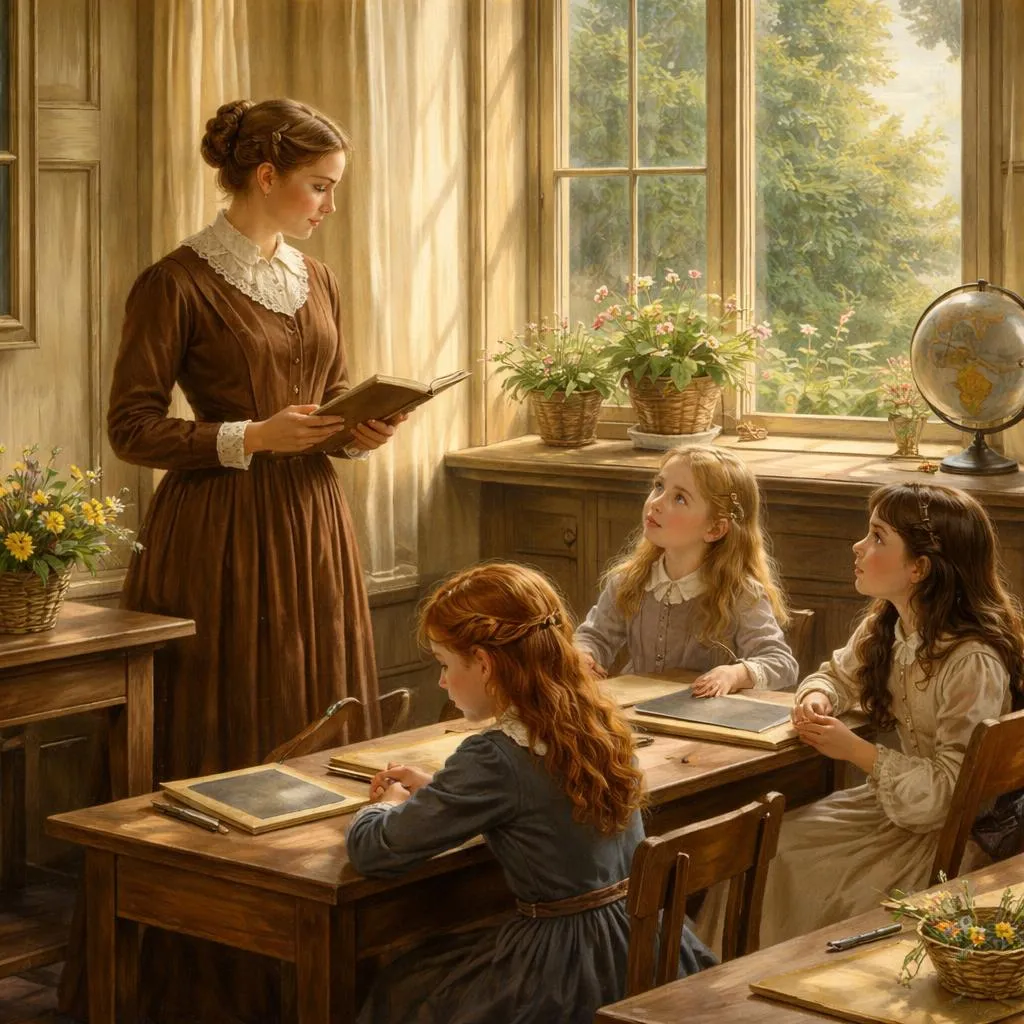

I left Horton Lodge, and went to join my mother in our new abode at A–. I found her well in health, resigned in spirit, and even cheerful, though subdued and sober, in her general demeanour. We had only three boarders and half a dozen day–pupils to commence with; but by due care and diligence we hoped ere long to increase the number of both.
I set myself with befitting energy to discharge the duties of this new mode of life. I call it NEW, for there was, indeed, a considerable difference between working with my mother in a school of our own, and working as a hireling among strangers, despised and trampled upon by old and young; and for the first few weeks I was by no means unhappy. ‘It is possible we may meet again,’ and ‘will it be of any consequence to you whether we do or not?’—Those words still rang in my ear and rested on my heart: they were my secret solace and support. ‘I shall see him again.—He will come; or he will write.’ No promise, in fact, was too bright or too extravagant for Hope to whisper in my ear. I did not believe half of what she told me: I pretended to laugh at it all; but I was far more credulous than I myself supposed; otherwise, why did my heart leap up when a knock was heard at the front door, and the maid, who opened it, came to tell my mother a gentleman wished to see her? and why was I out of humour for the rest of the day, because it proved to be a music–master come to offer his services to our school? and what stopped my breath for a moment, when the postman having brought a couple of letters, my mother said, ‘Here, Agnes, this is for you,’ and threw one of them to me? and what made the hot blood rush into my face when I saw it was directed in a gentleman’s hand? and why—oh! why did that cold, sickening sense of disappointment fall upon me, when I had torn open the cover and found it was ONLY a letter from Mary, which, for some reason or other, her husband had directed for her?
Was it then come to this—that I should be DISAPPOINTED to receive a letter from my only sister: and because it was not written by a comparative stranger? Dear Mary! and she had written it so kindly—and thinking I should be so pleased to have it!—I was not worthy to read it! And I believe, in my indignation against myself, I should have put it aside till I had schooled myself into a better frame of mind, and was become more deserving of the honour and privilege of its perusal: but there was my mother looking on, and wishful to know what news it contained; so I read it and delivered it to her, and then went into the schoolroom to attend to the pupils: but amidst the cares of copies and sums—in the intervals of correcting errors here, and reproving derelictions of duty there, I was inwardly taking myself to task with far sterner severity. ‘What a fool you must be,’ said my head to my heart, or my sterner to my softer self;—’how could you ever dream that he would write to you? What grounds have you for such a hope—or that he will see you, or give himself any trouble about you—or even think of you again?’ ‘What grounds?’—and then Hope set before me that last, short interview, and repeated the words I had so faithfully treasured in my memory. ‘Well, and what was there in that?—Who ever hung his hopes upon so frail a twig? What was there in those words that any common acquaintance might not say to another? Of course, it was possible you might meet again: he might have said so if you had been going to New Zealand; but that did not imply any INTENTION of seeing you—and then, as to the question that followed, anyone might ask that: and how did you answer?—Merely with a stupid, commonplace reply, such as you would have given to Master Murray, or anyone else you had been on tolerably civil terms with.’ ‘But, then,’ persisted Hope, ‘the tone and manner in which he spoke.’ ‘Oh, that is nonsense! he always speaks impressively; and at that moment there were the Greens and Miss Matilda Murray just before, and other people passing by, and he was obliged to stand close beside you, and to speak very low, unless he wished everybody to hear what he said, which—though it was nothing at all particular—of course, he would rather not.’ But then, above all, that emphatic, yet gentle pressure of the hand, which seemed to say, ‘TRUST me;’ and many other things besides—too delightful, almost too flattering, to be repeated even to one’s self. ‘Egregious folly—too absurd to require contradiction—mere inventions of the imagination, which you ought to be ashamed of. If you would but consider your own unattractive exterior, your unamiable reserve, your foolish diffidence—which must make you appear cold, dull, awkward, and perhaps ill–tempered too;—if you had but rightly considered these from the beginning, you would never have harboured such presumptuous thoughts: and now that you have been so foolish, pray repent and amend, and let us have no more of it!’
I cannot say that I implicitly obeyed my own injunctions: but such reasoning as this became more and more effective as time wore on, and nothing was seen or heard of Mr. Weston; until, at last, I gave up hoping, for even my heart acknowledged it was all in vain. But still, I would think of him: I would cherish his image in my mind; and treasure every word, look, and gesture that my memory could retain; and brood over his excellences and his peculiarities, and, in fact, all I had seen, heard, or imagined respecting him.
‘Agnes, this sea air and change of scene do you no good, I think: I never saw you look so wretched. It must be that you sit too much, and allow the cares of the schoolroom to worry you. You must learn to take things easy, and to be more active and cheerful; you must take exercise whenever you can get it, and leave the most tiresome duties to me: they will only serve to exercise my patience, and, perhaps, try my temper a little.’
So said my mother, as we sat at work one morning during the Easter holidays. I assured her that my employments were not at all oppressive; that I was well; or, if there was anything amiss, it would be gone as soon as the trying months of spring were over: when summer came I should be as strong and hearty as she could wish to see me: but inwardly her observation startled me. I knew my strength was declining, my appetite had failed, and I was grown listless and desponding;—and if, indeed, he could never care for me, and I could never see him more—if I was forbidden to minister to his happiness—forbidden, for ever, to taste the joys of love, to bless, and to be blessed—then, life must be a burden, and if my heavenly Father would call me away, I should be glad to rest. But it would not do to die and leave my mother. Selfish, unworthy daughter, to forget her for a moment! Was not her happiness committed in a great measure to my charge?—and the welfare of our young pupils too? Should I shrink from the work that God had set before me, because it was not fitted to my taste? Did not He know best what I should do, and where I ought to labour?—and should I long to quit His service before I had finished my task, and expect to enter into His rest without having laboured to earn it? ‘No; by His help I will arise and address myself diligently to my appointed duty. If happiness in this world is not for me, I will endeavour to promote the welfare of those around me, and my reward shall be hereafter.’ So said I in my heart; and from that hour I only permitted my thoughts to wander to Edward Weston—or at least to dwell upon him now and then—as a treat for rare occasions: and, whether it was really the approach of summer or the effect of these good resolutions, or the lapse of time, or all together, tranquillity of mind was soon restored; and bodily health and vigour began likewise, slowly, but surely, to return.
Early in June, I received a letter from Lady Ashby, late Miss Murray. She had written to me twice or thrice before, from the different stages of her bridal tour, always in good spirits, and professing to be very happy. I wondered every time that she had not forgotten me, in the midst of so much gaiety and variety of scene. At length, however, there was a pause; and it seemed she had forgotten me, for upwards of seven months passed away and no letter. Of course, I did not break my heart about THAT, though I often wondered how she was getting on; and when this last epistle so unexpectedly arrived, I was glad enough to receive it. It was dated from Ashby Park, where she was come to settle down at last, having previously divided her time between the continent and the metropolis. She made many apologies for having neglected me so long, assured me she had not forgotten me, and had often intended to write, &c. &c., but had always been prevented by something. She acknowledged that she had been leading a very dissipated life, and I should think her very wicked and very thoughtless; but, notwithstanding that, she thought a great deal, and, among other things, that she should vastly like to see me. ‘We have been several days here already,’ wrote she. ‘We have not a single friend with us, and are likely to be very dull. You know I never had a fancy for living with my husband like two turtles in a nest, were he the most delightful creature that ever wore a coat; so do take pity upon me and come. I suppose your Midsummer holidays commence in June, the same as other people’s; therefore you cannot plead want of time; and you must and shall come—in fact, I shall die if you don’t. I want you to visit me as a friend, and stay a long time. There is nobody with me, as I told you before, but Sir Thomas and old Lady Ashby: but you needn’t mind them—they’ll trouble us but little with their company. And you shall have a room to yourself, whenever you like to retire to it, and plenty of books to read when my company is not sufficiently amusing. I forget whether you like babies; if you do, you may have the pleasure of seeing mine—the most charming child in the world, no doubt; and all the more so, that I am not troubled with nursing it—I was determined I wouldn’t be bothered with that. Unfortunately, it is a girl, and Sir Thomas has never forgiven me: but, however, if you will only come, I promise you shall be its governess as soon as it can speak; and you shall bring it up in the way it should go, and make a better woman of it than its mamma. And you shall see my poodle, too: a splendid little charmer imported from Paris: and two fine Italian paintings of great value—I forget the artist. Doubtless you will be able to discover prodigious beauties in them, which you must point out to me, as I only admire by hearsay; and many elegant curiosities besides, which I purchased at Rome and elsewhere; and, finally, you shall see my new home—the splendid house and grounds I used to covet so greatly. Alas! how far the promise of anticipation exceeds the pleasure of possession! There’s a fine sentiment! I assure you I am become quite a grave old matron: pray come, if it be only to witness the wonderful change. Write by return of post, and tell me when your vacation commences, and say that you will come the day after, and stay till the day before it closes—in mercy to
‘Yours affectionately,
‘ROSALIE ASHBY.’
I showed this strange epistle to my mother, and consulted her on what I ought to do. She advised me to go; and I went—willing enough to see Lady Ashby, and her baby, too, and to do anything I could to benefit her, by consolation or advice; for I imagined she must be unhappy, or she would not have applied to me thus—but feeling, as may readily be conceived, that, in accepting the invitation, I made a great sacrifice for her, and did violence to my feelings in many ways, instead of being delighted with the honourable distinction of being entreated by the baronet’s lady to visit her as a friend. However, I determined my visit should be only for a few days at most; and I will not deny that I derived some consolation from the idea that, as Ashby Park was not very far from Horton, I might possibly see Mr. Weston, or, at least, hear something about him.
背景介紹與作者介紹
這段文字出自一部十九世紀的經典小說,反映了一位年輕女性的生活和內心想法,她正在應對個人希望和社會期望。作者寫作的時代,女性的角色往往局限於家庭和教育領域,她探討了愛、失望、責任和個人成長等主題。敘事風格是內省的,讓讀者深入了解主角的情感世界,她與希望和現實的鬥爭,以及她努力尋找意義和目標,儘管遭遇挫折。
詳細解讀與意義
故事生動地描繪了主角從依賴生活到承擔責任的轉變,她與母親搬到新家,並接受了管理一所小學校的挑戰。希望與失望之間的情感張力是核心:她緊抓著與愛德華·韋斯頓重新聯繫的可能性,他簡短而模棱兩可的互動激發了她的夢想,但現實卻反覆地用沉默和缺席來面對她。
這段文字也突出了主角的內心衝突——允許自己抱有希望,以及每次希望破滅後隨之而來的嚴厲的自我譴責。這種緊張關係反映了一種普遍的人類體驗,對於正在學習平衡夢想與現實的年輕讀者來說尤其令人心酸。母親的實用建議和關懷起到了奠基作用,鼓勵韌性和自我關懷。
來自艾希比夫人的邀請引入了新的社會動態和改變的潛力,象徵著主角在超越她眼前掙扎的更廣闊世界中邁出的試探性步伐。它也對比了不同的生活選擇和態度,讓讀者得以一窺友誼、社會地位和個人轉變的主題。
給學生的教訓和見解
-
希望與韌性: 主角的旅程教導學生希望的重要性,希望是安慰和動力的源泉,但也需要韌性,當希望沒有立即實現時。學會管理期望並保持內在力量是一項寶貴的生活技能。
-
自我反思與成長: 敘事鼓勵自我意識,展示了主角如何批判性地審視自己的感受和行為。學生可以學習誠實的自我反思在個人發展中的價值。
-
平衡情感與責任: 故事闡述了平衡情感慾望與責任的挑戰。這與學生面臨學業壓力、家庭期望或社會挑戰有關,提醒他們在個人感受和義務之間找到平衡。
-
同情心與理解他人: 通過主角對母親的關懷,以及她願意支持艾希比夫人,儘管犧牲了個人利益,讀者可以學到同情心、善良,以及在困難時幫助他人的重要性。
在日常生活中應用
-
在學習中: 學生可以在學習中運用主角的勤奮和毅力,認識到挫折是成長的一部分,保持希望可以激勵持續的努力。
-
在社交互動中: 故事鼓勵在人際關係中保持耐心和理解,表明人們的行為往往有更深層的原因,善良可以成為對他人掙扎的有力回應。
-
在個人發展中: 通過反思自己的希望和失望,學生可以培養情商,學會建設性地應對挑戰,並支持身邊的人。
從故事中培養積極的品質
-
耐心: 像主角一樣,學生可以對自己和他人練習耐心,理解並非所有慾望都能立即實現。
-
勇氣: 面對情感痛苦並繼續履行職責需要勇氣,學生可以通過走出舒適區並正面應對挑戰來培養這種品質。
-
希望: 即使在困難的情況下,保持希望也能激勵學生繼續努力實現自己的目標。
-
同情心: 主角對母親和艾希比夫人的同情心塑造了同情心,鼓勵學生成為體貼和支持的朋友和家人。
結論
這段摘錄提供了對人類情感和社會現實的豐富探索,這些內容至今仍與年輕讀者息息相關。通過參與主角的經歷,學生可以深入了解如何管理自己的感受、建立韌性,並以善良和責任感行事。這個故事不僅是一部文學作品,也是個人成長和社會理解的指南,使其成為教育和自我發展的寶貴資源。
